

Earned media refers to unpaid visibility gained through third-party coverage, where institutions are mentioned, cited, or analysed without direct financial exchange. It is more valuable than paid coverage because it generates stronger credibility signals, enhances search visibility, and reinforces stakeholder trust through independent validation.
Public affairs refers to the management of relationships between institutions and their stakeholders within political, regulatory, and societal systems, where perception, credibility, and trust are continuously shaped by information flows across digital ecosystems.
What is earned media within digital reputation systems?
Earned media is third-party coverage that emerges organically through editorial decisions, journalistic interest, or stakeholder relevance within digital ecosystems. It refers to visibility that institutions do not directly control but influence through relevance, authority, and informational value.
Within search ecosystems, earned media functions as a high-integrity reputation signal. It is indexed across authoritative domains such as news outlets, policy publications, and sector-specific platforms, contributing to entity recognition and contextual relevance. Algorithms interpret these mentions as indicators of legitimacy because they originate from independent sources with established editorial standards.
The mechanism behind earned media relies on narrative alignment and informational merit. When institutions provide data, commentary, or access that aligns with current public discourse, media entities incorporate these inputs into broader narratives. This process embeds the institution within a trusted information network, strengthening its digital footprint.
The impact on stakeholder perception is structural rather than temporary. Earned media enhances institutional credibility by associating the entity with verified sources, increasing trust signals across search engine results pages (SERPs). This improves long-term visibility, as authoritative mentions are repeatedly crawled, indexed, and ranked.
Why is earned media more valuable than paid coverage?
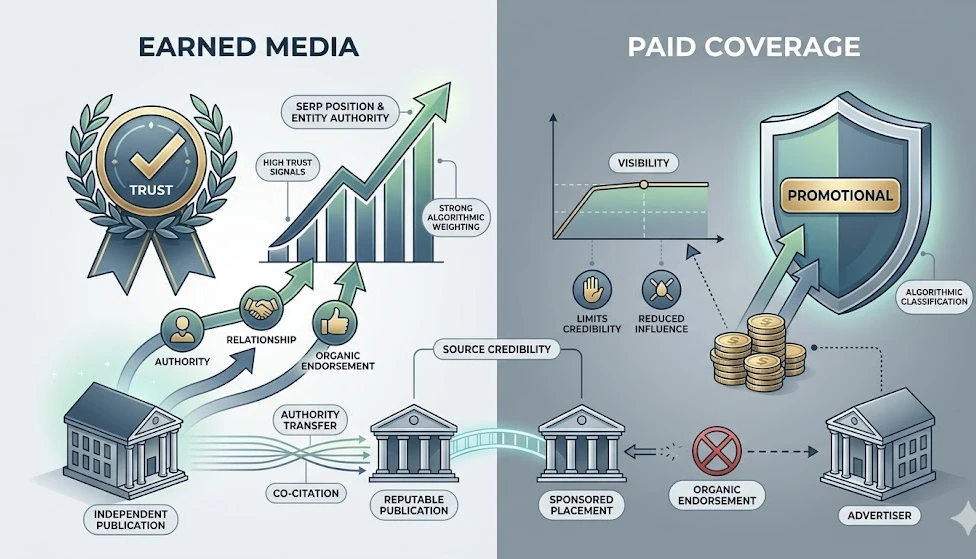
Earned media is more valuable than paid coverage because it generates higher trust signals and stronger algorithmic weighting in search ranking systems. Paid coverage refers to sponsored placements where visibility is purchased, limiting its credibility within perception frameworks.
Search engines evaluate content based on authority, relevance, and trustworthiness. Earned media satisfies these criteria because it originates from independent editorial processes, whereas paid content is often labelled and algorithmically classified as promotional. This classification reduces its influence on entity authority and SERP positioning.
The mechanism of value differentiation lies in source credibility. When a reputable publication references an institution, the association transfers authority through link equity, co-citation, and semantic relevance. Paid placements lack this transfer because they are not considered organic endorsements.
The impact on stakeholder trust is measurable through perception signals. Earned media contributes to positive sentiment analysis, increases brand/entity association with credible narratives, and reinforces institutional legitimacy. Paid coverage, by contrast, contributes to visibility without strengthening trust architecture.
How do search engines interpret earned media as authority signals?
Search engines interpret earned media as authority signals by analysing source credibility, contextual relevance, and frequency of mentions across trusted domains. This process defines how institutional authority is constructed within SERPs.
Algorithms evaluate multiple layers of content relationships. These include backlinks from authoritative domains, co-occurrence of entity names with high-trust topics, and semantic consistency across indexed pages. Earned media contributes to all three, strengthening the entity’s position within knowledge graphs.
The mechanism involves entity-based indexing. When an institution is repeatedly mentioned in credible publications, search engines establish it as a recognised entity within a specific topical cluster. This improves ranking potential for related queries and enhances visibility across informational searches.
The impact extends to digital authority and discoverability. Institutions with strong earned media presence achieve higher placement in organic results, increased inclusion in featured snippets, and stronger alignment with authoritative content clusters. This directly influences stakeholder perception by prioritising credible narratives.
How does earned media shape stakeholder perception and trust?
Earned media shapes stakeholder perception by embedding institutions within trusted narratives that are externally validated. It defines how audiences interpret credibility, legitimacy, and influence within public affairs ecosystems.
Stakeholder trust is built through repetition and consistency of credible mentions. When institutions appear in authoritative sources, the association signals reliability and relevance. This process reduces uncertainty and reinforces confidence in the institution’s role within its sector.
The mechanism operates through narrative framing. Media outlets contextualise institutional actions within broader socio-political or economic narratives, influencing how stakeholders interpret intent and impact. Earned media ensures that this framing is perceived as impartial rather than self-directed.
The impact on trust architecture is cumulative. Each credible mention strengthens the institution’s digital footprint, contributing to a layered perception system where authority is continuously reinforced. This leads to sustained trust rather than short-term visibility gains.
What role does narrative influence play in earned media visibility?
Narrative influence defines how information is structured, prioritised, and disseminated across media ecosystems, directly affecting earned media visibility. It refers to the alignment between institutional messaging and dominant public discourse.
Earned media emerges when institutional narratives intersect with high-relevance topics. Journalists and editors select content that contributes to ongoing discussions, meaning that narrative alignment determines coverage probability. Institutions that provide timely, data-driven insights are more likely to be included.
The mechanism involves semantic relevance and topical authority. Search engines prioritise content that reflects current discourse, and earned media contributes to this by linking institutions to trending topics. This enhances visibility within SERPs and increases the likelihood of content indexing.
The impact on perception is directional. Narrative influence shapes how stakeholders interpret institutional roles, positioning them as authoritative contributors or peripheral actors. Earned media ensures that institutions are embedded within high-impact narratives, strengthening their relevance.
How does earned media contribute to long-term digital authority?
Earned media contributes to long-term digital authority by creating a persistent network of high-quality references across authoritative domains. This network defines how institutions are evaluated over time within search ecosystems.
Digital authority is built through cumulative signals. Each earned media mention adds to a repository of indexed content that reinforces entity recognition, topical relevance, and trustworthiness. Unlike paid content, which has limited lifespan, earned media remains accessible and continuously contributes to ranking signals.
The mechanism involves link equity and semantic reinforcement. Authoritative backlinks increase domain credibility, while consistent thematic alignment strengthens the institution’s position within specific knowledge clusters. This dual effect enhances both visibility and authority.
The impact on institutional perception is enduring. Strong digital authority ensures consistent visibility across relevant queries, stabilises reputation signals, and reduces susceptibility to negative narratives. Earned media acts as a foundational element of this authority structure.
How do content ecosystems amplify earned media impact?
Content ecosystems amplify earned media impact by distributing and reinforcing information across interconnected platforms, including news sites, social media, and search engines. This amplification increases reach, visibility, and perception consistency.
Earned media serves as a primary source within these ecosystems. Once published, it is shared, referenced, and repurposed across multiple channels, creating a network effect. This expands the institution’s digital footprint and increases the frequency of exposure.
The mechanism involves cross-platform indexing and engagement signals. Search engines track how content is shared and referenced, using these signals to assess relevance and authority. Earned media generates higher engagement due to its perceived credibility, strengthening its impact.
The effect on stakeholder perception is multiplicative. Repeated exposure across trusted platforms reinforces credibility, ensuring that institutional narratives are consistently recognised and validated. This leads to stronger alignment between visibility and trust.

How does spokesperson preparation influence earned media outcomes?
Spokesperson preparation directly influences earned media outcomes by determining the clarity, consistency, and authority of institutional messaging. It defines how effectively an institution engages with media gatekeepers and contributes to public discourse.
Prepared spokespersons deliver structured, data-driven responses that align with journalistic requirements. This increases the likelihood of accurate representation and inclusion in coverage. Unstructured communication reduces clarity and weakens narrative integration.
The mechanism involves message discipline and narrative alignment. Spokespersons must articulate key points that resonate with current discourse while maintaining consistency with institutional positioning. This ensures that earned media reflects intended messaging.
The impact on digital perception is significant. Effective spokesperson engagement results in higher-quality coverage, stronger sentiment signals, and improved search visibility. For a deeper understanding of this process, refer to How to Prepare a Spokesperson for a High-Stakes Media Briefing.
Earned media defines a core component of digital reputation systems by providing credible, third-party validation that strengthens authority, trust, and visibility. Its value exceeds paid coverage due to its alignment with algorithmic evaluation criteria and stakeholder perception frameworks.
The interaction between earned media, search engines, and content ecosystems demonstrates how institutional credibility is constructed and maintained. Authority signals, narrative influence, and content indexing collectively shape how entities are perceived within digital environments.
Understanding earned media as a structural element of public affairs enables institutions to interpret how visibility translates into trust. This perspective highlights the importance of credibility-driven engagement in shaping long-term digital authority and stakeholder perception.
Frequently Asked Questions
What is earned media in digital marketing and PR?
Earned media refers to unpaid coverage gained through third-party sources such as news outlets, blogs, or industry publications. It is driven by editorial interest rather than payment, making it a strong signal of credibility and authority within digital reputation systems.
Why is earned media more effective than paid media?
Earned media is considered more effective because it generates higher trust and authenticity, as it comes from independent sources. Search engines and stakeholders interpret it as a stronger reputation signal compared to paid media, which is classified as promotional content.
How does earned media improve SEO and search visibility?
Earned media improves SEO by generating high-quality backlinks, increasing brand mentions, and strengthening entity recognition across authoritative domains. These factors enhance search visibility and contribute to higher rankings on search engine results pages.
What is the difference between earned media and owned media?
Earned media is coverage gained from third-party platforms, while owned media refers to content published on channels controlled by the brand, such as websites or blogs. Earned media carries greater credibility because it is externally validated rather than self-published.
How does Linkonize approach earned media in media relations?
Linkonize approaches earned media within media relations by focusing on narrative alignment, authoritative positioning, and consistent messaging across digital ecosystems. This approach strengthens institutional credibility and supports long-term stakeholder trust through high-quality media visibility.