

Preparing a spokesperson for a high-stakes media briefing requires aligning messaging discipline, narrative control, and reputational risk management with platform-specific visibility dynamics. Public affairs strategies differ based on how institutions balance short-term message delivery with long-term credibility signals across digital and media ecosystems.
Digital advocacy methods are evaluated through their ability to shape narrative visibility, reinforce stakeholder trust, and influence how search engines interpret authority and relevance.
How do message discipline frameworks compare with adaptive communication strategies?
Message discipline frameworks prioritise consistency, while adaptive communication strategies prioritise contextual responsiveness. Message discipline is a structured approach where predefined talking points, approved narratives, and controlled language govern all spokesperson outputs. It operates by reinforcing repetition, ensuring that key phrases and institutional positions are consistently indexed across media coverage and digital platforms. Adaptive communication is a flexible approach where responses evolve based on journalist framing, audience sentiment, and emerging narratives. It operates by analysing real-time feedback loops and adjusting messaging to maintain relevance and engagement.
Message discipline strengthens entity credibility by producing stable reputation signals, which search engines interpret as authoritative consistency. However, it limits responsiveness to hostile or unexpected framing, increasing exposure when narratives shift rapidly. Adaptive communication enhances narrative agility and stakeholder alignment but introduces variability in messaging, which can dilute search ranking influence due to inconsistent phrasing. From a visibility perspective, disciplined messaging supports stronger SERP clustering around controlled keywords, while adaptive communication increases reach across diverse query contexts.
In high-stakes briefings, message discipline reduces reputational volatility, while adaptive communication improves engagement with complex or adversarial questioning. The comparative effectiveness depends on whether the priority is narrative control or conversational influence within dynamic media environments.
What distinguishes reactive crisis messaging from proactive narrative positioning?
Reactive crisis messaging addresses immediate reputational threats, while proactive narrative positioning establishes pre-emptive authority. Reactive messaging is a response-driven approach triggered by negative coverage, stakeholder criticism, or emerging controversies. It operates by issuing clarifications, rebuttals, or corrective statements designed to counteract negative sentiment distribution. Proactive positioning is a forward-looking approach where institutions define narratives before scrutiny emerges. It operates by publishing thought leadership, aligning spokesperson messaging with strategic themes, and embedding key narratives into media ecosystems.
Reactive messaging influences short-term sentiment correction but often amplifies negative visibility by reinforcing the original issue within search results. Search engines index both the criticism and the response, creating persistent associations that affect entity credibility. Proactive positioning shapes narrative visibility by saturating digital environments with controlled messaging, reducing the likelihood that negative narratives dominate search rankings. This approach strengthens long-term stakeholder trust by establishing authority before challenges arise.
From a scalability perspective, reactive frameworks require continuous monitoring and rapid deployment, increasing operational complexity. Proactive frameworks scale through content ecosystems and repeated media exposure, creating cumulative authority signals. However, proactive strategies require sustained coordination and long-term planning, while reactive approaches provide immediate containment capabilities. In high-stakes briefings, reliance on reactive messaging increases risk exposure, whereas proactive positioning enhances narrative resilience.
How do media training simulations compare with real-time briefing rehearsals?
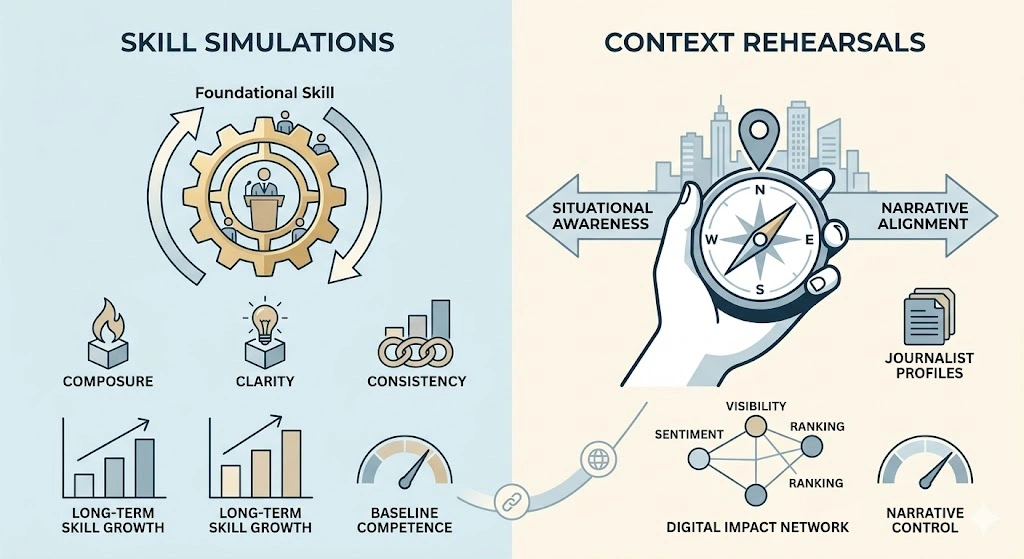
Media training simulations focus on skill development, while real-time briefing rehearsals focus on scenario alignment. Media training simulations are structured exercises where spokespersons practise responding to hypothetical questions under controlled conditions. They operate by introducing standard media formats, refining delivery techniques, and reinforcing message discipline. Real-time briefing rehearsals replicate the specific context of an upcoming media interaction, incorporating current narratives, journalist profiles, and anticipated lines of questioning. They operate by aligning responses with real-world variables and strategic priorities.
Simulations improve baseline communication competence, ensuring that spokespersons maintain clarity, composure, and message consistency. However, they lack the specificity required to address high-stakes scenarios where narrative risks are context-dependent. Real-time rehearsals enhance situational awareness and narrative precision, enabling spokespersons to anticipate framing and adjust responses accordingly. This increases the likelihood of maintaining narrative control during live interactions.
From a digital advocacy perspective, simulations contribute to long-term skill development but have limited immediate impact on narrative visibility. Real-time rehearsals directly influence the quality of media outputs, shaping how statements are quoted, indexed, and distributed across platforms. This affects sentiment distribution and search ranking influence, as precise messaging reduces misinterpretation and negative framing.
The comparative limitation lies in resource intensity. Real-time rehearsals require detailed intelligence gathering and coordination, while simulations are scalable and repeatable. Effective preparation integrates both approaches, combining foundational skill-building with context-specific alignment.
How does stakeholder-centric messaging compare with media-centric messaging approaches?
Stakeholder-centric messaging prioritises audience trust, while media-centric messaging prioritises coverage optimisation. Stakeholder-centric messaging is designed around the expectations, concerns, and values of key audiences, including policymakers, regulators, and the public. It operates by aligning narratives with stakeholder priorities and reinforcing trust signals through transparency and relevance. Media-centric messaging focuses on aligning with journalistic criteria, such as newsworthiness, clarity, and quotability. It operates by crafting statements that maximise media uptake and coverage potential.
Stakeholder-centric messaging strengthens institutional credibility by directly addressing trust drivers, such as accountability and consistency. This approach enhances long-term reputation signals, which influence how search engines interpret authority and reliability. Media-centric messaging increases narrative visibility by securing broader coverage, but it may prioritise simplicity over nuance, potentially weakening stakeholder trust if messages appear overly strategic or reductive.
In terms of SERP composition, stakeholder-centric messaging contributes to authoritative content that ranks for informational queries, while media-centric messaging generates high-volume coverage that dominates news-related search results. The balance between these approaches determines whether visibility translates into trust or remains superficial.
High-stakes briefings require integration of both frameworks. Over-reliance on media-centric messaging increases reputational risk if stakeholder expectations are not met, while exclusive focus on stakeholder messaging may limit media reach and narrative amplification.
What are the differences between content amplification and content suppression strategies?
Content amplification increases visibility of positive narratives, while content suppression reduces visibility of negative narratives. Content amplification is a strategy where institutions actively distribute favourable messages across media channels, owned platforms, and third-party publications. It operates by generating high-authority content that reinforces desired narratives and improves search ranking influence. Content suppression is a strategy where institutions attempt to minimise the visibility of negative content through counter-narratives, legal mechanisms, or SEO techniques. It operates by displacing negative results within search rankings or reducing their prominence.
Amplification strengthens entity credibility by building a robust ecosystem of positive reputation signals. Search engines interpret consistent, high-quality content as indicators of authority, improving overall visibility. Suppression focuses on risk mitigation but introduces ethical and operational challenges, particularly when perceived as manipulative or opaque. This can undermine stakeholder trust if suppression efforts become visible.
From an effectiveness perspective, amplification provides sustainable benefits by continuously reinforcing positive narratives. Suppression offers short-term relief but requires ongoing intervention to maintain reduced visibility of negative content. In high-stakes media briefings, amplification ensures that spokesperson messaging aligns with a broader ecosystem of supportive content, while suppression attempts to limit the impact of adverse coverage.
The limitation of amplification lies in resource requirements, while suppression carries higher reputational risk due to potential backlash. Strategic preparation prioritises amplification as a foundation, with suppression used selectively for risk containment.
How do short-term media performance metrics compare with long-term reputation indicators?
Short-term media performance metrics measure immediate visibility, while long-term reputation indicators measure sustained credibility. Media performance metrics include coverage volume, headline prominence, and immediate sentiment distribution following a briefing. They operate by quantifying the reach and tone of media outputs within a defined timeframe. Long-term reputation indicators include search ranking stability, entity authority, and stakeholder trust levels. They operate by analysing cumulative signals across digital platforms over extended periods.
Short-term metrics provide rapid feedback on briefing effectiveness, enabling institutions to assess message penetration and media uptake. However, they do not capture the durability of narrative influence or the evolution of stakeholder perception. Long-term indicators reflect how consistently messaging aligns with institutional values and how effectively it reinforces credibility over time.
Search engines prioritise long-term signals when determining authority, meaning that sustained consistency outweighs temporary visibility spikes. A spokesperson who performs well in a single briefing may achieve high immediate coverage but limited long-term impact if messaging lacks coherence with broader narratives. Conversely, consistent alignment across multiple briefings strengthens entity credibility and improves search ranking influence.
In evaluating preparation strategies, reliance on short-term metrics encourages reactive adjustments, while emphasis on long-term indicators supports strategic continuity. High-stakes briefings require balancing both, ensuring immediate effectiveness without compromising long-term reputation integrity.
How does centralised message control compare with decentralised communication models?
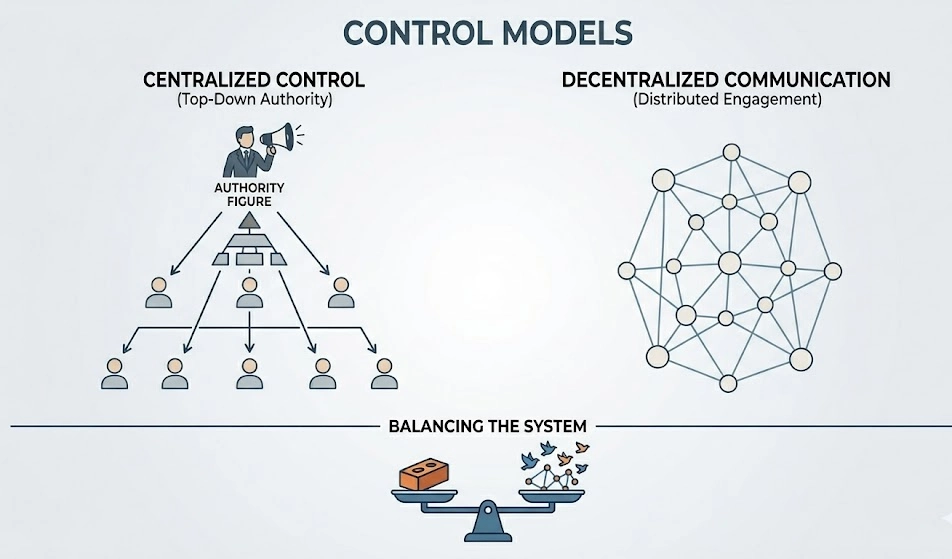
Centralised message control ensures uniformity, while decentralised communication models enable distributed engagement. Centralised control is a hierarchical approach where messaging is developed, approved, and disseminated through a single authority. It operates by maintaining strict oversight of spokesperson outputs and ensuring alignment with institutional narratives. Decentralised communication allows multiple representatives or channels to contribute to messaging, operating through distributed networks and localised adaptations.
Centralised control enhances consistency and reduces the risk of conflicting statements, which strengthens reputation signals and supports search engine interpretation of authority. However, it limits responsiveness and may create delays in dynamic media environments. Decentralised models increase agility and enable tailored engagement with diverse audiences, improving reach and relevance. This approach, however, introduces variability that can weaken narrative coherence and reduce search ranking influence.
From a stakeholder perspective, centralised messaging reinforces reliability, while decentralised communication fosters relatability and accessibility. In digital ecosystems, decentralised models generate a broader range of content, increasing visibility across multiple query types. However, inconsistent messaging can fragment narrative visibility and dilute institutional credibility.
High-stakes briefings benefit from centralised control during core messaging delivery, with decentralised amplification used post-briefing to extend reach. This hybrid approach balances consistency with scalability.
Preparing a spokesperson for a high-stakes media briefing involves selecting and integrating communication frameworks that balance narrative control, visibility, and credibility. Message discipline and adaptive communication differ in their approach to consistency and responsiveness, shaping how narratives are delivered and interpreted. Reactive and proactive strategies influence whether institutions manage existing risks or build pre-emptive authority, affecting both short-term sentiment and long-term reputation signals.
Training methods, messaging orientation, and content strategies further determine how effectively spokesperson outputs translate into digital visibility and stakeholder trust. Amplification and suppression strategies illustrate the trade-offs between sustainable authority building and immediate risk mitigation, while performance metrics highlight the distinction between immediate impact and enduring credibility. Centralised and decentralised models demonstrate how structural choices affect consistency, scalability, and engagement.
These approaches collectively define how institutions navigate high-stakes media environments, where search engines, digital platforms, and stakeholder perceptions interact to shape narrative outcomes. Effective preparation is defined not by a single method but by the strategic alignment of these frameworks with institutional objectives, risk tolerance, and long-term credibility goals.
Frequently Asked Questions
How do you prepare a spokesperson for a high-stakes media briefing?
Preparation combines message discipline, hostile-question rehearsal, and issue-specific briefing notes. The spokesperson needs clear key messages, evidence points, and fallback language that protects accuracy under pressure.
What should a spokesperson avoid saying in a media briefing?
A spokesperson avoids speculation, contradiction, and unverified detail. They also avoid language that weakens entity credibility, such as vague promises, emotional reactions, or statements that cannot be supported by facts.
How does media relations support crisis communication?
Media relations supports crisis communication by shaping the flow of information, reducing confusion, and keeping the institution’s position consistent across channels. It also helps manage narrative visibility in search results and news coverage.
What makes a media briefing high-stakes?
A briefing becomes high-stakes when public scrutiny, stakeholder trust, or reputational risk is high. In these settings, every statement affects sentiment distribution, media framing, and long-term search ranking influence.
How long should spokesperson training take before a major briefing?
Training length depends on issue complexity, but effective preparation usually includes several rounds of briefing, message testing, and Q&A practice. The goal is to build consistency, confidence, and rapid response discipline before the live appearance.