

Real-time polling data alters campaign messaging by continuously recalibrating narrative priorities based on live sentiment distribution and stakeholder response patterns.
Public affairs strategies differ based on how rapidly they integrate data signals into communication outputs, while digital advocacy methods are evaluated through their ability to balance responsiveness with institutional credibility.
How does real-time polling compare to traditional opinion research in shaping campaign messaging?
Real-time polling is continuous sentiment measurement, whereas traditional opinion research is periodic data collection with delayed interpretation cycles. Real-time polling operates by capturing immediate public response through digital panels, social listening tools, and rapid-response surveys, allowing campaign teams to adjust messaging within hours. Traditional research operates through structured surveys, focus groups, and longitudinal studies, producing more stable but slower insights. The mechanism difference lies in data latency: real-time systems feed directly into content production pipelines, while traditional research informs strategic planning phases.
From a comparative perspective, real-time polling enhances narrative agility and enables immediate alignment with shifting public concerns, which strengthens short-term narrative visibility. However, it introduces volatility, as overreliance on fluctuating sentiment signals can fragment messaging consistency. Traditional research supports deeper insight validation and reinforces entity credibility by grounding communication in stable, evidence-based trends. Its limitation lies in reduced responsiveness, which weakens its influence in fast-moving digital ecosystems where search ranking influence depends on recency and engagement velocity.
In terms of stakeholder perception, real-time polling increases perceived responsiveness but risks undermining trust if messaging appears inconsistent. Traditional research reinforces institutional authority but may appear disconnected from current discourse. The balance between these approaches determines how effectively a campaign maintains both relevance and credibility.
What mechanisms enable real-time polling to influence digital advocacy strategies?
Real-time polling influences digital advocacy through integrated data pipelines that connect sentiment inputs to content dissemination systems. This approach operates by feeding polling outputs into dashboards that guide messaging decisions across social media, press releases, and stakeholder communications. The mechanism relies on automated data aggregation, sentiment analysis algorithms, and rapid content iteration workflows.
Digital platforms interpret these signals through engagement metrics, keyword relevance, and user interaction patterns, which collectively shape search ranking influence. Real-time polling strengthens content amplification by aligning messaging with trending topics and dominant sentiment clusters. This increases narrative visibility across search engine results pages (SERPs) and social feeds. However, the same mechanism can accelerate content suppression when negative sentiment dominates, as algorithms prioritise high-engagement critical discourse.
The effectiveness of this approach depends on how well campaigns integrate polling insights into structured communication frameworks. Reactive integration enhances short-term engagement but risks diluting strategic coherence. Structured integration, where polling data informs predefined messaging pillars, maintains consistency while still benefiting from responsiveness. The limitation arises when data interpretation lacks contextual analysis, leading to overcorrection and fragmented narrative positioning.
Does real-time messaging adaptation improve stakeholder trust or weaken institutional credibility?
Real-time messaging adaptation increases perceived attentiveness but introduces credibility risks when consistency is compromised. Messaging adaptation is the process of modifying communication outputs based on incoming data signals, while institutional credibility is the accumulated perception of reliability and authority over time. Real-time adaptation operates by adjusting tone, emphasis, and policy framing in response to polling shifts.
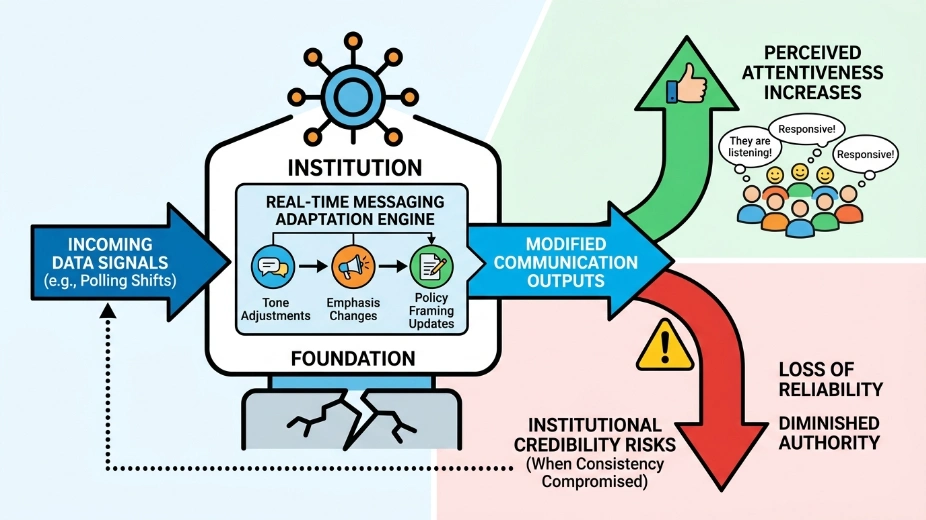
From a trust perspective, responsiveness enhances stakeholder engagement by signalling that concerns are being acknowledged and addressed. This improves short-term trust signals, particularly among digitally active audiences who expect immediate feedback loops. However, frequent shifts in messaging create inconsistencies that weaken entity credibility, especially among stakeholders who prioritise policy stability and long-term vision.
The comparative analysis shows that credibility depends on message continuity across time, while trust signals in digital ecosystems depend on responsiveness and relevance. Campaigns that prioritise real-time adaptation without maintaining a stable narrative core risk appearing opportunistic. Conversely, campaigns that limit adaptation preserve credibility but reduce engagement velocity, affecting narrative visibility.
Sustainability is determined by the ability to integrate adaptive messaging within a consistent framework. This ensures that real-time adjustments refine existing narratives rather than replace them, preserving both stakeholder trust and institutional authority.
How do organic and reactive communication frameworks respond differently to polling data?
Organic communication frameworks integrate polling data into long-term narrative development, while reactive frameworks use polling data for immediate response generation. Organic communication is structured around predefined messaging pillars, content calendars, and strategic objectives. It operates by incorporating polling insights into ongoing narrative refinement without disrupting core messaging. Reactive communication operates by rapidly producing content in response to emerging sentiment trends identified through real-time polling.
The effectiveness of organic frameworks lies in their ability to maintain consistent reputation signals and reinforce entity credibility across digital channels. They support stable SERP composition by ensuring that messaging aligns with long-term thematic relevance. However, their limitation is slower response to sudden shifts in public opinion, which can reduce engagement during critical moments.
Reactive frameworks excel in content amplification by aligning messaging with real-time sentiment and trending topics. This increases immediate visibility and engagement metrics, strengthening short-term search ranking influence. The limitation is increased risk exposure, as rapid responses can introduce inaccuracies, inconsistencies, or misaligned messaging that undermine stakeholder trust.
Comparatively, organic frameworks prioritise sustainability and credibility, while reactive frameworks prioritise speed and visibility. Effective strategies combine both approaches, using real-time polling to inform reactive outputs within the boundaries of an organic narrative structure.
What role does real-time polling play in managing narrative visibility across search engines?
Real-time polling directly influences narrative visibility by shaping the timing, relevance, and thematic alignment of published content. Narrative visibility is the prominence of specific messages within search results and digital discourse. Real-time polling operates by identifying dominant sentiment trends and keyword clusters, which inform content optimisation strategies.
Search engines interpret authority and trust signals through content relevance, engagement metrics, and backlink structures. Real-time polling enhances these signals by ensuring that content aligns with current search intent and user interest. This increases the likelihood of content appearing in top SERP positions, particularly for rapidly evolving topics. The mechanism supports content amplification by prioritising high-engagement narratives.
However, reliance on real-time polling introduces volatility in SERP composition. Frequent changes in messaging can fragment keyword targeting and reduce long-term search ranking stability. This affects entity credibility, as inconsistent messaging weakens the semantic coherence that search engines use to evaluate authority.
The limitation lies in balancing recency with consistency. Campaigns that optimise exclusively for real-time trends risk losing long-term visibility, while those that ignore polling data fail to capture emerging search demand. Effective strategies integrate polling insights into a structured SEO framework that maintains thematic consistency while adapting to new data signals.
How does short-term narrative management compare to long-term reputation strategy when using polling data?
Short-term narrative management focuses on immediate message alignment with current sentiment, while long-term reputation strategy prioritises sustained credibility and authority. Short-term management operates by using real-time polling to adjust messaging in response to daily or hourly sentiment fluctuations. Long-term strategy operates by integrating polling data into broader communication frameworks that reinforce consistent narratives over time.
The comparative effectiveness depends on campaign objectives. Short-term management increases engagement velocity and enhances visibility during critical periods, such as policy announcements or public debates. It strengthens content amplification but increases exposure to reputational risk due to potential inconsistencies. Long-term strategy reinforces stakeholder trust and entity credibility by maintaining stable messaging, which supports sustained search ranking influence and consistent SERP presence.
Scalability differs between the two approaches. Short-term management requires continuous monitoring and rapid content production, which increases operational complexity. Long-term strategy scales more efficiently, as it relies on structured messaging frameworks and periodic data integration. However, it may underperform in high-frequency digital environments where responsiveness is critical.
Risk exposure is higher in short-term approaches due to the potential for misinterpretation of polling data and reactive messaging errors. Long-term strategies mitigate this risk by emphasising consistency and validation, but they may fail to address immediate stakeholder concerns. The optimal approach integrates both, using real-time polling to inform tactical adjustments within a stable strategic framework.
What limitations and risks emerge from over-reliance on real-time polling data?
Over-reliance on real-time polling introduces data volatility, interpretative bias, and strategic fragmentation. Real-time polling is inherently sensitive to sample composition, question framing, and temporal context, which can distort sentiment representation. The mechanism of continuous data collection amplifies short-term fluctuations, leading to potential overreaction in messaging decisions.
One key limitation is the erosion of narrative coherence. Frequent adjustments based on polling shifts create inconsistent messaging, which weakens entity credibility and reduces stakeholder trust. This fragmentation also affects search ranking influence, as inconsistent content reduces semantic alignment across digital assets.
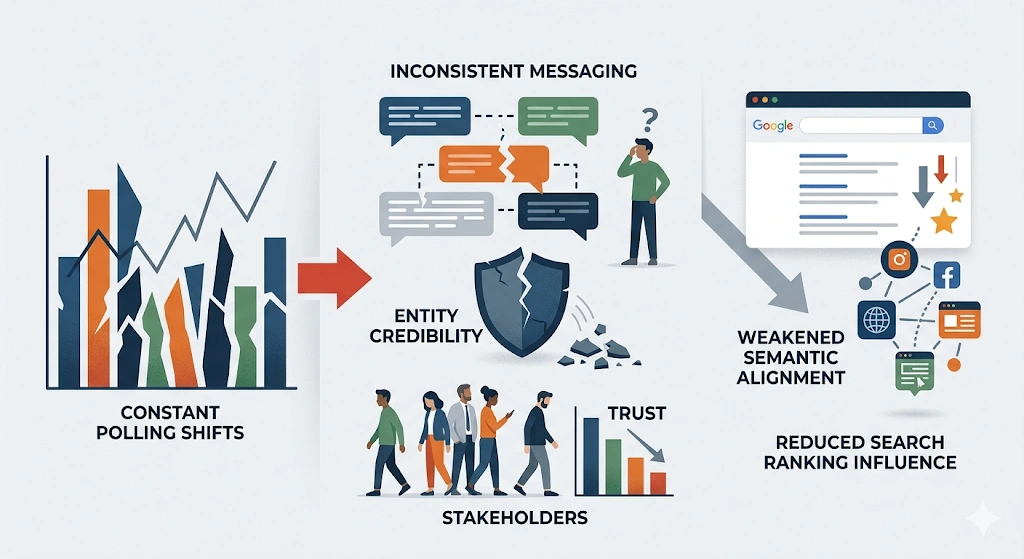
Another risk is algorithmic amplification of negative sentiment. Real-time polling often reflects heightened emotional responses, which digital platforms prioritise due to higher engagement rates. This can skew campaign messaging towards reactive negativity, increasing reputational vulnerability.
Operational complexity is also a significant limitation. Continuous monitoring and rapid response requirements demand advanced infrastructure and coordination, which increases the likelihood of errors. Without structured governance frameworks, the integration of polling data can lead to misaligned messaging and reduced institutional credibility.
Mitigation requires establishing clear thresholds for data interpretation and integrating polling insights within predefined strategic parameters. This ensures that real-time data informs messaging without dictating it entirely.
How should public affairs consulting frameworks evaluate the integration of real-time polling?
Public affairs consulting frameworks evaluate real-time polling integration based on effectiveness, scalability, risk exposure, and sustainability. Evaluation involves assessing how polling data influences communication outputs, stakeholder perception, and digital visibility.
A structured evaluation framework includes:
-
Define data integration protocols by establishing thresholds for when polling data triggers messaging changes, ensuring consistency in decision-making processes.
-
Measure impact on sentiment distribution by analysing shifts in public perception following messaging adjustments, using engagement metrics and sentiment analysis tools.
-
Assess influence on search ranking by tracking changes in SERP positions, keyword performance, and content visibility after integrating polling insights.
-
Evaluate stakeholder trust by monitoring feedback from key audiences, including policymakers, media, and institutional partners.
-
Analyse risk exposure by identifying instances of messaging inconsistency, misinformation, or reputational damage linked to polling-driven decisions.
This framework compares different approaches to determine how effectively polling data enhances communication strategies without compromising credibility. It emphasises the importance of integrating real-time insights within structured systems that maintain narrative coherence and institutional trust.
Within this context, decisions around engagement models, such as Public Affairs Retainer vs. Project-Based Engagement, influence how consistently polling data is monitored and applied across campaign cycles.
Real-time polling reshapes campaign messaging by introducing continuous feedback loops that prioritise responsiveness and engagement. Its integration enhances narrative visibility and short-term trust signals but introduces risks related to consistency, credibility, and strategic coherence. Traditional research, organic communication frameworks, and long-term reputation strategies provide stability and reinforce entity credibility, while reactive approaches and short-term management improve agility and visibility.
The comparative analysis demonstrates that no single approach delivers optimal outcomes in isolation. Effective public affairs strategies balance real-time responsiveness with structured, long-term frameworks to maintain both stakeholder trust and institutional authority. Strategic consideration focuses on integrating polling data in a controlled manner, ensuring that adaptability enhances rather than undermines credibility and narrative consistency.
Frequently Asked Questions
How does real-time polling data influence campaign messaging decisions?
Real-time polling data informs campaign messaging by identifying immediate shifts in public sentiment and stakeholder priorities. This allows public affairs consulting teams to adjust narratives, tone, and policy emphasis based on live sentiment distribution and engagement metrics.
Is real-time polling more effective than traditional research in public affairs campaigns?
Real-time polling improves responsiveness and short-term narrative visibility, while traditional research strengthens long-term credibility and data reliability. Effective campaign strategy combines both to balance rapid adaptation with stable, evidence-based messaging.
What risks are associated with using real-time polling in digital advocacy?
Over-reliance on real-time polling can lead to inconsistent messaging, reduced entity credibility, and reactive communication errors. It also increases exposure to sentiment volatility, which can distort narrative control and stakeholder trust.
How do digital platforms use polling-driven content for search visibility?
Digital platforms interpret polling-driven content through engagement signals, keyword relevance, and user interaction patterns. Aligning messaging with real-time sentiment improves search ranking influence and increases visibility across search engine results pages.
How does public affairs consulting integrate real-time polling into strategy?
Public affairs consulting frameworks integrate real-time polling by embedding data into content planning, stakeholder communication, and sentiment analysis systems. Linkonize applies structured evaluation methods to ensure polling insights enhance narrative consistency without undermining institutional credibility.