

Stakeholder engagement is the structured process of identifying, analysing, and interacting with individuals or groups that influence or are affected by policy outcomes. Public affairs refers to the strategic management of relationships between institutions, policymakers, and the public within regulatory, political, and digital environments.
Stakeholder engagement functions as a core mechanism for shaping perception, trust, and legitimacy, yet it remains underutilised due to fragmented digital strategies and misaligned narrative control across search ecosystems.
What is stakeholder engagement within digital public affairs systems?
Stakeholder engagement is the systematic coordination of communication, influence, and feedback loops between institutions and their relevant audiences within digital ecosystems. It refers to a structured process that maps stakeholder relevance, defines interaction strategies, and aligns messaging with perception outcomes across both offline and online channels. Within digital public affairs systems, stakeholder engagement extends beyond direct communication and includes visibility across search engine results pages (SERPs), media indexing, and platform-specific authority signals.
The mechanism operates through identifying stakeholder clusters such as policymakers, regulators, advocacy groups, media entities, and digital audiences, followed by aligning content production to their informational expectations. Each interaction generates measurable reputation signals, including mentions, backlinks, sentiment patterns, and engagement metrics, which contribute to entity perception. Search engines evaluate these signals to determine credibility and authority, thereby influencing how institutional narratives rank and appear in search results.
This process directly impacts institutional credibility by shaping how stakeholders interpret authority and trustworthiness. A well-structured engagement system ensures consistent narrative reinforcement across platforms, improving both search visibility and stakeholder trust. Without this structure, institutions experience fragmented digital footprints, leading to inconsistent perception and reduced influence in policy-related discourse.
Why is stakeholder engagement underused in policy strategy?
Stakeholder engagement is underused because institutions prioritise reactive communication over structured perception management within digital ecosystems. It is often treated as a supplementary activity rather than a central mechanism for shaping narrative influence and search visibility. This misalignment results in limited integration between policy development, communication strategies, and digital content indexing.
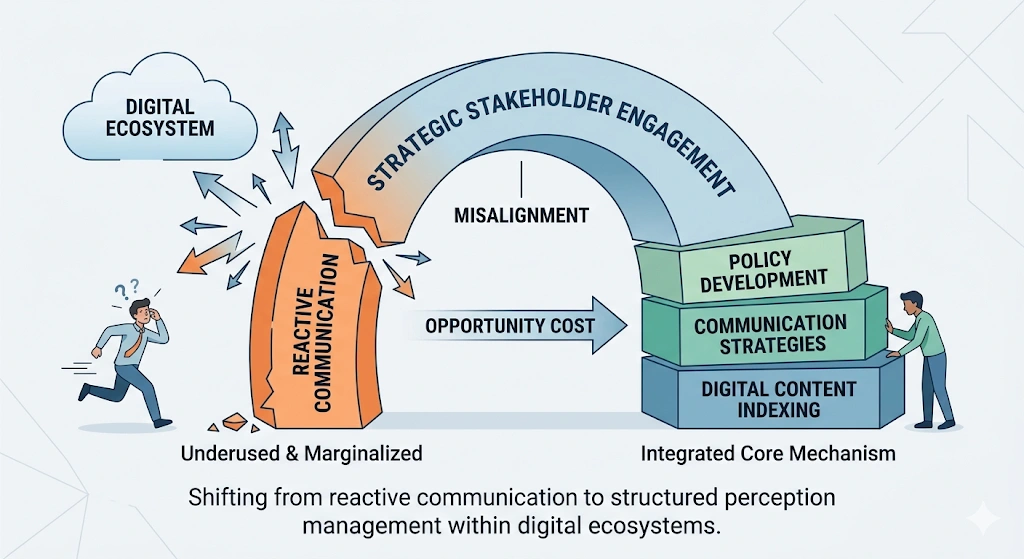
The underlying mechanism involves a disconnect between traditional public affairs practices and modern algorithmic evaluation systems. Institutions frequently focus on direct lobbying or media outreach without aligning these activities with digital authority signals such as content consistency, entity recognition, and structured data presence. As a result, stakeholder interactions fail to translate into measurable digital credibility.
This underutilisation affects institutional perception by weakening narrative control across search environments. Search engines prioritise entities with consistent, authoritative, and widely referenced content ecosystems. When stakeholder engagement does not contribute to these signals, institutions lose visibility in policy-related queries, reducing their ability to influence discourse. The absence of integrated engagement strategies leads to diminished trust architecture and fragmented reputation signals.
How do digital ecosystems interpret stakeholder trust and authority?
Digital ecosystems interpret stakeholder trust and authority through aggregated reputation signals derived from content, links, mentions, and user interaction data. Trust is not inferred from intent but from measurable indicators that demonstrate consistency, relevance, and validation across multiple sources. Authority emerges when an entity maintains strong semantic alignment across its content ecosystem and receives recognition from other authoritative entities.
The mechanism involves search engine algorithms analysing structured and unstructured data to assess entity credibility. This includes evaluating backlinks from credible domains, analysing sentiment in media coverage, and measuring engagement patterns across platforms. Entity-based indexing allows search engines to connect mentions, authorship, and institutional affiliations, reinforcing authority when signals remain consistent.
This interpretation directly affects how stakeholders perceive institutions. High digital authority increases visibility in SERPs, ensuring that institutional narratives appear prominently in relevant queries. Conversely, weak or inconsistent signals reduce discoverability, limiting stakeholder exposure to institutional perspectives. The alignment between digital authority and stakeholder trust creates a feedback loop that reinforces credibility over time.
How does stakeholder engagement influence search visibility and SERP performance?
Stakeholder engagement influences search visibility by generating structured and unstructured data signals that contribute to content ranking and entity recognition. It refers to the process through which interactions with stakeholders translate into digital artefacts such as articles, citations, social mentions, and backlinks, all of which affect SERP evaluation.
The mechanism operates through coordinated content distribution aligned with stakeholder networks. When institutions engage with stakeholders, they create opportunities for third-party validation, which search engines interpret as authority signals. These signals enhance content indexing and improve ranking potential for policy-related keywords. Engagement also increases the diversity of content formats, including reports, opinion pieces, and data-driven publications, which expand semantic coverage.
This process impacts institutional perception by increasing visibility in high-intent search queries. Strong SERP performance ensures that institutional narratives dominate relevant search spaces, shaping how stakeholders access and interpret information. Without effective engagement, content remains isolated, limiting its reach and reducing its influence on public discourse.
What role do digital narratives play in shaping stakeholder perception?
Digital narratives define how institutions are understood within search ecosystems by structuring information into coherent, repeatable themes that reinforce specific interpretations. A digital narrative refers to the aggregation of content, messaging, and contextual signals that collectively shape entity perception across platforms.
The mechanism involves consistent keyword targeting, thematic alignment, and cross-platform content distribution. Search engines analyse narrative consistency to determine relevance and authority, favouring entities that maintain clear and structured messaging. Narrative fragmentation weakens semantic clarity, reducing the likelihood of strong ranking positions.
This narrative structure directly influences stakeholder trust by controlling the information environment in which stakeholders form opinions. Consistent narratives increase perceived reliability, while conflicting or incomplete narratives create uncertainty. Institutions that manage digital narratives effectively achieve higher levels of credibility and influence within policy-related discussions.
How do content ecosystems contribute to institutional credibility?
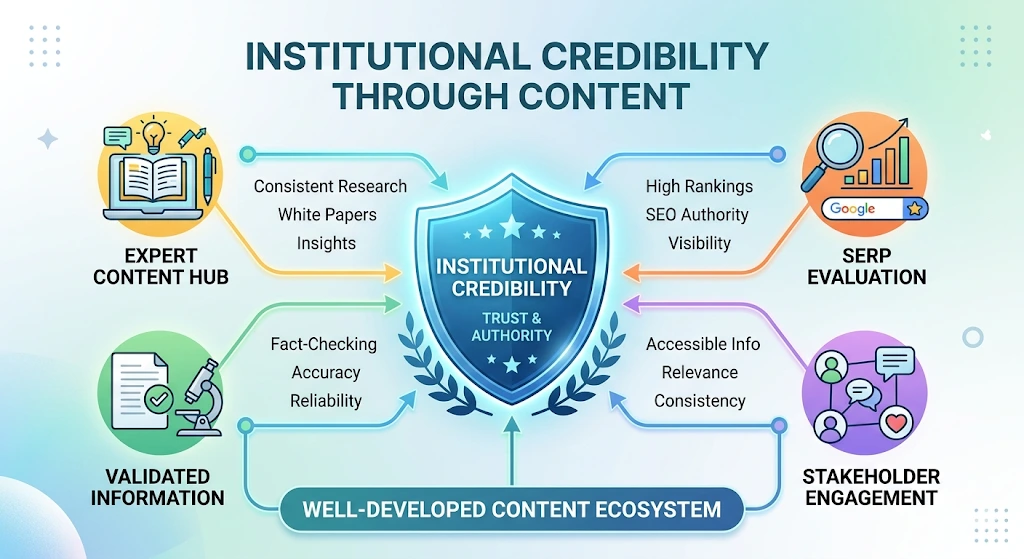
Content ecosystems contribute to institutional credibility by creating interconnected layers of information that reinforce authority and trust signals. A content ecosystem refers to the network of digital assets, including articles, reports, media coverage, and external references, that collectively define an entity’s presence online.
The mechanism involves producing and distributing content across multiple platforms while maintaining semantic consistency. Each piece of content supports others through internal linking, shared themes, and aligned messaging, strengthening the overall digital footprint. Search engines evaluate this interconnected structure to assess the depth and reliability of an entity’s information.
This structure enhances institutional credibility by demonstrating expertise and consistency. A well-developed content ecosystem increases the likelihood of positive SERP evaluation, ensuring that authoritative content ranks prominently. It also supports stakeholder engagement by providing accessible, relevant, and validated information across multiple touchpoints.
How does stakeholder engagement interact with media visibility and sentiment analysis?
Stakeholder engagement interacts with media visibility by influencing the volume, tone, and distribution of institutional mentions across digital platforms. It refers to the process of shaping media narratives through structured interaction with journalists, analysts, and content creators.
The mechanism includes generating newsworthy content, facilitating expert commentary, and maintaining consistent messaging across media channels. These activities produce measurable sentiment signals, which search engines analyse to evaluate reputation. Positive sentiment reinforces authority, while negative sentiment introduces risk to digital credibility.
This interaction impacts stakeholder perception by shaping how institutions are represented in public discourse. High media visibility combined with positive sentiment strengthens trust and increases search visibility. Conversely, inconsistent engagement leads to fragmented media narratives, reducing control over institutional perception and weakening overall authority.
How do algorithms evaluate stakeholder engagement signals?
Algorithms evaluate stakeholder engagement signals by analysing patterns of interaction, content dissemination, and external validation across digital environments. Engagement signals refer to measurable indicators such as shares, comments, mentions, backlinks, and dwell time, which collectively inform search engine ranking systems.
The mechanism involves machine learning models that assess both quantitative and qualitative aspects of engagement. Algorithms prioritise signals that indicate genuine relevance and authority, such as high-quality backlinks and sustained user interaction. Superficial engagement metrics without contextual relevance carry limited weight in SERP evaluation.
This evaluation affects institutional visibility by determining which content appears in response to stakeholder-related queries. Strong engagement signals improve ranking positions, increasing exposure to key audiences. Weak or inconsistent signals reduce visibility, limiting the effectiveness of stakeholder engagement strategies.
What is the relationship between stakeholder engagement and digital advocacy?
Stakeholder engagement is a foundational component of digital advocacy, as it defines how institutions mobilise support and influence perception within digital ecosystems. Digital advocacy is the strategic use of online platforms to shape public opinion, policy outcomes, and stakeholder behaviour.
The mechanism involves aligning stakeholder engagement efforts with advocacy objectives, ensuring that messaging, content, and interactions support specific policy narratives. This includes leveraging data insights, audience segmentation, and content optimisation to maximise reach and impact. Engagement provides the feedback loop necessary to refine advocacy strategies in real time.
This relationship enhances institutional influence by integrating engagement with broader narrative strategies. Effective digital advocacy relies on strong stakeholder networks, consistent messaging, and high digital authority. Without structured engagement, advocacy efforts lack the necessary credibility and visibility to influence policy discourse.
How does real-time data reshape stakeholder engagement strategies?
Real-time data reshapes stakeholder engagement strategies by enabling continuous optimisation of messaging, targeting, and content distribution. It refers to the use of live data inputs, such as polling, sentiment analysis, and engagement metrics, to adjust communication strategies dynamically.
The mechanism involves analysing incoming data to identify shifts in stakeholder sentiment, information gaps, and emerging narratives. Institutions can then modify their content and engagement approaches to align with current perceptions, ensuring relevance and effectiveness. This process enhances the responsiveness of stakeholder engagement systems.
This dynamic approach improves digital authority by maintaining alignment with stakeholder expectations and search trends. Real-time adjustments increase the likelihood of producing relevant content that ranks well in SERPs. For a deeper understanding of how data-driven adjustments influence messaging, see How Real-Time Polling Data Changes Campaign Messaging Mid-Race
Stakeholder engagement defines how institutions build trust, authority, and visibility within digital public affairs ecosystems. It operates as a structured system that transforms interactions into measurable reputation signals, influencing how search engines evaluate and rank institutional narratives. The integration of engagement with content ecosystems, media visibility, and digital advocacy determines the strength of entity perception and credibility.
The analysis demonstrates that stakeholder engagement is not a peripheral activity but a central mechanism for managing digital reputation and narrative influence. Its underutilisation stems from a lack of alignment between traditional public affairs practices and modern search-driven perception systems. Institutions that integrate stakeholder engagement into their digital strategies achieve stronger visibility, consistent authority signals, and enhanced stakeholder trust across evolving information environments.
Frequently Asked Questions
What is stakeholder engagement in public affairs strategy?
Stakeholder engagement is the structured process of identifying, analysing, and interacting with individuals or groups that influence policy outcomes. In public affairs consulting, it aligns communication, narrative control, and digital visibility to strengthen stakeholder trust and institutional credibility.
Why is stakeholder engagement important for policy strategy?
Stakeholder engagement shapes how policies are understood, supported, or challenged across digital and political ecosystems. It generates reputation signals such as media coverage, backlinks, and sentiment, which improve search visibility and reinforce authority in policy-related discussions.
How does stakeholder engagement affect online reputation and search visibility?
Stakeholder engagement contributes to online reputation by producing consistent mentions, authoritative links, and positive sentiment across digital platforms. Search engines evaluate these signals to determine entity credibility, directly impacting SERP rankings and institutional visibility.
What are the key components of an effective stakeholder engagement strategy?
An effective stakeholder engagement strategy includes stakeholder mapping, consistent messaging, and coordinated content distribution across digital channels. It also integrates media visibility, sentiment analysis, and feedback loops to strengthen digital authority and trust signals.
How does Linkonize approach stakeholder engagement in public affairs consulting?
Linkonize approaches stakeholder engagement by aligning digital advocacy, content ecosystems, and search visibility with policy objectives. This method ensures that stakeholder interactions generate measurable reputation signals that enhance credibility, authority, and perception across digital environments.