

Rapid-response social media in advocacy depends on balancing speed, accuracy, and stakeholder trust during periods of heightened scrutiny. Effective crisis posting operates through structured decision-making frameworks that protect narrative visibility while limiting reputation risk.
Public affairs strategies differ based on stakeholder expectations, institutional accountability requirements, and platform dynamics. Digital advocacy methods are evaluated through their impact on reputation signals, sentiment distribution, entity credibility, narrative visibility, and long-term stakeholder trust.
How Does Rapid-Response Communication Compare with Deliberate Advocacy Messaging?
Rapid-response communication prioritises immediate stakeholder awareness, whereas deliberate advocacy messaging prioritises narrative consistency and strategic positioning over time.
Rapid-response communication is a crisis-oriented framework designed to address emerging developments as they occur. It operates by publishing timely updates across social platforms to provide information, clarify positions, and reduce information gaps. Deliberate advocacy messaging is a structured communication approach focused on sustained issue engagement through planned content cycles and coordinated stakeholder outreach.
The primary advantage of rapid-response communication is speed. Fast publication reduces the opportunity for external actors to dominate narrative visibility. Search engines, social platforms, and news aggregation systems often prioritise fresh content during developing situations, increasing the visibility of early responses.
The limitation of rapid-response communication is elevated risk exposure. Incomplete information, inaccurate framing, or inconsistent messaging can weaken stakeholder trust and create long-term reputation challenges. Once information is indexed, archived, and shared across platforms, corrective communication receives lower visibility than the original publication.
Deliberate advocacy messaging provides stronger narrative consistency and more stable reputation signals. However, slower response times can create visibility gaps that allow external narratives to shape public perception before institutional communication enters the conversation.
Which Crisis Posting Framework Produces Stronger Stakeholder Trust Signals?
Structured verification frameworks generate stronger stakeholder trust signals than reactive publishing frameworks that prioritise speed above accuracy.
A structured verification framework is a communication process that requires evidence validation, stakeholder review, and message alignment before publication. Reactive publishing frameworks operate by releasing information immediately after a triggering event with limited internal verification.
Trust signals are evaluated through consistency, transparency, accuracy, and message coherence. Digital platforms and audiences interpret contradictory updates as indicators of uncertainty. Search engines also associate authoritative entities with content consistency, source reliability, and sustained topical relevance.
Structured verification frameworks strengthen entity credibility because published information remains aligned across channels. Stakeholders encounter fewer discrepancies between social media updates, official statements, media coverage, and search results. This consistency supports positive sentiment distribution and reduces confusion.
Reactive publishing frameworks improve response speed but increase the probability of content correction cycles. Repeated revisions create uncertainty around institutional reliability. In advocacy environments, uncertainty weakens stakeholder confidence and reduces message effectiveness.
The strongest trust outcomes emerge from systems that combine rapid monitoring with rigorous verification controls. This approach preserves response speed while maintaining information integrity.
How Do Organic and Reactive Communication Approaches Influence Crisis Outcomes?
Organic communication strengthens long-term credibility, while reactive communication strengthens immediate visibility during active developments.
Organic communication is a relationship-building approach focused on continuous engagement before a crisis occurs. It operates through stakeholder dialogue, educational content, issue awareness campaigns, and consistent narrative development. These foundations are closely connected to advocacy communication frameworks that use narrative development and stakeholder understanding to strengthen long-term trust.
The effectiveness of organic communication stems from accumulated stakeholder trust. Established audiences are more likely to interpret crisis statements positively when prior engagement demonstrates transparency and consistency. Existing trust relationships act as credibility reserves during periods of uncertainty.
Reactive communication performs differently. Its primary objective is narrative intervention rather than relationship development. The framework focuses on correcting misinformation, clarifying positions, and maintaining visibility within rapidly changing information environments.
The limitation of organic communication is reduced effectiveness during immediate crisis escalation when stakeholders seek urgent answers. The limitation of reactive communication is dependence on existing reputation signals. Institutions with weak credibility foundations receive less benefit from reactive messaging because audiences already question information reliability.
Comparative analysis shows that organic communication improves sustainability, while reactive communication improves responsiveness. Effective digital advocacy integrates both approaches into a unified communication ecosystem.
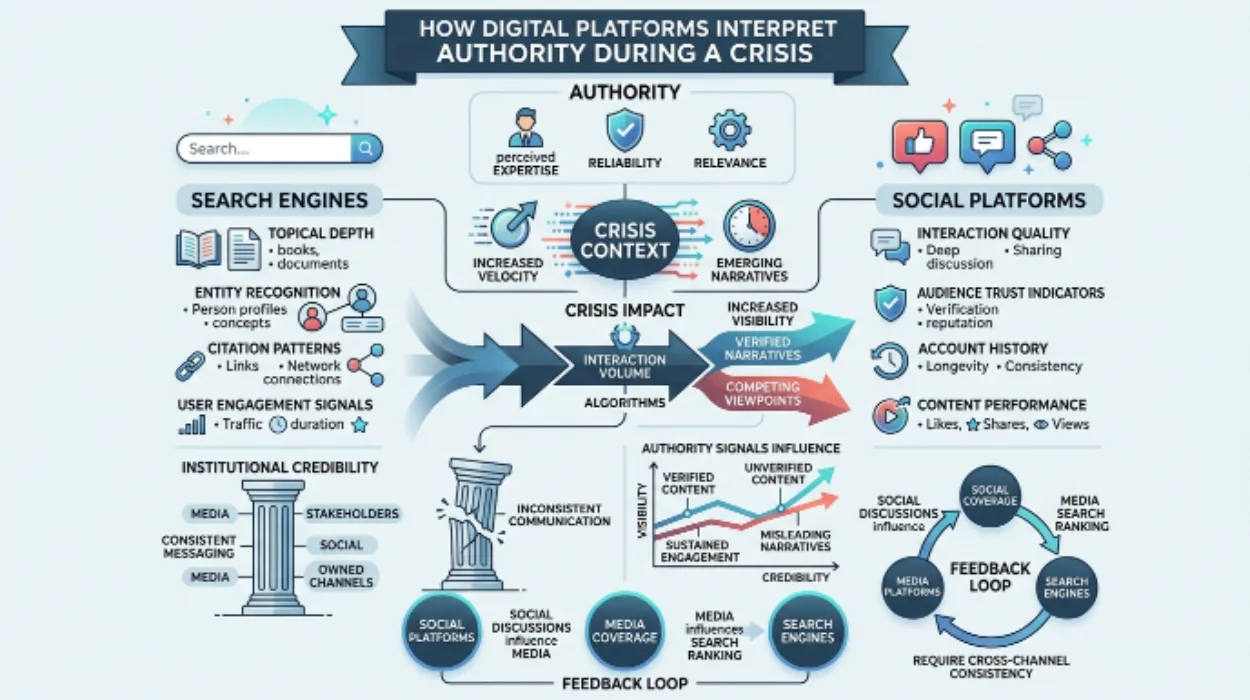
How Do Social Platforms and Search Engines Interpret Authority During a Crisis?
Digital platforms interpret authority through behavioural signals, content consistency, source credibility, and engagement quality.
Authority is a measurable representation of perceived expertise, reliability, and relevance within a digital ecosystem. Search engines evaluate authority through topical depth, entity recognition, citation patterns, and user engagement signals. Social platforms evaluate authority through interaction quality, audience trust indicators, account history, and content performance.
During a crisis, information velocity increases significantly. Algorithms prioritise content receiving immediate engagement because platforms interpret interaction volume as evidence of relevance. This mechanism increases the visibility of emerging narratives and competing viewpoints.
Authority signals influence search ranking influence and narrative visibility. Verified information from recognised entities often receives greater visibility than unverified content. However, sustained engagement with inaccurate information can temporarily amplify misleading narratives despite weaker credibility signals.
Institutional credibility becomes particularly important during crisis periods. Consistent messaging across owned channels, media coverage, stakeholder communications, and social platforms reinforces authority recognition. Inconsistent communication weakens entity credibility and fragments narrative visibility.
The interaction between search engines and social platforms creates a feedback loop. Highly visible social discussions influence media coverage, while media coverage influences search ranking influence. Crisis communication strategies therefore require cross-channel consistency rather than platform-specific responses.
What Are the Differences Between Content Amplification and Content Suppression Strategies?
Content amplification increases visibility for preferred narratives, whereas content suppression seeks to reduce visibility for harmful narratives.
Content amplification is a visibility strategy focused on increasing reach, engagement, and discoverability. It operates through coordinated publishing, stakeholder engagement, media alignment, and search optimisation. Content suppression is a risk management strategy focused on limiting the prominence of damaging, inaccurate, or misleading information.
Amplification strengthens narrative visibility by increasing the frequency and consistency of authoritative content. Search engines interpret sustained publication activity as evidence of relevance. Social platforms reward engagement patterns that indicate audience interest and informational value.
Suppression operates through corrective communication, clarification content, factual updates, and strategic content replacement. Rather than removing information, suppression frameworks reduce its relative prominence by introducing more authoritative alternatives.
The limitation of suppression-focused strategies is that they remain dependent on external narratives. Organisations become reactive rather than proactive. This approach often produces short-term improvements but weaker long-term authority development.
Amplification-focused strategies contribute more effectively to stakeholder trust and institutional credibility because they establish narrative leadership rather than narrative defence. Comparative evaluation indicates that amplification generates stronger sustainability outcomes when supported by accurate information and transparent communication.
How Does Stakeholder Engagement Compare with Media Visibility as a Crisis Response Priority?
Stakeholder engagement produces stronger long-term trust outcomes, while media visibility produces stronger short-term awareness outcomes.
Stakeholder engagement is a communication model focused on direct interaction with affected groups, decision-makers, community representatives, and advocacy audiences. Media visibility is a communication model focused on maximising exposure across digital, social, and traditional channels.
Stakeholder engagement operates through dialogue, consultation, feedback collection, and issue clarification. The framework strengthens trust because communication flows in multiple directions. Stakeholders become participants rather than passive recipients of information.
Media visibility operates through publication frequency, message distribution, and audience reach. Its effectiveness is measured through exposure metrics, share of voice, and narrative prominence. During a crisis, visibility supports awareness and information dissemination.
The limitation of visibility-focused approaches is reduced depth. High exposure does not automatically translate into trust. Audiences evaluate information quality, consistency, and credibility alongside reach metrics.
Stakeholder engagement creates stronger institutional resilience because trust develops through sustained interaction. Visibility remains important, but credibility depends on engagement quality rather than exposure volume alone.
Which Risks Increase When Organisations Post Too Quickly?
Accelerated publication increases factual, reputational, operational, and governance-related risks.
Speed-related communication risks emerge when verification processes fail to keep pace with publication requirements. Information inaccuracies become embedded within digital ecosystems through reposting, indexing, and media citation. Correction efforts rarely achieve equivalent visibility.
The first major risk is factual inconsistency. Conflicting updates weaken stakeholder trust and reduce entity credibility. Search engines and digital audiences interpret inconsistencies as indicators of unreliable information management.
The second risk involves sentiment distribution. Negative stakeholder reactions often accelerate when organisations appear defensive, incomplete, or contradictory. Sentiment patterns influence future engagement behaviour and shape broader narrative interpretation.
The third risk concerns governance credibility. Advocacy organisations, public affairs teams, and institutional communicators operate within accountability frameworks. Poorly verified statements create compliance concerns and weaken organisational legitimacy.
Risk evaluation frameworks commonly include the following mechanisms:
- Verify source credibility before publication to maintain information accuracy.
- Align stakeholder messaging across channels to preserve narrative consistency.
- Measure sentiment distribution continuously to identify emerging perception shifts.
- Document decision processes to strengthen accountability and governance transparency.
Risk reduction depends on process quality rather than publication speed alone.
How Does Short-Term Narrative Management Compare with Long-Term Institutional Credibility Building?
Short-term narrative management protects immediate visibility, while long-term institutional credibility building protects enduring trust and authority.
Narrative management is a tactical communication process designed to influence information interpretation during specific events. Institutional credibility building is a strategic process focused on developing consistent trust signals across extended periods.
Narrative management operates through rapid updates, clarification posts, media engagement, and issue framing. Its effectiveness is measured through immediate visibility, sentiment stabilisation, and stakeholder awareness. The framework addresses immediate communication requirements but does not automatically strengthen long-term reputation.
Institutional credibility building operates through transparency, consistency, evidence-based communication, and sustained stakeholder engagement. Search engines, media systems, and audiences recognise these patterns as indicators of authority and reliability.
Long-term credibility frameworks continue generating value because trust signals accumulate over time. Organisations that formalise governance processes, stakeholder engagement systems, monitoring structures, and crisis response protocols often implement these activities through a structured digital advocacy retainer model designed to support ongoing campaign management and institutional visibility objectives.
The limitation of narrative management is sustainability. Crisis-specific visibility gains decline after public attention shifts. Long-term credibility frameworks continue generating value because trust signals accumulate over time.
Comparative evaluation shows that institutional credibility influences future crisis outcomes. Organisations with established trust foundations experience stronger stakeholder confidence, more favourable sentiment distribution, and greater resilience against reputation challenges.
Conclusion
Rapid-response social media in advocacy is most effective when communication speed remains balanced with verification, consistency, and stakeholder trust requirements. Different approaches produce different outcomes across visibility, credibility, scalability, and risk exposure.
Reactive frameworks improve immediate narrative visibility, while organic engagement frameworks strengthen long-term stakeholder trust. Content amplification strategies support authority development more effectively than suppression-focused approaches. Stakeholder engagement generates stronger credibility outcomes than visibility alone, while institutional trust systems provide greater sustainability than short-term narrative management.
Digital advocacy evaluation therefore centres on how communication mechanisms influence reputation signals, entity credibility, search ranking influence, sentiment distribution, and stakeholder trust across both immediate and long-term time horizons.
Frequently Asked Questions
What is rapid-response social media in advocacy?
Rapid-response social media in advocacy is a communication approach used to publish timely updates during emerging issues, crises, or public debates. It focuses on maintaining narrative visibility, providing accurate information, and protecting stakeholder trust while events continue to develop.
Why is speed important during a digital advocacy crisis?
Speed is important because digital platforms prioritise recent and highly relevant content during fast-moving situations. Early communication helps organisations maintain visibility, reduce information gaps, and prevent external narratives from dominating public discussion.
How does rapid-response communication affect stakeholder trust?
Rapid-response communication affects stakeholder trust through the accuracy, consistency, and transparency of published information. Trust strengthens when updates remain aligned across channels and weakens when organisations issue contradictory or poorly verified statements.
What is the difference between crisis communication and long-term advocacy communication?
Crisis communication focuses on managing immediate issues, protecting reputation signals, and responding to emerging developments. Long-term advocacy communication focuses on sustained stakeholder engagement, institutional credibility, and consistent narrative development over an extended period.
How do search engines influence advocacy crisis management?
Search engines influence advocacy crisis management by determining which information receives visibility in search results. Content quality, authority signals, relevance, and credibility influence search ranking performance, affecting how stakeholders discover and interpret information during a crisis.