

Political campaign strategy refers to the structured use of data, messaging systems, and communication channels to influence voter perception and behaviour within defined electoral environments. Public affairs refers to the management of relationships, narratives, and institutional positioning between organisations, governments, and stakeholders across both offline and digital ecosystems.
How does political campaign strategy function within digital perception systems?
Political campaign strategy functions as a perception management system that defines how entities are understood, evaluated, and ranked across digital environments. It integrates data analytics, narrative construction, and channel distribution to shape stakeholder interpretation and trust signals. Within digital ecosystems, campaign strategy is not limited to persuasion; it is a process of constructing visibility, authority, and relevance across search engines, social platforms, and media networks. These systems evaluate entities based on structured content, engagement patterns, and contextual authority signals.
The mechanism operates through data ingestion, segmentation, and content deployment. Campaign teams analyse behavioural datasets, demographic indicators, and historical engagement metrics to define audience clusters. These clusters are then mapped to specific narratives that align with perceived values and informational expectations. Algorithms interpret these narratives through measurable signals such as keyword alignment, engagement consistency, and content freshness. This process directly influences search visibility and determines how political entities appear within search engine results pages (SERPs).
The impact on institutional perception is measurable through visibility metrics and sentiment analysis. A campaign strategy that aligns with algorithmic expectations generates higher indexing efficiency and stronger ranking stability. This results in enhanced digital authority, where the entity is consistently associated with relevant political topics and search queries. Consequently, stakeholder trust is reinforced through repeated exposure to structured, credible, and contextually relevant information.
What role does data play in shaping voter perception and digital authority?
Data defines the structural foundation of political campaign strategy by enabling precise audience segmentation and behavioural prediction. It refers to structured and unstructured information collected from digital interactions, public records, and platform analytics within digital ecosystems. This data is processed to identify patterns in voter interests, engagement triggers, and informational gaps. These insights inform both narrative construction and distribution strategies.
The mechanism involves transforming raw data into actionable perception signals. Campaign systems categorise voters into segments based on attributes such as geographic location, search behaviour, and issue prioritisation. Each segment is then associated with specific content clusters designed to address targeted concerns. Algorithms interpret these clusters through semantic relevance, which enhances content indexing and improves SERP evaluation. This structured approach ensures that content aligns with both user intent and algorithmic ranking criteria.
The impact on digital authority is direct and measurable. Data-driven campaigns produce consistent, topic-specific content that reinforces entity relevance across multiple search queries. This increases topical authority, which search engines interpret as a signal of credibility. As a result, the entity gains higher visibility across political discourse, strengthening its position within digital perception systems and reinforcing stakeholder trust.
How does voter micro-targeting influence narrative control and trust signals?
Voter micro-targeting is the process of delivering highly specific messages to narrowly defined audience segments based on detailed data profiling. It refers to the refinement of audience segmentation within digital advocacy systems, where messaging is tailored to individual behavioural and demographic attributes. This approach enables campaigns to control narrative exposure at a granular level.
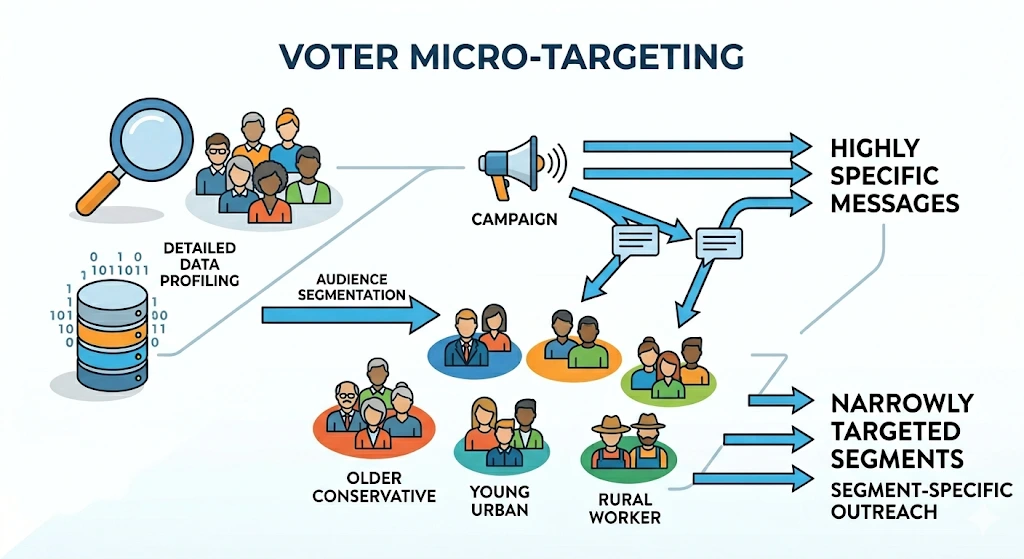
The mechanism operates through algorithmic distribution and content personalisation. Campaign systems use predictive models to determine which messages resonate with specific audience segments. These messages are then distributed through targeted channels such as social media feeds, search ads, and content platforms. Algorithms track engagement metrics, including click-through rates and dwell time, to evaluate message effectiveness. This feedback loop allows continuous optimisation of narrative delivery.
The impact on trust signals is complex and multi-layered. Micro-targeting increases message relevance, which enhances engagement and perceived authenticity. However, it also fragments the overall narrative, creating multiple versions of the same entity across different audience segments. This fragmentation influences how search engines and stakeholders interpret consistency and credibility. A structured approach to micro-targeting, as explored in How Voter Micro-Targeting Works in 2026, demonstrates how narrative alignment across segments maintains both relevance and institutional trust.
How do search engines evaluate political authority and credibility?
Search engines evaluate political authority and credibility through a combination of content relevance, source reliability, and engagement signals. Authority refers to the perceived expertise and trustworthiness of an entity within a specific topic domain. Credibility is assessed through consistency, factual accuracy, and alignment with recognised information sources.
The mechanism involves multi-layered ranking systems that analyse content structure, keyword alignment, and external validation signals. Search algorithms index political content based on semantic relationships between topics, entities, and queries. They also evaluate backlinks, media citations, and domain authority to determine the reliability of the source. Engagement metrics such as user interaction and content retention further influence ranking outcomes.
The impact on institutional perception is significant. Entities that meet these criteria achieve higher search visibility and are more frequently presented in prominent SERP positions. This visibility reinforces perceived authority, as users associate higher-ranked content with credibility. Over time, consistent ranking performance strengthens digital authority and establishes the entity as a reliable source within political discourse.
What is the relationship between digital narratives and stakeholder trust?
Digital narratives define how political entities are interpreted within information ecosystems. A digital narrative is a structured set of messages, themes, and content formats that shape public understanding of an entity’s identity and position. Within public affairs, narratives function as the primary mechanism for influencing stakeholder perception and trust.
The mechanism involves aligning content production with strategic messaging frameworks. Campaigns develop narrative pillars that reflect key policy positions and institutional values. These pillars are translated into content formats such as articles, videos, and social posts. Algorithms evaluate these narratives based on consistency, topical relevance, and engagement patterns. This evaluation determines how narratives are indexed and ranked across platforms.
The impact on stakeholder trust is cumulative. Consistent and coherent narratives reinforce credibility by providing clear and stable information signals. In contrast, fragmented or inconsistent narratives reduce trust by creating ambiguity. Search engines amplify this effect by prioritising content that demonstrates clarity and authority. As a result, narrative coherence directly influences both digital visibility and stakeholder trust.
How do SERPs shape political visibility and perception?
Search engine results pages (SERPs) function as the primary interface through which users access political information. They define which entities are visible, how information is prioritised, and what narratives are presented. SERPs are structured environments where algorithms rank content based on relevance, authority, and user intent.
The mechanism involves ranking algorithms that evaluate multiple signals simultaneously. These include keyword relevance, content quality, domain authority, and user engagement. SERPs also incorporate features such as featured snippets, knowledge panels, and news carousels, which further influence visibility. Each element within the SERP contributes to the overall perception of an entity by highlighting specific aspects of its digital footprint.
The impact on perception is immediate and measurable. Higher-ranking positions receive greater visibility and user engagement, reinforcing authority and trust. Conversely, lower-ranking or absent content reduces visibility and weakens perception signals. SERPs therefore act as gatekeepers of political information, shaping how stakeholders interpret credibility and relevance within digital ecosystems.
What defines institutional credibility in digital campaign environments?
Institutional credibility refers to the perceived reliability, expertise, and integrity of a political entity within digital ecosystems. It is defined by the consistency and quality of information presented across multiple channels. Credibility is not inherent; it is constructed through measurable signals that align with algorithmic evaluation criteria.
The mechanism involves the integration of content strategy, data consistency, and external validation. Campaigns produce structured content that aligns with defined narrative themes and keyword clusters. This content is supported by references from authoritative sources, including media outlets and recognised institutions. Algorithms evaluate these signals to determine the entity’s credibility within specific topic domains.
The impact on digital perception is foundational. High credibility enhances search visibility and strengthens stakeholder trust. It also increases the likelihood of content being featured in prominent SERP positions. Over time, sustained credibility establishes the entity as a central node within political information networks, reinforcing its authority and influence.
How does digital advocacy shape long-term reputation signals?
Digital advocacy is the strategic use of digital platforms to influence public perception, policy discourse, and stakeholder engagement. It refers to the continuous management of narratives, content, and interactions within digital ecosystems. Unlike short-term campaign tactics, digital advocacy focuses on sustained reputation building.
The mechanism operates through consistent content production, engagement management, and narrative reinforcement. Campaigns maintain active digital footprints by publishing content that aligns with long-term strategic objectives. They also monitor engagement signals to identify shifts in stakeholder perception. Algorithms interpret these activities as indicators of relevance and authority, influencing content ranking and visibility.
The impact on reputation signals is cumulative and enduring. Continuous digital advocacy strengthens the entity’s presence across search engines and media platforms. It reinforces narrative consistency and enhances stakeholder trust over time. This process creates a stable foundation for future campaigns, where established authority and credibility reduce the need for intensive perception management.
Political campaign strategy operates as a structured system for managing digital perception, where data, narratives, and algorithmic evaluation intersect to shape visibility and trust. Data-driven segmentation defines how audiences are understood, while micro-targeting refines how narratives are delivered. Search engines act as evaluators of authority and credibility, translating content signals into ranked visibility across SERPs. Digital narratives provide the framework through which stakeholders interpret political entities, and institutional credibility emerges from consistent, validated information signals.
Within this ecosystem, digital advocacy sustains long-term reputation by reinforcing authority and trust across platforms. The interaction between content indexing, engagement metrics, and narrative coherence determines how political entities are perceived and ranked. Understanding these systems enables a clearer interpretation of how influence is constructed and maintained within modern public affairs environments.
Frequently Asked Questions
What is political campaign strategy and why is it important?
Political campaign strategy is the process of using data, messaging, and communication channels to influence voter perception and engagement. It helps campaigns allocate resources effectively, shape public narratives, and improve visibility across digital and traditional media.
How does voter micro-targeting work in political campaigns?
Voter micro-targeting uses demographic, behavioural, and geographic data to deliver tailored messages to specific audience segments. This approach increases message relevance and helps campaigns address the concerns and interests of different voter groups more effectively.
How do search engines influence political campaign visibility?
Search engines rank political content based on relevance, authority, credibility, and user engagement signals. Higher visibility in search results can strengthen public perception by making campaign information easier for voters and stakeholders to find.
What role does data analytics play in political campaign strategy?
Data analytics helps campaigns identify voter trends, audience segments, and engagement patterns. By analysing these insights, campaign teams can create targeted content, improve outreach efforts, and make evidence-based strategic decisions.
How does digital advocacy support long-term political reputation management?
Digital advocacy involves consistently publishing relevant content and engaging with stakeholders across digital platforms. Over time, this strengthens online authority, reinforces trust signals, and helps maintain a credible public reputation beyond a single election cycle.