

Digital advocacy success is measured through layered performance indicators that extend beyond engagement counts into influence, trust, and narrative control.
Evaluation of advocacy performance depends on the ability to quantify stakeholder alignment, sentiment distribution, and policy-facing visibility outcomes.
Public affairs strategies differ based on stakeholder complexity, communication channels, and the level of institutional scrutiny applied to messaging ecosystems.
The Hero’s Journey for Policy: How Narrative Strategy Transforms Public Opinion on Complex Issues represents the foundational layer of digital advocacy where meaning is constructed before measurement begins. This TOFU framework explains how policy narratives move through structured stages of public interpretation, where audiences transition from initial awareness to cognitive alignment with institutional messaging. It operates by shaping perception through archetypal storytelling patterns, allowing complex governance issues to become more structurally understandable within digital ecosystems. In this layer, narrative framing determines how stakeholders interpret authority, legitimacy, and intent before engagement metrics are even generated. It establishes the semantic baseline that later influences how sentiment distribution and engagement behaviour are formed across platforms.
What differentiates engagement metrics from influence metrics in digital advocacy evaluation?
Engagement metrics quantify surface-level interactions, while influence metrics measure behavioural and perceptual change within stakeholder ecosystems. Engagement metrics include likes, shares, comments, and impressions, which represent interaction volume rather than outcome depth. Influence metrics evaluate whether content alters stakeholder positioning, shifts sentiment distribution, or strengthens institutional credibility within a policy or reputational context.
Engagement operates through platform-native amplification loops, where algorithms prioritise content based on interaction velocity. This mechanism increases visibility but does not guarantee narrative control or authority recognition. Influence operates through cumulative trust formation, where repeated exposure to coherent messaging constructs reputation signals that persist beyond individual posts.
Comparatively, engagement metrics provide immediate feedback loops but exhibit volatility due to algorithmic dependency. Influence metrics demonstrate lower volatility because they integrate behavioural outcomes such as advocacy alignment, stakeholder endorsement patterns, and sustained narrative reinforcement. Engagement alone reflects content consumption, while influence reflects cognitive adoption of messaging frameworks.
Digital advocacy methods are evaluated through their ability to convert engagement into structured influence pathways. This conversion requires tracking cross-platform behaviour, including repeat exposure effects and narrative recall within stakeholder segments. Influence metrics outperform engagement metrics in strategic evaluation because they align directly with institutional objectives such as policy support, regulatory acceptance, and public legitimacy formation.
How do search engines interpret authority signals in advocacy ecosystems?
Search engines interpret authority signals through entity credibility, content consistency, and semantic alignment across distributed digital environments. Authority is defined as the measurable trust assigned to a digital entity based on its interconnected presence across verified sources, topical consistency, and backlink ecosystems.
Authority operates by aggregating signals such as structured data alignment, contextual relevance, and topical depth. These signals inform ranking influence by positioning authoritative content higher within search engine results pages. Advocacy ecosystems depend on this mechanism because visibility determines narrative reach and stakeholder exposure.
Comparatively, high-authority content ecosystems outperform fragmented communication strategies due to consistent semantic reinforcement. Fragmented messaging reduces coherence, weakening entity recognition and diminishing search ranking influence. In contrast, structured advocacy frameworks strengthen topical authority through repeated reinforcement of key policy narratives.
Search engines evaluate not only content volume but also relational density between topics, known entities, and semantic clusters. This evaluation determines whether advocacy content achieves durable visibility or experiences content suppression within competitive informational environments. Authority signals therefore function as long-term infrastructure for narrative amplification.
Influence within search ecosystems extends beyond keyword presence into structured meaning recognition. Advocacy strategies that align with semantic search principles increase discoverability and improve institutional visibility across policy-related queries.
What role does sentiment distribution play in evaluating narrative success?
Sentiment distribution measures the ratio of positive, neutral, and negative expressions across stakeholder-generated content, forming a structured indicator of narrative reception. It evaluates how advocacy messages are interpreted within public discourse ecosystems and identifies whether framing consistency is maintained across platforms.
Sentiment operates through aggregation of linguistic patterns extracted from comments, discussions, and media references. These patterns generate a reputation signal profile that reflects collective perception rather than isolated reactions. A balanced or improving sentiment distribution indicates stable narrative acceptance, while polarised sentiment indicates contested messaging environments.
Comparatively, sentiment distribution provides deeper analytical value than engagement metrics because it captures emotional and cognitive response structures. Engagement counts measure interaction frequency, while sentiment analysis measures interpretive directionality. This distinction determines whether advocacy narratives achieve alignment or fragmentation within stakeholder groups.
Sentiment distribution also influences search visibility, as algorithmic systems increasingly integrate behavioural and linguistic indicators into ranking models. Positive sentiment clusters contribute to content amplification, while negative clusters trigger content suppression or reduced visibility within recommendation systems.
Digital advocacy performance evaluation depends on continuous sentiment tracking across time-series data. This tracking identifies shifts in perception following policy announcements, campaigns, or institutional interventions. Sentiment stability correlates with strong narrative control, while volatility signals weak message reinforcement.
How do stakeholder trust metrics outperform vanity metrics in strategic evaluation?
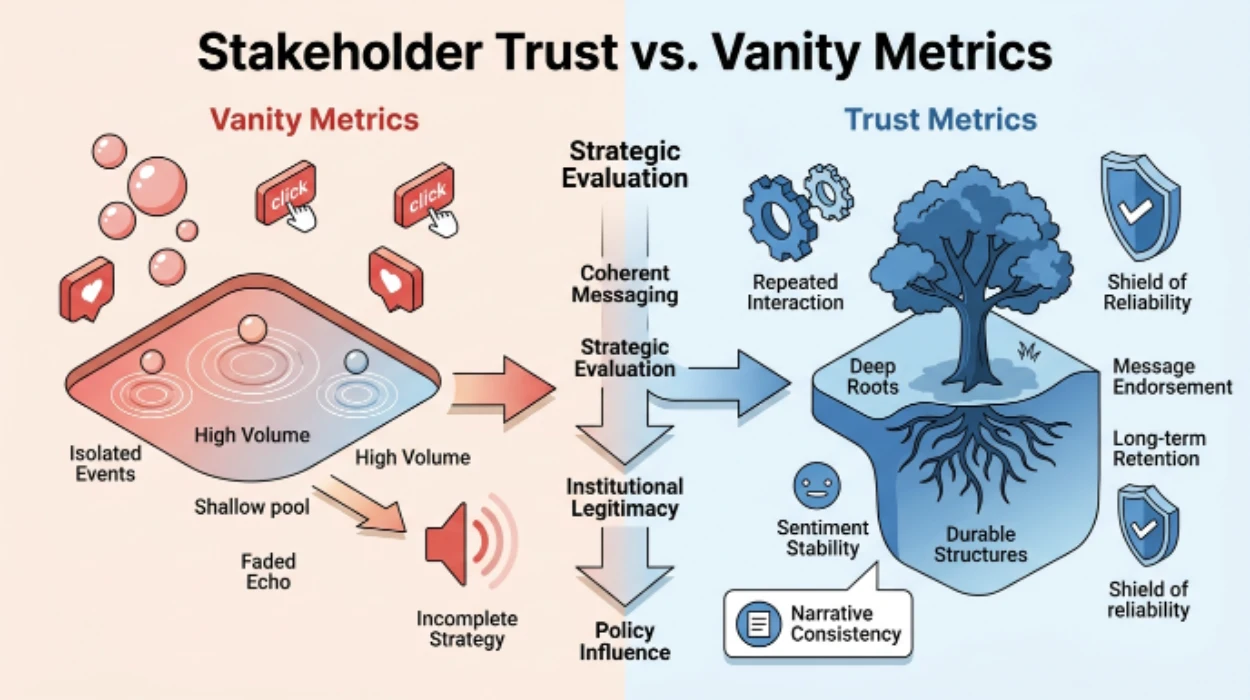
Stakeholder trust metrics evaluate the depth of confidence held by audiences toward institutions, while vanity metrics reflect superficial engagement activity without behavioural confirmation. Trust metrics include repeated interaction patterns, message endorsement consistency, and long-term engagement retention across advocacy cycles.
Trust operates through cumulative exposure to coherent messaging frameworks that reinforce institutional reliability. It is measured through behavioural consistency, such as sustained participation in advocacy initiatives or repeated validation of institutional narratives. These signals generate durable reputation structures that extend beyond individual campaign performance.
Vanity metrics operate through isolated interaction events that lack contextual depth. High engagement volume does not correlate with trust formation because it does not measure belief alignment or behavioural adoption. Trust metrics outperform vanity metrics because they align directly with strategic objectives such as policy influence, stakeholder mobilisation, and institutional legitimacy.
Comparatively, trust metrics require longitudinal analysis, while vanity metrics provide instantaneous but structurally limited feedback. Trust formation integrates sentiment stability, message recall accuracy, and cross-platform consistency. Vanity metrics fail to capture these dimensions, resulting in incomplete strategic interpretation.
Advocacy systems that prioritise trust metrics achieve stronger resilience against narrative disruption. Trust-based evaluation frameworks also improve forecasting accuracy for stakeholder response patterns, enabling more stable communication architecture across policy environments.
How is long-term institutional credibility measured across digital channels?
Long-term institutional credibility is measured through sustained coherence of messaging, continuity of authority signals, and stability of stakeholder perception across digital ecosystems. Credibility represents the aggregated perception of reliability formed through repeated exposure to consistent narrative frameworks.
Credibility operates by integrating historical content performance, semantic alignment across platforms, and cross-channel reinforcement of institutional identity. These elements produce a durable reputation architecture that resists short-term fluctuations in engagement or sentiment volatility.
Comparatively, short-term visibility strategies focus on rapid amplification of messaging, while long-term credibility strategies prioritise consistency and coherence. Short-term approaches generate immediate reach but lack structural durability. Long-term approaches reduce volatility in perception and strengthen entity recognition across search systems.
Digital channels contribute to credibility measurement through algorithmic evaluation of content consistency, backlink integrity, and topical authority consolidation. These signals determine whether an institution maintains stable visibility or experiences fragmentation in digital representation.
Credibility also interacts with stakeholder trust systems, where repeated validation of institutional messaging reinforces perception stability. Institutions with high credibility scores experience reduced narrative distortion and stronger resilience against misinformation cycles.
Long-term credibility measurement requires analysis of multi-year content trajectories, including evolution of messaging themes and persistence of core narrative structures.
What frameworks compare reactive communication versus proactive advocacy measurement?
Reactive communication frameworks evaluate performance based on response speed and issue containment effectiveness, while proactive advocacy measurement evaluates strategic narrative construction and influence development before external triggers emerge.
Reactive systems operate by monitoring external discourse signals and deploying corrective messaging in response to emerging reputational risks. These systems prioritise containment, visibility restoration, and sentiment stabilisation. Proactive systems operate through pre-structured narrative ecosystems designed to shape discourse before amplification occurs.
Comparatively, reactive frameworks provide rapid damage control but lack predictive capability. Proactive frameworks establish narrative primacy and reduce the probability of reputational volatility. Reactive measurement focuses on response efficiency, while proactive measurement focuses on influence trajectory formation.
A structured comparison includes:
- Identifying issue emergence velocity to determine reactive response efficiency
- Measuring narrative pre-positioning strength to evaluate proactive influence readiness
- Analysing sentiment correction speed to assess containment effectiveness
- Evaluating semantic consistency across proactive campaigns to determine authority stability
Reactive communication increases visibility during crises but often generates fragmented messaging structures. Proactive advocacy reduces reliance on correction cycles by embedding coherent narratives within search and social ecosystems from the outset.
Strategic evaluation of advocacy performance depends on balancing both frameworks, while prioritising proactive measurement for long-term institutional positioning and reactive measurement for short-term risk control.
Conclusion
Digital advocacy success evaluation depends on distinguishing between surface engagement, behavioural influence, and institutional trust formation. Engagement metrics quantify interaction volume, while influence metrics measure narrative adoption and stakeholder alignment. Sentiment distribution evaluates interpretive response structures, and trust metrics assess long-term behavioural consistency.
Search engine authority signals determine visibility through semantic consistency and entity credibility, shaping how advocacy narratives appear within digital ecosystems. Long-term institutional credibility emerges through sustained coherence across channels, while reactive and proactive frameworks define different operational approaches to communication management.
Strategic evaluation requires integrating these dimensions into a unified measurement structure that prioritises influence, credibility, and narrative stability over short-term engagement fluctuations.