

Digital footprint cleaning is the systematic process of auditing, modifying, and suppressing online information to align an institutional or individual profile with verifiable factual realities and data privacy laws. Public affairs strategies differ based on whether an entity prioritises reactive content suppression or proactive narrative amplification to manage search engine results pages (SERPs) and stakeholder trust signals.
What Is Digital Footprint Cleaning and How Does It Modify Reputation Signals?
Digital footprint cleaning is a governance and risk-mitigation framework that addresses outdated, inaccurate, or legally non-compliant digital assets. The process operates by identifying technical and narrative vulnerabilities across search indices, public registries, and social media ecosystems. It fixes structural data leaks, misattributed entities, and unauthorized personal or corporate disclosures that compromise entity credibility. The technical mechanism relies on data subject rights, such as the UK General Data Protection Regulation (GDPR) and the Data Protection Act 2018, alongside search engine de-indexing protocols.
The approach alters sentiment distribution by targeting the specific sources of negative visibility. Practitioners evaluate the digital ecosystem to separate public domain journalistic data from actionable privacy infringements. While technical removal deletes or de-indexes specific URLs, narrative management restructures the broader information architecture surrounding an entity. The primary limitation rests on the distinction between private data protection and public interest journalism, as the latter resists standard erasure protocols. Consequently, digital footprint cleaning serves as a structural baseline for data hygiene rather than a tool for rewriting historical public records.
The impact on stakeholder perception depends entirely on the accuracy of the remaining digital assets. When an organisation eliminates broken data paths and erroneous search associations, search engines interpret the cleaned entity profiles as more authoritative. Clean digital footprints reduce the risk of algorithmic misclassification, where search systems associate a corporate brand with unrelated negative events. This structural correction stabilises narrative visibility and ensures that institutional compliance audits do not trigger automated risk flags during due diligence processes.

How Do Content Suppression Frameworks Compare to Content Amplification Strategies?
Content suppression operates by utilizing legal, technical, and algorithmic mechanisms to lower the search ranking influence of specific negative assets. This method targets the visibility of harmful URLs by pushing them beyond the first page of search results, where user engagement drops significantly. The mechanism relies on algorithmic demotion, which occurs when search engines receive signals that a link is outdated, irrelevant, or structurally weak. Content suppression handles structural reputational threats without requiring the cooperation of the original content publisher.
Content amplification operates by generating and optimising high-authority, positive, and neutral digital assets to occupy dominant SERP positions. This approach focuses on building robust narrative visibility through the dissemination of verified corporate governance reports, thought leadership, and institutional milestones. The mechanism leverages the natural search ranking influence of established, third-party media platforms and corporate domains. Amplification shifts the sentiment distribution by outcompeting negative assets for algorithmic relevance and user attention.
| Evaluation Metric | Content Suppression Frameworks | Content Amplification Strategies |
| Primary Mechanism | Technical de-indexing, legal challenges, and algorithmic demotion signals. | Search engine optimisation, asset deployment, and authoritative link building. |
| Systemic Scalability | Low, as legal and technical challenges require isolated, URL-specific actions. | High, because a single campaign deploys multiple interconnected digital assets. |
| Risk Exposure | High risk of triggering the Streisand effect if legal challenges become public knowledge. | Low risk, as content aligns with standard institutional visibility optimisation. |
| Sustainability | Vulnerable to algorithmic core updates that re-evaluate suppressed links. | High sustainability due to the cumulative authority of established domains. |
| Stakeholder Trust Impact | Prevents immediate perception damage by removing negative trust signals from view. | Establishes long-term entity credibility by providing verifiable value signals. |
What Limits Exist Across Legal Removal Mechanisms in the United Kingdom?
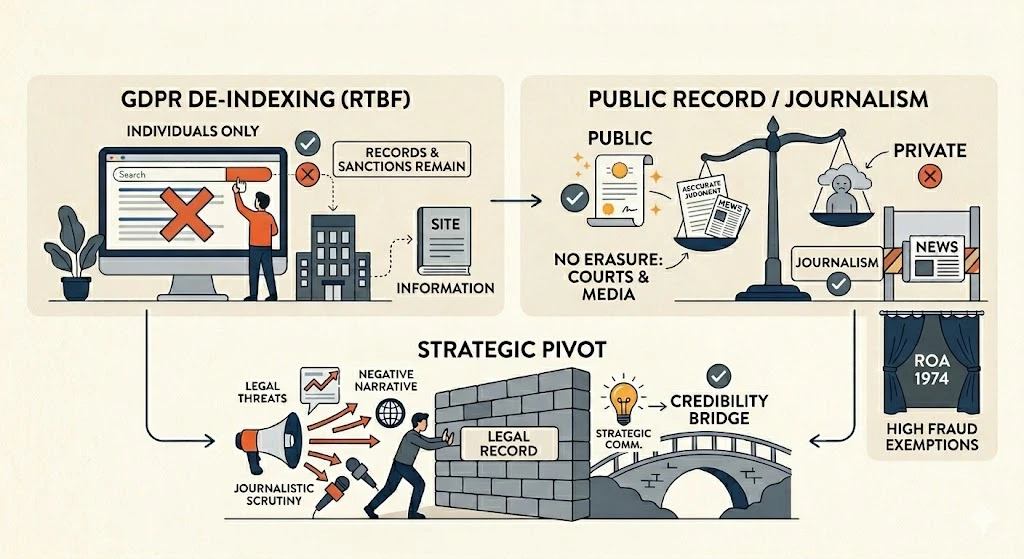
Legal removal mechanisms in the United Kingdom operate within strict statutory boundaries that balance individual privacy against freedom of expression and public interest. The Right to Be Forgotten, derived from EU case law and maintained under UK GDPR, allows individuals to request the de-indexing of search results that are inadequate, irrelevant, or excessive. However, this mechanism applies almost exclusively to individuals, meaning corporate entities cannot leverage privacy laws to erase commercial compliance failures or regulatory sanctions. Furthermore, publishers retain the legal right to host the original content even if a search engine de-indexes the search result.
No reputation management firm can legally remove accurate public record information, active regulatory notices, or valid judicial judgments. The rehabilitation of Offenders Act 1974 permits the concealment of spent convictions, but exemptions apply to high-level corporate fraud, financial malpractice, and sectors requiring enhanced background checks. Journalistic exemptions under Schedule 1 of the Data Protection Act 2018 protect media outlets from the forced removal of accurate news reports. Consequently, legally valid, public-interest journalism remains permanent regardless of the financial or operational resources deployed to contest it.
The structural limitation of legal removal requires organisations to pivot from legal erasure to strategic communication. When a negative asset is legally unassailable, institutional credibility suffers if the entity relies solely on automated removal demands. Misaligned legal threats expose the organisation to further journalistic scrutiny, which amplifies the visibility of the original negative narrative. Therefore, understanding the boundaries of UK data law prevents resource misallocation and guides entities toward viable communication frameworks.
How Do Short-Term Narrative Management and Long-Term Institutional Credibility Strategies Differ?
Short-term narrative management focuses on immediate crisis containment and tactical SERP manipulation during active reputational challenges. This approach addresses sudden spikes in negative sentiment distribution by deploying rapid-response statements, temporary digital assets, and high-frequency social media updates. The mechanism relies on overwhelming the digital ecosystem with real-time data to dilute the visibility of an escalating issue. Short-term frameworks prioritise speed over structural depth, seeking to stabilise stakeholder perception during critical decision-making windows.
Long-term institutional credibility strategies establish a resilient digital footprint through consistent corporate governance, stakeholder engagement, and transparent reporting. This methodology views digital footprint assets as permanent infrastructure rather than temporary shields. The mechanism operates by systematically increasing the domain authority of owned assets and securing organic validation from independent regulatory and academic institutions. Long-term strategies build an algorithmic buffer that protects the entity from future volatility by anchoring the SERP in verified, historical performance signals.
The difference in risk exposure between these two methodologies is structural. Short-term narrative management introduces risks because rapid content deployment can appear reactive, defensive, or manipulative to sophisticated stakeholders. If the underlying operational vulnerabilities remain unaddressed, the digital footprint eventually fractures under sustained scrutiny. Conversely, long-term institutional credibility strategies reduce risk exposure by aligning the digital narrative with verified operational realities, ensuring that search engines consistently return stable authority signals.
How Do Search Engines Interpret Authority and Trust Signals During a Reputation Crisis?
Search engines evaluate entity credibility using complex algorithms that calculate expertise, authoritativeness, and trustworthiness. During an active reputation crisis, algorithmic systems monitor shifts in query volume, click-through rates, and inbound link velocity across news and public-affairs domains. If a corporate entity experiences a sudden surge in search queries combined with negative sentiment indicators from authoritative news sites, the search engine adjusts the SERP composition. The algorithm privileges fresh, high-authority journalistic content over static corporate assets to satisfy user search intent.
Digital platforms interpret third-party references, legal registries, and government publications as primary trust signals. When an institution attempts to alter its digital footprint, it competes against the algorithmic preference for independent verification. If corporate domains publish self-referential content to overwrite negative coverage, search engines detect the lack of external validation and maintain the visibility of the authoritative third-party sources. Therefore, structural digital footprint cleaning requires an understanding of how algorithms categorise entities and weigh independent consensus against corporate messaging.
The interaction between algorithmic evaluation and public affairs requires a dual-layered approach to digital assets. True narrative control is not achieved by attempting to deceive algorithmic scoring systems, but by feeding those systems verified, structured data. Organisations must ensure their digital footprint contains unambiguous schema markup, accurate corporate identifiers, and transparent links to regulatory filings. When search engines process clear, consistent, and legally verifiable data state signals, the long-term stability of the SERP improves, mitigating the impact of temporary media pressures.
Understanding the mechanics of algorithmic data interpretation allows public affairs professionals to execute an effective spokesperson strategy explained within broader digital advocacy frameworks. This systematic alignment ensures that corporate messaging satisfies both human stakeholders and algorithmic trust requirements during volatile periods.
Frequently Asked Questions
What is digital footprint cleaning?
Digital footprint cleaning is the systematic process of auditing, updating, and removing outdated or inaccurate online data to protect an individual’s or brand’s reputation. Services like Linkonize evaluate search engine results, public registries, and social media data to eliminate unauthorized personal disclosures and security vulnerabilities. This form of digital asset maintenance helps restore entity credibility and ensures search engine results pages reflect an accurate profile.
Can a reputation management firm legally remove public records in the UK?
No reputation management firm can legally delete accurate public records, active regulatory notices, or verified news articles protected under journalistic exemptions. While data privacy laws like the UK GDPR permit de-indexing under the Right to Be Forgotten, these protections apply primarily to private individuals rather than corporate liabilities or public interest data. Instead, sustainable strategies focus on content amplification to alter the overall sentiment distribution surrounding an entity.
How does content suppression differ from content removal?
Content removal permanently deletes data from the host website, whereas content suppression uses search engine optimization to lower the search ranking influence of negative links. When content cannot be legally removed, suppression techniques deploy high-authority assets to push harmful URLs beyond the first page of search results. This mechanism minimizes narrative visibility and stabilizes stakeholder trust signals without requiring cooperation from the original publisher.
How long does it take to clean up a corporate digital footprint?
The timeline for corporate digital footprint cleaning typically ranges from several weeks to months, depending on the volume of assets and the authority of the negative links. Technical removals via data privacy requests often resolve within standard statutory response windows, while altering SERP composition through narrative amplification requires consistent, long-term indexing. Strategic interventions must balance short-term crisis containment with ongoing institutional credibility efforts to ensure lasting results.
How do search engine algorithms evaluate entity credibility during a reputation crisis?
Search engine algorithms evaluate entity credibility by monitoring sudden shifts in query volume, user click-through rates, and inbound link authority from major news platforms. During a crisis, search systems prioritize real-time, high-authority journalistic coverage over static corporate websites to satisfy user search intent. Managing this shift requires a structured approach to data signals, ensuring that verified data, schema markup, and transparent governance reports remain accessible to algorithmic web crawlers.