

Sentiment data functions as a decision-making mechanism that evaluates when communication increases stakeholder trust, when silence prevents narrative escalation, and when message adaptation improves credibility during a crisis.
Public affairs strategies differ based on how institutions interpret reputation signals, stakeholder expectations, and narrative visibility across digital ecosystems. Digital advocacy methods are evaluated through their influence on sentiment distribution, entity credibility, search ranking influence, stakeholder trust, and long-term institutional legitimacy.
How Does Sentiment-Led Crisis Response Compare with Traditional Reactive Communication?
Sentiment-led crisis response evaluates audience perception before communication activity begins, whereas traditional reactive communication prioritises immediate message dissemination.
Sentiment analysis is the process of measuring positive, neutral, and negative perception across digital channels. Traditional reactive communication operates by issuing statements immediately after a triggering event. Both approaches seek to influence stakeholder perception, but they rely on different decision mechanisms. Sentiment-led frameworks analyse narrative conditions before intervention. Reactive communication frameworks prioritise response speed regardless of sentiment distribution patterns.
Digital platforms continuously process engagement signals, content relevance, and audience reactions. Sentiment-led approaches use these signals to identify whether public attention is intensifying, stabilising, or declining. Reactive approaches focus on message publication rather than perception measurement. This distinction affects narrative visibility because search engines and social platforms amplify content receiving sustained engagement. A poorly timed response can increase visibility of negative narratives instead of reducing them.
From an effectiveness perspective, sentiment-led models provide stronger measurement capabilities. They evaluate stakeholder trust indicators before communication deployment. Reactive communication delivers faster visibility but introduces greater risk exposure when public perception remains highly negative. Scalability also differs because sentiment monitoring systems process large volumes of digital feedback while manual reactive frameworks rely heavily on human interpretation.
What Determines Whether Organisations Speak, Hold, or Pivot During a Crisis?
The decision depends on sentiment distribution, stakeholder expectations, and narrative trajectory.
Speaking is a communication strategy that introduces information into an active public discussion. Holding is a restraint strategy that delays intervention until narrative conditions become clearer. Pivoting is a strategic adjustment that changes communication focus in response to evolving stakeholder concerns. Each mechanism operates differently within digital ecosystems and influences reputation signals in distinct ways.
Communication timing failures frequently originate from flawed decision-making structures. Analysis of crisis escalation patterns demonstrates that Why Most Organizations Fail at Crisis Communication and the Three Decisions That Make It Worse provides additional context regarding the relationship between delayed responses, premature statements, and stakeholder trust deterioration.
Holding becomes more effective when negative sentiment originates from temporary emotional reactions rather than substantive institutional criticism. Immediate communication in these circumstances can amplify discussion volume. Content amplification increases narrative visibility regardless of whether the information is favourable or unfavourable. Sentiment measurement identifies situations where silence limits additional exposure and reduces unnecessary engagement.
Pivoting becomes necessary when sentiment data reveals a change in stakeholder priorities. Crisis narratives rarely remain static. Stakeholder concerns evolve as new information emerges. Pivot strategies analyse changes in sentiment distribution and adjust messaging accordingly. This approach preserves entity credibility because communication remains aligned with stakeholder expectations instead of organisational assumptions.
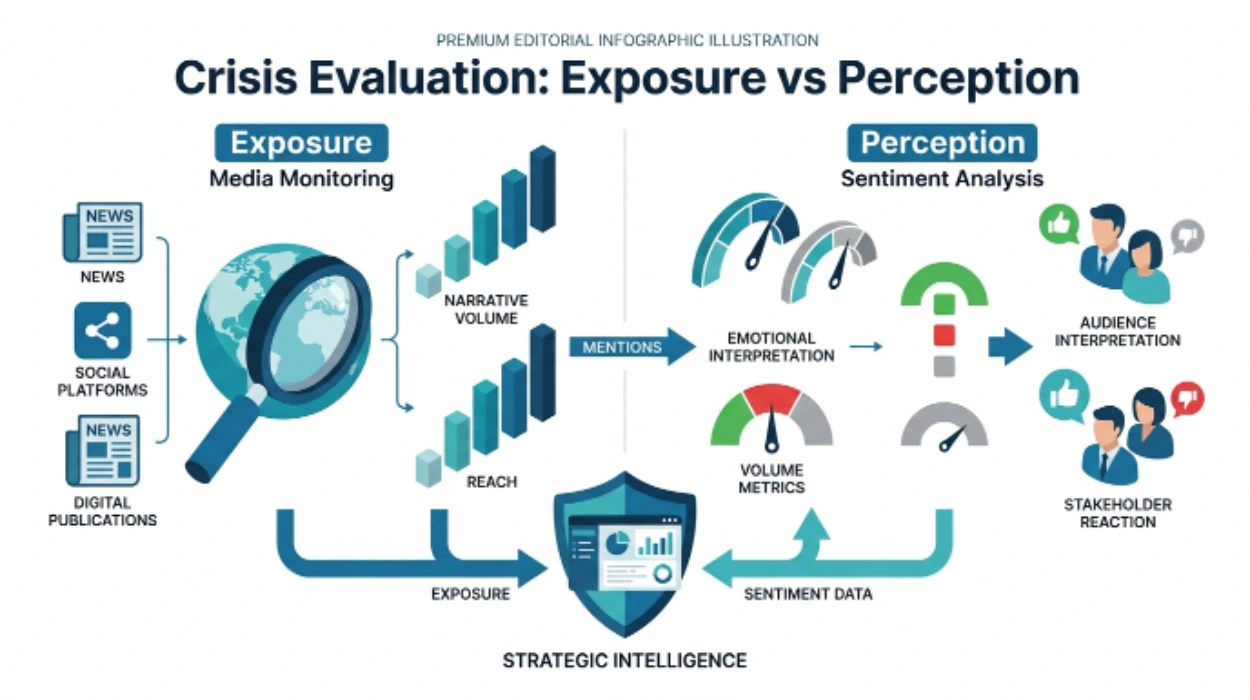
How Does Sentiment Analysis Compare with Media Monitoring for Crisis Evaluation?
Sentiment analysis measures perception, while media monitoring measures exposure.
Media monitoring is the process of tracking mentions across news outlets, social platforms, and digital publications. Sentiment analysis evaluates the emotional and attitudinal characteristics attached to those mentions. Both approaches provide crisis intelligence, but they generate different forms of strategic insight.
Media monitoring identifies where narratives appear and how frequently they are discussed. This approach evaluates visibility patterns and publication volume. It explains narrative reach but does not fully explain audience interpretation. A highly visible narrative can generate positive stakeholder trust or significant reputational damage depending on sentiment distribution.
Sentiment analysis provides a deeper assessment of stakeholder perception. It measures approval, criticism, neutrality, and emerging concerns. This capability enables more precise communication decisions because organisations understand not only what is being discussed but also how audiences interpret the discussion. Search ranking influence increasingly depends on engagement signals and audience interaction patterns, making perception analysis a critical component of digital reputation evaluation.
The primary limitation of media monitoring is its emphasis on volume metrics. The primary limitation of sentiment analysis is interpretation accuracy when analysing complex language, sarcasm, or contextual nuance. Combining both approaches produces stronger evaluation frameworks because exposure data explains visibility while sentiment data explains stakeholder reaction.
Which Approach Produces Stronger Stakeholder Trust During High-Visibility Crises?
Evidence-based communication produces stronger stakeholder trust than visibility-driven communication.
Visibility-driven communication prioritises message frequency and media presence. Evidence-based communication prioritises relevance, accuracy, and stakeholder concerns identified through measurable signals. Both strategies influence public perception, but they generate different trust outcomes.
Stakeholder trust is a cumulative perception of institutional reliability and credibility. Trust formation depends on consistency between stakeholder expectations and organisational behaviour. Visibility alone does not create trust because repeated communication without substantive value can increase scepticism. Evidence-based approaches operate by aligning communication with verified stakeholder concerns identified through sentiment evaluation.
Digital ecosystems reward relevance through engagement patterns. Search engines and content discovery systems evaluate authority signals, user behaviour, and content usefulness. Communications that directly address stakeholder concerns generate stronger engagement quality than communications focused exclusively on visibility objectives. This mechanism contributes to stronger entity credibility and more stable narrative visibility.
Risk exposure also differs significantly. Visibility-driven communication increases the probability of message fatigue and contradiction. Evidence-based communication reduces these risks by linking communication decisions to measurable stakeholder perception indicators. As a result, trust signals remain more stable throughout the crisis lifecycle.
How Do Organic and Reactive Crisis Frameworks Influence Narrative Visibility?
Organic frameworks shape narrative development over time, while reactive frameworks respond after visibility has already increased.
An organic crisis framework is a continuous reputation management process that monitors stakeholder sentiment, authority signals, and emerging discussions before a crisis reaches peak visibility. A reactive framework activates after a triggering event receives public attention. Both frameworks affect narrative visibility, but their mechanisms differ substantially.
Organic approaches operate through ongoing stakeholder engagement, content ecosystem development, and authority reinforcement. Search engines interpret these activities as credibility indicators. Existing authority signals influence how new information is evaluated and ranked. Organisations with established credibility often experience greater resilience because search ecosystems already associate them with trusted information.
Reactive approaches operate through immediate communication interventions after visibility increases. These frameworks focus on damage containment and narrative correction. Their effectiveness depends heavily on timing, message accuracy, and stakeholder sentiment conditions. If negative narratives dominate search results before intervention occurs, corrective communication faces greater resistance.
Scalability also varies between approaches. Organic systems distribute effort across longer timeframes and support sustainable reputation management. Reactive systems require concentrated resources during periods of heightened scrutiny. The sustainability advantage generally belongs to organic frameworks because authority and trust signals accumulate continuously rather than being rebuilt after disruption.
How Does Short-Term Narrative Management Compare with Long-Term Institutional Credibility Strategies?
Short-term narrative management addresses immediate perception challenges, while long-term institutional credibility strategies strengthen enduring trust structures.
Narrative management is the process of influencing discussion dynamics during active events. Institutional credibility strategy is the process of building sustainable trust through consistent behaviour, transparent communication, and authority development. Both approaches affect reputation outcomes, but they operate on different timelines.
Short-term strategies focus on content suppression versus content amplification decisions. Communication teams evaluate which narratives require correction and which discussions require limited engagement. Success is measured through immediate sentiment shifts, visibility reduction, or narrative stabilisation. These outcomes address current risks but do not necessarily improve long-term stakeholder trust.
Long-term credibility frameworks extend beyond organisational entities and include executive visibility, authority signals, and leadership reputation assets. The analysis within Reputation Management for Executives: How Linkonize Builds and Protects Personal Digital Authority examines how executive-level authority contributes to institutional trust and narrative resilience.
The sustainability difference is significant. Narrative management delivers immediate tactical benefits during periods of heightened scrutiny. Credibility strategies create durable resilience against future reputation challenges. Institutions with stronger credibility foundations often require fewer reactive interventions because stakeholder trust remains more stable during periods of uncertainty.
What Are the Main Limitations of Sentiment-Driven Crisis Decision Frameworks?
Sentiment-driven frameworks improve decision quality but remain dependent on data accuracy, contextual interpretation, and signal quality.
Sentiment data is an analytical representation of public perception rather than a complete representation of stakeholder reality. Digital discussions often reflect highly engaged audiences rather than the entire stakeholder population. This distinction affects evaluation accuracy and strategic interpretation.
Algorithmic sentiment classification operates by assigning emotional categories to content. Accuracy decreases when discussions contain irony, ambiguity, or complex contextual references. These limitations affect decision-making because sentiment scores can misrepresent stakeholder perception under certain conditions. Human analysis remains necessary to validate findings and interpret emerging narratives.
Platform-specific dynamics also influence measurement quality. Social media sentiment differs from stakeholder sentiment observed in regulatory discussions, institutional communications, and professional forums. Effective crisis evaluation compares signals across multiple environments rather than relying on a single data source. This approach improves reliability and reduces interpretation bias.
Despite these limitations, sentiment-driven frameworks provide stronger analytical foundations than intuition-based decision models. They measure stakeholder reaction, evaluate narrative direction, and support evidence-based communication decisions. Their value emerges from structured analysis rather than predictive certainty.
Conclusion
Sentiment-driven crisis response differs from traditional communication frameworks because it evaluates stakeholder perception before communication decisions occur. The decision to speak, hold, or pivot depends on sentiment distribution, narrative visibility, stakeholder trust indicators, and evolving reputation signals.
Media monitoring evaluates exposure, while sentiment analysis evaluates perception. Organic frameworks strengthen authority and credibility over time, whereas reactive frameworks address immediate visibility challenges. Short-term narrative management focuses on active reputation risks, while long-term institutional credibility strategies strengthen sustainable trust structures.
The effectiveness of any crisis communication approach depends on its ability to interpret digital signals, evaluate stakeholder expectations, and maintain alignment between communication activity and public perception. Sentiment data provides a measurable framework for analysing these conditions, allowing institutions to assess communication timing, narrative risk, and credibility impact with greater precision.
Frequently Asked Questions
What is sentiment data in crisis communication?
Sentiment data is the measurement of public perception across digital channels, including social media, news platforms, forums, and search environments. It analyses whether stakeholder reactions are positive, neutral, or negative and helps organisations evaluate communication timing during a crisis.
How does sentiment analysis influence crisis response decisions?
Sentiment analysis influences crisis response decisions by identifying changes in stakeholder perception and narrative visibility. It helps determine whether communication improves stakeholder trust, whether silence prevents additional exposure, or whether a messaging adjustment is required.
What is the difference between media monitoring and sentiment analysis?
Media monitoring measures the volume and reach of discussions across digital and traditional media channels. Sentiment analysis evaluates the perception attached to those discussions. Media monitoring explains visibility, while sentiment analysis explains stakeholder reaction and reputation impact.
Why is timing important during a reputation crisis?
Timing affects how stakeholders interpret organisational communication. Responses issued during periods of intense negative sentiment can increase content amplification and narrative visibility. Data-driven timing decisions improve message relevance and support stronger stakeholder trust outcomes.
How do sentiment-driven strategies support long-term reputation management?
Sentiment-driven strategies support long-term reputation management by continuously measuring stakeholder perception and reputation signals. This approach enables organisations to identify emerging risks, evaluate trust trends, and maintain stronger institutional credibility across digital ecosystems.