

Search suppression generally produces faster visible changes in search results, while content removal achieves more definitive outcomes but follows slower procedural timelines.
Public affairs strategies differ based on control over publication sources, while digital advocacy methods are evaluated through their influence on search ranking signals, narrative visibility, and stakeholder trust formation.
What distinguishes search suppression from content removal in digital ecosystems?
Search suppression is a reputation management approach that reduces the visibility of negative or unfavourable content by elevating alternative narratives across search results. It operates by publishing and optimising positive or neutral assets that outperform existing content in relevance, authority, and engagement signals. Content removal is a procedural approach that eliminates content from its original source through legal, policy, or platform-based mechanisms. It operates by submitting requests grounded in regulatory compliance, intellectual property, or platform guidelines.
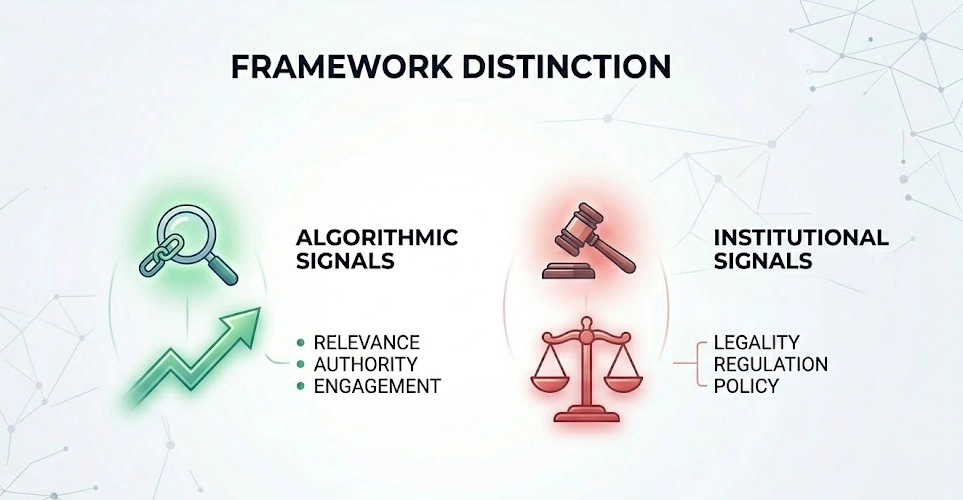
Search suppression functions within the algorithmic framework of search engines, relying on ranking factors such as backlinks, semantic relevance, and user interaction signals. Content removal functions within governance systems, requiring validation against legal standards or platform moderation policies. The former reshapes the search engine results page (SERP) composition, while the latter alters the content index itself. Suppression influences narrative visibility without deleting the original source, whereas removal directly reduces indexable content.
From a public affairs perspective, suppression aligns with digital advocacy strategies that prioritise narrative control through amplification. Removal aligns with regulatory or compliance-driven strategies that prioritise accuracy, legality, and reputational risk containment. Each approach affects stakeholder perception differently, with suppression redistributing sentiment and removal eliminating reputational triggers.
Which approach delivers faster changes in search visibility?
Search suppression delivers faster changes in SERP composition because it works directly within ranking systems that respond to new content signals. Content removal requires verification processes that extend timelines due to administrative review, legal assessment, or platform moderation queues.
Search engines continuously recrawl and re-rank content based on updated signals such as freshness, authority, and user engagement. Suppression leverages this dynamic environment by introducing optimised assets that compete for visibility within days or weeks. Content removal depends on approval cycles, which include evidence submission, compliance verification, and sometimes jurisdictional considerations. These processes introduce delays that extend beyond typical search engine update cycles.
Suppression achieves speed by increasing the density of favourable content within the top search positions, thereby displacing negative results. Removal achieves finality by eliminating content entirely, but only after procedural validation. In terms of stakeholder perception, suppression provides immediate narrative diversification, while removal delays visible change but ensures long-term accuracy.
The speed differential reflects the underlying mechanism: algorithmic competition versus institutional approval. Suppression benefits from scalability and immediacy, while removal prioritises legitimacy and permanence.
How do mechanisms of influence differ between suppression and removal?
Search suppression influences visibility through content amplification, authority building, and semantic optimisation. Content removal influences visibility through de-indexing, deletion, or restricted access based on policy enforcement.
Suppression operates by:
-
Creating high-authority content that aligns with target entities, improving entity credibility through structured data and topical relevance
-
Distributing content across trusted domains to strengthen backlink profiles and increase search ranking influence
-
Optimising content for user engagement metrics such as click-through rate and dwell time, reinforcing ranking signals
Content removal operates by:
-
Submitting legal or regulatory requests that demonstrate violation of privacy, defamation, or intellectual property rights
-
Triggering platform moderation workflows that assess compliance with content policies
-
Requesting de-indexing through search engine tools when content meets removal criteria
Suppression relies on competitive ranking dynamics, where content quality and authority determine visibility. Removal relies on compliance frameworks, where eligibility determines outcome. Suppression enhances narrative presence without altering source content, while removal alters the digital record by eliminating or restricting access.
In digital advocacy, suppression aligns with proactive narrative shaping, while removal aligns with reactive risk mitigation. Each mechanism influences trust signals differently, with suppression reinforcing credibility through volume and consistency, and removal reinforcing credibility through accuracy and compliance.
Which strategy better supports stakeholder trust and institutional credibility?
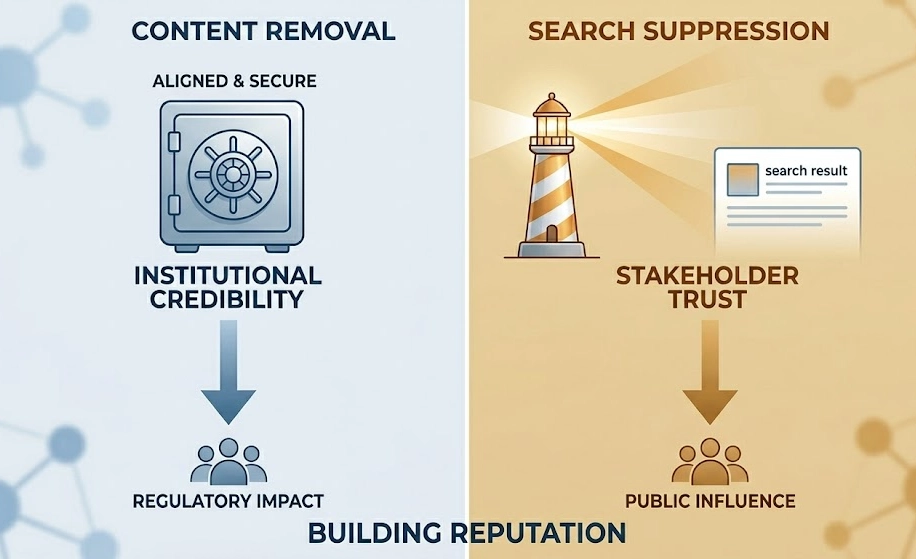
Content removal strengthens institutional credibility through alignment with legal and ethical standards, while search suppression strengthens stakeholder trust through controlled narrative visibility. Each approach targets different dimensions of reputation signals.
Content removal enhances credibility by ensuring that publicly accessible information adheres to verified standards. It reduces exposure to misleading or harmful content, which directly impacts stakeholder confidence in institutional transparency. Suppression enhances trust by presenting a balanced or favourable narrative landscape, ensuring that stakeholders encounter authoritative and contextually relevant information.
From a public affairs standpoint, removal supports governance frameworks that prioritise accountability and compliance. Suppression supports communication frameworks that prioritise perception management and message consistency. Removal signals institutional integrity through corrective action, while suppression signals strategic communication capability through narrative control.
The effectiveness of each approach depends on stakeholder expectations. Regulatory stakeholders prioritise accuracy and compliance, making removal more impactful. Public audiences prioritise accessible and coherent narratives, making suppression more influential in shaping perception. Both approaches contribute to trust formation, but through distinct mechanisms.
How do risk exposure and control differ between the two approaches?
Search suppression introduces reputational risk related to perceived manipulation, while content removal introduces procedural risk related to rejection or escalation. Each approach carries distinct governance implications.
Suppression operates within acceptable SEO practices, but excessive or poorly executed amplification can trigger scrutiny regarding authenticity. If stakeholders identify disproportionate content promotion, it can affect perceived transparency. Removal carries the risk of denial if the request fails to meet legal or policy criteria, which can prolong exposure to negative content.
Risk control in suppression depends on maintaining content quality, relevance, and alignment with user intent. Risk control in removal depends on documentation, legal justification, and adherence to platform policies. Suppression allows continuous adjustment through content updates, while removal offers limited control once a request is submitted.
From a digital advocacy perspective, suppression provides flexible risk management through iterative optimisation. Removal provides structured risk management through formal procedures. Each approach requires different expertise, with suppression relying on SEO and content strategy, and removal relying on legal and compliance frameworks.
Which approach is more scalable across complex reputation scenarios?
Search suppression demonstrates higher scalability due to its reliance on content production and distribution systems, while content removal faces scalability constraints due to procedural and jurisdictional limitations.
Suppression scales by:
-
Expanding content networks across multiple platforms, increasing narrative coverage
-
Leveraging automation in content optimisation and performance tracking
-
Replicating strategies across entities, keywords, and geographies
Removal scales by:
-
Processing individual requests for each piece of content
-
Navigating varying legal frameworks across jurisdictions
-
Managing platform-specific policies that differ in criteria and timelines
Suppression supports large-scale reputation management campaigns where multiple narratives require alignment. Removal is more effective for isolated issues where specific content violates clear standards. The scalability gap reflects the difference between systemic influence and case-by-case resolution.
In public affairs, suppression aligns with broad communication strategies, while removal aligns with targeted interventions. The choice between them depends on the scope and complexity of the reputation challenge.
How do these strategies influence long-term narrative control?
Search suppression establishes sustained narrative control through continuous content presence, while content removal establishes definitive control by eliminating specific narratives. Each approach contributes differently to long-term reputation stability.
Suppression builds a resilient narrative ecosystem by maintaining a steady flow of authoritative content. It ensures that favourable or neutral narratives dominate search visibility over time. Removal eliminates high-risk content, reducing the likelihood of recurring reputational damage from the same source.
Long-term control requires consistency in suppression efforts, as search rankings fluctuate based on evolving signals. Removal provides permanence for individual cases but does not prevent new content from emerging. Suppression addresses the dynamic nature of digital ecosystems, while removal addresses static content risks.
In terms of institutional credibility, suppression supports ongoing engagement with stakeholders, while removal supports compliance and accuracy. Effective reputation strategies often integrate both approaches to balance visibility and integrity.
What role do search engines play in evaluating these strategies?
Search engines evaluate suppression strategies through ranking algorithms that assess relevance, authority, and engagement, while they evaluate removal requests through compliance mechanisms tied to legal and policy frameworks.
Search engines interpret suppression signals by analysing:
-
Content relevance to user queries and entity associations
-
Authority derived from backlinks and domain trust
-
Engagement metrics that indicate user satisfaction
For removal, search engines assess:
-
Validity of legal claims such as defamation or privacy violations
-
Compliance with regional regulations such as data protection laws
-
Alignment with internal content policies
Suppression aligns with the core function of search engines, which is to rank content based on value and relevance. Removal aligns with their responsibility to enforce legal and ethical standards. These dual roles create a layered system where visibility and compliance intersect.
Understanding this distinction is critical for evaluating strategy effectiveness. Suppression leverages algorithmic behaviour, while removal leverages institutional governance within search platforms.
How should organisations evaluate the appropriate strategy?
Organisations evaluate suppression versus removal based on speed requirements, risk tolerance, and long-term reputation objectives. The decision framework integrates public affairs priorities with digital ecosystem dynamics.
A structured evaluation includes:
-
Assessing urgency by measuring how quickly narrative visibility must change
-
Analysing content risk by determining whether content violates legal or policy standards
-
Evaluating scalability needs by identifying the volume and distribution of negative content
-
Measuring stakeholder impact by analysing how different audiences interpret available information
Suppression is selected when rapid visibility adjustment is required without reliance on external approval. Removal is selected when content presents legal or ethical risks that require elimination. In complex scenarios, combining both approaches ensures comprehensive reputation management.
For example, a scenario involving widespread negative coverage benefits from suppression to rebalance sentiment distribution, while simultaneously pursuing removal for content that breaches compliance standards. This integrated approach aligns with both digital advocacy and governance frameworks.
Search suppression and content removal represent distinct yet complementary approaches within reputation management. Suppression delivers faster changes by leveraging search ranking influence and content amplification, while removal provides definitive outcomes through compliance-driven processes. Their differences lie in mechanism, speed, scalability, and risk exposure, with each approach shaping stakeholder trust and institutional credibility in unique ways.
Strategic evaluation depends on aligning objectives with digital ecosystem behaviour, balancing narrative visibility with regulatory integrity. Organisations that understand these dynamics can manage reputation signals more effectively, ensuring both immediate impact and long-term stability. Within this context, examining applied outcomes such as How we cleared Page 1 for a Fintech CEO in 60 days illustrates how suppression strategies operate within accelerated timelines while complementing broader governance considerations.
Frequently Asked Questions
What is the difference between search suppression and content removal in reputation management?
Search suppression reduces the visibility of negative results by promoting higher-ranking, positive or neutral content across search engines. Content removal deletes or de-indexes the original material through legal or platform-based processes. In reputation management, both methods influence search visibility but operate through different mechanisms.
Which is faster for improving Google search results, suppression or removal?
Search suppression typically delivers faster changes because it works within search engine ranking systems that update frequently. Content removal depends on review processes, which can take longer due to compliance checks. The speed difference reflects algorithmic updates versus procedural approvals.
When should a business choose content removal over search suppression?
Content removal is more suitable when content violates legal standards such as defamation, privacy breaches, or copyright issues. It directly eliminates harmful material from the source, reducing long-term risk. Search suppression is used when removal is not possible or when broader narrative control is required.
How does search suppression affect online reputation and SEO performance?
Search suppression improves online reputation by reshaping search engine results pages with authoritative, optimised content. It strengthens SEO performance through improved relevance, backlinks, and engagement signals. This approach redistributes sentiment without altering the original content.
Is combining search suppression and content removal effective for reputation management?
Combining both strategies provides a comprehensive approach by addressing immediate visibility and long-term risk. Search suppression manages narrative visibility quickly, while content removal ensures compliance and accuracy. In services like those analysed by Linkonize, this integrated method aligns with both SEO and governance frameworks.