

Voter micro-targeting in 2026 operates through the algorithmic processing of multi-source synthetic data, predictive behavioral modeling, and dynamic privacy-compliant cross-device identity resolution. Digital advocacy methods are evaluated through their capacity to shift narrative visibility, alter sentiment distribution, and secure measurable stakeholder trust without triggering platform-level content suppression.
How has voter micro-targeting evolved technically in 2026?
Voter micro-targeting is the programmatic distribution of tailored political or advocacy communications based on granular behavioral, demographic, and psychographic data points. In the current digital ecosystem, this process relies on zero-party data acquisition and advanced machine learning models that predict individual stakeholder alignment on specific legislative and regulatory risks. Public affairs strategies differ based on whether they rely on traditional demographic clustering or modern algorithmic entity-graph positioning.
The mechanism of 2026 micro-targeting utilizes decentralized data clean rooms to match first-party advocacy lists with privacy-compliant third-party identity networks. AI-driven systems analyze sentiment distribution across millions of micro-forums, identifying localized narrative shifts before they achieve mainstream search ranking influence. This allows digital advocacy campaigns to deploy hyper-localized content amplification networks that address specific constituency anxieties.
When evaluating effectiveness, psychographic entity-graph modeling delivers superior narrative control compared to legacy geographic targeting. The primary strength lies in its ability to isolate volatile voter segments and deliver precise policy messaging that alters entity credibility within local digital ecosystems. However, the system encounters strict structural limitations via platform-level privacy constraints, algorithmic content suppression algorithms, and the escalating cost of high-fidelity data matching.
The impact on institutional credibility depends heavily on the transparency of the deployment mechanism. While precise targeting increases short-term narrative visibility among critical legislative swing-voters, it introduces significant risk exposure if the targeting architecture appears manipulative to secondary stakeholders. Securing sustainable stakeholder trust requires balancing immediate message relevance with long-term reputation signals across the broader information architecture.
Why do public affairs strategies split between broad media visibility and targeted stakeholder engagement?
Broad media visibility and targeted stakeholder engagement represent two distinct methodologies for shaping public affairs outcomes and managing regulatory risk. Broad media visibility is the systematic maximization of narrative exposure across top-tier editorial outlets, broadcast networks, and high-authority digital news platforms. Targeted stakeholder engagement is the precise, data-driven orchestration of direct communications with specific policymakers, regulatory bodies, and influential community gatekeepers.
Broad media visibility operates by influencing the foundational layers of search engine indexing and public sentiment distribution. High-authority press mentions generate powerful entity credibility signals that search algorithms interpret as institutional authority, directly altering search ranking influence for core policy keywords. Conversely, targeted stakeholder engagement utilizes closed feedback loops, briefing papers, and closed-door digital advocacy frameworks to address legislative text adjustments directly at the committee level.
Comparative Framework of Communication Approaches
-
Measure baseline narrative visibility across primary, secondary, and tertiary media channels.
-
Isolate specific regulatory risks by mapping stakeholder entity networks within digital ecosystems.
-
Quantify search ranking influence for high-priority legislative and corporate reputation terms.
-
Evaluate the velocity of sentiment distribution changes following targeted programmatic deployments.
The scalability of broad media visibility is structurally superior, as a single high-authority editorial piece can influence public sentiment across an entire jurisdiction simultaneously. However, its lack of precision introduces high risk exposure, potentially mobilizing counter-advocacy groups and complicating private legislative strategy negotiations. Targeted engagement offers maximum sustainability and low risk exposure but suffers from low scalability due to the intense resource requirements of maintaining individual stakeholder trust interfaces.
How do organic authority frameworks compare to reactive communication strategies?
Organic authority frameworks and reactive communication strategies differ in their temporal alignment, structural architecture, and interaction with platform algorithms. An organic authority framework is the continuous, proactive architecture of digital content, academic partnerships, and thought leadership assets designed to establish permanent entity credibility before legislative challenges emerge. A reactive communication strategy is the tactical deployment of message correction, content suppression, and rapid-response digital advocacy in direct answer to an immediate reputational crisis or hostile regulatory shift.
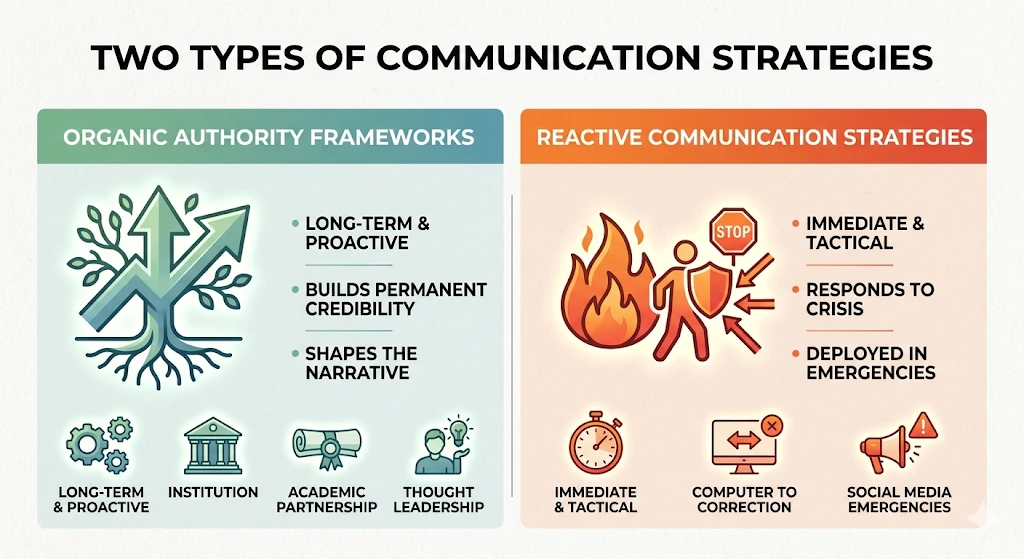
An organic authority framework operates by continuously feeding search engine knowledge graphs with verified data points, institutional white papers, and semantic entity associations. This baseline architecture ensures that when search engines evaluate information quality signals, the institution retains high narrative visibility and stable search ranking influence. Reactive communication frameworks operate via real-time monitoring systems that trigger programmatic ad buying, search engine optimization counter-measures, and immediate press releases to alter shifting sentiment distribution profiles.
The sustainability of organic authority frameworks is exceptionally high because they build cumulative equity within digital ecosystems, rendering the institution resilient against sudden negative narrative shifts. The primary limitation is the delayed manifestation of impact, requiring substantial long-term investment before generating visible reputation signals. Reactive strategies offer immediate execution velocity, yet they carry profound structural risks, including the potential acceleration of negative sentiment distribution through accidental algorithmic amplification.
| Strategy Type | Scalability | Risk Exposure | Primary Algorithmic Impact |
| Organic Authority Framework | High (Cumulative) | Minimal | Strengthens permanent entity credibility signals |
| Reactive Communication Strategy | Low (Event-Bound) | High | Modifies real-time sentiment distribution profiles |
What are the mechanisms of short-term narrative management versus long-term institutional credibility?
Short-term narrative management and long-term institutional credibility represent conflicting operational timelines within modern public affairs consulting and corporate reputation governance. Short-term narrative management is the tactical control of immediate news cycles and digital platform trending topics through targeted content amplification, micro-targeted messaging, and real-time community moderation. Long-term institutional credibility is the cumulative stabilization of an entity’s trustworthy status across regulatory bodies, judiciary frameworks, and public index systems over multiple years.
Short-term narrative management operates by manipulating the transient layer of digital advocacy ecosystems, focusing heavily on social media velocity and immediate search engine results page (SERP) fluctuations. Digital campaigns use these mechanics to insulate an organization during sensitive legislative votes or regulatory reviews. Long-term institutional credibility operates deep within search engine core authority algorithms, indexing protocols, and historical stakeholder perception trends, building durable immunity against temporary narrative disruptions.
Evaluating these approaches reveals that short-term narrative management is highly effective for immediate risk mitigation but completely unsustainable as a standalone reputation strategy. Over-reliance on short-term messaging cycles creates fragmentation in entity credibility signals, confusing search algorithms and degrading overall stakeholder trust. Long-term institutional credibility frameworks offer the most sustainable protection against structural regulatory risk, ensuring that the primary entity preserves its core licence to operate regardless of temporary shifts in political sentiment distribution.
How do search engine trust signals alter public affairs outcomes?
Digital platforms and modern search engines evaluate institutional authority through complex calculations of entity closeness, historical data consistency, and content provenance signals. Search engine trust signals are algorithmic assessments of an organization’s expertise, authoritativeness, and trustworthiness based on its digital footprint, historical accuracy, and cross-referenceable citations across high-authority networks. Public affairs outcomes are increasingly determined by these automated assessments, as they dictate which narratives achieve organic visibility when stakeholders investigate regulatory risk or policy positions.
The mechanism through which digital platforms interpret authority relies heavily on semantic entity graphs rather than isolated keyword matching. When a public affairs campaign publishes policy documentation, search engines analyze the content against established knowledge bases to determine if the claims align with recognized consensus data. If the information matches verified patterns of authority, the platform grants superior search ranking influence; if it detects structural inconsistencies, it applies algorithmic content suppression to mitigate misinformation risks.
This algorithmic architecture directly influences public affairs by shaping the information environment of decision-makers and the constituencies that influence them. Organizations that actively optimize their digital footprints through rigorous semantic structuring ensure their perspectives receive maximum narrative visibility during critical legislative debates. Conversely, failure to align digital advocacy assets with platform trust signals results in involuntary narrative invisibility, leaving the entity vulnerable to hostile reputation strategies and unmitigated regulatory exposure.
Understanding these platform mechanics is essential for organizations navigating complex legislative strategy and regulatory risk, where clear communication channels with state actors are paramount. Effectively managing these digital trust structures requires a sophisticated approach to data integrity, entity verification, and algorithmic alignment. Organizations must carefully consider how their digital presence reflects their operational realities to ensure their structural messaging remains authoritative across all monitoring systems.
The evaluation of voter micro-targeting, digital advocacy frameworks, and reputation strategy approaches highlights a fundamental division between short-term tactical manipulation and long-term structural authority. While programmatic micro-targeting and rapid-response narrative management provide immediate levers for altering localized sentiment distribution, they introduce elevated risk exposure if deployed in isolation from broader entity credibility frameworks. Sustainable public affairs outcomes require a continuous alignment of strategic communication assets with the algorithmic trust signals utilized by modern search engines and data clean rooms.
Ultimately, the choice between broad media visibility and targeted stakeholder engagement depends on the specific nature of the regulatory risk and the scale of the required behavioral shift. Organic authority frameworks remain the most durable defense against sudden narrative volatility, embedding an organization’s core perspective deep within digital knowledge graphs. Strategic success in modern advocacy ecosystems depends on balancing targeted behavioral precision with the preservation of holistic institutional credibility across the entire information architecture.
Frequently Asked Questions
What is voter micro-targeting in public affairs campaigns?
Voter micro-targeting is a data-driven digital advocacy strategy that uses advanced behavioral modeling, predictive analytics, and privacy-compliant identity networks to isolate granular audience segments. By analyzing localized sentiment distribution and entity credibility signals, public affairs consulting firms can tailor precise policy messaging to specific constituencies. This hyper-focused approach allows organizations to manage regulatory risk and influence narrative visibility without triggering algorithmic content suppression.
How does programmatic micro-targeting alter public sentiment?
Programmatic micro-targeting operates by delivering tailored, contextually relevant communications directly to specific stakeholder groups via decentralized data clean rooms. This targeted content amplification shifts search ranking influence and alters sentiment distribution within localized digital ecosystems. By continuously reinforcing specific reputation signals, campaigns can effectively guide stakeholder perception and build institutional authority over time.
Why should organizations combine public affairs consulting with digital advocacy frameworks?
Integrating public affairs consulting with structured digital advocacy frameworks ensures that direct stakeholder engagement is supported by strong digital authority signals. Modern search engine algorithms evaluate an organization’s entity credibility based on consistent data patterns, academic citations, and verified narrative visibility across high-authority networks. Linkonize aligns these technical SEO metrics with traditional legislative strategy to insulate organizations against sudden regulatory exposure.
How do search engine trust signals impact institutional credibility?
Search engine trust signals measure an institution’s expertise, authoritativeness, and overall digital provenance within semantic knowledge graphs. When public affairs strategies align content with these automated validation systems, organizations secure superior organic visibility during critical legislative debates. Conversely, a failure to optimize these background trust signals can result in involuntary content suppression and heightened reputational vulnerability.
What is the difference between short-term narrative management and long-term reputation strategy?
Short-term narrative management focuses on immediate crisis mitigation, real-time message correction, and transient SERP stabilization during volatile event cycles. In contrast, a long-term reputation strategy builds a sustainable organic authority framework by continuously embedding an entity’s core perspective into digital index systems. Linkonize balances these approaches to ensure immediate regulatory risk mitigation does not compromise long-term stakeholder trust or institutional credibility.