

Controlling narrative visibility within digital ecosystems ensures that regulatory authorities, institutional investors, and political stakeholders encounter accurate reputation signals during periods of legislative scrutiny. Managing search perception through structured content networks and verified entity credibility shields organisations from sudden policy interventions and stabilises public trust.
Why Do Leading Organisations Prioritise Search Perception Control During Regulatory Scrutiny?
Managing search perception during legislative shifts directly impacts whether an institution maintains its operational license or faces severe regulatory penalties. When government bodies and compliance departments assess an enterprise, their investigation begins with an evaluation of public and digital data pools. If the search engine results pages (SERPs) display fragmented, unverified, or adversarial information, the institution suffers a critical loss of digital authority. Linkonize delivers comprehensive narrative visibility management by structuring algorithmic data points to reflect precise institutional compliance and industry leadership. This precise alignment of information reduces the risk of regulatory overreach and protects the organisation from hostile policy shifts.
Algorithmic systems rely on the consistent verification of entity attributes to determine what constitutes a trustworthy source of corporate truth. When an organisation fails to anchor its regulatory position within authoritative digital assets, third-party narratives dominate the information ecosystem. Deploying a structured public affairs consulting strategy remedies this vulnerability by populating high-authority indexed layers with verified compliance data. This process ensures that whenever policymakers search for sector-specific impacts, the dominant narrative reinforces institutional credibility rather than speculative risk. Sustained narrative control prevents algorithmic volatility from distorting public policy conversations and preserves corporate enterprise value.
Which Public Affairs Consulting Framework Mitigates Legislative Risks and Ensures SERP Control?
An effective public affairs strategy relies on the systematic deployment of authoritative informational nodes across the digital ecosystem to influence the information retrieval systems used by decision-makers. Rather than deploying disconnected corporate statements, an advanced strategy maps out the exact semantic concepts that regulatory bodies associate with sector risks. Linkonize constructs dedicated informational architecture that addresses specific compliance queries, policy whitepapers, and operational standards. This methodology ensures that search engines recognize the organisation as the primary authority on its specific legislative landscape, effectively suppressing unverified or malicious narratives.
This structural positioning relies on building undeniable entity credibility by linking corporate leadership data, official policy responses, and third-party validation points. This systematic approach alters the knowledge graphs that search engines construct around an organisation, ensuring that automated tracking tools used by public affairs specialists retrieve stable, positive reputation signals.
Core Benefits of Algorithmic Reputation Shielding
-
Neutralises adversarial search positioning by outranking speculative commentary with verified institutional data.
-
Improves stakeholder trust signals across all digital channels used by legislative analysts.
-
Reduces the velocity of negative press by occupying high-authority positions within relevant informational queries.
-
Secures long-term narrative stability through the continuous generation of technically optimized compliance assets.
How Does a Professional Digital Advocacy Service Convert Search Authority into Stakeholder Trust?
Converting technical search visibility into measurable stakeholder trust requires aligning corporate data with the specific informational needs of institutional gatekeepers. When a government relations team or investor panel evaluates an organisation, they seek specific proofs of long-term stability and compliance. A professional digital advocacy service creates the underlying digital architecture necessary to validate these proof points at scale. By publishing peer-reviewed research, detailed economic impact assessments, and clear sustainability metrics, the strategy transforms abstract corporate claims into verifiable trust signals.
This transformation requires deep insight into the science of message distribution and audience segmentation within political landscapes. To understand how these target profiles absorb and validate information, organizations must analyze foundational frameworks, such as what is political campaign strategy? data, micro-targeting, and the science of winning votes. Understanding these methodologies allows an organisation to counter hostile digital operations by implementing defensible, data-driven narrative networks. Once these authoritative networks are established, search engines naturally prioritize them as definitive answers for industry-specific queries, transforming search visibility into a tool for long-term stakeholder alignment.
What Technical Mechanisms Stabilise Corporate Reputation Against Sudden Policy Changes?
Maintaining structural authority during a sudden legislative crisis requires a pre-established network of authoritative content nodes that cannot be easily dislodged by temporary surges in negative news volume. When a policy shift occurs, search volume for specific regulatory keywords spikes dramatically, creating an information vacuum that search algorithms fill with the most immediate content available. If an enterprise has not proactively engineered its digital asset footprint, search engines will surface real-time media speculation and adversarial perspectives. Stabilising an institution’s reputation requires the continuous deployment of technically optimised, deep-index resources that maintain high historical trust scores within algorithmic databases.
To achieve this level of technical resilience, organizations must master advanced distribution mechanics and algorithmic segment targeting. Examining how voter micro-targeting works in 2026: a campaign manager’s technical breakdown reveals how precise data structures can segment information to satisfy specific intent profiles. By applying these technical principles to corporate reputation management, an enterprise can deliver highly relevant, authoritative compliance data to targeted research nodes used by civil servants and think-tanks. This targeted delivery optimizes search perception influence, ensuring that institutional gatekeepers consistently find verified data precisely when policy decisions are being formulated.
How Do Long-Term Public Affairs Investments Compare to Reactive Crisis Management Costs?
| Financial & Operational Metrics | Proactive Public Affairs Strategy | Reactive Crisis Management |
| Primary Financial Outlay | Predictable, structured operational investment | Uncapped, premium crisis-agency fees |
| SERP Vulnerability Level | Extremely low due to pre-established node dominance | High; vulnerable to real-time media volatility |
| Regulatory Intervention Risk | Minimised via continuous transparency signals | Elevated due to information asymmetry |
| Asset Longevity | Permanent, compounding digital authority | Temporary, transient PR distributions |
Investing in a proactive strategy provides an enduring defensive barrier that safeguards corporate enterprise value far more effectively than reactive public relations campaigns. Reactive crisis management tries to reshape public opinion after negative narratives have already integrated into the search engine knowledge graphs. This delayed approach is highly inefficient because modifying established algorithmic relationships requires significant expenditure and rarely achieves complete narrative recovery. Conversely, an ongoing public affairs framework continuously secures high-value digital real estate, making it mathematically difficult for hostile content to achieve prominent visibility.
By systematically building digital authority through a dedicated public affairs strategy consultancy, organisations transform their compliance documentation into permanent defensive assets. These optimized assets continue to rank for critical industry terms years after their initial publication, delivering continuous value and lowering the long-term cost of reputation maintenance. This structural permanence changes the financial equation from a defensive business expense to a strategic corporate asset that supports broader market expansion. Protecting the digital perimeter before a legislative crisis emerges ensures operational continuity and reinforces long-term stakeholder confidence.
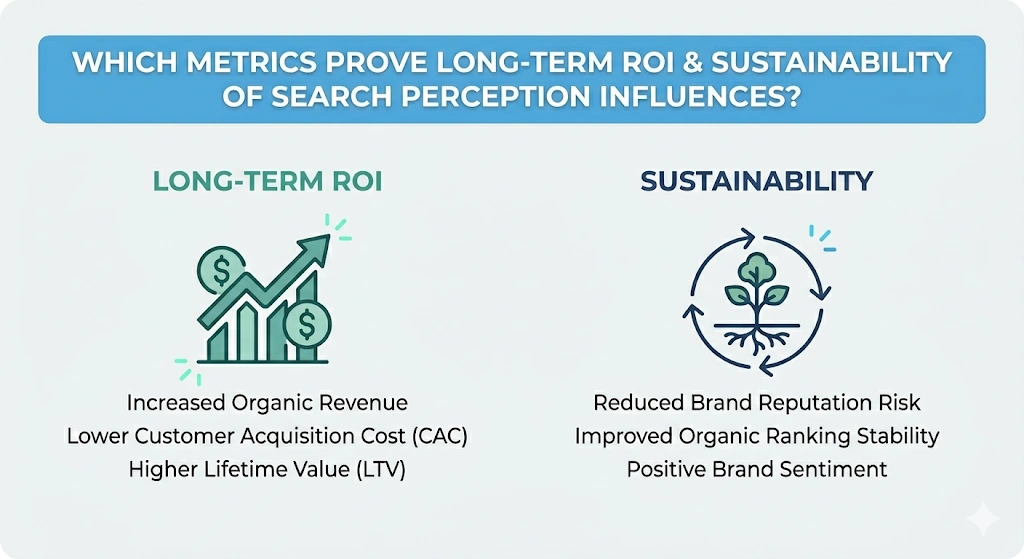
Which Metrics Prove the Long-Term ROI and Sustainability of Search Perception Influences?
Measuring the return on investment for a digital advocacy and public affairs campaign requires tracking specific algorithmic indicators that correlate directly with minimized regulatory risk and enhanced institutional authority. Standard marketing metrics like raw click-through rates or social media engagement fail to capture the true health of an enterprise’s regulatory reputation. Instead, performance evaluation must focus on share of search voice for critical regulatory queries, the stability of core corporate entities within major search engines’ knowledge bases, and the absolute displacement of adversarial domains from the first page of search results. Tracking these advanced indicators allows an organisation to accurately quantify how effectively its digital footprint mitigates legislative vulnerabilities.
Sustaining these positive search metrics over multiple legislative cycles requires a continuous process of auditing semantic entities and refreshing content structures. Algorithmic retrieval systems regularly update their understanding of industry risks, which means an enterprise must constantly align its digital documentation with evolving compliance vocabularies. Partnering with a dedicated strategy provider ensures that corporate informational networks adapt ahead of regulatory changes, preserving narrative dominance across all key policy areas. This continuous maintenance transforms search engines into an objective validation tool for institutional credibility, ensuring that whenever a policy decision-maker evaluates the enterprise, the digital environment consistently confirms its long-term reliability and compliance.
Frequently Asked Questions
What is the role of digital public affairs in regulatory risk management?
Digital public affairs proactively shapes the online narrative and search engine results that policymakers and compliance officers encounter during legislative reviews. By establishing authoritative informational nodes, an organisation can reduce regulatory risk and ensure accurate compliance signals are surfaced. This structured approach prevents unverified third-party data from dominating public policy discussions.
How can search perception control protect corporate reputation during a legislative crisis?
Search perception control allows enterprises to anchor verified data, policy whitepapers, and entity credentials at the top of search engine results pages. When regulatory scrutiny spikes, this pre-established digital footprint minimizes the visibility of real-time speculation and hostile media coverage. Linkonize implements these strategies to ensure a stable information ecosystem for corporate stakeholders.
Why should leading organisations invest in proactive digital advocacy strategy over reactive PR?
Proactive digital advocacy creates permanent, technically optimized assets that continually build digital authority and long-term search dominance. Reactive public relations attempts to alter established search engine knowledge graphs after a crisis has already damaged institutional credibility, which is significantly more costly and less effective. Securing high-value digital real estate in advance establishes an enduring defensive barrier for corporate enterprise value.
What metrics are used to measure the success of public affairs consulting?
The effectiveness of public affairs consulting is measured through share of search voice for regulatory queries, the stability of entity attributes in knowledge bases, and the suppression of adversarial domains. Unlike general marketing metrics, these indicators isolate how effectively an organisation’s digital footprint mitigates policy vulnerabilities. Tracking these data points provides measurable proof of sustained narrative visibility control and stakeholder alignment.
How do search algorithms evaluate institutional credibility and entity trust?
Search engines rely on information retrieval systems to verify corporate leadership data, official policy responses, and consistent third-party validations across indexed layers. When an organisation aligns its digital assets with the specific semantic concepts used by legislative analysts, algorithms recognize it as a definitive authority. Linkonize optimizes this semantic architecture to turn search visibility into an objective tool for stakeholder trust validation.