

Grassroots and grasstops advocacy are the two primary mechanisms through which organisations, institutions, and stakeholder groups influence public perception, policy awareness, and institutional visibility. Grassroots advocacy mobilises broad public participation, while grasstops advocacy engages influential stakeholders whose authority shapes decision-making environments.
Public affairs refers to the management of relationships between institutions, stakeholders, policymakers, media entities, and the public within governance and communication ecosystems. Digital advocacy is the structured use of digital channels to influence awareness, stakeholder engagement, narrative visibility, and public perception across interconnected information networks.
What are grassroots and grasstops advocacy?
Grassroots advocacy is public participation-driven influence, while grasstops advocacy is influence driven by recognised authorities and high-trust stakeholders.
Grassroots advocacy refers to collective action initiated and amplified by members of the public, community groups, supporters, employees, or affected stakeholders. Within digital ecosystems, grassroots activity generates widespread engagement signals that demonstrate public awareness, participation, and issue visibility. The primary objective is to create volume, attention, and public legitimacy around a topic, issue, or policy position.
Grasstops advocacy refers to engagement with individuals who possess institutional authority, professional credibility, recognised expertise, or established stakeholder trust. These participants include industry leaders, academic experts, professional associations, policy specialists, and influential decision-makers. Their involvement creates authority signals that shape how narratives are interpreted by both institutions and audiences.
Both approaches function as perception-building systems. Grassroots advocacy contributes public legitimacy, while grasstops advocacy contributes institutional credibility. Together they influence how narratives are evaluated within public affairs ecosystems and digital information environments.
Why do advocacy campaigns rely on both grassroots and grasstops influence?
Successful advocacy campaigns rely on both approaches because public perception is formed through a combination of participation signals and authority signals.
Public attention alone does not automatically generate institutional credibility. High levels of engagement demonstrate relevance, but institutional stakeholders evaluate expertise, trustworthiness, and authority before assigning legitimacy to a narrative. Grasstops advocates provide these credibility-enhancing signals through recognised expertise and established reputational standing.
Institutional authority alone does not automatically create widespread public visibility. Expert commentary, policy analysis, and stakeholder endorsements require public engagement to generate broader narrative influence. Grassroots participation increases visibility by distributing messages across digital channels, media ecosystems, and stakeholder networks.
Search visibility demonstrates this relationship clearly. Search engines evaluate content using signals associated with authority, expertise, relevance, and engagement. Content supported by trusted entities benefits from stronger credibility signals, while content that receives substantial audience interaction benefits from stronger visibility indicators. Advocacy campaigns therefore require both dimensions to sustain influence across digital ecosystems.
The interaction between grassroots and grasstops activity creates a balanced perception architecture. One generates public momentum, while the other reinforces institutional trust.
How does grassroots advocacy shape public perception?
Grassroots advocacy shapes public perception by increasing issue visibility and demonstrating stakeholder engagement.
Public perception is heavily influenced by exposure frequency. When large numbers of participants discuss a topic, share information, publish content, or engage with narratives, visibility increases across search engines, social platforms, media coverage, and stakeholder communication channels. Repeated exposure strengthens issue recognition and influences narrative prominence.
Digital ecosystems interpret grassroots activity through measurable engagement indicators. Comments, discussions, content distribution, petitions, community engagement, and public participation all contribute to a broader digital footprint. These signals demonstrate that an issue occupies stakeholder attention and maintains relevance within public discourse.
Search visibility is directly affected by content ecosystems that emerge from grassroots participation. User-generated content, discussion forums, media references, organisational publications, and stakeholder commentary create interconnected content networks. Search engines index these assets and evaluate their relevance when determining SERP positioning.
Grassroots advocacy also influences sentiment interpretation. Public conversations generate reputation signals that help institutions, journalists, analysts, and search systems evaluate prevailing stakeholder attitudes. The resulting narrative landscape contributes to broader entity perception and issue visibility.
How does grasstops advocacy influence credibility and trust?
Grasstops advocacy influences credibility and trust by connecting narratives to recognised sources of authority.
Stakeholder trust is strongly associated with expertise, institutional standing, and professional reputation. When recognised experts participate in advocacy efforts, audiences interpret information through established trust frameworks. The credibility of the source affects the credibility of the message.
Digital authority functions similarly within search ecosystems. Search engines evaluate signals associated with expertise, author reputation, entity recognition, and authoritative references. Content linked to trusted individuals and institutions often benefits from stronger SERP evaluation because authority signals help algorithms assess informational quality.
Institutional credibility assessment often depends on evaluating expertise signals, authority indicators, and stakeholder trust frameworks. Organisations seeking to understand expert selection criteria can further explore How to Choose the Right Advocacy Influencer: A Framework for Vetting Subject Matter Experts.
Grasstops advocacy therefore operates as a credibility mechanism. Rather than generating volume, it reinforces trust architecture. The outcome is stronger institutional perception, improved narrative legitimacy, and enhanced stakeholder confidence in information quality.
How do search engines interpret advocacy-related authority signals?
Search engines interpret authority signals by evaluating expertise, relevance, credibility, and content relationships across digital ecosystems.
Content indexing processes collect information from websites, publications, media sources, organisational platforms, and stakeholder-generated content. Algorithms then analyse relationships between entities, topics, authors, references, and engagement patterns. These relationships help determine content quality and relevance.
Authority signals emerge from multiple interconnected factors. Expert authorship, trusted citations, institutional references, recognised entities, topical depth, and content consistency all contribute to digital authority assessment. Search systems evaluate these factors collectively rather than relying on a single metric.
Entity perception plays a central role in modern search evaluation. Search engines increasingly analyse organisations, individuals, institutions, and topics as interconnected entities. The quality of relationships between these entities influences perceived credibility and topical authority.
Advocacy narratives gain visibility when authority signals align with relevance signals. Strong expertise combined with stakeholder engagement creates a content ecosystem that supports both credibility evaluation and search visibility. This alignment strengthens SERP performance while reinforcing institutional trust.
What role do digital narratives play in advocacy campaigns?
Digital narratives define how information is organised, interpreted, and understood across stakeholder networks.
A digital narrative is a structured collection of messages, content assets, stakeholder discussions, media references, and institutional communications that shape perception around a specific topic. Narratives provide context that influences how audiences interpret information and evaluate credibility.
Narrative influence depends on consistency and visibility. Repeated themes appearing across multiple trusted sources create stronger perception signals than isolated content assets. Search engines, media organisations, and stakeholders evaluate recurring patterns to understand topic relevance and authority.
Content ecosystems amplify narrative influence through interconnected publications. Articles, reports, expert commentary, media coverage, stakeholder discussions, and organisational resources reinforce thematic consistency. These relationships strengthen semantic associations and improve information discoverability.
Institutional perception is shaped by narrative architecture because stakeholders rarely evaluate individual content assets in isolation. Instead, they assess broader patterns of information. Advocacy campaigns therefore rely on coherent narrative frameworks to establish credibility, visibility, and trust.
How do content ecosystems affect stakeholder trust?
Content ecosystems affect stakeholder trust by creating interconnected evidence that supports credibility evaluation.
A content ecosystem refers to the network of digital assets associated with a topic, organisation, institution, or advocacy effort. This includes websites, media publications, reports, stakeholder commentary, expert analysis, search results, and social content. Each asset contributes additional context to perception formation.
Stakeholders evaluate trust by analysing consistency across information sources. Consistent information appearing across authoritative channels strengthens credibility signals. Inconsistent information introduces uncertainty and weakens stakeholder confidence. Trust therefore emerges from information alignment rather than isolated claims.
Search engines also analyse ecosystem consistency. Content relationships, citation patterns, topical relevance, and entity associations help algorithms assess authority and quality. Strong content ecosystems improve indexing accuracy and strengthen SERP evaluation outcomes.
Digital advocacy operates within these ecosystems rather than through individual messages. Reputation signals accumulate across interconnected assets, creating broader perceptions of authority, legitimacy, and institutional credibility.
How do grassroots and grasstops strategies influence institutional reputation?
Grassroots and grasstops strategies influence institutional reputation by shaping both visibility and credibility simultaneously.
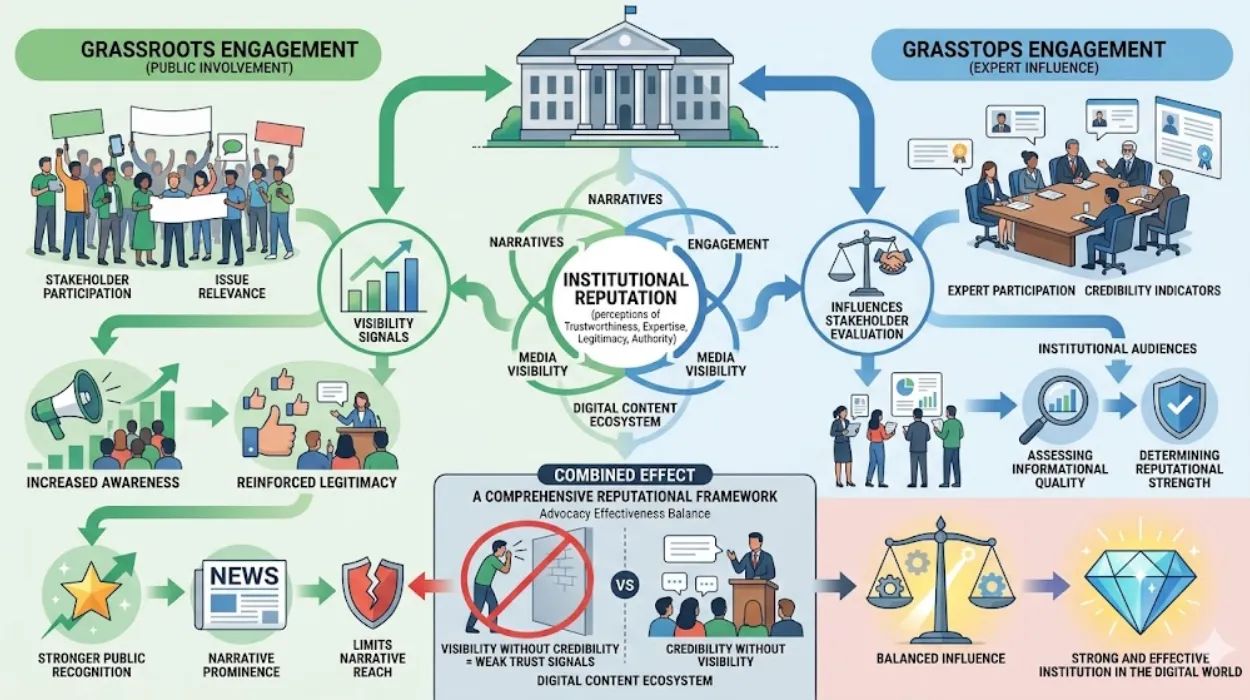
Institutional reputation refers to collective stakeholder perceptions regarding trustworthiness, expertise, legitimacy, and authority. Reputation emerges from continuous interactions between narratives, stakeholder engagement, media visibility, and digital content ecosystems. Advocacy activity contributes directly to these perception-building processes.
Grassroots engagement strengthens reputation by demonstrating stakeholder participation and issue relevance. Public involvement generates visibility signals that increase awareness and reinforce legitimacy through broad engagement. These signals contribute to stronger public recognition and narrative prominence.
Grasstops engagement strengthens reputation by enhancing authority and trust. Expert participation introduces credibility indicators that influence stakeholder evaluation. Institutional audiences often rely on these signals when assessing informational quality and reputational strength.
The combined effect creates a more comprehensive reputation framework. Visibility without credibility produces weak trust signals, while credibility without visibility limits narrative reach. Advocacy effectiveness therefore depends on balancing both forms of influence within digital ecosystems.
Why is understanding advocacy influence important in modern digital ecosystems?
Understanding advocacy influence is important because public perception increasingly develops through interconnected digital systems.
Search engines, media platforms, stakeholder networks, and institutional communication channels collectively shape how information is discovered, interpreted, and evaluated. Advocacy campaigns operate within these systems and contribute to broader reputation formation processes. Understanding the mechanisms behind influence provides insight into how visibility, authority, and trust emerge.
Digital authority is not defined solely by publication volume. It is established through entity perception, expertise signals, stakeholder trust, content relevance, and ecosystem consistency. These factors influence both search visibility and institutional credibility. Advocacy strategies therefore function as components of larger information architectures.
Grassroots and grasstops approaches represent complementary influence models. One generates public participation and visibility, while the other reinforces authority and trust. Together they shape narrative influence, stakeholder perception, and institutional reputation across digital environments.
A comprehensive understanding of advocacy influence requires analysing how narratives travel through content ecosystems, how authority signals are interpreted, and how trust is established through interconnected information networks. These mechanisms define modern public affairs, digital advocacy, and reputation systems.
Conclusion
Grassroots and grasstops advocacy represent the two foundational engines of advocacy influence. Grassroots activity generates visibility, engagement, and public legitimacy, while grasstops activity contributes authority, expertise, and stakeholder trust.
Within digital ecosystems, both approaches influence how narratives are discovered, interpreted, and evaluated. Search engines assess authority signals, content relationships, and entity perception, while stakeholders evaluate credibility through trust architecture and information consistency. Institutional reputation emerges from these interconnected processes.
Understanding the relationship between grassroots participation and grasstops authority provides a clearer framework for analysing public affairs, digital advocacy, stakeholder perception, and online reputation. Together they define how influence operates across modern information ecosystems.
Frequently Asked Questions
What is the difference between grassroots and grasstops advocacy?
Grassroots advocacy focuses on mobilising large groups of people to increase public awareness and engagement around an issue. Grasstops advocacy focuses on engaging recognised experts, institutional leaders, and influential stakeholders whose authority contributes to credibility and trust. Both approaches influence perception, but they operate through different mechanisms.
Why are grassroots and grasstops strategies used together?
Grassroots and grasstops strategies are used together because visibility and credibility are separate components of influence. Grassroots participation increases awareness and public engagement, while grasstops participation strengthens authority and stakeholder trust. Combining both approaches creates stronger narrative influence across digital and institutional environments.
How does advocacy affect online reputation?
Advocacy affects online reputation by shaping the narratives, content assets, and stakeholder discussions associated with an organisation, institution, or issue. Search engines, media platforms, and stakeholders evaluate these signals when forming perceptions of credibility, relevance, and authority.
What role do search engines play in advocacy visibility?
Search engines influence advocacy visibility by indexing, evaluating, and ranking content related to specific topics and entities. Algorithms assess relevance, expertise, authority, and trust signals when determining search visibility. Strong advocacy ecosystems often generate content relationships that support improved SERP evaluation.
How does stakeholder trust influence advocacy outcomes?
Stakeholder trust influences advocacy outcomes because audiences evaluate information based on credibility, expertise, and consistency. Trust strengthens narrative acceptance, improves institutional perception, and enhances the effectiveness of communication efforts across digital ecosystems.