

Selecting the right advocacy influencer depends on evaluating subject matter expertise, stakeholder trust signals, audience relevance, and narrative credibility rather than audience size alone. Effective vetting frameworks compare authority indicators, reputation signals, engagement quality, and alignment with public affairs objectives.
Public affairs strategies differ based on stakeholder influence structures, institutional objectives, and communication environments. Digital advocacy methods are evaluated through authority validation, trust measurement, visibility impact, and their influence on stakeholder perception within digital ecosystems.
What Distinguishes a Subject Matter Expert from a General Influencer?
A subject matter expert is an individual whose authority derives from demonstrable expertise, evidence-based communication, and recognised contributions within a specific policy, governance, industry, or societal domain.
General influencers operate through audience attention and content reach. Subject matter experts operate through knowledge authority and entity credibility. In digital advocacy environments, this distinction affects stakeholder trust, narrative visibility, and institutional legitimacy. Search engines interpret expertise signals through publication history, citation patterns, topical consistency, and semantic relevance. Digital platforms evaluate authority through engagement quality, audience composition, and content interaction patterns.
The comparative difference becomes significant when advocacy campaigns address regulatory issues, legislative priorities, public consultations, or institutional accountability topics. General influencers often generate broad awareness. Subject matter experts contribute to credibility formation, stakeholder validation, and informed discourse. This distinction directly influences reputation signals and search ranking influence across policy-related content ecosystems.
Understanding the distinction between expertise-based influence and audience-based influence requires a broader understanding of digital advocacy ecosystems and stakeholder engagement frameworks.
Which Authority Signals Provide the Most Reliable Evaluation Criteria?
The most reliable authority signals originate from demonstrated expertise, recognised professional contributions, and sustained topical relevance.
Authority is a measurable digital asset. It operates by creating confidence among stakeholders, search engines, journalists, policymakers, and institutional audiences. Reliable authority signals include professional credentials, published research, policy contributions, expert commentary records, conference participation, and documented sector experience.
The strongest authority indicators display consistency over time. Consistent publication activity establishes topical ownership. Regular participation in policy discussions reinforces entity credibility. Independent citations strengthen reputation signals by demonstrating external validation. Search engines increasingly evaluate these signals through entity recognition systems that associate expertise with specific knowledge domains.
Weak authority signals include follower counts, viral engagement spikes, and audience volume without contextual relevance. These metrics measure attention rather than expertise. Attention generates visibility, whereas expertise generates trust. Public affairs outcomes depend more heavily on stakeholder trust than audience scale.
A comprehensive evaluation framework examines:
- Verify professional credentials linked to the advocacy topic.
- Analyse publication history for topical consistency.
- Measure independent citations and external references.
- Evaluate policy engagement records and institutional participation.
- Assess audience composition rather than audience size.
This process creates a more accurate assessment of long-term advocacy value.
How Does Audience Relevance Compare with Audience Size?
Audience relevance is a stronger indicator of advocacy effectiveness than audience size because stakeholder influence depends on audience composition rather than numerical reach.
Audience size measures exposure potential. Audience relevance measures strategic alignment. In public affairs environments, advocacy outcomes emerge through engagement with policymakers, journalists, regulators, community leaders, researchers, and issue-specific stakeholders. Large audiences frequently contain low concentrations of decision-making participants.
Digital advocacy ecosystems operate through network influence rather than mass communication alone. Search engines and social platforms evaluate content interactions within topical communities. Relevant audiences generate stronger authority reinforcement, more meaningful engagement patterns, and higher-quality reputation signals.
A comparative analysis demonstrates a significant distinction. Large audiences increase content amplification. Relevant audiences increase policy engagement and stakeholder trust. Content amplification affects narrative visibility. Stakeholder trust affects institutional credibility. Advocacy objectives often prioritise the latter.
Evaluation frameworks therefore analyse audience demographics, professional affiliations, issue relevance, geographic concentration, and stakeholder composition. These indicators provide stronger predictive value than follower counts when assessing digital advocacy effectiveness.
How Do Organic Advocacy Approaches Compare with Reactive Communication Models?
Organic advocacy frameworks build long-term credibility, while reactive communication models focus on immediate narrative response.
Organic advocacy is a structured communication approach based on sustained engagement, educational content, stakeholder dialogue, and consistent issue visibility. Reactive communication is a response-oriented model triggered by emerging events, criticism, regulatory developments, or reputation challenges.
Organic approaches operate by establishing authority before scrutiny emerges. Consistent content publication strengthens search ranking influence and entity credibility. Stakeholders encounter established expertise rather than isolated responses. This process supports narrative stability and long-term trust development.
Reactive models operate by addressing immediate information gaps or correcting negative sentiment distribution. They provide speed and adaptability. However, reactive strategies frequently depend on existing credibility reserves. Organisations or campaigns lacking established authority often struggle to achieve trust restoration through reactive communication alone.
The comparison reveals a fundamental trade-off. Organic frameworks prioritise sustainability and institutional credibility. Reactive frameworks prioritise responsiveness and narrative correction. Effective advocacy evaluation examines the balance between these approaches rather than treating them as mutually exclusive alternatives.
What Role Does Reputation Analysis Play in Influencer Vetting?
Reputation analysis measures the trustworthiness and credibility of advocacy participants across digital environments.
Reputation is a collection of observable trust signals generated through content, stakeholder interactions, media visibility, and public perception. Reputation analysis operates by examining sentiment distribution, authority consistency, stakeholder endorsements, and historical communication patterns.
Digital advocacy campaigns increasingly require systematic reputation assessments because visibility alone does not indicate credibility. High visibility combined with negative sentiment distribution creates risk exposure. Moderate visibility combined with strong trust signals often produces stronger advocacy outcomes.
Search engines evaluate reputation through signals associated with expertise, authority, trustworthiness, and entity recognition. Digital platforms reinforce these evaluations through engagement quality and community validation mechanisms. Consequently, reputation directly influences narrative visibility and content discoverability.
A robust vetting framework evaluates:
- Analyse historical content for consistency and accuracy.
- Measure stakeholder sentiment across relevant communities.
- Evaluate media references and expert citations.
- Review controversy patterns and reputation volatility.
- Assess trust alignment with advocacy objectives.
These indicators provide insight into long-term credibility sustainability.
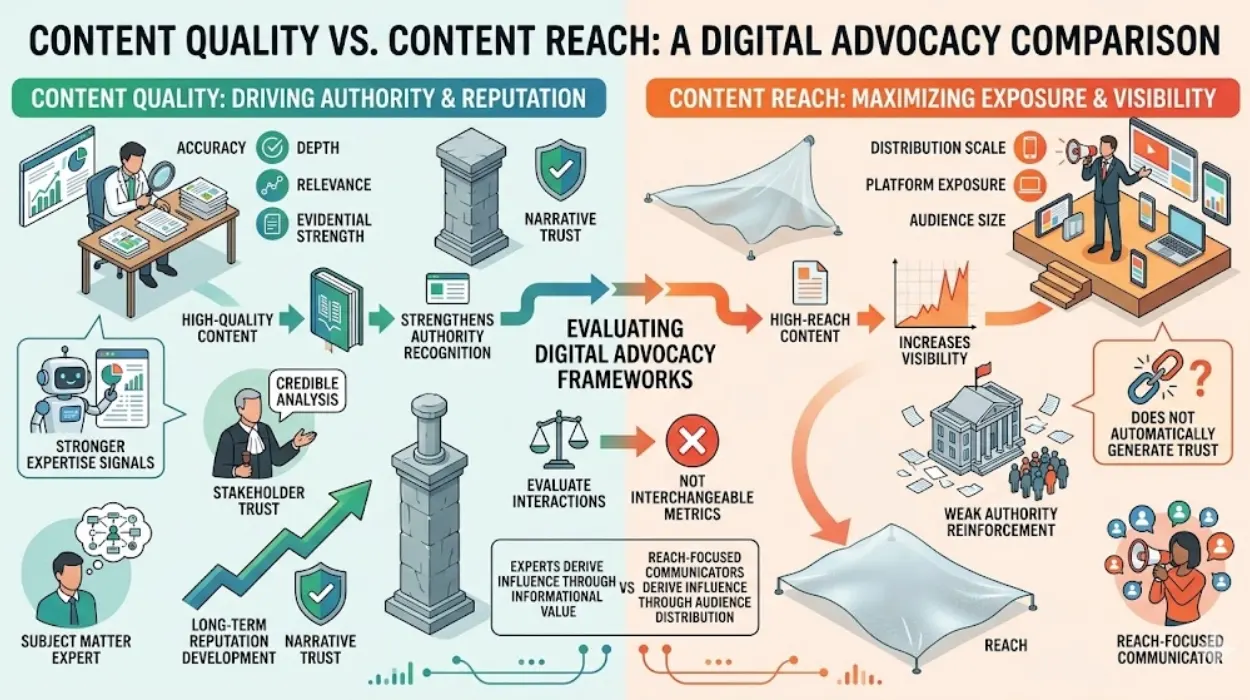
How Does Content Quality Compare with Content Reach?
Content quality exerts greater influence on authority formation, while content reach exerts greater influence on exposure.
Content quality is the accuracy, depth, relevance, and evidential strength of information. Content reach is the distribution scale achieved through platform exposure and audience size. Both metrics contribute to advocacy outcomes, but they influence different mechanisms.
High-quality content strengthens authority recognition. Search engines interpret comprehensive, evidence-based content as stronger expertise signals. Stakeholders perceive accurate analysis as a marker of credibility. This process contributes to long-term reputation development and narrative trust.
High reach increases visibility but does not automatically generate trust. Broad exposure without substantive expertise creates weak authority reinforcement. In policy-oriented advocacy campaigns, stakeholders frequently prioritise evidence quality over communication volume.
The comparison becomes particularly important when evaluating subject matter experts. Experts derive influence through informational value. Reach-focused communicators derive influence through audience distribution. Effective digital advocacy frameworks evaluate how these factors interact rather than treating them as interchangeable metrics.
Which Risk Factors Require Evaluation Before Collaboration?
Risk exposure assessment is an essential component of advocacy influencer selection because credibility disruptions affect both narrative visibility and stakeholder trust.
Risk factors emerge from communication inconsistency, reputation volatility, misinformation patterns, undisclosed affiliations, and audience misalignment. These variables influence campaign effectiveness and institutional credibility.
Digital ecosystems amplify both positive and negative signals. Search results, social platforms, media databases, and stakeholder networks continuously process reputation indicators. Consequently, historical communication records remain visible long after publication. This persistence increases the importance of due diligence.
A structured risk assessment framework includes:
- Identify contradictions between current and historical positions.
- Evaluate evidence standards used within published content.
- Measure controversy frequency and sentiment concentration.
- Review transparency regarding affiliations and interests.
- Analyse audience alignment with advocacy objectives.
These mechanisms reduce uncertainty and improve stakeholder confidence in advocacy partnerships.
How Do Short-Term Visibility Gains Compare with Long-Term Credibility Outcomes?
Short-term visibility gains improve awareness, whereas long-term credibility outcomes strengthen institutional trust and sustained influence.
Visibility is the degree to which content appears across digital channels. Credibility is the perceived reliability of information and expertise. Both contribute to advocacy performance, yet they function through distinct mechanisms.
Short-term visibility often emerges from trending discussions, reactive communications, or concentrated content amplification. These tactics generate immediate exposure and increase share of voice. However, visibility without credibility produces limited influence over stakeholder perceptions.
Long-term credibility develops through consistency, expertise demonstration, and trusted engagement. Search engines reinforce credible entities through recurring authority signals. Stakeholders reward credible sources with sustained trust and repeated engagement. This process strengthens narrative durability across changing communication environments.
The comparison highlights a strategic distinction between content amplification and authority development. Content amplification expands reach. Authority development increases influence. Public affairs and Digital Advocasy programmes evaluate both outcomes because effective advocacy requires visibility supported by trust.
How Can Organisations Apply a Structured Vetting Framework?
A structured vetting framework combines authority assessment, audience evaluation, reputation analysis, content review, and risk measurement into a unified decision-making process.
The framework operates by converting subjective perceptions into measurable criteria. Each evaluation category contributes to a comprehensive understanding of advocacy suitability. This method improves consistency and reduces reliance on surface-level metrics.
A practical evaluation process follows five stages:
- Define advocacy objectives and stakeholder targets.
- Measure subject matter expertise and authority indicators.
- Analyse audience relevance and engagement quality.
- Evaluate reputation signals and sentiment distribution.
- Assess long-term credibility and risk exposure.
This structure supports evidence-based decision-making while maintaining alignment with public affairs objectives. It also improves transparency in influencer selection and strengthens institutional trust.
Discussion of rapid mobilisation frameworks becomes particularly relevant when evaluating advocacy effectiveness. For example, analysing Case Study: How a Click-to-Call Campaign Generated 4,000 Legislative Contacts in 72 Hours provides insight into how authority, audience alignment, and stakeholder engagement mechanisms influence large-scale advocacy participation.
Conclusion
Choosing the right advocacy influencer requires systematic evaluation rather than reliance on visibility metrics alone. Subject matter expertise, authority signals, audience relevance, reputation strength, and risk exposure provide stronger indicators of advocacy effectiveness than audience size or engagement volume.
The comparison between organic and reactive communication frameworks highlights different strengths in narrative management and institutional credibility development. Similarly, the distinction between content quality and content reach demonstrates the relationship between authority formation and visibility generation. Effective digital advocacy evaluation measures how these factors interact within stakeholder ecosystems, search environments, and public discourse networks.
Long-term credibility, stakeholder trust, and sustainable narrative visibility emerge from evidence-based assessment frameworks that prioritise expertise, reputation signals, and audience relevance. These considerations provide a structured foundation for evaluating advocacy participants within contemporary public affairs environments.
Frequently Asked Questions
How is an advocacy influencer different from a social media influencer?
An advocacy influencer derives influence from expertise, stakeholder trust, and recognised authority within a specific topic area. A social media influencer derives influence primarily from audience reach and content visibility. In public affairs and digital advocacy, expertise and credibility provide stronger trust signals than audience size alone.
What factors are most important when vetting a subject matter expert?
The most important factors include professional credentials, publication history, policy engagement, audience relevance, reputation signals, and topical consistency. These indicators help evaluate entity credibility, stakeholder trust, and long-term authority within a specific advocacy area.
Why is audience relevance more important than follower count?
Audience relevance measures whether content reaches policymakers, journalists, regulators, researchers, and other key stakeholders. Follower count measures potential exposure. Advocacy outcomes depend on engagement from influential stakeholders rather than broad but unrelated audiences.
How do reputation signals affect advocacy effectiveness?
Reputation signals influence stakeholder trust, narrative visibility, and institutional credibility. Positive reputation indicators include consistent expertise, evidence-based communication, and recognised authority. Negative reputation indicators include misinformation, controversy concentration, and inconsistent public positions.
What risks should organisations assess before working with an advocacy influencer?
Organisations should evaluate historical content, sentiment distribution, transparency of affiliations, communication consistency, and reputation volatility. This assessment helps identify risks that affect stakeholder perception, trust formation, and the credibility of advocacy initiatives.