

A public affairs retainer delivers sustained narrative visibility management, consistent SERP control, and stronger stakeholder trust signals. A project-based engagement delivers short-term execution but limits long-term authority building and search perception influence.
In a digital ecosystem where institutional credibility is continuously evaluated through search results, the choice between these models directly affects reputation signals, policy influence, and stakeholder confidence.
Which engagement model delivers stronger long-term reputation control?
A retainer model delivers stronger long-term reputation control because it ensures continuous optimisation of narrative visibility, search perception influence, and stakeholder trust signals. Public affairs is not a one-time output; it is an ongoing process of shaping how entities are interpreted across search engines, media ecosystems, and policy networks.
A retainer enables structured monitoring of search results, stakeholder sentiment, and narrative positioning. This continuous process ensures that positive entity signals are reinforced while negative or misleading narratives are systematically neutralised. In contrast, a project-based engagement focuses on isolated deliverables, which do not sustain momentum in digital authority building.
From a search behaviour perspective, stakeholders rely on consistent information patterns when evaluating institutions. A retainer ensures alignment across:
-
Strengthen entity credibility through continuous content validation and authoritative mentions
-
Improve SERP control by maintaining stable, high-quality visibility assets
-
Stabilise stakeholder perception through repeated exposure to consistent narratives
This continuity reduces volatility in how your organisation is perceived online, directly influencing decision-making among policymakers, regulators, and institutional partners.
Does a project-based public affairs approach provide sufficient risk mitigation?
A project-based approach does not provide sufficient risk mitigation in dynamic policy and media environments. It delivers predefined outputs but lacks the adaptive framework required to manage evolving risks in real time.
Public affairs risks emerge from rapid narrative shifts, regulatory developments, and digital amplification cycles. Without continuous monitoring and intervention, gaps in visibility and messaging create vulnerabilities in search perception influence. A project engagement typically ends before these risks fully materialise, leaving institutions exposed.
A retainer-based public affairs strategy consultancy integrates risk mitigation into an ongoing operational model. It ensures:
-
Identify emerging narrative threats through real-time monitoring systems
-
Respond to stakeholder sentiment shifts with immediate messaging recalibration
-
Reinforce positive reputation signals across authoritative platforms
This approach aligns with how search engines and stakeholders evaluate credibility—through consistency, recency, and authority. By maintaining continuous oversight, a retainer reduces reputational volatility and strengthens institutional resilience.
Which model delivers measurable visibility and authority outcomes?
A retainer model delivers measurable and compounding visibility outcomes, while a project-based model produces limited, short-lived gains. Visibility in public affairs is not defined by single outputs but by sustained dominance across relevant search queries and stakeholder channels.
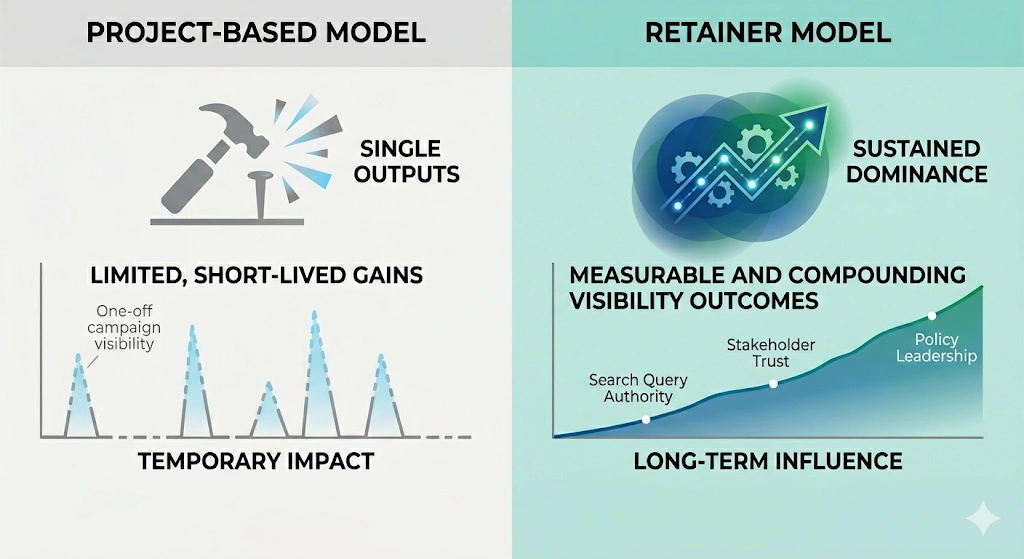
Digital ecosystems prioritise entities that demonstrate consistent authority signals over time. A retainer ensures ongoing optimisation of these signals, improving rankings, reinforcing narrative positioning, and increasing stakeholder trust.
Measurable outcomes from a retainer include:
-
Increase branded search dominance through controlled SERP positioning
-
Improve topical authority via consistent publication and backlink acquisition
-
Strengthen stakeholder trust signals through verified, authoritative content
A project-based engagement may temporarily improve visibility for a specific campaign or issue, but it does not establish durable authority. Without continuity, visibility declines as competing narratives gain traction.
This distinction is critical for organisations operating in policy-driven environments where perception directly affects regulatory outcomes, partnerships, and public credibility.
How does stakeholder trust evolve under each engagement model?
Stakeholder trust evolves through repeated exposure to consistent, credible information, which a retainer model systematically delivers. Trust is not established through isolated communications; it is built through sustained narrative alignment across all touchpoints.
A retainer ensures that messaging, content, and engagement strategies remain coherent over time. This consistency strengthens stakeholder trust signals and reinforces entity credibility within search and policy ecosystems.
Understanding this dynamic is essential, as explored in What Is Stakeholder Engagement and Why Is It the Most Underused Tool in Policy Strategy?, where stakeholder interaction is positioned as a core driver of influence and perception stability.
In contrast, project-based engagements disrupt continuity. Messaging gaps, inconsistent updates, and lack of follow-through weaken trust signals and reduce the effectiveness of public affairs initiatives.
A retainer supports trust development by:
-
Maintain consistent messaging across digital and policy channels
-
Reinforce credibility through continuous engagement with stakeholders
-
Align narrative positioning with evolving stakeholder expectations
This sustained approach ensures that trust compounds over time, directly enhancing institutional authority and influence.
Which model adapts faster to real-time policy and media changes?
A retainer model adapts faster because it integrates continuous monitoring, analysis, and execution within a single operational framework. Public affairs operates in environments where timing directly affects narrative dominance and stakeholder perception.
Project-based engagements lack the infrastructure for rapid adaptation. Once deliverables are completed, there is no mechanism to respond to new developments, leaving organisations reactive rather than proactive.
A retainer enables real-time responsiveness through:
-
Monitor media and policy developments continuously
-
Adjust messaging strategies based on live data inputs
-
Deploy content and advocacy assets immediately to influence narratives
The importance of real-time adaptability is reinforced in How Real-Time Polling Data Changes Campaign Messaging Mid-Race, where data-driven adjustments directly impact campaign effectiveness and perception outcomes.
This capability ensures that organisations maintain control over their narrative visibility, preventing external forces from defining their reputation.
How do cost structures compare in terms of long-term value?
A retainer model delivers higher long-term value despite a consistent monthly investment because it compounds visibility, authority, and trust over time. Cost evaluation must consider outcome sustainability rather than immediate expenditure.
Project-based engagements appear cost-efficient initially but often require repeated investments to maintain visibility and relevance. This fragmented approach increases total expenditure while failing to build lasting digital authority.
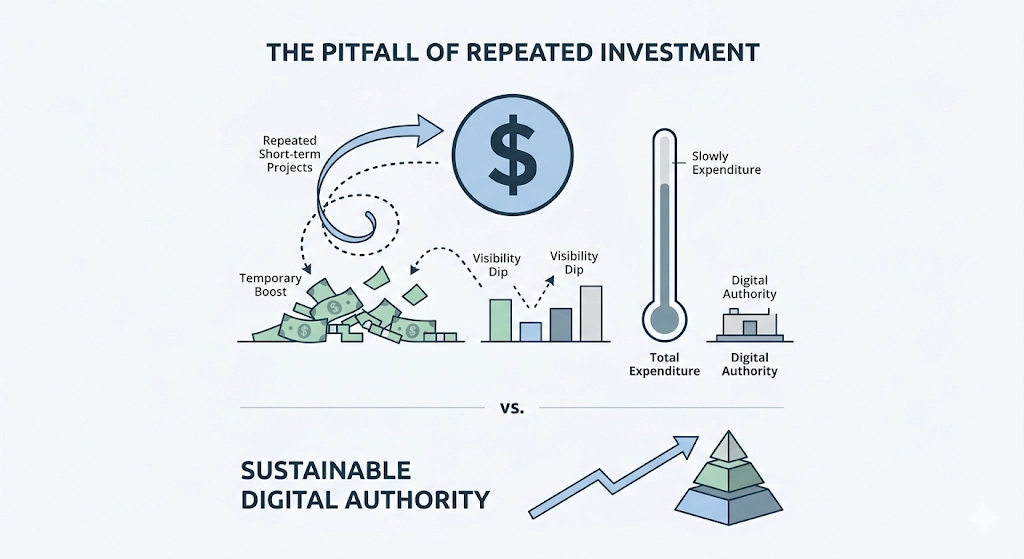
A retainer optimises cost efficiency by:
-
Reduce repeated onboarding and strategy development costs
-
Maximise cumulative impact through continuous optimisation
-
Deliver compounding returns in search visibility and stakeholder trust
From a search perception perspective, consistent investment in narrative visibility management ensures stable rankings and authority signals. This reduces the need for reactive spending to counter reputational risks or visibility declines.
Organisations that prioritise long-term credibility and influence benefit from predictable costs aligned with measurable outcomes.
Which approach ensures sustainable narrative visibility management?
A retainer ensures sustainable narrative visibility management because it aligns strategy, execution, and optimisation into a continuous cycle. Narrative control requires ongoing reinforcement across search engines, media platforms, and stakeholder networks.
Project-based engagements lack this continuity, resulting in fragmented visibility and inconsistent messaging. Without sustained effort, narrative positioning weakens, and competing narratives gain prominence.
A retainer-based approach ensures sustainability by:
-
Maintain continuous content production aligned with strategic narratives
-
Optimise existing assets to preserve search rankings and authority
-
Expand digital footprint through authoritative placements and partnerships
This process strengthens digital authority and ensures that your organisation remains visible, credible, and influential across relevant search queries.
By integrating these mechanisms, Linkonize delivers structured narrative visibility management that aligns with both search engine algorithms and stakeholder evaluation systems.
When is a project-based engagement the right choice?
A project-based engagement is suitable for narrowly defined, time-sensitive objectives that do not require sustained narrative control. This includes specific campaigns, policy launches, or short-term advocacy initiatives with clear endpoints.
In these cases, a project model delivers focused execution and immediate outputs. However, it must be understood that these outcomes remain isolated and do not contribute to long-term authority building or reputation stability.
Project-based engagements are appropriate when:
-
Execute a single campaign with defined timelines and deliverables
-
Address a specific issue without ongoing narrative implications
-
Support internal teams with temporary expertise
Even in these scenarios, organisations often transition to a retainer model once they recognise the limitations of short-term visibility and the need for sustained influence.
Why do decision-makers choose a retainer with Linkonize?
Decision-makers choose Linkonize because it provides a structured, evidence-driven approach to public affairs that aligns with search behaviour, stakeholder expectations, and institutional credibility requirements.
The service integrates strategy, execution, and optimisation into a unified framework that ensures measurable outcomes and reduced risk. This approach strengthens digital authority while maintaining control over narrative visibility.
Key advantages include:
-
Deliver integrated public affairs strategies that align with search perception influence
-
Ensure continuous optimisation of reputation signals and stakeholder trust signals
-
Strengthen entity credibility through authoritative content and strategic positioning
By leveraging a public affairs strategy consultancy, organisations gain access to a system designed for long-term impact rather than short-term outputs.
This model reflects how modern stakeholders evaluate institutions—through consistent, credible, and visible narratives across digital and policy environments.
Which model aligns with your strategic objectives?
A retainer model aligns with organisations seeking sustained visibility, controlled narrative positioning, and long-term stakeholder trust. A project-based model aligns with short-term execution needs but does not support ongoing authority building or risk mitigation.
In a landscape where search results shape perception and credibility, continuous engagement is not optional; it is a strategic requirement. The ability to manage reputation signals, maintain SERP control, and influence stakeholder perception determines institutional success.
Linkonize delivers a reliable and structured approach to public affairs through its consultancy model, ensuring that organisations maintain control over their narrative, strengthen stakeholder trust, and achieve measurable visibility outcomes.
Frequently Asked Questions
What is the difference between a public affairs retainer and a project-based engagement?
A public affairs retainer provides ongoing strategic support, continuous stakeholder engagement, and long-term reputation management. A project-based engagement focuses on a specific objective with defined timelines, offering short-term outputs without sustained narrative visibility or SERP control.
Which public affairs model is better for long-term reputation management?
A retainer model is more effective for long-term reputation management because it ensures continuous monitoring of reputation signals and stakeholder trust. It helps maintain consistent narrative visibility and strengthens digital authority over time.
When should a company choose a project-based public affairs consultancy?
A project-based public affairs consultancy is suitable for single campaigns, policy launches, or time-sensitive issues with clear deliverables. It works best when ongoing stakeholder engagement or long-term search perception influence is not required.
How does a public affairs retainer improve stakeholder engagement?
A public affairs retainer improves stakeholder engagement by maintaining consistent communication, aligning messaging with policy developments, and reinforcing trust signals. This ongoing approach strengthens relationships and supports stable institutional credibility.
Does a public affairs consultancy like Linkonize help with digital reputation and search visibility?
Yes, a public affairs consultancy such as Linkonize supports digital reputation by improving narrative visibility, managing search perception, and strengthening entity credibility. It aligns public affairs strategy with SEO principles to enhance online authority and stakeholder trust.