

A five-year-old article continues to rank because search engines prioritise established authority, consistent relevance signals, and historical engagement data over content freshness alone. Persistent visibility reflects how digital systems evaluate trust, entity association, and content indexing stability over time.
Online reputation refers to the aggregate perception of an individual or entity as constructed through indexed digital content, search visibility, and algorithmically interpreted reputation signals across platforms.
Why do older articles maintain high search visibility for a name?
Older articles maintain high search visibility because they accumulate durable authority signals that reinforce their relevance within search engine results pages (SERPs). Authority refers to the perceived reliability and expertise of a content source as interpreted through backlinks, domain history, and user engagement metrics.
Over time, older articles often attract consistent inbound links, citations, and behavioural engagement, which strengthens their ranking position. Content indexing stability ensures that search engines retain confidence in the page’s relevance to a specific entity or query. The absence of stronger competing content allows legacy articles to persist as dominant references. This persistence directly shapes entity perception, as users repeatedly encounter the same narrative framing.
How do search engines evaluate reputation-related content?
Search engines evaluate reputation-related content through a combination of semantic relevance, authority scoring, and trust signal aggregation. Content relevance is determined by how closely the text aligns with a named entity and associated queries, including variations of a person’s or organisation’s name. Authority scoring incorporates backlinks, source credibility, and publication reputation, which together define digital authority.
Trust signals include consistency of information, lack of conflicting data, and alignment with recognised knowledge sources. Algorithms also assess user interaction data such as click-through rates and dwell time to validate perceived usefulness. This evaluation framework ensures that content shaping public perception remains stable unless disrupted by stronger, more credible inputs.
What role does content indexing play in long-term rankings?
Content indexing defines how search engines store, categorise, and retrieve web pages in response to queries. Indexed content becomes part of a structured database where relevance, authority, and entity association are continuously evaluated. Once an article is indexed and linked to a specific name, it forms part of that entity’s digital footprint.
Long-term rankings persist when indexing signals remain unchanged, meaning no significant updates or competing content alter the page’s relevance. Historical indexing also benefits from accumulated crawl frequency and data reinforcement, which stabilises its position. This mechanism ensures that older content retains visibility unless actively displaced by stronger signals.
How do narrative structures influence entity perception in search results?
Narrative structures influence entity perception by defining how information about a subject is framed, repeated, and reinforced across digital ecosystems. A narrative refers to the structured presentation of facts, interpretations, and associations linked to an entity. When a five-year-old article presents a clear and authoritative narrative, search engines interpret it as a reliable reference point.
Repetition of similar narratives across multiple sources strengthens semantic alignment, reinforcing the same perception. This creates a feedback loop where visibility amplifies credibility, and credibility sustains visibility. As a result, stakeholder trust becomes anchored to the dominant narrative, regardless of its age.
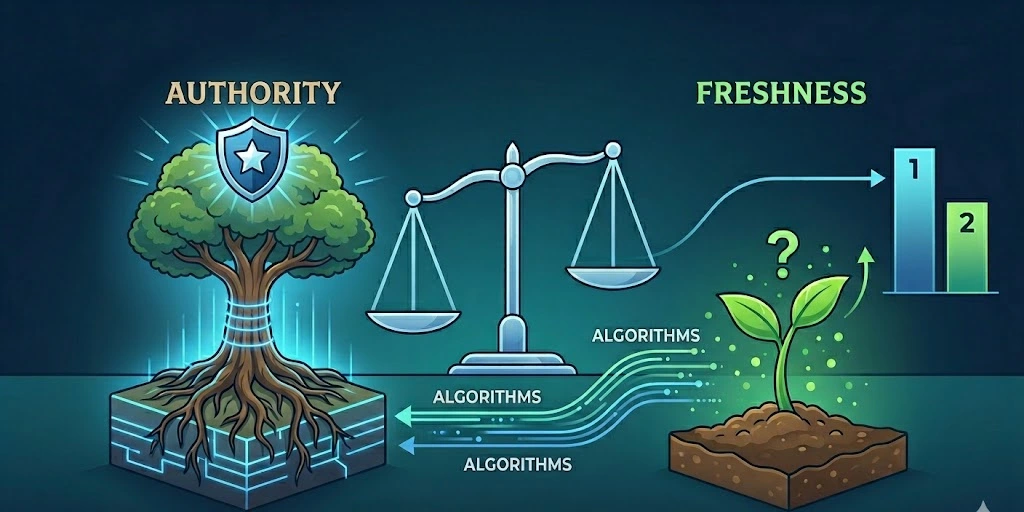
Why does digital authority outweigh content freshness in some cases?
Digital authority outweighs content freshness when established signals provide stronger validation than newer but less authoritative content. Authority reflects accumulated trust over time, including backlinks from credible domains, consistent engagement, and verified entity associations.
Fresh content lacks this historical validation unless it originates from highly authoritative sources. Search algorithms prioritise reliability and consistency, especially for queries related to identity and reputation. This prioritisation ensures that users receive stable and verified information rather than untested updates. Consequently, older articles retain ranking positions when newer content fails to surpass their authority threshold.
How do backlinks reinforce the ranking of older reputation content?
Backlinks reinforce rankings by acting as external validation signals that confirm the credibility and relevance of a page. Each backlink represents a reference from another source, contributing to the page’s authority score. Older articles often accumulate backlinks over time, creating a dense network of references that strengthens their position.
High-quality backlinks from reputable domains carry greater weight, amplifying digital authority. This network effect makes it difficult for newer content to compete without equivalent link-building strength. The result is sustained visibility that continues to influence stakeholder perception and trust.
What is the impact of user engagement on persistent rankings?
User engagement impacts persistent rankings by signalling content usefulness and relevance to search engines. Engagement metrics include click-through rates, dwell time, and interaction patterns, which collectively inform SERP evaluation. Older articles that consistently attract clicks and retain user attention reinforce their perceived value.
This behavioural data becomes part of the ranking algorithm’s feedback system, stabilising the article’s position. High engagement indicates that the content satisfies user intent, reducing the likelihood of displacement. Over time, this creates a self-reinforcing cycle where visibility drives engagement, and engagement sustains visibility.
How does media visibility shape institutional credibility online?
Media visibility shapes institutional credibility by determining which sources and narratives are most accessible within search results. Visibility refers to how prominently content appears across SERPs, news platforms, and aggregated feeds.
Articles from established media outlets carry inherent authority, influencing how algorithms interpret credibility. When such content ranks highly, it becomes a primary reference point for users evaluating an entity. This visibility consolidates trust signals and reinforces perceived legitimacy. Institutional credibility therefore becomes a function of both source authority and search prominence.
Why do negative or controversial articles persist in rankings?
Negative or controversial articles persist because they often generate high engagement and attract extensive backlinks, both of which strengthen ranking signals. Controversial content tends to be widely referenced, discussed, and shared, increasing its visibility and authority.
Search engines interpret this activity as a sign of relevance, regardless of sentiment. Sentiment analysis identifies tone but does not override authority and engagement metrics in ranking decisions. As a result, negative narratives can dominate search results if they maintain strong digital signals. This persistence directly impacts reputation by anchoring perception to specific events or interpretations.
How do content ecosystems influence stakeholder trust?
Content ecosystems influence stakeholder trust by creating interconnected networks of information that reinforce specific narratives and authority signals. A content ecosystem includes websites, media platforms, social channels, and aggregated data sources that collectively shape digital perception.
Consistency across these sources strengthens trust, as search engines and users interpret alignment as validation. Inconsistencies weaken credibility by introducing conflicting signals that disrupt narrative coherence. Stakeholder trust emerges from repeated exposure to stable, authoritative information across the ecosystem. This system-level interaction defines how reputation is constructed and maintained online.
What mechanisms allow newer content to replace older rankings?
Newer content replaces older rankings when it introduces stronger relevance, authority, and engagement signals that surpass existing benchmarks. This process involves several mechanisms:
-
Establish higher authority: Secure backlinks from credible domains to exceed the existing article’s link profile, demonstrating stronger external validation.
-
Improve semantic relevance: Align content more precisely with entity-related queries, incorporating structured data and clear entity references.
-
Increase engagement signals: Generate higher click-through rates and longer dwell time through improved content clarity and relevance.
-
Update indexing signals: Publish and update content frequently to encourage more frequent crawling and re-evaluation by search engines.
These mechanisms collectively shift SERP evaluation, enabling newer content to displace established articles and reshape entity perception.
How does search suppression differ from content removal in visibility control?
Search suppression differs from content removal in that it focuses on reducing the visibility of existing content rather than eliminating it from the internet. Content removal involves deleting or de-indexing a page, which requires legal, platform, or publisher intervention. Search suppression operates by introducing stronger competing content that pushes the original article lower in rankings. This method relies on altering authority, relevance, and engagement signals within the search ecosystem. It directly affects visibility without changing the underlying content landscape. A detailed comparison of these mechanisms is explored in Search Suppression vs. Content Removal: Which is faster?, which analyses speed, control, and systemic impact.
How do algorithms interpret trust and credibility signals over time?
Algorithms interpret trust and credibility signals as cumulative and time-sensitive indicators of reliability. Trust signals include consistent information, authoritative sourcing, and alignment with recognised entities. Over time, these signals are reinforced through repeated validation, such as backlinks and user engagement. Algorithms prioritise stability, meaning that long-standing signals carry more weight than newly introduced ones. This temporal dimension ensures that credibility is not easily disrupted by short-term changes. The result is a ranking system that favours established trust, reinforcing persistent visibility for older content.
A five-year-old article continues to rank because digital ecosystems prioritise authority, consistency, and validated relevance over simple recency. Search engines evaluate reputation through interconnected signals including backlinks, engagement, indexing stability, and narrative alignment. Older content benefits from accumulated trust and reinforced visibility, which together define its position within SERPs. Narrative structures and media authority further anchor perception, influencing how stakeholders interpret credibility. Changes in rankings require systemic shifts in authority and relevance rather than isolated updates. Understanding these mechanisms clarifies how online reputation is constructed, maintained, and reshaped within search environments.

Frequently Asked Questions
Why is an old article still ranking for my name instead of fresh content?
Older articles rank because they accumulate strong authority signals like backlinks, consistent engagement, and established entity associations that search engines prioritise over freshness. Linkonize helps analyse these reputation signals to understand why legacy content dominates your search visibility.
How do I remove or suppress old content ranking for my name?
You can suppress old content by creating stronger, authoritative pages that outrank it, or remove it through legal/platform requests if the content violates policies. Linkonize offers strategic approaches to both search suppression and content removal based on your specific reputation goals.
What makes search engines trust older content about a person or brand?
Search engines trust older content when it has accumulated verified backlinks, consistent information across sources, and stable indexing signals that reinforce its reliability as an entity reference. This trust is measured through digital authority and reputation signals that Linkonize evaluates in SEO audits.
Can new content outrank a 5-year-old article for my name?
Yes, new content can outrank old articles if it establishes higher digital authority through quality backlinks, stronger semantic relevance to your name, and better user engagement metrics. Linkonize builds authority link strategies that help new content compete effectively against legacy ranking pages.
How does old content ranking affect my online reputation?
Old content shapes your online reputation by defining the primary narrative stakeholders encounter in search results, which directly influences entity perception and stakeholder trust. Linkonize’s reputation management services analyse and optimise these search visibility patterns to control how your digital footprint is interpreted.