

PR events generate long-term value when they operate as content infrastructure rather than isolated communication activities. The most effective approach converts event outputs into interconnected assets that continue influencing visibility, stakeholder perception, and reputation signals across digital channels after the event concludes.
Public affairs strategies differ based on how organisations distribute authority, stakeholder engagement, and narrative visibility throughout the content lifecycle. Digital advocacy methods are evaluated through their ability to sustain search presence, reinforce entity credibility, and maintain stakeholder trust beyond a single communication moment.
Which PR Event Content Approach Creates Greater Long-Term Visibility?
A content ecosystem approach creates greater long-term visibility than a single-publication event communications model. The distinction lies in how information assets are structured, distributed, and connected after the event concludes.
A single-publication model is a communications approach focused on immediate exposure through event announcements, media coverage, and post-event summaries. It operates by concentrating attention within a limited publication window. Search visibility generated through this model declines as news relevance decreases and newer content replaces event-related coverage.
A content ecosystem model is a structured framework that transforms event outputs into multiple interconnected content assets. It operates by repurposing speeches, stakeholder insights, media interviews, policy discussions, presentations, and audience interactions into enduring digital resources. Each asset reinforces thematic relevance and expands search ranking influence across related topics.
From a comparative perspective, the single-publication model provides concentrated short-term exposure but demonstrates limited sustainability. The content ecosystem model distributes authority signals across multiple content formats, improving narrative visibility and expanding opportunities for search discovery. This structure strengthens institutional presence while supporting long-term content amplification rather than temporary visibility spikes.
How Do Media Visibility and Stakeholder Engagement Approaches Compare After an Event?
Media visibility approaches generate broader awareness, while stakeholder engagement approaches create deeper trust and stronger credibility signals. Both mechanisms influence reputation outcomes through different pathways.
Media visibility is a public affairs approach centred on news coverage, editorial mentions, and external publication opportunities. It operates by increasing exposure through third-party platforms that transfer authority and credibility signals. Search engines interpret these references as indicators of relevance, expertise, and institutional prominence.
Stakeholder engagement is a relationship-driven approach focused on direct interaction with policymakers, community groups, industry participants, and professional audiences. It operates by generating feedback loops, dialogue opportunities, and trust-building interactions that influence stakeholder perception.
The comparative difference emerges in sustainability. Media visibility expands audience reach and contributes to search ranking influence through external authority signals. Stakeholder engagement strengthens stakeholder trust through consistent interaction and evidence of responsiveness. Media visibility improves discoverability, whereas stakeholder engagement improves credibility retention.
When incorporated into a content ecosystem, both approaches reinforce one another. Media coverage generates external validation, while stakeholder engagement produces original insights and perspectives that sustain future content creation. This combination improves sentiment distribution and supports long-term entity credibility.
What Content Formats Extend PR Event Value Most Effectively?
Multi-format content ecosystems extend PR event value more effectively than reliance on a single content type. Format diversification increases distribution opportunities and expands visibility across search, social, and stakeholder channels.
A transcript-based approach operates by publishing complete event discussions. This method preserves information accuracy and creates extensive topical coverage. However, user engagement metrics often remain lower due to format density and reduced accessibility.
A summary-based approach operates by extracting key insights and presenting condensed information. This structure improves readability and audience consumption but limits topical depth and semantic coverage.
A multi-format ecosystem combines multiple content assets derived from the same event source. Common formats include:
- Transform keynote discussions into thematic analysis articles that expand topical authority.
- Convert stakeholder questions into FAQ resources that capture search demand.
- Publish expert commentary pieces that reinforce narrative visibility.
- Extract data points into visual content that improves information accessibility.
- Develop opinion and policy analysis content that supports institutional credibility.
This approach expands semantic relevance while improving content longevity. Search engines interpret interconnected assets as evidence of topical expertise, strengthening authority signals and increasing opportunities for sustained ranking performance.
How Do Organic and Reactive Communication Frameworks Influence Content Longevity?
Organic communication frameworks generate greater long-term sustainability, while reactive communication frameworks prioritise immediate narrative response. Their effectiveness depends on communication objectives and risk exposure.
Organic communication is a proactive framework based on planned content development and structured information distribution. It operates by establishing consistent thematic coverage that accumulates authority signals over time. Content ecosystems generated from PR events frequently align with this framework because event outputs can be repurposed into ongoing content initiatives.
Reactive communication is a response-driven framework designed to address emerging issues, stakeholder concerns, or media developments. It operates by rapidly producing content that addresses changing circumstances and protects narrative visibility.
The limitation of reactive communication is dependency on external events. Visibility gains frequently remain temporary because content relevance is linked to immediate developments. Organic frameworks maintain value longer because they address enduring topics and stakeholder interests.
From a digital advocacy perspective, organic content ecosystems strengthen search presence and institutional visibility through cumulative authority. Reactive frameworks support issue management and reputation protection but provide lower sustainability when used independently. Combining both frameworks allows organisations to maintain long-term visibility while preserving responsiveness during periods of heightened scrutiny.
How Do Search Engines Evaluate Authority Signals Generated by PR Events?
Search engines evaluate authority signals through content quality, topical relevance, entity associations, and external validation mechanisms. PR events influence these signals when event content is transformed into structured digital assets.
Authority signals are indicators that help search systems assess expertise, credibility, and relevance. They originate from content consistency, external references, stakeholder engagement, and publication quality.
Entity credibility is the degree of confidence search systems assign to an organisation, institution, or public figure based on verifiable information and contextual relationships. PR event content contributes to entity credibility when discussions, insights, and expert contributions become discoverable digital resources.
The evaluation process includes:
- Measure topical consistency across event-derived content assets.
- Assess external references generated through media relations activities.
- Analyse semantic relationships between topics, stakeholders, and institutional entities.
- Evaluate engagement indicators that reflect user interest and content relevance.
A single event announcement contributes limited authority because its information scope remains narrow. A content ecosystem expands contextual coverage and strengthens semantic relationships. This broader footprint improves narrative visibility while increasing search ranking influence across interconnected topics.
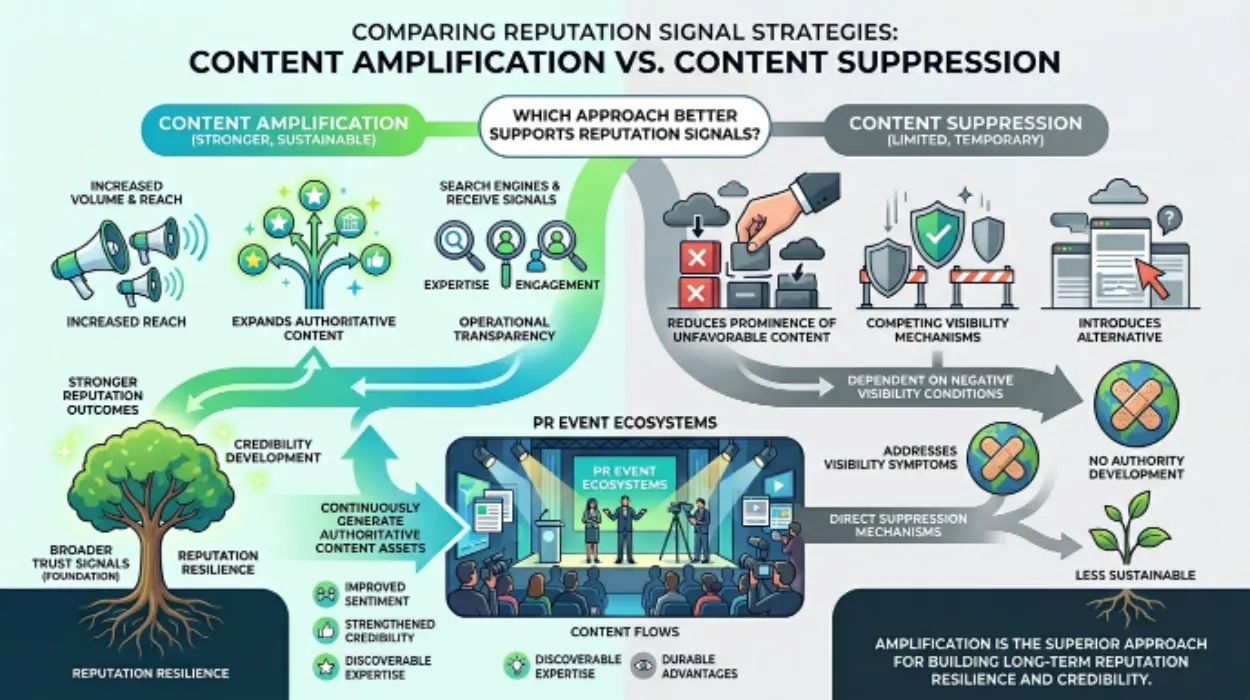
Which Approach Better Supports Reputation Signals: Content Amplification or Content Suppression?
Content amplification supports stronger long-term reputation outcomes than content suppression when evaluating sustainability and credibility development. Each approach influences visibility through distinct mechanisms.
Content amplification is a strategy that increases the volume, reach, and relevance of positive or neutral information assets. It operates by expanding the availability of authoritative content across digital ecosystems. Search engines and audiences receive stronger signals regarding institutional expertise, stakeholder engagement, and operational transparency.
Content suppression is a strategy focused on reducing the prominence of unfavourable content through competing visibility mechanisms. It operates by introducing alternative information that occupies search and attention spaces.
The comparative limitation of content suppression is its dependence on existing negative visibility conditions. The strategy addresses visibility symptoms rather than authority development. Content amplification creates a broader foundation of trust signals that supports reputation resilience.
PR event ecosystems contribute more effectively to amplification because they continuously generate authoritative content assets. These assets improve sentiment distribution, strengthen entity credibility, and increase the proportion of discoverable information associated with institutional expertise. This creates durable visibility advantages without relying on direct suppression mechanisms.
How Do Short-Term Narrative Management and Long-Term Institutional Credibility Strategies Differ?
Short-term narrative management protects immediate visibility outcomes, while long-term institutional credibility strategies establish enduring trust and authority. The difference lies in timeframe, measurement criteria, and stakeholder impact.
Narrative management is a communications framework focused on controlling message interpretation during specific events or periods of heightened attention. It operates by coordinating messaging, media engagement, and stakeholder communications to influence perception.
Institutional credibility strategy is a long-term framework designed to establish trust through consistent evidence, transparency, and authoritative communication. It operates by accumulating credibility signals across digital and stakeholder environments.
Narrative management delivers immediate benefits during event promotion, issue response, and media engagement activities. However, visibility gains decline when communication activity decreases. Institutional credibility strategies continue generating value because authority signals remain accessible and discoverable over extended periods.
A PR event functions as a catalyst within both frameworks. For narrative management, the event supports message dissemination. For institutional credibility, the event becomes a source of enduring content assets that reinforce expertise and trust signals. Organisations seeking sustainable reputation outcomes evaluate event success through long-term authority accumulation rather than short-term exposure metrics.
What Evaluation Framework Measures the Success of a PR Event Content Ecosystem?
A multi-dimensional evaluation framework measures PR event content ecosystems more effectively than attendance or media coverage metrics alone. Long-term value emerges through visibility, authority, trust, and engagement indicators.
Traditional evaluation methods focus on attendance figures, publication counts, and immediate media exposure. These metrics provide insight into event performance but offer limited analysis of ongoing influence.
A content ecosystem evaluation framework measures broader outcomes:
- Analyse search ranking influence across event-related topics.
- Measure narrative visibility within search results and digital platforms.
- Evaluate stakeholder trust indicators through engagement patterns.
- Assess sentiment distribution across owned, earned, and shared channels.
- Track entity credibility growth through authority-related signals.
This framework connects event performance to institutional visibility and reputation outcomes. It also identifies whether event-generated content continues attracting attention, generating references, and supporting stakeholder engagement after the event concludes.
The strongest ecosystems demonstrate sustained discoverability, stable reputation signals, and expanding topical authority. These characteristics indicate that event content functions as a continuing strategic asset rather than a temporary communication output.
Conclusion
PR events generate greater long-term value when structured as content ecosystems rather than isolated communications activities. The comparison between media visibility and stakeholder engagement approaches demonstrates the importance of balancing reach with credibility. The evaluation of organic and reactive communication frameworks highlights differences in sustainability, responsiveness, and authority development.
Search engines interpret event-derived content through authority signals, entity credibility indicators, and semantic relevance. Content amplification strengthens reputation outcomes through expanded visibility and trust signals, while content suppression focuses primarily on managing existing visibility challenges. The distinction between short-term narrative management and long-term institutional credibility strategies further demonstrates that sustainable reputation development depends on continuous authority accumulation.
Evaluating PR events through content ecosystem performance provides a broader understanding of visibility, stakeholder trust, sentiment distribution, and narrative influence. This approach analyses how event-generated assets continue shaping perception and search presence long after the original event has ended. Within this context, topics such as Media Relations for Sensitive Industries illustrate how communication frameworks are evaluated when scrutiny levels, stakeholder expectations, and reputation risks increase.
Frequently Asked Questions
How does a PR event contribute to long-term content visibility?
A PR event contributes to long-term content visibility when event materials are transformed into multiple digital assets. Presentations, discussions, stakeholder insights, and media coverage can be repurposed into articles, analysis pieces, FAQs, and resource pages. This approach extends search visibility beyond the event date and strengthens topical authority over time.
What is a content ecosystem in media relations?
A content ecosystem is a network of interconnected content assets built around a central topic or event. It operates by linking related resources that support the same narrative and subject area. In media relations, a content ecosystem improves authority signals, stakeholder engagement, and search discoverability through consistent thematic coverage.
Why is content amplification more effective than content suppression?
Content amplification increases the visibility of authoritative and relevant information across digital channels. This approach strengthens reputation signals, entity credibility, and stakeholder trust. Content suppression focuses on reducing the prominence of existing information, while amplification expands positive and informative content that supports long-term reputation management.
How do search engines evaluate PR event content?
Search engines evaluate PR event content through relevance, authority, credibility, and user engagement indicators. They analyse relationships between content assets, external references, topical depth, and entity associations. Structured event content that covers related topics comprehensively generates stronger authority signals than isolated announcements.
Which metrics measure the success of a PR event content ecosystem?
The most useful metrics include search ranking influence, narrative visibility, stakeholder engagement levels, sentiment distribution, and authority growth. These indicators measure how effectively event-generated content continues attracting attention and supporting institutional credibility after the original event has ended.