

Organisations operating in high-scrutiny sectors require media relations strategies that protect reputation signals, strengthen stakeholder trust signals, and ensure narrative visibility management across search ecosystems.
Effective media relations delivers SERP control, reinforces entity credibility, and stabilises public perception by ensuring accurate, authoritative narratives remain visible when stakeholders, regulators, journalists, investors, and the public evaluate an organisation.
Why Is Specialist Media Relations Essential for High-Scrutiny Industries?
Specialist media relations is the most reliable way to maintain narrative credibility in sectors where public scrutiny directly influences institutional trust and stakeholder behaviour. Industries facing regulatory oversight, political attention, public concern, or reputational sensitivity operate within an environment where every media mention contributes to search perception influence. Search engines continuously evaluate media coverage as an authority signal, while stakeholders use visible narratives to assess credibility and trustworthiness.
Media relations strengthens digital authority by ensuring accurate information reaches influential journalists and trusted publications. Positive visibility alone is not the objective. The objective is maintaining consistent narrative positioning that aligns with organisational goals, regulatory realities, and stakeholder expectations. This approach reduces risk associated with misinformation, fragmented messaging, and uncontrolled media exposure.
For sensitive industries, media coverage functions as a public validation layer. Search results containing authoritative media references reinforce entity credibility and improve institutional confidence. Organisations that actively manage media relationships establish stronger foundations for long-term reputation resilience.
Which Media Relations Approach Delivers Stronger Narrative Visibility Management?
A proactive, intelligence-led media relations framework delivers stronger narrative visibility management than reactive press outreach. Reactive engagement allows external narratives to define perception. Strategic engagement ensures organisations influence the information ecosystem before reputation challenges emerge.
Linkonize applies structured media relations methodologies designed specifically for complex and high-scrutiny sectors. The process focuses on identifying stakeholder concerns, analysing search behaviour patterns, evaluating media narratives, and aligning communication priorities with organisational objectives. This ensures messaging remains credible, relevant, and discoverable.
Narrative visibility management depends on consistent media placement across authoritative publications. When stakeholders search for information, they encounter credible coverage that supports trust formation. This strengthens reputation signals while reducing the visibility of inaccurate or outdated narratives.
The approach improves:
- Establish authoritative media positioning that strengthens digital authority.
- Secure credible editorial coverage that improves search perception influence.
- Reinforce stakeholder trust signals through consistent narrative alignment.
- Strengthen entity credibility across search and media ecosystems.
- Reduce reputation risk through proactive issue visibility management.
These outcomes create a stable foundation for sustainable institutional credibility.
How Does Media Relations Influence Stakeholder Trust and Public Credibility?
Media relations directly influences stakeholder trust because media coverage functions as third-party validation. Stakeholders place greater confidence in narratives reinforced by independent editorial sources than in self-published corporate content. This trust transfer effect strengthens institutional perception and supports long-term credibility.
Search engines also interpret authoritative media mentions as reputation signals. Publications with established editorial standards contribute to digital authority, increasing the visibility of trusted narratives. As a result, media relations affects both human perception and algorithmic evaluation simultaneously.
For sensitive industries, credibility depends on consistency. Contradictory narratives create uncertainty. Reliable media engagement ensures stakeholders repeatedly encounter aligned messaging across trusted sources. This consistency improves confidence among investors, policymakers, community groups, partners, regulators, and journalists.
Public credibility becomes measurable through indicators such as increased positive visibility, stronger branded search sentiment, improved narrative consistency, and greater stakeholder engagement with authoritative content. These outcomes support sustainable reputation growth rather than short-term publicity.
How Does Strategic Media Engagement Improve Search Perception Influence?
Strategic media engagement improves search perception influence by shaping the information users encounter during decision-making journeys. Search behaviour reflects stakeholder intent, and search results influence perception before direct engagement occurs.
Media coverage published on authoritative domains often ranks prominently for branded, industry, and issue-related search queries. This visibility influences how stakeholders interpret organisational credibility. Search users rarely separate search results from reputation assessment. They evaluate both simultaneously.
An effective media relations strategy ensures authoritative narratives dominate visibility opportunities. This strengthens SERP control by increasing the presence of trusted content associated with the organisation. The result is a search ecosystem that supports trust rather than uncertainty.
Search perception influence strengthens when organisations:
- Publish authoritative narratives through trusted media channels.
- Reinforce message consistency across multiple editorial environments.
- Increase visibility for positive reputation signals.
- Reduce prominence of inaccurate or misleading information.
- Strengthen entity associations within search ecosystems.
These mechanisms create measurable improvements in narrative visibility and stakeholder confidence.
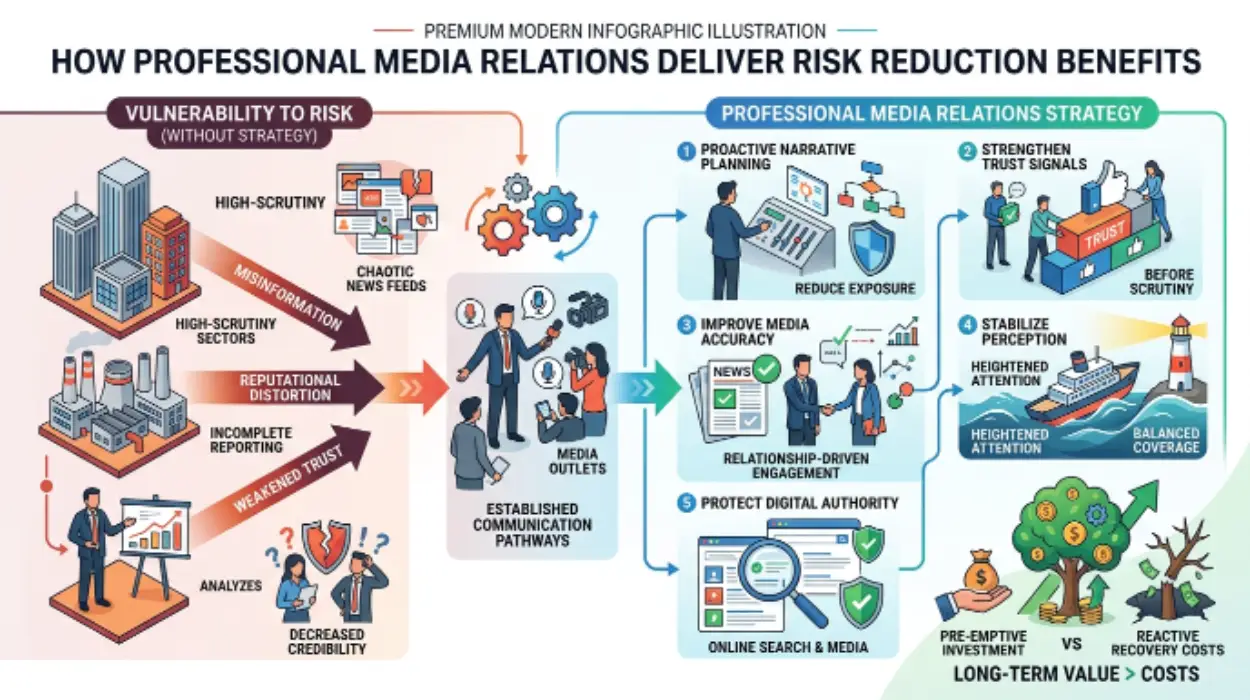
Which Risk Reduction Benefits Make Professional Media Relations a Better Investment?
Professional media relations delivers measurable risk reduction benefits that extend beyond publicity. Reputation volatility creates operational, commercial, and stakeholder challenges. Strategic media management reduces exposure to these risks by establishing stronger narrative control mechanisms.
High-scrutiny sectors face elevated expectations regarding transparency, accountability, and responsiveness. Without structured media engagement, organisations become vulnerable to misinformation, incomplete reporting, and reputational distortion. These outcomes undermine stakeholder trust and weaken institutional credibility.
A professional media relations strategy improves resilience by creating established communication pathways with relevant journalists and media outlets. Existing relationships improve information accuracy and support more balanced coverage during sensitive situations. This strengthens reputation protection before challenges emerge.
The investment delivers value through:
- Reduce reputational exposure through proactive narrative planning.
- Strengthen trust signals before scrutiny intensifies.
- Improve media accuracy through relationship-driven engagement.
- Stabilise perception during periods of heightened attention.
- Protect digital authority across search and media environments.
These outcomes provide long-term value that exceeds the cost of reactive reputation recovery.
How Does Linkonize Deliver Reliable Outcomes for Complex Industries?
Reliable outcomes depend on process clarity, strategic discipline, and evidence-driven execution. Linkonize delivers media relations services through structured frameworks that prioritise narrative credibility, stakeholder trust signals, and measurable visibility outcomes.
The process begins with detailed narrative analysis. Existing media visibility, stakeholder sentiment, search perception patterns, and authority signals are evaluated to identify opportunities and risks. This intelligence informs communication priorities and media engagement strategies.
Execution focuses on securing relevant editorial visibility while maintaining message consistency. Journalists receive information that aligns with news value requirements while accurately representing organisational priorities. This improves placement quality and strengthens credibility.
Performance monitoring ensures continuous optimisation. Visibility trends, reputation signals, media impact, and stakeholder engagement indicators provide actionable insights that guide strategic adjustments. This disciplined process improves reliability while reducing uncertainty.
The result is a media relations programme designed to strengthen institutional perception, improve search visibility, and support long-term reputation resilience.
What Long-Term Value Does Strategic Media Relations Create?
Strategic media relations creates long-term value because reputation assets compound over time. Authoritative media coverage continues influencing search visibility, stakeholder trust, and institutional perception long after publication.
Each credible media mention contributes to a broader reputation framework. Search engines evaluate these signals when determining authority. Stakeholders evaluate them when assessing credibility. This dual impact strengthens both visibility and trust simultaneously.
Sustainable value emerges through cumulative authority building. Organisations that consistently secure credible media coverage establish stronger digital authority and greater narrative resilience. This improves competitive positioning while reducing future reputation management costs.
Long-term outcomes include:
- Strengthen institutional credibility through sustained media validation.
- Improve SERP control across branded and industry-related searches.
- Increase stakeholder confidence through trusted narrative visibility.
- Enhance digital authority through authoritative media associations.
- Build durable reputation signals that support future growth.
These benefits continue generating value across stakeholder interactions, public engagement initiatives, and organisational decision-making environments.
Which Indicators Demonstrate That a Media Relations Service Is Delivering Results?
The strongest indicators combine visibility, trust, authority, and perception metrics. Effective media relations creates measurable improvements across each area rather than focusing exclusively on coverage volume.
Visibility indicators include increased presence within authoritative publications and improved search result positioning. Trust indicators include stronger stakeholder engagement with credible content and improved narrative consistency across media channels. Authority indicators include growth in high-quality media references associated with the organisation.
Decision-makers should evaluate whether media activity strengthens broader reputation objectives. Successful campaigns improve how stakeholders discover, interpret, and trust organisational information. This creates measurable improvements in search perception influence and institutional credibility.
Organisations evaluating media relations providers benefit from examining strategic methodology, reporting transparency, narrative management capabilities, and demonstrated expertise within sensitive sectors. These factors provide stronger indicators of future success than coverage volume alone.
Decision-makers seeking a professional Media Relations service gain the greatest value when media engagement supports broader reputation objectives. Understanding The Anatomy of a Great Media Pitch: What Makes Journalists Say Yes Instead of Delete helps validate how strategic outreach influences editorial success, while analysing How to Use PR Events to Generate a Content Ecosystem That Keeps Working After the Event Ends demonstrates how media visibility supports long-term authority building beyond individual campaigns.
Media relations for sensitive industries requires more than publicity. It requires disciplined narrative visibility management, stakeholder trust optimisation, and sustained reputation signal development. Linkonize provides a structured, evidence-driven approach that strengthens digital authority, improves search perception influence, and supports long-term institutional credibility. Through strategic media engagement, organisations gain reliable visibility, stronger trust signals, and a more resilient reputation framework capable of performing under scrutiny.
Frequently Asked Questions
How does media relations improve reputation management in sensitive industries?
Media relations improves reputation management by ensuring accurate and credible information appears across trusted media outlets. This strengthens reputation signals, supports stakeholder trust, and improves narrative visibility management. Consistent media coverage also enhances digital authority and helps organisations maintain greater control over public perception.
Why is media relations important for organisations facing public scrutiny?
Organisations operating under public scrutiny require strong media relations to maintain narrative credibility and stakeholder confidence. Strategic media engagement ensures accurate information reaches journalists and audiences while reducing the risk of misinformation, negative speculation, and reputational instability.
How quickly can media relations influence search visibility?
Media relations can generate visibility improvements as soon as authoritative media coverage is published and indexed by search engines. Long-term benefits increase as credible media mentions accumulate, strengthening entity credibility, search perception influence, and overall digital authority over time.
What makes media relations different from traditional public relations?
Media relations focuses specifically on building relationships with journalists, securing editorial coverage, and influencing narrative visibility through trusted media channels. Traditional public relations covers broader communication activities, while media relations directly contributes to reputation signals, SERP control, and stakeholder trust development.
How does Linkonize manage media relations for high-risk sectors?
Linkonize uses an evidence-driven approach that combines narrative analysis, stakeholder perception assessment, media outreach, and performance monitoring. This process strengthens narrative visibility management, improves search perception influence, and supports institutional credibility while reducing reputational risk in complex and high-scrutiny environments.