

Omnichannel communication is the coordinated delivery of consistent messages across all digital and offline communication channels. Inconsistent messaging reduces credibility because stakeholders evaluate trust, authority, and institutional reliability through repeated narrative alignment across interconnected information environments.
Public affairs refers to the management of relationships, communication, and perception between institutions and their stakeholders. Within digital ecosystems, omnichannel communication functions as a reputation architecture that influences stakeholder trust, search visibility, narrative influence, and institutional credibility. Search engines, media platforms, social networks, and owned content environments continuously evaluate consistency as a trust signal. When messages differ across channels, entities create conflicting reputation signals that affect perception formation and SERP evaluation. Understanding omnichannel communication therefore requires analysing how information flows through interconnected digital ecosystems and how consistency contributes to authority recognition.
What Is Omnichannel Communication Within Digital Ecosystems?
Omnichannel communication is the integration of messages, narratives, and information across all stakeholder touchpoints.
The concept refers to maintaining narrative continuity regardless of where information is discovered, consumed, or evaluated. A stakeholder encounters information through search engines, media publications, social platforms, institutional websites, newsletters, and public communications. Omnichannel communication ensures that core messages remain aligned across each environment. The objective is not message repetition but narrative consistency. Consistency creates coherent reputation signals that define entity perception across digital ecosystems. Search engines and users interpret this alignment as evidence of organisational reliability and information integrity.
Within public affairs and reputation systems, omnichannel communication functions as a visibility framework. Every digital asset contributes to a broader perception network. Search visibility improves when information remains consistent because content indexing systems recognise thematic alignment across sources. Narrative continuity also strengthens stakeholder trust because repeated information reduces interpretative ambiguity. The result is a more stable perception architecture across digital environments.
Why Does Consistent Messaging Influence Organisational Credibility?
Consistent messaging influences credibility because credibility is formed through repeated verification of information across multiple sources.
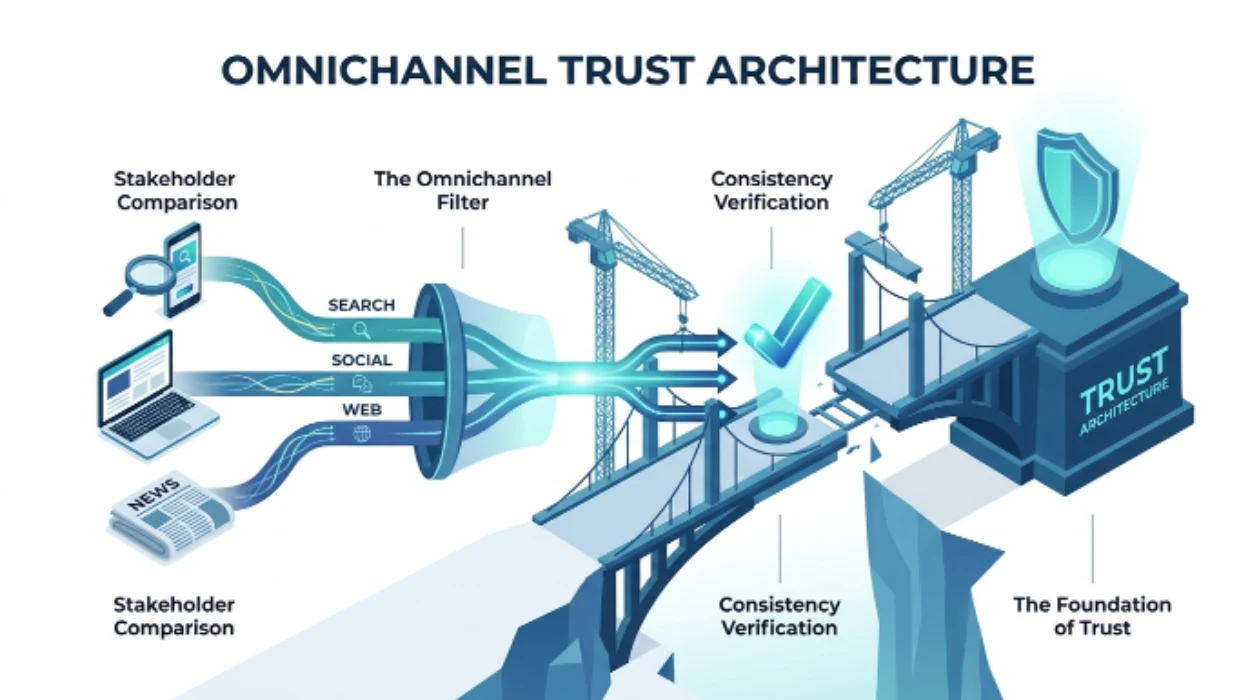
Institutional credibility refers to the perceived reliability, expertise, and trustworthiness of an entity within public and digital environments. Stakeholders rarely evaluate a single communication asset in isolation. They compare messages across websites, news coverage, social channels, public statements, and search results. Consistency enables verification. Verification strengthens confidence in the information being presented. This process establishes stronger stakeholder trust because the same narrative framework appears throughout the digital footprint.
Digital ecosystems reward consistency through authority recognition. Search engines evaluate topical relevance, entity associations, and content relationships during indexing and ranking processes. When communications reinforce identical themes and factual positions, search systems identify stronger entity coherence. Entity coherence contributes to digital authority because algorithms interpret consistent information as a signal of reliability. Credibility therefore emerges from both human interpretation and algorithmic evaluation.
How Do Search Engines Interpret Messaging Consistency?
Search engines interpret messaging consistency as a signal that helps define entity understanding and trust evaluation.
Modern search systems evaluate entities rather than isolated webpages. An entity refers to a recognisable organisation, institution, individual, or concept that exists across multiple digital sources. Search engines collect information from websites, media publications, structured data, social platforms, and external references to construct entity profiles. Consistent messaging strengthens entity recognition because thematic signals remain aligned throughout the content ecosystem.
Content indexing processes identify recurring topics, terminology, relationships, and contextual associations. When those signals remain stable, search systems develop greater confidence in entity definitions. Greater confidence improves content relevance evaluation and strengthens search visibility. Contradictory messaging creates competing interpretations that weaken entity understanding. As a result, inconsistent communication reduces clarity within search evaluation frameworks and weakens authority signals.
How Does Entity Perception Affect Search Visibility?
Entity perception is the collective understanding that search systems develop about an organisation.
Search visibility depends partly on how clearly an entity is defined across digital environments. Consistent communication reinforces identifiable themes, expertise areas, institutional priorities, and stakeholder associations. Search engines use these signals to evaluate topical authority and relevance. Strong entity perception improves the probability of appearing in relevant search results because the organisation becomes easier to categorise and understand. Clear categorisation contributes directly to stronger SERP evaluation outcomes.
What Happens When Messaging Becomes Inconsistent?
Inconsistent messaging creates conflicting reputation signals that weaken stakeholder trust and authority recognition.
A reputation signal is any piece of information that contributes to public understanding of an entity. Examples include published content, media references, executive statements, social communications, and institutional resources. When these signals contradict each other, stakeholders encounter multiple interpretations of the same organisation. This fragmentation reduces narrative clarity and complicates trust formation.
Search engines experience a similar challenge. Contradictory information disrupts entity consistency and weakens semantic relationships across content assets. Content ranking systems rely on clear contextual patterns to understand authority and relevance. Inconsistent messaging introduces ambiguity into those patterns. The result is weaker narrative influence, reduced digital authority, and diminished institutional credibility within search ecosystems.
How Do Digital Narratives Shape Stakeholder Perception?
Digital narratives shape stakeholder perception by defining how information is interpreted, connected, and remembered.
A digital narrative is the collection of themes, messages, and contextual associations attached to an entity across digital channels. Narratives influence perception because stakeholders organise information through patterns rather than isolated facts. Every article, webpage, social post, and media mention contributes to a larger interpretative framework. Consistent narratives strengthen understanding by reinforcing identical themes across multiple environments.
Narrative influence affects institutional reputation because repeated associations become perception shortcuts. Stakeholders use these shortcuts when evaluating expertise, reliability, transparency, and authority. Search engines also identify recurring narrative patterns during content evaluation. Strong narrative consistency creates clearer entity definitions and stronger relevance signals. Consequently, narrative alignment influences both human perception and algorithmic interpretation.
How Does Omnichannel Communication Support Stakeholder Trust?
Omnichannel communication supports stakeholder trust by reducing informational friction across communication environments.
Stakeholder trust refers to confidence in the accuracy, reliability, and consistency of information provided by an institution. Trust develops through predictability. When stakeholders encounter the same information across multiple channels, verification becomes easier. Easier verification increases confidence because information appears stable and coherent.
Digital ecosystems amplify the importance of verification. Information travels across search engines, media outlets, social networks, and institutional properties. Stakeholders compare sources before forming opinions. Omnichannel communication ensures that comparison produces confirmation rather than contradiction. This consistency strengthens reputation signals and improves overall trust architecture. Trust architecture refers to the collection of factors that influence confidence in an entity’s communications and public presence.
What Role Does Media Visibility Play in Reputation Formation?
Media visibility contributes to reputation formation by influencing how institutions are discovered and interpreted.
Media visibility refers to the presence of an organisation within news environments, industry publications, and digital information channels. Visibility alone does not create credibility. Credibility emerges when visible information aligns with broader organisational narratives. Consistent messaging ensures that media references reinforce existing reputation signals rather than creating competing interpretations.
Media sentiment also influences perception systems. Sentiment interpretation refers to the evaluation of positive, neutral, or negative contextual associations attached to an entity. Search engines and stakeholders both encounter sentiment signals through media coverage. Consistent communication creates stronger narrative control because institutional information remains aligned regardless of source. This alignment improves credibility assessment and supports stable reputation development.
How Does Content Ecosystem Alignment Affect Digital Authority?
Content ecosystem alignment affects digital authority because authority is evaluated through relationships between interconnected information assets.
A content ecosystem consists of all digital assets associated with an organisation. These assets include websites, articles, reports, social content, media mentions, and public communications. Search engines analyse relationships between these assets to understand expertise and relevance. Alignment strengthens those relationships because recurring themes create semantic consistency.
Digital authority refers to the perceived expertise and reliability of an entity within a defined subject area. Authority emerges when content assets consistently reinforce the same topical signals. Misalignment weakens authority because conflicting information reduces interpretative certainty. Search systems therefore evaluate content ecosystems as interconnected networks rather than isolated publications. Strong alignment creates stronger authority signals and improved search visibility.
Which Factors Strengthen Content Ecosystem Alignment?
Content ecosystem alignment strengthens when communication assets reinforce identical thematic structures.
- Define consistent terminology by maintaining identical entity descriptions across websites, media references, and institutional content.
- Reinforce topical expertise by publishing content that supports clearly defined subject associations and expertise areas.
- Maintain narrative continuity by ensuring strategic messages remain consistent across all indexed communication channels.
- Align information architecture by organising content around coherent topics that strengthen semantic relationships.
These mechanisms improve content indexing, entity recognition, and authority evaluation across digital ecosystems.
Why Is Omnichannel Communication Relevant to Public Affairs?
Omnichannel communication is relevant to public affairs because public perception develops across interconnected information environments.
Public affairs involves the management of stakeholder relationships, institutional visibility, and public understanding. Digital ecosystems have expanded the number of channels through which perception is formed. Stakeholders evaluate organisations through search results, media coverage, public statements, and digital content assets simultaneously. Omnichannel communication provides a framework for maintaining consistency across these environments.
Institutional credibility depends on the stability of information available to stakeholders. Consistent communication strengthens trust signals, improves entity perception, and supports clearer narrative influence. Public affairs objectives therefore intersect directly with digital communication structures because perception formation increasingly occurs within searchable and indexable environments. Understanding omnichannel communication provides insight into how credibility is established, maintained, and evaluated across modern information ecosystems.
Conclusion
Omnichannel communication is a system for maintaining narrative consistency across interconnected communication channels. Within digital ecosystems, consistency influences stakeholder trust, entity perception, search visibility, and institutional credibility. Search engines evaluate coherent information patterns when interpreting authority, while stakeholders use narrative alignment to verify reliability and expertise.
Inconsistent messaging disrupts reputation signals, weakens digital authority, and creates ambiguity in both human and algorithmic evaluation processes. Consistent communication strengthens content ecosystem alignment, supports trust architecture, and improves the clarity of institutional narratives. As public affairs, reputation management, and digital advocacy become increasingly connected to searchable information environments, omnichannel communication remains a foundational mechanism for shaping how organisations are understood across digital ecosystems.
A deeper understanding of How to Measure PR Success Beyond Clip Counts: The Metrics That Show Real Business Impact provides additional context for evaluating how communication effectiveness influences visibility, credibility, and stakeholder perception.
Frequently Asked Questions
What is the difference between omnichannel communication and multichannel communication?
Omnichannel communication focuses on maintaining consistent messaging across all communication channels. Multichannel communication refers to using multiple channels without necessarily integrating messages or narratives between them. Omnichannel strategies prioritise narrative alignment, while multichannel approaches prioritise channel presence.
Why does inconsistent messaging damage organisational credibility?
Inconsistent messaging creates conflicting reputation signals across digital ecosystems. Stakeholders compare information from websites, media coverage, social platforms, and search results before forming opinions. When information differs between sources, trust declines because verification becomes more difficult.
How does omnichannel communication affect search visibility?
Omnichannel communication improves search visibility by strengthening entity perception and content consistency. Search engines analyse relationships between digital assets to understand authority and relevance. Consistent messaging creates clearer topical associations, which supports content indexing and SERP evaluation.
What are reputation signals in digital ecosystems?
Reputation signals are pieces of information that influence how stakeholders and search engines perceive an organisation. These signals include media mentions, published content, social communications, institutional statements, backlinks, and search results. Consistent reputation signals contribute to stronger digital authority and stakeholder trust.
How does omnichannel communication support public affairs objectives?
Omnichannel communication supports public affairs by ensuring that institutional narratives remain consistent across stakeholder touchpoints. Consistent communication strengthens credibility, improves narrative influence, and creates a more reliable information environment. This alignment helps maintain institutional trust within digital and public perception systems.