

Public relations success is measured through changes in visibility, stakeholder perception, trust signals, and organisational outcomes rather than media clip volume alone. Metrics that demonstrate real business impact evaluate how media exposure influences reputation signals, narrative visibility, engagement quality, and institutional credibility.
Public affairs strategies differ based on how organisations prioritise visibility, stakeholder influence, and long-term trust development. Digital advocacy methods are evaluated through their effect on reputation signals, search ranking influence, sentiment distribution, and stakeholder trust across interconnected digital ecosystems.
Why Are Clip Counts Considered an Incomplete Measure of PR Success?
Clip counts measure media exposure volume rather than communication effectiveness. They quantify the number of media mentions an organisation receives but do not evaluate whether those mentions improve stakeholder trust, narrative visibility, or institutional credibility.
Media coverage volume operates by tracking publication frequency across news outlets, trade publications, and digital media platforms. This approach provides a surface-level indication of visibility but excludes contextual variables such as sentiment distribution, message retention, and audience relevance. An organisation can achieve extensive coverage while experiencing declining stakeholder trust if negative narratives dominate the conversation.
Business-impact metrics analyse outcomes rather than outputs. They evaluate how media exposure affects stakeholder perception, website engagement, search ranking influence, policy awareness, investor confidence, or organisational authority. This framework compares communication effectiveness against strategic objectives rather than measuring publication activity in isolation.
Clip counts remain useful for benchmarking media activity levels. However, they provide limited insight into whether communication efforts contribute to narrative control, reputation resilience, or long-term entity credibility.
Which Metrics Better Demonstrate Business Impact Than Media Volume?
Outcome-focused metrics provide stronger indicators of organisational impact because they connect communication activity with measurable stakeholder responses. These metrics evaluate influence rather than exposure alone.
How Does Share of Voice Compare with Clip Counts?
Share of voice is a comparative visibility metric that measures an organisation’s presence relative to competitors, institutions, or advocacy groups within a defined topic area. Clip counts measure only the volume of mentions attributed to a single organisation.
Share of voice operates by analysing the proportion of media coverage associated with a specific entity within a broader conversation. This mechanism evaluates competitive narrative visibility and identifies whether organisations dominate or lose influence within strategic discussions.
Compared with clip counts, share of voice provides stronger insight into agenda-setting capability and public discourse participation. However, share of voice does not assess whether visibility generates positive stakeholder perception or reinforces institutional credibility.
How Does Referral Traffic Reflect PR Effectiveness?
Referral traffic is a behavioural metric that measures audience movement from media coverage to organisational digital assets. It evaluates whether media visibility stimulates meaningful stakeholder engagement.
This metric operates by tracking visits originating from news publications, industry websites, and online commentary platforms. Referral patterns reveal audience interest, content relevance, and message resonance.
Compared with media volume metrics, referral traffic demonstrates stronger evidence of stakeholder action. However, traffic alone does not confirm trust formation or reputation enhancement. Evaluation requires integration with engagement quality indicators such as dwell time, conversion behaviour, and content interaction.
How Does Engagement Quality Compare with Reach Metrics?
Engagement quality evaluates audience interaction depth, while reach metrics evaluate audience exposure scale. Reach measures how many people potentially encountered a message, whereas engagement quality measures behavioural responses.
Engagement quality operates through indicators such as reading completion rates, content sharing behaviour, stakeholder comments, policy document downloads, and newsletter subscriptions. These actions reveal active interest rather than passive exposure.
Reach metrics provide visibility benchmarks but offer limited evidence of influence. Engagement quality delivers stronger insight into stakeholder attention and message absorption, although measurement complexity increases across fragmented digital channels.
How Do Sentiment Metrics Compare with Visibility Metrics?
Sentiment metrics evaluate perception quality, while visibility metrics evaluate exposure quantity. Effective reputation assessment requires analysis of both dimensions simultaneously.
Sentiment analysis is the process of categorising public discussion according to positive, neutral, or negative reputation signals. Visibility analysis measures the prominence and frequency of organisational mentions across digital and traditional media environments.
Sentiment measurement operates by analysing language patterns, contextual framing, stakeholder commentary, and media narratives. This process identifies whether increased visibility strengthens or weakens institutional credibility.
Visibility metrics indicate awareness levels but fail to explain stakeholder attitudes. Sentiment metrics reveal perception shifts but require contextual interpretation because emotional polarity does not always align with strategic objectives. Public affairs campaigns addressing controversial policy topics frequently generate increased negative sentiment while successfully influencing agenda visibility.
The strongest evaluation framework combines visibility and sentiment analysis to understand both narrative reach and narrative quality.
How Can Search Visibility Metrics Demonstrate Long-Term PR Value?
Search visibility metrics demonstrate how communication activities influence digital authority and information discoverability. These measurements assess the durability of reputation outcomes beyond immediate media exposure.
Search engines evaluate authority through entity recognition, source credibility, citation patterns, content relevance, and user engagement signals. PR activities contribute to these mechanisms by generating authoritative references, trusted mentions, and topical associations.
How Does Branded Search Growth Compare with Media Coverage Volume?
Branded search growth measures increases in searches for an organisation, institution, or public figure. Media coverage volume measures publication frequency without evaluating audience curiosity or awareness development.
Branded search behaviour operates as an indicator of stakeholder interest. Increased search demand suggests audiences actively seek additional information after exposure to media narratives.
Compared with clip counts, branded search growth provides stronger evidence of awareness generation and narrative penetration. However, interpretation requires sentiment analysis because heightened search activity can originate from positive or negative events.
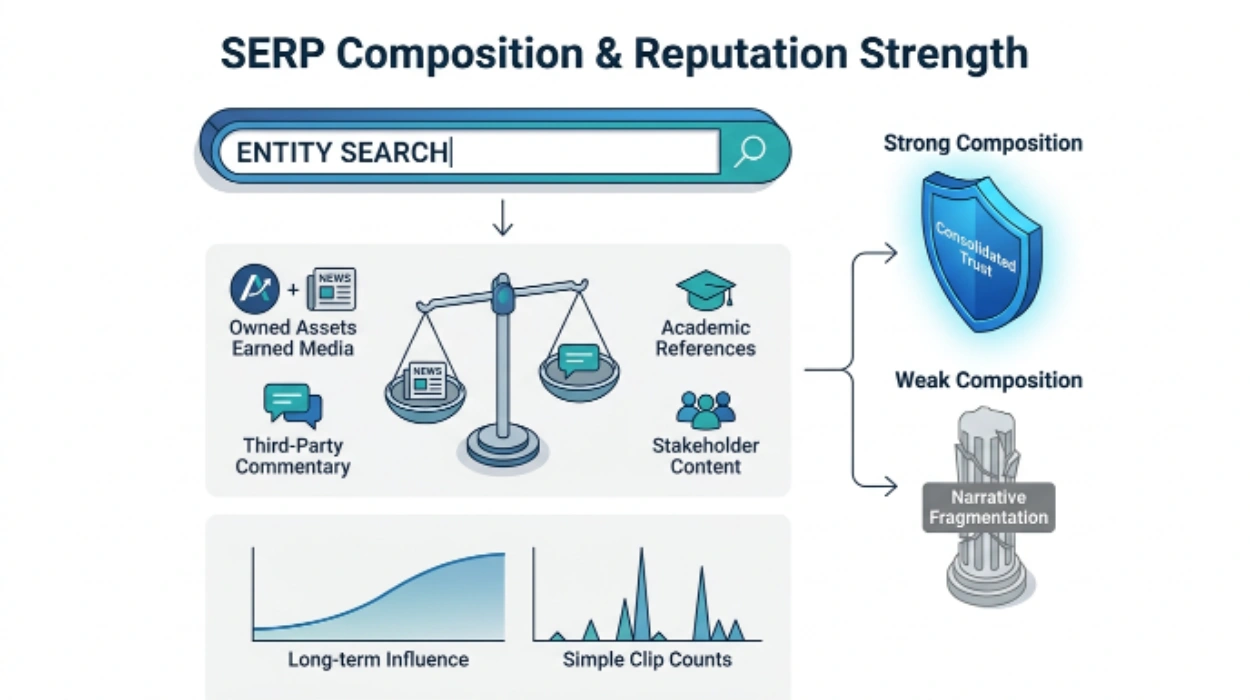
How Does SERP Composition Reflect Reputation Strength?
SERP composition is the distribution of content sources appearing within search engine results for an organisation, policy issue, or institutional entity. It evaluates narrative visibility within information discovery environments.
SERP composition operates by analysing the balance between owned assets, earned media coverage, third-party commentary, academic references, and stakeholder-generated content. Search engines interpret these sources collectively when establishing authority and relevance.
Strong SERP composition reinforces stakeholder trust by presenting authoritative and consistent information. Weak SERP composition increases exposure to narrative fragmentation, misinformation, and reputation volatility. Compared with clip counts, SERP analysis provides a more sustainable assessment of long-term visibility influence.
Which Approach Is More Effective: Reactive Communication or Strategic Reputation Measurement?
Strategic reputation measurement provides stronger long-term evaluation because it assesses systemic performance rather than isolated communication events. Reactive communication measurement focuses on immediate outputs generated during specific incidents or campaigns.
Reactive frameworks operate by tracking media mentions, press coverage volume, response speed, and short-term sentiment fluctuations. These metrics provide rapid feedback during crises, policy disputes, or reputational challenges.
Strategic measurement frameworks analyse longitudinal changes in stakeholder trust, narrative visibility, search ranking influence, and institutional credibility. This approach identifies cumulative reputation development over extended periods.
Reactive measurement supports short-term issue management but provides limited visibility into sustained organisational authority. Strategic measurement enables evaluation of reputation resilience, stakeholder confidence, and digital ecosystem performance.
Comparative analysis demonstrates that organisations requiring policy influence, public trust, or sector leadership benefit from strategic evaluation models that extend beyond campaign-specific reporting.
How Do Stakeholder Trust Metrics Compare with Media Performance Metrics?
Stakeholder trust metrics evaluate confidence, credibility, and relationship quality. Media performance metrics evaluate communication distribution and exposure.
Trust measurement operates through stakeholder surveys, institutional reputation assessments, policy engagement rates, consultation participation, and long-term sentiment trends. These indicators reflect perceptions of reliability, transparency, and competence.
Media performance metrics analyse publication frequency, audience reach, and message distribution. These measurements explain communication activity but do not necessarily explain stakeholder confidence.
Trust metrics provide stronger evidence of organisational legitimacy because they reflect behavioural and attitudinal outcomes. However, trust measurement requires extended observation periods and methodological consistency.
Media performance data remains valuable for understanding communication efficiency. Combined analysis provides a more complete picture of reputation development and stakeholder relationship strength.
What Is the Difference Between Content Amplification and Content Suppression Metrics?
Content amplification metrics evaluate narrative expansion, while content suppression metrics evaluate narrative displacement within digital information environments.
Content amplification operates by increasing the visibility of specific narratives through media coverage, stakeholder engagement, authoritative citations, and digital distribution. Measurement focuses on reach growth, engagement quality, and search visibility improvements.
Content suppression operates by reducing the prominence of undesirable narratives through stronger competing content, improved authority signals, and enhanced information relevance. Measurement focuses on changes in SERP composition, declining visibility of negative content, and reduced narrative prominence.
Amplification metrics assess proactive communication success. Suppression metrics assess reputation risk mitigation effectiveness. Both approaches influence narrative visibility, but amplification focuses on expansion whereas suppression focuses on repositioning information hierarchy.
Comparative evaluation demonstrates that amplification contributes to authority development, while suppression contributes to reputation protection. Sustainable reputation strategies integrate both mechanisms within broader institutional credibility frameworks.
Which Measurement Framework Provides the Most Complete View of PR Success?
Integrated measurement frameworks provide the most complete assessment because they evaluate visibility, engagement, trust, and authority simultaneously. Single-metric approaches isolate one dimension of performance while overlooking broader organisational outcomes.
An effective framework operates by combining media visibility metrics, sentiment distribution analysis, search ranking influence indicators, stakeholder trust measurements, and behavioural engagement data. This structure captures both immediate communication effects and long-term reputation outcomes.
Evaluation across public affairs, digital advocacy, and media relations environments demonstrates that organisational credibility develops through cumulative interactions rather than isolated media mentions. Search engines, stakeholders, policymakers, and digital platforms interpret authority through interconnected trust signals rather than publication volume alone.
Compared with clip-count reporting, integrated measurement frameworks provide stronger insight into narrative visibility, stakeholder perception, institutional trust, and reputation resilience. They also provide greater scalability for evaluating long-term communication effectiveness across evolving digital ecosystems.
Conclusion
Measuring PR success beyond clip counts requires analysis of outcomes rather than communication outputs. Visibility metrics explain exposure levels, while sentiment distribution, stakeholder trust indicators, search visibility metrics, and engagement quality measurements explain influence and credibility.
Comparative evaluation shows that media volume metrics provide operational visibility but limited insight into reputation performance. Strategic measurement frameworks assess authority development, stakeholder perception, narrative visibility, and institutional trust across digital ecosystems.
Long-term reputation assessment depends on integrated analysis that combines visibility, engagement, trust signals, search ranking influence, and behavioural outcomes. This approach provides a more complete understanding of how public affairs, digital advocacy, and media relations activities contribute to sustainable institutional credibility.
Within broader communication strategy evaluation, organisations frequently examine What Is Omnichannel Communication and Why Inconsistent Messaging Costs Organizations Credibility? when assessing message consistency and stakeholder trust formation across channels.
Measurement frameworks are also frequently discussed alongside Request a Media Relations Proposal from the Linkonize Team when evaluating how media relations activities contribute to broader reputation and visibility objectives.
Frequently Asked Questions
What is the most important metric for measuring PR success?
There is no single metric that fully measures PR success. Effective evaluation combines visibility, sentiment distribution, stakeholder trust, engagement quality, and search visibility indicators. These metrics provide a broader understanding of communication impact than media coverage volume alone.
Why are clip counts still used in PR reporting?
Clip counts remain useful because they provide a simple measure of media exposure and publication activity. They help track campaign output and media relations performance. However, they do not explain how coverage influences stakeholder perception, reputation signals, or organisational credibility.
How does sentiment analysis improve PR measurement?
Sentiment analysis evaluates whether media coverage and public discussions create positive, neutral, or negative reputation signals. This measurement helps organisations understand how audiences interpret communication efforts and whether visibility contributes to stakeholder trust or reputational risk.
What role does search visibility play in reputation measurement?
Search visibility measures how easily stakeholders can discover information about an organisation through search engines. Strong search visibility supports narrative visibility, entity credibility, and institutional authority. It also reveals how earned media influences search ranking influence and SERP composition.
How can organisations connect PR performance to business outcomes?
Organisations connect PR performance to business outcomes by analysing referral traffic, stakeholder engagement, branded search growth, sentiment trends, and trust indicators. These measurements demonstrate whether communication activities influence awareness, credibility, engagement behaviour, and long-term reputation development.