

A communications war room is a coordinated crisis response system that centralises narrative control, information verification, and digital messaging across all communication channels when a crisis breaks.
Public affairs refers to the structured management of relationships between institutions, stakeholders, and governance environments within digital ecosystems. Digital advocacy is the strategic shaping of narratives across search engines, media platforms, and networked publics to influence perception and engagement. Online reputation refers to the aggregated entity perception formed through SERP evaluation, content indexing, and authority signals across digital environments.
What defines a communications war room in digital crisis ecosystems?
A communications war room is a structured coordination hub that centralises crisis communication, narrative governance, and real-time information validation within digital ecosystems. It defines a controlled operational environment where institutional messaging aligns across media channels, search platforms, and stakeholder interfaces. The system operates as a semantic control layer for reputation signals, ensuring coherence between internal intelligence and external communication outputs.
A communications war room functions through integrated monitoring, decision synchronisation, and content deployment mechanisms. It aggregates data from news cycles, social platforms, and search engine results pages to evaluate entity perception in real time. This process ensures that misinformation, narrative fragmentation, and reputational distortion receive immediate correction through coordinated messaging outputs.
The impact of a communications war room extends into search visibility, digital authority, and institutional credibility. It stabilises SERP evaluation by reinforcing consistent narrative signals across indexed content. It also strengthens trust architecture by reducing contradictory messaging across stakeholder touchpoints, ensuring a unified perception of organisational intent and action.
How does a communications war room influence search visibility and SERP evaluation during a crisis?
A communications war room directly influences search visibility by controlling the flow, structure, and timing of crisis-related content published across digital channels. It ensures that search engines index authoritative statements before fragmented or external narratives dominate SERP positions. This process defines how institutional reputation appears in query-based environments where perception is formed through ranking hierarchy.
Search engine systems evaluate credibility through content freshness, semantic consistency, and authority signals. A communications war room orchestrates these variables by synchronising press releases, official statements, and verified updates. This alignment strengthens digital authority and reduces algorithmic amplification of conflicting narratives that distort entity perception.
SERP evaluation during crisis conditions depends on coherence across multiple indexed sources. A communications war room enforces narrative alignment across owned media, third-party references, and structured announcements. This alignment stabilises ranking volatility and ensures that authoritative content remains dominant in search visibility layers.
How do communications war rooms structure authority and decision flow?
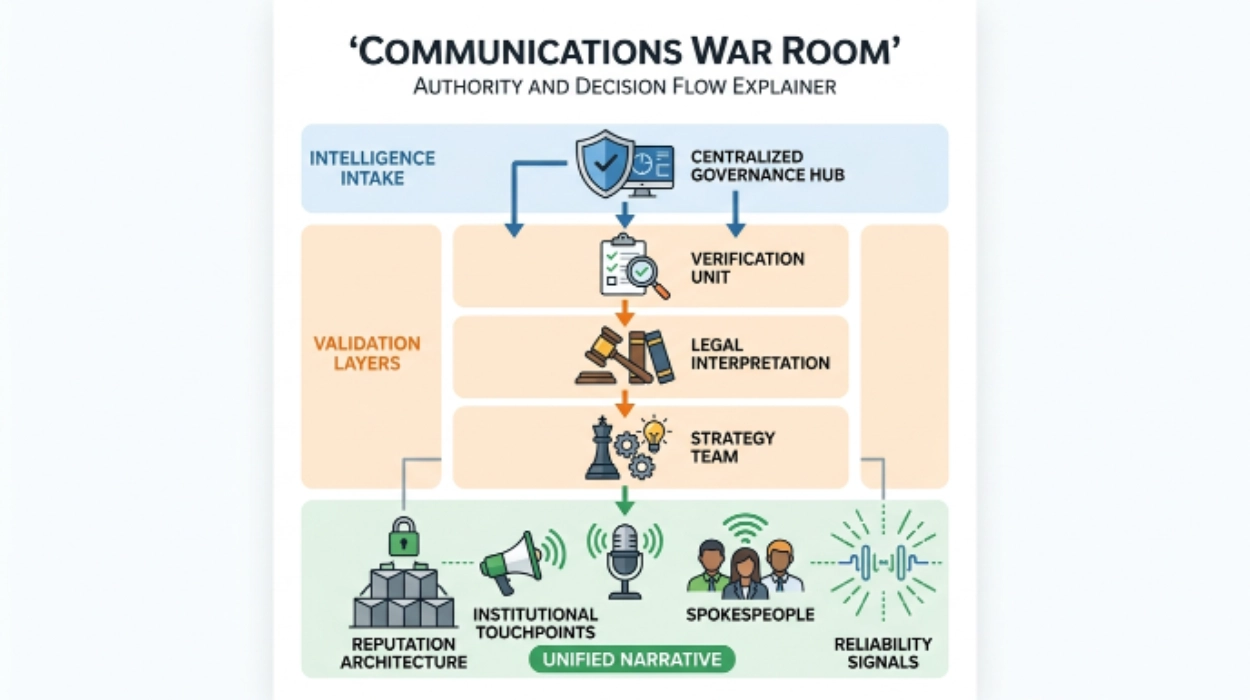
A communications war room structures authority through hierarchical decision pathways that define message approval, verification protocols, and publication sequencing. It establishes a centralised governance model where crisis intelligence flows through designated roles before reaching external communication channels. This structure ensures precision in narrative control and eliminates fragmented messaging across institutional touchpoints.
Decision flow within a communications war room operates through layered validation stages. Information passes through verification units, legal interpretation nodes, and communication strategy teams before publication. This process ensures that all outputs align with institutional credibility standards and digital reputation frameworks.
The impact of structured authority flow extends to stakeholder trust and entity perception stability. Consistent decision pathways reduce contradiction across public statements, reinforcing reliability signals within digital ecosystems. This strengthens long-term reputation architecture by embedding consistency into communication behaviour.
How does narrative control operate within a communications war room?
A communications war room operates narrative control by defining the sequencing, framing, and distribution of crisis-related information across digital ecosystems. Narrative control refers to the ability to structure how events are interpreted through authoritative messaging rather than external speculation. It shapes perception by ensuring that institutional explanations dominate early information cycles.
Narrative control functions through coordinated publishing systems that regulate timing and message alignment. It ensures that official statements enter search indexing cycles before secondary interpretations reshape public understanding. This process stabilises digital authority by embedding primary narratives into content ecosystems.
The impact of narrative control extends into stakeholder perception and algorithmic interpretation. Search engines and media aggregators prioritise early authoritative content, which influences how crises are framed across SERPs. This establishes a controlled perception environment where institutional credibility remains anchored to verified communication outputs.
How do algorithms interpret trust signals during crisis communication activity?
Algorithms interpret trust signals through structured analysis of content authority, publication consistency, and engagement patterns across digital ecosystems. A communications war room strengthens these signals by producing verified, semantically consistent outputs that align across multiple indexed sources. These signals determine how search systems rank crisis-related content.
Trust signals include domain authority, content freshness, entity consistency, and cross-platform validation. A communications war room ensures that these signals remain stable by coordinating publication timing and message uniformity. This reduces algorithmic uncertainty and improves the reliability score assigned to institutional content.
Algorithmic interpretation of trust directly shapes visibility outcomes in SERPs. Consistent messaging improves ranking stability, while fragmented narratives weaken authority perception. A communications war room therefore functions as a stabilisation mechanism for trust architecture within dynamic information environments.
How does stakeholder perception change through coordinated crisis messaging?
Stakeholder perception changes through coordinated crisis messaging by aligning institutional narratives with consistent, verified information across digital touchpoints. A communications war room ensures that stakeholders receive uniform explanations across search engines, media platforms, and official communication channels. This alignment defines how credibility is interpreted under crisis pressure.
Perception shifts occur when stakeholders evaluate message consistency, response speed, and informational clarity. A communications war room reduces ambiguity by synchronising all public outputs into a single narrative framework. This reduces interpretive fragmentation and strengthens trust formation within digital ecosystems.
The impact of coordinated messaging extends into long-term reputation stability. Stakeholders form entity perception based on repeated exposure to consistent signals across SERPs and media indexing systems. A communications war room reinforces these signals to ensure narrative coherence remains intact throughout crisis cycles.
How does a crisis holding statement integrate into communications war room activation?
A crisis holding statement integrates into communications war room activation as the initial structured response unit that stabilises early narrative conditions. It defines the first layer of institutional messaging used to control uncertainty, establish acknowledgment, and guide subsequent communication development within digital ecosystems.
The function of a crisis holding statement operates through rapid publication across owned channels and search-indexable platforms. It ensures that authoritative content enters SERP environments before speculative narratives dominate visibility. This stabilises early-stage entity perception and strengthens credibility signals during high volatility periods.
A communications war room coordinates the drafting, approval, and distribution of holding statements through structured decision flow systems. This ensures alignment between legal interpretation, communication strategy, and stakeholder messaging. The process reduces narrative fragmentation and reinforces trust architecture at the earliest stage of crisis response.
The role of holding statements extends into search visibility and digital authority formation. Early publication creates indexed reference points that guide algorithmic interpretation of subsequent information. This establishes a controlled narrative baseline that shapes how all later crisis communication is evaluated.
Conclusion: how communications war rooms shape digital perception systems
A communications war room defines a centralised mechanism for managing crisis communication across digital ecosystems where reputation, trust, and authority are continuously evaluated. It structures narrative control, decision flow, and information validation into a coordinated system that influences how institutions are perceived across search engines and media environments.
Its impact extends across SERP evaluation, algorithmic trust interpretation, stakeholder perception, and narrative consistency. Each operational layer reinforces institutional credibility by ensuring that communication outputs remain aligned, verified, and semantically coherent across all digital touchpoints.
The integration of structured response mechanisms, including early-stage messaging frameworks such as crisis holding statements, demonstrates how controlled communication environments stabilise reputation signals during high-uncertainty events. This establishes a predictable architecture of digital authority that governs how crises are interpreted and indexed across information systems.
Frequently Asked Questions
What is a communications war room in crisis management?
A communications war room is a centralised coordination structure used during crises to manage messaging, monitor digital narratives, and control information flow. It operates as a real-time decision hub where institutional communication is aligned across media channels, search platforms, and stakeholder networks. The system ensures that verified information is prioritised and distributed consistently. It also stabilises entity perception by reducing contradictory or fragmented messaging. In digital ecosystems, it functions as a mechanism for maintaining search visibility and protecting institutional credibility during high-risk events.
How does a communications war room improve crisis response speed?
A communications war room improves crisis response speed by centralising decision-making and eliminating fragmented approval chains. Information is rapidly validated, structured, and released through coordinated communication pathways. This reduces delays between incident detection and public messaging. It also ensures that search engines and media platforms index authoritative content early in the crisis cycle. Faster response timing strengthens digital authority signals and reduces the visibility of unverified narratives.
Why is narrative control important in a communications war room?
Narrative control is important because it determines how a crisis is interpreted across digital ecosystems. A communications war room structures messaging to ensure that official explanations dominate early information cycles. This reduces misinformation spread and stabilises SERP evaluation. Narrative control also ensures semantic consistency across press statements, social updates, and institutional communications. The result is stronger reputation stability and improved trust signals across stakeholder networks.
How do communications war rooms affect online reputation?
Communications war rooms affect online reputation by shaping how information is indexed, ranked, and interpreted in search engines and media platforms. They ensure that consistent, authoritative content is published across all digital channels. This strengthens digital authority and improves entity perception in SERP environments. By coordinating messaging, they reduce contradictions that weaken trust signals. Over time, this maintains a stable reputation architecture even under crisis pressure.
What role does search visibility play in a communications war room?
Search visibility plays a central role because it determines which narratives dominate public interpretation of a crisis. A communications war room ensures that official statements are prioritised for indexing by search engines. It aligns content publication with ranking signals such as freshness, authority, and semantic consistency. This ensures that accurate information remains visible above speculative or external content. Strong search visibility reinforces institutional credibility during high-intensity information events.