

Crisis communication fails when organisations misunderstand how digital perception systems interpret silence, messaging consistency, and narrative control. The most damaging failures emerge from three decisions: delayed response, reactive narrative framing, and inconsistent information governance.
Public affairs refers to the management of relationships between institutions, stakeholders, policymakers, media ecosystems, and public audiences. Online reputation refers to the collection of trust signals, authority indicators, sentiment patterns, and visibility factors that shape how an entity is interpreted across digital ecosystems.
Why does crisis communication fail in digital perception systems?
Crisis communication fails because digital ecosystems evaluate information faster than institutions produce it.
A crisis is a disruption in perception stability. Within digital environments, crises are not defined solely by operational events. A crisis becomes visible when information gaps emerge and competing narratives begin influencing stakeholder interpretation. Search engines, media publishers, social platforms, and public commentary systems create a distributed environment where information is continuously indexed, evaluated, and ranked.
The mechanism of failure begins when institutions assume communication is linear. Digital ecosystems function through interconnected signals that influence search visibility, content indexing, media prominence, and stakeholder engagement. Information spreads across multiple channels simultaneously, creating parallel narratives that search systems and audiences evaluate in real time. Delayed institutional responses create opportunities for external interpretations to become dominant reputation signals.
The impact extends beyond immediate visibility. Search engine results pages (SERPs) capture and preserve narrative momentum through ranking systems. Once a narrative becomes associated with an entity, subsequent content is evaluated within that contextual framework. Institutional credibility becomes linked to the consistency, authority, and accessibility of information available across the digital footprint.
What are the three decisions that make crisis communication worse?
Three decisions consistently intensify crisis communication failures: delaying response, allowing external narrative ownership, and creating message inconsistency.
These decisions weaken institutional visibility within information ecosystems. They reduce control over reputation signals and increase reliance on external interpretations. Search systems, media organisations, and stakeholder audiences interpret information availability as part of overall entity perception.
Each decision affects how authority, trust, and credibility are evaluated. The result is reduced narrative influence and increased dependence on third-party content to define institutional meaning.
How does delaying a response damage stakeholder trust?
Delaying a response creates an information vacuum that external actors fill.
Stakeholder trust depends on information accessibility. When institutions fail to establish an initial position, alternative sources become the primary reference points for understanding events. Media coverage, public commentary, and independent analysis gain disproportionate visibility because they satisfy immediate informational demand. Search engines prioritise available content for indexing and ranking, reinforcing early narrative dominance.
The mechanism is driven by information scarcity. Digital systems reward content availability and topical relevance. During a crisis, search demand increases rapidly, creating heightened competition for visibility. Institutions that delay communication reduce their opportunity to establish authoritative content assets. External sources accumulate citations, engagement signals, and relevance indicators that strengthen search performance.
The impact is long-term. Stakeholders often encounter archived coverage and indexed commentary long after the event concludes. These assets continue contributing to entity perception, influencing credibility assessments and institutional trust evaluations.
How does external narrative ownership reduce institutional authority?
External narrative ownership occurs when third parties define the meaning of an event before the institution does.
Authority is established through interpretive leadership. Institutions strengthen authority when they provide accurate, accessible, and contextual information that explains developments. When external actors become the primary interpreters, institutional voices shift from defining narratives to responding to narratives. This transition alters perception dynamics across digital ecosystems.
The mechanism relies on visibility distribution. Media organisations, commentators, industry analysts, and public stakeholders generate content that frames events. Search engines evaluate these sources based on relevance, authority, and engagement. If institutional content lacks visibility or clarity, third-party interpretations become the dominant sources within SERP evaluation processes.
The impact extends into digital authority formation. Stakeholders repeatedly encountering external interpretations begin associating those narratives with institutional identity. Authority becomes fragmented because the organisation no longer serves as the primary source of contextual understanding.
Why does message inconsistency weaken credibility?
Message inconsistency introduces conflicting reputation signals across digital channels.
Credibility depends on informational coherence. Stakeholders evaluate whether institutional communications align across websites, media statements, executive commentary, social platforms, and public documentation. Inconsistencies create uncertainty regarding information reliability. Digital ecosystems capture and preserve these contradictions through content indexing and archiving processes.
The mechanism involves signal conflict. Search systems analyse relationships between content assets, references, and entity associations. When multiple institutional messages present different explanations, interpretations, or priorities, credibility indicators weaken. Journalists, analysts, and stakeholders often highlight discrepancies, increasing visibility of the inconsistency itself.
The impact affects stakeholder trust architecture. Trust develops through repeated confirmation of reliability. Contradictory messaging interrupts that process, making future communications subject to greater scrutiny and reduced confidence.
How do digital narratives influence crisis outcomes?
Digital narratives define how information is organised, interpreted, and remembered.
A narrative is a structured explanation that connects events, causes, consequences, and institutional behaviour. Within digital ecosystems, narratives influence search visibility, media framing, audience interpretation, and stakeholder perception. They function as organising frameworks that help users understand complex developments.
The mechanism operates through repetition and reinforcement. Search engines identify relationships between entities, topics, and contextual references. When a narrative appears consistently across authoritative sources, it gains semantic strength. Content indexing systems associate recurring themes with institutional entities, creating persistent perception patterns.
The impact on reputation is substantial. Narrative influence affects how future information is interpreted. New content does not enter a neutral environment. Instead, it is evaluated alongside existing associations, historical coverage, and established sentiment indicators. This process shapes institutional credibility and public trust.
How do search engines evaluate trust and authority during a crisis?
Search engines evaluate trust and authority through reputation signals, content quality indicators, and entity relationships.
Digital authority refers to the perceived reliability and expertise associated with an entity within online ecosystems. Search systems assess authority through signals such as source consistency, citation patterns, content relevance, expertise indicators, and topical depth. During a crisis, these evaluations become particularly significant because information demand increases.
The mechanism involves entity recognition and contextual validation. Search engines analyse whether content aligns with established knowledge structures and recognised entities. Authoritative content demonstrates clarity, factual consistency, and strong contextual relationships. These characteristics strengthen ranking potential and increase visibility within search results.
The impact affects institutional perception directly. High-ranking content often becomes the primary source of stakeholder understanding. Visibility therefore functions as a trust amplifier. Institutions with strong authority signals maintain greater influence over narrative interpretation and information discovery.
What role do reputation signals play in search visibility?
Reputation signals help search systems determine informational reliability.
Reputation signals include citations, authoritative references, topical relevance, sentiment patterns, consistency indicators, and engagement metrics. These signals contribute to the broader assessment of entity trustworthiness. Search engines use them to evaluate whether content deserves prominent placement within search results.
The mechanism is based on comparative evaluation. Search systems analyse multiple content assets covering similar topics. Content associated with stronger reputation signals receives enhanced visibility because it demonstrates greater informational value and credibility. This process supports search quality objectives.
The impact extends beyond rankings. Reputation signals influence how institutions are understood across digital ecosystems. Positive signals strengthen authority, while conflicting or negative signals alter perception frameworks and stakeholder expectations.
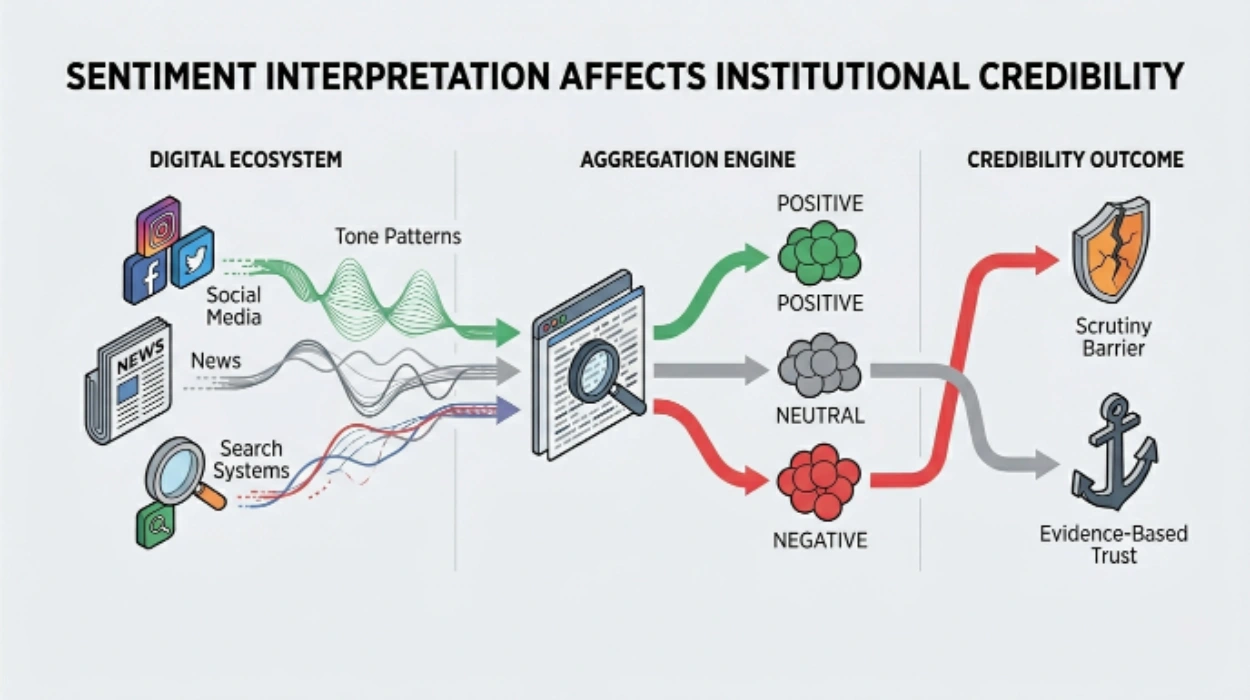
How does sentiment interpretation affect institutional credibility?
Sentiment interpretation influences how stakeholders evaluate organisational behaviour and trustworthiness.
Sentiment refers to the observable tone associated with content, discussions, media coverage, and public commentary. Within digital ecosystems, sentiment contributes to perception analysis rather than objective truth determination. It reflects how audiences interpret available information.
The mechanism involves aggregation and contextual analysis. Search systems, media monitoring platforms, and perception analysts evaluate recurring language patterns and thematic associations. Positive, neutral, and negative sentiment clusters create measurable indicators of stakeholder response. These indicators contribute to broader assessments of institutional reputation.
The impact on credibility emerges through perception reinforcement. Consistent negative sentiment increases scrutiny and influences future content interpretation. Consistent neutral or balanced sentiment supports credibility preservation because information remains connected to evidence rather than emotional amplification.
How do content ecosystems shape stakeholder trust?
Content ecosystems shape trust by determining which information stakeholders discover, consume, and reference.
A content ecosystem is the network of websites, media platforms, search engines, social channels, databases, and publications connected to an entity. Stakeholder trust develops through repeated exposure to information that demonstrates reliability, consistency, and authority. Digital ecosystems influence this process by controlling information accessibility and visibility.
The mechanism depends on interconnected content relationships. Search engines evaluate links between sources, entities, topics, and references. Authoritative ecosystems contain coherent information structures that support understanding and verification. Weak ecosystems contain fragmented or contradictory information that complicates interpretation.
The impact affects institutional credibility at scale. Stakeholders often evaluate organisations through digital evidence rather than direct interaction. Content ecosystems therefore function as trust infrastructure, influencing reputation formation across audiences, sectors, and governance environments.
Why is institutional visibility a core factor in reputation management?
Institutional visibility determines whether authoritative information is discoverable during periods of heightened attention.
Visibility refers to the prominence of institutional content across search engines, media coverage, and digital information channels. Without visibility, accurate information struggles to influence perception because stakeholders cannot easily access it. Visibility therefore operates as a prerequisite for narrative influence.
The mechanism involves search rankings, media distribution, content indexing, and entity recognition. Institutions with strong visibility maintain greater presence within information journeys. Their content appears more frequently in search results, topic clusters, and related discussions. This presence increases opportunities to shape understanding.
The impact on reputation is direct. Stakeholders often equate visibility with relevance and authority. Institutions that maintain discoverable, coherent, and authoritative information structures strengthen credibility and preserve trust during periods of uncertainty.
How does crisis communication relate to long-term digital reputation?
Crisis communication and digital reputation operate within the same perception framework.
Digital reputation refers to the cumulative interpretation of an entity across search engines, media environments, stakeholder discussions, and content ecosystems. Crisis communication influences this framework because crises generate concentrated periods of information production, indexing, and evaluation. Decisions made during these periods become part of the permanent digital footprint.
The mechanism involves narrative preservation. Search engines archive content relationships and entity associations over time. Media coverage remains accessible through search results and content repositories. Stakeholders evaluating institutional credibility often encounter historical information alongside current materials. This creates continuity between crisis response and long-term reputation outcomes.
The impact extends beyond the immediate event. Institutional credibility, stakeholder trust, digital authority, and search visibility become interconnected through accumulated reputation signals. Effective perception management therefore depends on understanding how digital ecosystems interpret, organise, and rank information over time.
Within this broader framework, analysis of How Linkonize Uses Sentiment Data to Decide When to Speak, When to Hold and When to Pivot During a Crisis contributes to understanding how sentiment interpretation influences communication timing and narrative evaluation across digital ecosystems.
Conclusion
Most organisations fail at crisis communication because they misinterpret how digital perception systems create and evaluate authority, trust, and visibility. Delayed responses, external narrative ownership, and message inconsistency weaken reputation signals that search engines, media ecosystems, and stakeholders use to assess credibility.
Institutional reputation is formed through interconnected processes involving content indexing, SERP evaluation, sentiment interpretation, digital authority, and stakeholder trust. Digital narratives influence how information is understood, while visibility determines whether authoritative content can shape perception. Understanding these mechanisms provides a clearer view of how crises affect long-term reputation within modern digital ecosystems.
Frequently Asked Questions
Why is crisis communication important for institutional reputation?
Crisis communication is important because it influences how stakeholders interpret an organisation during periods of uncertainty. Digital ecosystems rapidly distribute and index information, making institutional responses part of the long-term digital footprint. Effective communication helps maintain credibility, trust, and visibility across search engines, media platforms, and stakeholder networks.
How do search engines influence public perception during a crisis?
Search engines influence public perception by ranking and displaying information based on relevance, authority, and trust signals. High-ranking content often becomes the primary source of stakeholder understanding. As a result, search visibility plays a direct role in shaping narrative influence and entity perception.
What are reputation signals in digital ecosystems?
Reputation signals are indicators that help search engines and audiences evaluate credibility and authority. These signals include citations, media coverage, content consistency, topical relevance, sentiment patterns, and authoritative references. Reputation signals contribute to how institutions are perceived and ranked online.
How does stakeholder trust develop online?
Stakeholder trust develops through repeated exposure to accurate, consistent, and accessible information. Trust is strengthened when institutional communications align across websites, media coverage, and public channels. Digital content ecosystems create the environment where these trust signals are discovered and evaluated.
What is the connection between digital narratives and online reputation?
Digital narratives provide the framework through which stakeholders interpret events and organisational behaviour. Search engines, media publishers, and content platforms reinforce recurring narratives through indexing and ranking processes. Over time, these narratives become associated with institutional identity and influence long-term online reputation.