

Executive reputation management delivers direct control over search visibility, stakeholder trust signals, and digital authority. In a digital environment where search results shape first impressions, narrative credibility determines how investors, regulators, partners, journalists, and decision-makers assess leadership.
Personal digital authority functions as a measurable trust asset. Strong reputation signals improve stakeholder confidence, strengthen entity credibility, and ensure accurate narrative visibility across search ecosystems, media environments, and public-facing digital channels.
Why Does Executive Reputation Management Deliver Strategic Business Value?
Executive reputation management delivers measurable value because leadership perception directly influences organisational credibility, stakeholder engagement, and commercial trust.
Search engines operate as perception gateways. Before engaging with an organisation, stakeholders frequently evaluate executive profiles, media mentions, professional commentary, and third-party references. Negative search visibility, inconsistent narratives, or weak authority signals create perception friction that reduces trust.
A structured reputation management programme improves search perception influence by establishing consistent authority indicators across digital assets. This process strengthens executive visibility while ensuring that relevant and credible information occupies prominent positions within search results.
Effective reputation management also supports institutional resilience. Executive credibility contributes to investor confidence, regulatory trust, partnership opportunities, and media relationships. Strong digital authority creates a stable foundation that protects organisational reputation during periods of increased scrutiny.
For organisations operating within public affairs, policy, advocacy, or highly regulated sectors, executive reputation becomes a strategic asset that supports long-term stakeholder engagement and credibility management.
Which Reputation Management Approach Produces Sustainable Digital Authority?
The most effective approach combines SERP control, narrative visibility management, entity optimisation, and stakeholder trust signal development.
Digital authority does not emerge from isolated content activity. It develops through coordinated reputation signals distributed across trusted digital environments. Search engines assess consistency, authority, relevance, and credibility when determining visibility outcomes.
A comprehensive reputation management framework focuses on:
- Strengthen entity credibility through authoritative digital assets and verified professional profiles.
- Improve SERP control by increasing visibility of positive and relevant search results.
- Establish narrative visibility management through strategically aligned content ecosystems.
- Reinforce stakeholder trust signals through credible third-party references and authoritative mentions.
- Stabilise search perception influence through ongoing monitoring and optimisation.
This integrated methodology ensures reputation growth remains sustainable rather than dependent on temporary visibility tactics.
How Does Reputation Management Reduce Executive Risk Exposure?
Reputation management reduces risk by identifying vulnerabilities before they influence stakeholder perception.
Digital ecosystems operate continuously. Search results, media coverage, social discussions, and industry commentary collectively shape public understanding of executive leadership. Unmanaged narratives create opportunities for misinformation, reputation erosion, and perception instability.
A proactive reputation strategy establishes monitoring systems that identify emerging issues early. This allows organisations to respond with evidence-based communication rather than reactive damage control.
Risk reduction also depends on narrative ownership. Executives with strong digital authority possess established credibility frameworks that make stakeholder audiences more receptive to factual communication during periods of heightened attention.
Understanding broader crisis communication failures provides valuable context for executive reputation protection. Analysis such as Why Most Organizations Fail at Crisis Communication and the Three Decisions That Make It Worse demonstrates how delayed responses and poor strategic choices accelerate reputational risk and undermine stakeholder confidence.
When authority signals already exist across trusted digital channels, organisations maintain stronger control over public interpretation and stakeholder evaluation.
What Outcomes Can Organisations Expect From Professional Reputation Management?
Professional reputation management delivers measurable improvements in visibility, authority, credibility, and stakeholder trust.
The primary objective is not simply generating positive content. The objective is creating an environment where search ecosystems consistently surface accurate, credible, and strategically aligned information.
Common outcomes include:
- Increase executive visibility across high-authority search results.
- Improve stakeholder trust through stronger reputation signals.
- Strengthen entity credibility within search engine knowledge systems.
- Reduce exposure to negative narrative dominance.
- Enhance public credibility through authoritative digital positioning.
- Improve narrative consistency across multiple digital channels.
These outcomes create cumulative benefits over time. Strong search visibility improves discovery. Improved discovery strengthens authority. Stronger authority reinforces stakeholder trust signals. This cycle contributes to long-term reputation stability.
For decision-makers evaluating reputation management investment, the value extends beyond visibility metrics. Reputation strength influences commercial opportunities, partnership development, media engagement, and stakeholder confidence.
How Does Linkonize Build Executive Digital Authority Through Search Perception Influence?
Linkonize builds executive digital authority through a structured framework designed to improve reputation signals, strengthen narrative positioning, and enhance search visibility.
The process begins with comprehensive reputation analysis. Existing search visibility, stakeholder perception indicators, authority gaps, and narrative vulnerabilities are assessed to establish a measurable baseline.
Following assessment, strategic visibility assets are developed to improve entity credibility. Content ecosystems, professional profiles, authority publications, and digital references work together to create a coherent reputation architecture.
Search perception influence improves because search engines receive stronger credibility indicators across multiple trusted sources. As authority signals increase, executive visibility becomes more resilient and more representative of professional expertise.
The methodology also prioritises narrative consistency. Stakeholders encounter aligned messaging across search results, professional platforms, media references, and public-facing content. This consistency strengthens trust formation and improves reputation durability.
By focusing on measurable authority development rather than short-term visibility gains, Linkonize ensures reputation assets continue supporting executive credibility over extended periods.
Which Trust Signals Have the Greatest Impact on Stakeholder Decision-Making?
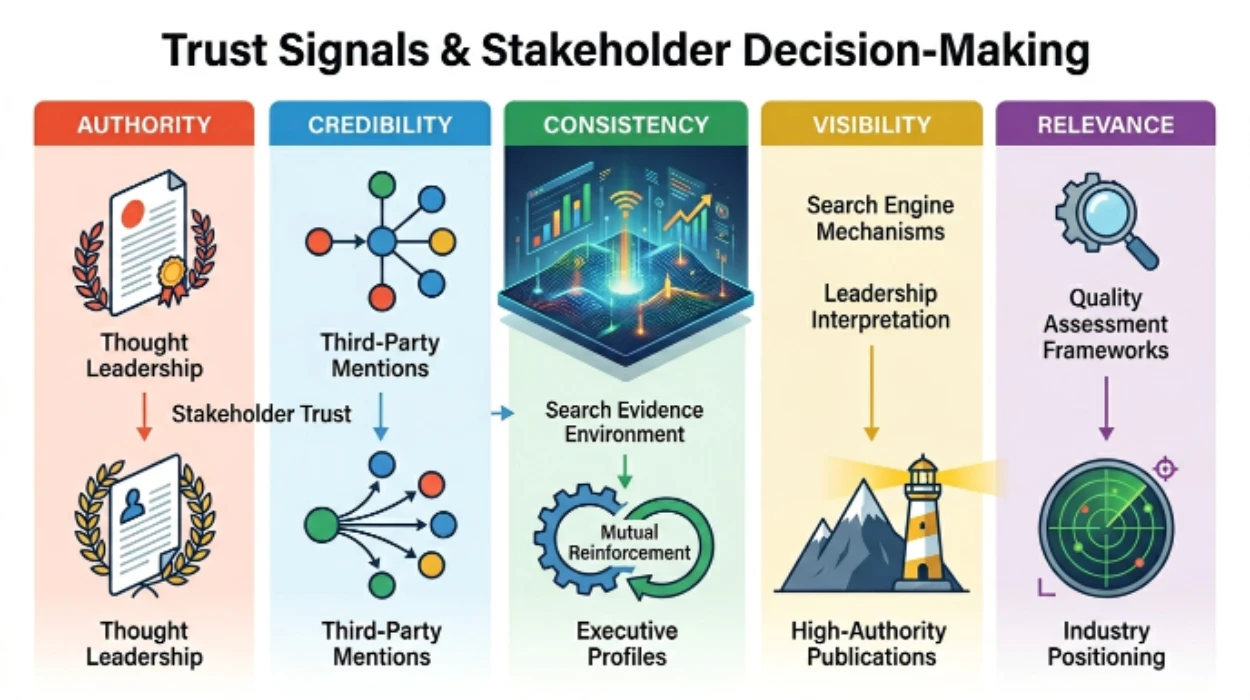
The most influential trust signals are authority, consistency, credibility, and relevance.
Stakeholders evaluate information through credibility frameworks rather than isolated content pieces. Search results act as evidence environments where users assess trustworthiness based on available signals.
Strong trust signals include:
- Demonstrate expertise through authoritative thought leadership assets.
- Establish credibility through trusted third-party mentions and references.
- Maintain consistency across executive profiles and public communications.
- Improve visibility through high-authority digital publications.
- Reinforce relevance through industry-specific expertise positioning.
These signals influence how stakeholders interpret leadership capability and institutional reliability.
Search engines also utilise similar evaluation mechanisms. Strong reputation signals improve visibility because credibility indicators align with search quality assessment frameworks. This creates mutual reinforcement between stakeholder trust and search performance.
As a result, executive reputation management contributes simultaneously to perception management and search visibility optimisation.
How Quickly Does Executive Reputation Management Generate Visibility Improvements?
Visibility improvements begin when reputation signals are strengthened, although sustainable authority development follows a structured progression.
Initial improvements often emerge through enhanced profile optimisation, improved search result alignment, and increased authority signal consistency. These changes create immediate foundations for stronger digital authority.
Long-term outcomes depend on continuous narrative visibility management. Search ecosystems reward sustained credibility rather than short-term activity spikes. Authority development therefore focuses on cumulative reputation growth.
Stakeholders evaluating reputation management frequently prioritise speed. However, sustainable reputation performance depends on building credible digital assets that retain value over time.
Decision-makers seeking evidence-based reputation management strategies often benefit from reviewing How Linkonize Uses Sentiment Data to Decide When to Speak, When to Hold and When to Pivot During a Crisis. The analysis highlights how data-driven decision frameworks improve communication timing and strengthen reputation outcomes during sensitive situations.
When authority-building activities align with stakeholder expectations and search quality signals, visibility improvements become more durable and more resistant to future reputational challenges.
Why Does Professional Reputation Management Deliver Better Long-Term Value Than Reactive Reputation Repair?
Professional reputation management delivers superior value because prevention costs less than recovery.
Reactive reputation repair occurs after negative narratives establish visibility and stakeholder influence. At that stage, organisations face increased resource requirements, longer recovery timelines, and reduced perception control.
Proactive reputation management creates protective infrastructure before issues emerge. Strong digital authority, established credibility, and positive reputation signals reduce vulnerability to narrative disruption.
Long-term value is generated through:
- Reduce future reputation risk through proactive visibility management.
- Strengthen stakeholder trust before critical events occur.
- Improve SERP control through sustained authority development.
- Establish credible narrative ownership across digital ecosystems.
- Protect institutional credibility through continuous optimisation.
This preventative approach aligns with modern public affairs and digital advocacy principles, where perception management depends on preparation rather than reaction.
Organisations investing in reputation management therefore gain both reputational protection and measurable authority growth.
Is Reputation Management the Right Strategic Investment for Executive Leadership?
Yes. Reputation management represents a strategic investment in trust, visibility, credibility, and stakeholder confidence.
Executive reputation influences organisational perception across regulatory, commercial, political, media, and public-facing environments. Search visibility increasingly determines how stakeholders form opinions and evaluate leadership credibility.
A structured reputation management programme strengthens digital authority through measurable improvements in reputation signals, stakeholder trust indicators, entity credibility, and narrative visibility management. These outcomes support stronger institutional perception and reduce exposure to reputational risk.
For organisations seeking reliable control over search perception influence, reputation management provides a clear framework for protecting executive credibility while strengthening long-term authority. Through evidence-driven processes, transparent methodology, and sustained optimisation, Linkonize delivers a dependable solution for organisations that recognise reputation as a strategic asset rather than a reactive concern.
To explore a dedicated Reputation Management solution, organisations can review the service offering available through the professional reputation management framework designed to improve digital authority, stakeholder trust signals, and long-term narrative control.
Frequently Asked Questions
What is executive reputation management?
Executive reputation management is the process of improving and protecting an executive’s digital authority across search engines, media platforms, and professional channels. It focuses on strengthening reputation signals, improving search visibility, and ensuring stakeholders encounter credible and accurate information when researching leadership profiles.
Why is digital authority important for executives?
Digital authority influences how investors, partners, regulators, journalists, and customers evaluate leadership credibility. Strong digital authority improves stakeholder trust signals, strengthens entity credibility, and supports positive perception across search ecosystems and public-facing digital environments.
How does reputation management improve search visibility?
Reputation management improves search visibility by enhancing authoritative digital assets, strengthening reputation signals, and implementing effective SERP control strategies. This increases the prominence of credible content while supporting stronger narrative visibility management across search results.
How long does it take to see results from reputation management?
Initial improvements can appear within the first stages of optimisation as search visibility and reputation signals strengthen. Sustainable digital authority develops through ongoing narrative visibility management, authority-building activities, and continuous optimisation that supports long-term credibility.
How does reputation management reduce reputational risk?
Reputation management reduces risk by identifying vulnerabilities early, strengthening stakeholder trust signals, and establishing credible digital assets before issues arise. A proactive strategy improves narrative control, stabilises perception, and reduces the impact of negative or misleading information within search ecosystems.