

Executive branding is the process through which leadership visibility, expertise, credibility, and narrative influence become identifiable reputation signals across digital ecosystems. It is one of the most overlooked layers of organisational reputation management because search engines, stakeholders, media ecosystems, and institutional audiences evaluate leadership entities alongside organisational entities when forming trust assessments.
Online reputation refers to the collection of digital signals, narratives, references, and authority indicators that shape how individuals and organisations are perceived across search environments, media ecosystems, and stakeholder networks. Public affairs refers to the management and interpretation of relationships between institutions, stakeholders, policymakers, media actors, and public audiences. Digital advocacy is the strategic distribution of information and narratives that influence awareness, perception, and credibility within digital ecosystems.
Why Is Executive Branding a Reputation Management Issue Rather Than a Marketing Activity?
Executive branding is a reputation management function because leadership visibility directly contributes to organisational credibility and stakeholder trust.
Within digital ecosystems, organisational entities rarely exist independently from leadership entities. Search engines index executive profiles, media mentions, interviews, publications, conference appearances, and professional commentary as interconnected reputation signals. These signals contribute to entity perception and influence how institutional authority is evaluated.
Executive branding refers to the creation and maintenance of a coherent leadership identity that search engines, stakeholders, journalists, regulators, investors, and industry observers can consistently interpret. The process defines who represents institutional expertise and how authority is communicated within public information environments.
The mechanism operates through content indexing, knowledge graph associations, citation networks, and media visibility. Search systems evaluate leadership-related content as part of broader organisational relevance calculations. As leadership visibility increases, executive entities become integrated into organisational reputation ecosystems.
The impact extends beyond personal recognition. Executive visibility influences stakeholder trust, affects institutional credibility assessments, and contributes to search visibility across reputation-sensitive topics.
How Does Executive Branding Influence Organisational Reputation?
Executive branding influences organisational reputation by shaping the interpretation of authority, expertise, and accountability.
Institutional reputation is formed through the aggregation of reputation signals distributed across digital channels. Leadership entities function as high-authority sources within these environments because stakeholders frequently associate organisational decisions, values, and expertise with executive representatives.
Search engines evaluate relationships between entities. When executive content consistently aligns with organisational themes, expertise areas, and public discourse topics, stronger semantic associations emerge. These associations strengthen digital authority and improve the clarity of institutional positioning.
Media ecosystems reinforce this relationship through repeated references. Executive commentary often becomes a primary source for journalists, analysts, and industry publications. This creates additional content indexing opportunities that contribute to visibility and credibility.
The resulting reputation framework enables stakeholders to interpret organisational identity through identifiable leadership narratives. Executive branding therefore functions as a structural component of organisational reputation management rather than an isolated communications activity.
What Reputation Signals Define Executive Authority in Digital Ecosystems?
Executive authority is defined by signals that demonstrate expertise, consistency, relevance, and credibility.
Authority signals refer to observable indicators that algorithms and stakeholders use to evaluate trustworthiness. These signals exist across owned, earned, and referenced digital assets.
Which Signals Strengthen Executive Credibility?
The strongest credibility signals include:
- Demonstrating expertise through published content – Search engines analyse topic relevance, semantic depth, and content consistency to evaluate subject-matter authority.
- Generating media citations – News articles, industry publications, and professional commentary create third-party validation mechanisms that strengthen entity perception.
- Maintaining consistent professional profiles – Structured information across platforms improves entity recognition and supports accurate content indexing.
- Establishing topical relevance – Repeated association with specific industry themes helps algorithms understand expertise boundaries.
- Building citation relationships – References from authoritative sources strengthen digital authority and improve trust interpretation.
Each signal contributes to how executive entities are understood within search ecosystems and stakeholder environments.
How Do Search Engines Interpret Authority Signals?
Search engines interpret authority through entity relationships rather than isolated content assets.
Modern ranking systems evaluate contextual relevance, source credibility, citation patterns, and semantic consistency. Executive entities become measurable components within larger information networks.
When leadership content demonstrates expertise across a clearly defined topic cluster, algorithms identify stronger authority relationships. This process influences content ranking dynamics, knowledge graph development, and SERP evaluation.
Authority therefore emerges from interconnected reputation signals rather than individual content pieces. Executive branding strengthens these signals by creating consistency across the digital footprint.
How Do Digital Narratives Shape Executive and Organisational Perception?
Digital narratives shape perception by providing interpretive frameworks that stakeholders use to understand institutions and leadership figures.
A digital narrative is a collection of interconnected content assets, references, media mentions, and stakeholder discussions that collectively define perception. Narratives influence how information is contextualised and understood.
Executive branding contributes to narrative formation because leadership communication frequently acts as a central reference point within organisational discourse. Published commentary, interviews, articles, speeches, and industry analysis become narrative-building assets.
Search ecosystems reinforce narratives through ranking mechanisms. Content that receives sustained visibility gains additional interpretive influence because stakeholders encounter it repeatedly across multiple information sources.
The impact on institutional perception is significant. Consistent narratives improve interpretability, while fragmented narratives create uncertainty regarding expertise, authority, and organisational identity. Executive branding therefore functions as a narrative coordination mechanism within reputation ecosystems.
Why Do Search Engine Results Pages Matter for Executive Branding?
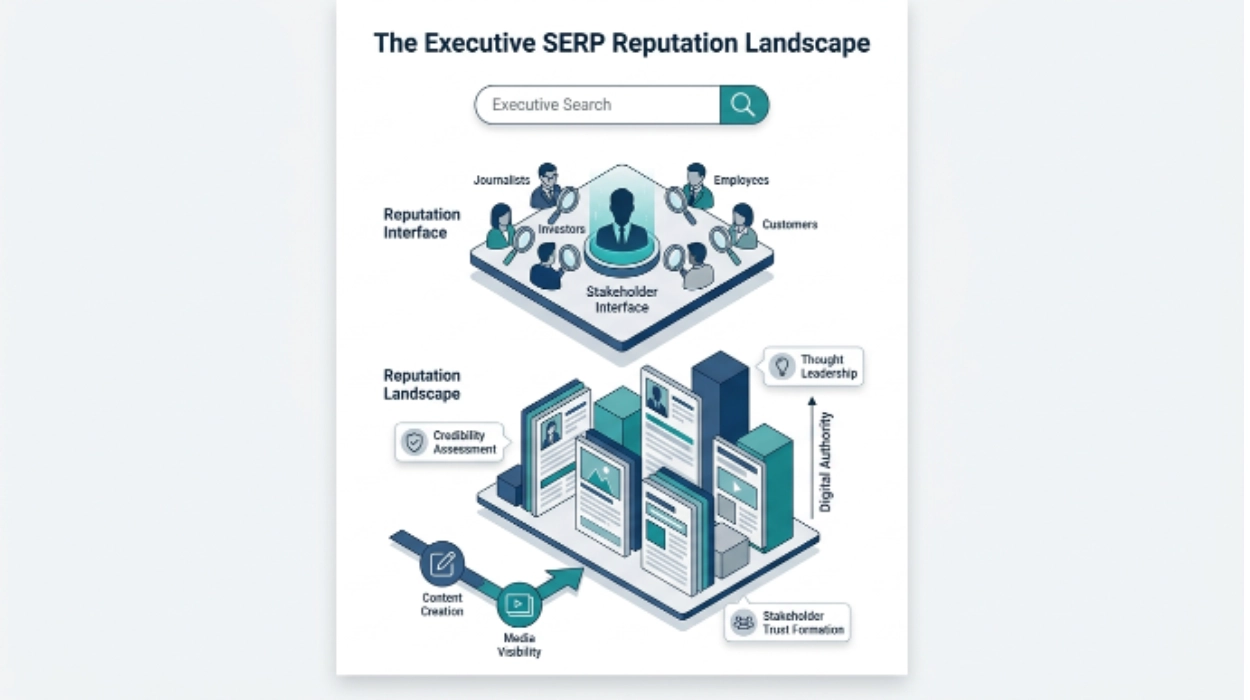
Search engine results pages matter because they act as public reputation interfaces.
SERPs represent one of the most influential environments for stakeholder perception. Journalists, investors, regulators, employees, customers, and industry observers frequently use search engines to evaluate organisations and leadership entities.
Executive branding influences SERP composition through content creation, media visibility, professional profiles, and third-party references. Search engines aggregate these assets into a visible reputation landscape.
A leadership entity with strong digital authority typically generates search results containing credible, relevant, and contextually aligned information. These assets help define stakeholder understanding before direct engagement occurs.
SERP evaluation therefore becomes an important component of reputation analysis. Executive branding contributes to search visibility by increasing the volume, consistency, and authority of indexed leadership-related information.
The resulting visibility influences trust formation because stakeholders often rely on search results as preliminary credibility assessment tools.
How Does Executive Branding Contribute to Stakeholder Trust?
Executive branding contributes to stakeholder trust by improving transparency, expertise visibility, and information accessibility.
Stakeholder trust refers to confidence in the reliability, competence, and legitimacy of an institution or its representatives. Trust formation depends on accessible evidence rather than organisational claims.
Executive branding creates that evidence through publicly available expertise indicators. Published insights, professional achievements, media participation, and thought leadership content provide observable trust signals.
Digital ecosystems amplify this effect because information remains searchable, indexable, and discoverable over time. Stakeholders can evaluate leadership credibility using independently accessible sources rather than relying exclusively on institutional communications.
Trust architecture develops when reputation signals remain consistent across platforms and information environments. Executive branding supports this architecture by strengthening alignment between leadership visibility and organisational expertise.
The result is a more coherent perception framework that enables stakeholders to interpret institutional credibility with greater confidence.
What Is the Relationship Between Executive Branding and Crisis Resilience?
Executive branding contributes to crisis resilience by establishing pre-existing credibility frameworks before reputation challenges emerge.
Crisis resilience refers to an institution’s ability to maintain trust and credibility during periods of scrutiny, uncertainty, or heightened public attention. Existing reputation signals influence how stakeholders interpret emerging information.
Leadership entities with established authority, expertise, and visibility possess stronger credibility reserves within digital ecosystems. Search engines, media organisations, and stakeholders already recognise these entities through previously indexed information.
This recognition affects narrative interpretation. Existing trust signals provide contextual information that stakeholders use when evaluating new developments. Strong executive visibility therefore influences how institutional responses are understood.
The relationship between reputation management and preparedness becomes particularly relevant when organisations examine How to Build a Crisis Communication Plan Before You Need One: A Step-by-Step Guide for Leadership Teams. Crisis planning and executive credibility operate within the same trust architecture because both influence stakeholder interpretation during periods of uncertainty.
Executive branding therefore functions as a foundational reputation layer that supports institutional resilience through established authority and visibility.
Why Is Executive Branding Frequently Overlooked in Reputation Strategy?
Executive branding is frequently overlooked because organisational reputation management often focuses exclusively on corporate assets rather than entity ecosystems.
Traditional approaches prioritise websites, media relations, corporate communications, and organisational messaging. These activities remain important, yet they do not fully account for how search systems evaluate leadership entities.
Digital ecosystems increasingly rely on entity-based interpretation models. Search engines identify relationships between people, organisations, topics, and sources. Executive entities therefore become influential components within reputation networks.
Ignoring leadership visibility creates information gaps. Stakeholders searching for executive expertise, authority, or credibility encounter limited contextual information, reducing the strength of available reputation signals.
A comprehensive reputation framework recognises that organisational authority is distributed across multiple entities. Executive branding addresses the leadership component of that ecosystem, making it an essential yet frequently underestimated aspect of reputation management.
Conclusion
Executive branding is a reputation management discipline focused on the visibility, authority, and credibility of leadership entities within digital ecosystems. It contributes to organisational reputation by strengthening reputation signals, supporting stakeholder trust, improving search visibility, and reinforcing narrative influence.
Search engines, media ecosystems, and stakeholder audiences evaluate leadership entities alongside organisational entities when forming credibility assessments. Executive branding therefore operates as a structural layer within institutional reputation systems rather than a standalone communications activity.
Understanding executive branding requires analysing how authority signals are interpreted, how narratives shape perception, how SERP evaluation influences trust, and how digital ecosystems connect leadership visibility with organisational credibility. These interconnected mechanisms explain why executive branding remains one of the most overlooked yet influential components of modern reputation management.
Frequently Asked Questions
What is executive branding in reputation management?
Executive branding is the process of establishing a leadership identity that is visible, credible, and recognisable across digital ecosystems. It helps search engines, stakeholders, media organisations, and industry audiences understand an executive’s expertise, authority, and relevance within a specific topic area.
Why is executive branding important for organisational reputation?
Executive branding strengthens organisational reputation by contributing additional credibility and authority signals. Leadership visibility influences stakeholder trust, media interpretation, and search visibility, making executive perception an important part of overall reputation management.
How do search engines evaluate executive authority?
Search engines evaluate executive authority through reputation signals such as published content, media mentions, professional profiles, topic relevance, and citation networks. These signals help algorithms determine expertise, credibility, and entity relationships within digital ecosystems.
What is the connection between executive branding and stakeholder trust?
Executive branding supports stakeholder trust by making expertise, knowledge, and leadership perspectives more accessible. Consistent visibility across trusted sources creates a stronger trust architecture and improves confidence in institutional credibility.
How does executive branding affect search visibility?
Executive branding improves search visibility by increasing the amount of authoritative and relevant content associated with a leadership entity. Search engines index and rank these assets, contributing to stronger entity perception and broader visibility across search engine results pages.