

A crisis communication plan is a structured framework that defines how leadership teams identify, assess, communicate, and manage reputation risks before a disruptive event occurs. Effective plans establish governance, communication pathways, stakeholder priorities, and narrative management mechanisms that preserve institutional credibility during periods of heightened scrutiny.
Public affairs strategies differ based on stakeholder expectations, regulatory environments, and organisational visibility. Digital advocacy methods are evaluated through their influence on reputation signals, stakeholder trust, narrative visibility, and the speed at which information ecosystems distribute both accurate and inaccurate information.
What Makes a Crisis Communication Plan More Effective Than Reactive Crisis Response?
A proactive crisis communication plan creates stronger organisational resilience than a reactive communication model because it establishes decision-making structures before operational pressure emerges.
A crisis communication plan is a predefined governance framework. Reactive crisis response is an improvised communication process developed after a reputational event has already affected stakeholder perception. The distinction influences how institutions manage information flow, maintain message consistency, and preserve entity credibility across digital and traditional channels.
Proactive planning operates by identifying risk categories, assigning responsibilities, defining approval workflows, and creating communication protocols before disruption occurs. Reactive approaches operate by responding to events in real time without established procedures. This difference affects response speed, message accuracy, and stakeholder confidence.
From a reputation management perspective, proactive frameworks strengthen trust signals because communication remains consistent across platforms. Reactive models often create fragmented messaging that weakens narrative visibility and increases reputational uncertainty. Search engines and digital platforms interpret consistency as an indicator of authority, making structured communication frameworks more effective for maintaining search ranking influence during periods of scrutiny.
The limitation of proactive planning is resource investment before a crisis occurs. Reactive frameworks require fewer initial resources but generate higher risk exposure when communication failures become visible across media, stakeholder networks, and search ecosystems.
Which Stakeholder Mapping Approach Produces Stronger Crisis Preparedness?
Stakeholder prioritisation models create stronger crisis preparedness than broad audience communication frameworks because they identify influence relationships before communication becomes urgent.
Stakeholder mapping is the process of categorising audiences according to influence, dependency, interest, and communication impact. Broad audience communication treats all stakeholders as a single group. These approaches generate different outcomes during periods of reputational stress.
How Does Influence-Based Stakeholder Mapping Operate?
Influence-based stakeholder mapping operates by identifying groups capable of affecting organisational outcomes. Leadership teams evaluate regulators, employees, investors, media representatives, community groups, industry bodies, and digital audiences according to their capacity to shape perception.
This model improves communication efficiency because resources focus on stakeholders with the greatest impact on institutional credibility. It also enables faster escalation processes when emerging issues require targeted engagement.
How Does Audience-Wide Communication Compare?
Audience-wide communication distributes messages uniformly across stakeholder groups. The mechanism increases reach but reduces relevance because stakeholder concerns differ according to institutional relationships.
The approach offers scalability during large-scale incidents but weakens message precision. Trust signals often decline when stakeholders receive generic communications that fail to address specific concerns or responsibilities.
From an evaluation perspective, influence-based stakeholder mapping produces stronger stakeholder trust and more sustainable credibility outcomes because communication aligns with stakeholder expectations rather than communication volume.
How Should Leadership Teams Evaluate Risk Identification Frameworks?
Scenario-based risk assessment provides greater communication preparedness than incident-based planning because it evaluates potential future conditions rather than historical events alone.
Risk identification is the foundation of crisis communication planning. Incident-based frameworks focus on previous crises. Scenario-based frameworks analyse operational, regulatory, political, social, and digital risks that can emerge across changing environments.
Scenario planning operates by modelling communication outcomes under multiple conditions. Leadership teams evaluate stakeholder reactions, media narratives, regulatory responses, and digital amplification patterns. This process identifies communication vulnerabilities before an incident develops.
Incident-based planning offers valuable historical context but limits preparedness when emerging risks differ from previous events. Digital ecosystems evolve rapidly, making historical comparisons insufficient as standalone planning mechanisms.
Scenario-based approaches improve institutional visibility management because leadership teams understand potential narrative pathways before information enters public channels. This reduces uncertainty and strengthens communication consistency across stakeholder groups.
The primary limitation of scenario planning is complexity. It requires continuous monitoring and periodic reassessment. However, its scalability and sustainability exceed incident-only frameworks because it accommodates changing risk environments.
How Do Communication Governance Structures Influence Crisis Outcomes?
Executive visibility remains a significant component of organisational credibility during periods of reputational pressure. Leadership communication often becomes a primary trust signal for stakeholders evaluating institutional accountability and transparency. The relationship between leadership perception and organisational reputation explains why executive branding functions as a strategic layer within broader reputation governance frameworks. When executive authority aligns with organisational messaging, stakeholder trust and narrative consistency become easier to maintain across digital and traditional communication channels.
What Communication Channels Provide the Most Reliable Crisis Visibility?
Integrated channel strategies provide greater narrative control than single-channel communication approaches because stakeholders consume information across multiple digital and traditional environments.
A communication channel strategy determines how information reaches stakeholders during a crisis. Single-channel approaches rely on one platform. Integrated strategies coordinate messaging across owned, earned, and shared communication channels.
Owned channels include organisational websites, executive communications, and direct stakeholder updates. Earned channels include media coverage and third-party commentary. Shared channels include social platforms and community discussions.
Integrated strategies operate by synchronising information across all communication environments. This increases narrative visibility and reduces information gaps that external actors can fill with speculation or misinformation.
Single-channel approaches simplify management but reduce communication reach. Stakeholders who rely on alternative information sources receive incomplete information, which weakens trust signals and increases uncertainty.
The comparative advantage of integrated communication lies in visibility optimisation. Consistent information across multiple channels strengthens institutional authority and improves stakeholder confidence in message accuracy.
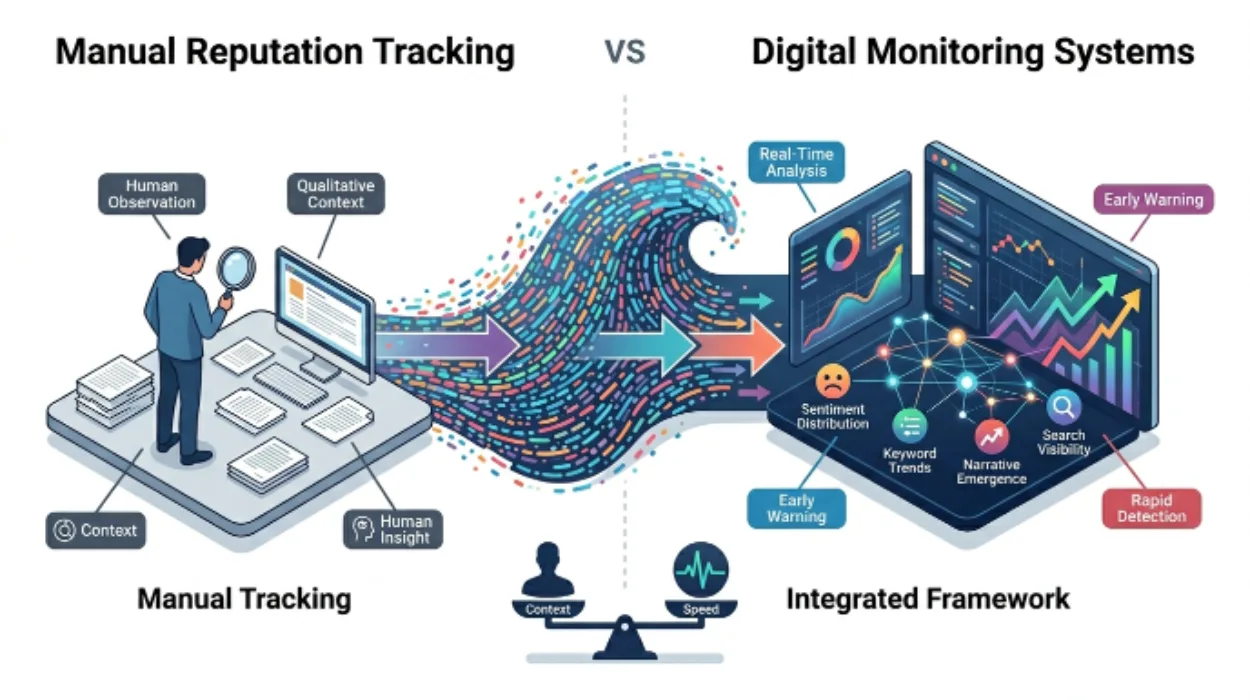
How Do Digital Monitoring Systems Compare With Manual Reputation Tracking?
Digital monitoring systems provide greater crisis detection capability than manual tracking processes because they analyse information velocity, sentiment distribution, and narrative emergence in real time.
Reputation monitoring is the process of evaluating public perception across search engines, media platforms, social networks, and stakeholder communities. Manual tracking relies on human observation. Digital monitoring uses automated analysis and data aggregation.
Digital monitoring operates by identifying keyword trends, sentiment changes, stakeholder discussions, media references, and search visibility patterns. These mechanisms provide leadership teams with early warning indicators before issues become widespread.
Manual tracking offers contextual understanding and qualitative interpretation. However, information volume within modern digital ecosystems exceeds the capacity of purely manual analysis.
The effectiveness of digital monitoring is measured through speed, coverage, and detection accuracy. Automated systems improve risk identification and support rapid decision-making. Manual evaluation remains valuable for interpreting complex stakeholder sentiment but performs less effectively as a primary monitoring mechanism.
Monitoring systems provide measurable indicators that help leadership teams evaluate whether stakeholder confidence is improving after a reputational event. Sentiment distribution, search visibility trends, media coverage patterns, and stakeholder engagement metrics offer evidence of changing perception. These indicators explain how organisations measure reputation recovery through benchmark analysis rather than relying on isolated communication outcomes or temporary reductions in negative attention.
How Does Content Suppression Compare With Content Amplification During a Crisis?
Content amplification creates more sustainable reputation outcomes than content suppression because it strengthens authoritative narratives rather than attempting to reduce information visibility directly.
Content suppression focuses on reducing the prominence of negative information. Content amplification increases the visibility of credible, authoritative, and relevant information.
Suppression strategies operate through legal mechanisms, platform policies, or technical visibility interventions. Amplification strategies operate by increasing the publication, distribution, and discoverability of authoritative content.
Search engines evaluate relevance, authority, and user value. As a result, amplification aligns more effectively with platform ranking systems because it contributes additional trust signals and entity credibility indicators.
Suppression approaches can reduce short-term visibility under specific circumstances. However, they often generate sustainability challenges because stakeholder attention remains focused on the disputed information. Amplification strategies strengthen institutional authority and improve long-term narrative visibility.
From a reputation management perspective, amplification demonstrates greater scalability and lower risk exposure because it supports ecosystem trust mechanisms rather than attempting to restrict information access.
Which Crisis Communication Plan Components Deliver Long-Term Institutional Credibility?
Integrated planning frameworks generate stronger long-term credibility than isolated communication procedures because they connect governance, monitoring, stakeholder engagement, and visibility management into a single system.
Leadership teams benefit from evaluating crisis preparedness through the following framework:
- Define stakeholder categories through influence-based mapping to improve communication relevance.
- Establish governance structures that assign communication authority and escalation responsibilities.
- Develop scenario-based risk models that evaluate operational, regulatory, and reputational threats.
- Integrate communication channels to maintain narrative consistency across digital ecosystems.
- Implement monitoring systems that measure sentiment distribution and emerging reputation signals.
- Strengthen content amplification mechanisms that increase authoritative narrative visibility.
- Review performance indicators regularly to maintain institutional credibility over time.
These components operate collectively rather than independently. Effective crisis communication is not a single communication activity. It is a governance system that influences stakeholder trust, search ranking influence, narrative visibility, and institutional resilience.
Conclusion
Building a crisis communication plan before a crisis occurs provides a structured method for managing stakeholder expectations, reputation signals, and institutional credibility under conditions of uncertainty.
The analysis demonstrates clear distinctions between proactive and reactive communication frameworks, influence-based stakeholder engagement and audience-wide messaging, scenario planning and incident-focused preparation, as well as content amplification and content suppression strategies. Each approach produces different outcomes in terms of trust signals, visibility management, scalability, and risk exposure.
Leadership teams evaluating crisis preparedness benefit from examining communication mechanisms rather than communication volume alone. Effective frameworks integrate governance, stakeholder analysis, monitoring systems, and visibility optimisation into a coordinated structure that supports long-term institutional credibility across evolving digital and public affairs environments.
Frequently Asked Questions
What is a crisis communication plan?
A crisis communication plan is a documented framework that defines how an organisation communicates during a disruptive event. It establishes stakeholder priorities, communication responsibilities, approval processes, and response procedures to protect institutional credibility and maintain trust during periods of uncertainty.
Why is stakeholder mapping important in crisis communication?
Stakeholder mapping identifies the groups that influence organisational reputation and decision-making outcomes. By categorising stakeholders according to influence and communication needs, leadership teams can deliver relevant information more efficiently and strengthen stakeholder trust during a crisis.
How often should a crisis communication plan be reviewed?
A crisis communication plan requires regular review to remain effective. Leadership teams typically evaluate communication protocols, stakeholder priorities, risk scenarios, and governance structures annually or following significant organisational, regulatory, or operational changes.
How do digital monitoring tools support crisis management?
Digital monitoring tools analyse reputation signals across search engines, media platforms, social networks, and stakeholder discussions. These systems help organisations detect emerging issues, evaluate sentiment distribution, and monitor narrative visibility in real time, allowing faster and more informed communication decisions.
What is the difference between content suppression and content amplification?
Content suppression focuses on reducing the visibility of negative information, while content amplification increases the visibility of authoritative and credible content. Amplification generally supports stronger long-term reputation outcomes because it aligns with search engine authority signals and contributes to sustainable narrative visibility.