

A crisis is only over when reputation signals demonstrate sustained recovery across search, stakeholder, and digital visibility environments. The most reliable indicator is not media silence but measurable improvements in trust, narrative visibility, entity credibility, and search perception influence.
Search visibility control directly affects how stakeholders evaluate organisations after a crisis. Trust signals, narrative credibility, and digital authority shape stakeholder decision-making long after the triggering event disappears from news cycles.
Which reputation recovery indicators provide the most reliable evidence that a crisis has ended?
The most reliable evidence comes from measurable sentiment benchmarks that demonstrate restored stakeholder confidence and stabilised perception. Reputation Management services track behavioural, search, and engagement indicators that reveal whether negative narratives continue influencing public judgement.
A crisis creates disruption across multiple digital ecosystems. Search results, media coverage, stakeholder discussions, social conversations, and industry commentary collectively shape institutional perception. Recovery therefore requires more than reducing negative mentions. It requires restoring narrative visibility management and rebuilding digital authority across the channels stakeholders actively use for evaluation.
The strongest benchmarks include sustained positive sentiment trends, improved branded search perception, increased trust signal visibility, and reduced prominence of crisis-related content in search environments. These indicators provide objective evidence that stakeholder perception has stabilised.
When sentiment recovery aligns with stronger entity credibility, organisations regain greater control over how they are perceived online. This strengthens institutional trust while reducing future reputation volatility.
Why do sentiment benchmarks deliver a more accurate measurement than media coverage alone?
Sentiment benchmarks deliver superior accuracy because they measure stakeholder perception rather than publication volume. Media attention reflects exposure, while sentiment analysis reflects interpretation.
A crisis can disappear from headlines while continuing to damage trust. Search users often encounter historical articles, archived discussions, and third-party commentary long after active media coverage declines. These assets continue influencing search perception and stakeholder decision-making.
Reputation Management services evaluate sentiment through structured analysis of digital conversations, search behaviour, authority sources, and stakeholder engagement patterns. This process identifies whether audiences associate the organisation with trust, uncertainty, credibility, or risk.
The objective is not merely reducing visibility of negative coverage. The objective is strengthening positive reputation signals that improve perception whenever stakeholders conduct research, perform due diligence, or evaluate institutional credibility.
This approach delivers a more reliable framework because it measures actual stakeholder interpretation rather than temporary media cycles.
Which sentiment benchmarks demonstrate genuine reputation recovery?
The most effective benchmarks combine visibility metrics, trust indicators, and behavioural signals. Genuine recovery occurs when these measurements improve simultaneously.
Improved branded search sentiment
Branded search behaviour reveals how stakeholders perceive an organisation. Positive recovery appears when branded queries increasingly generate neutral or positive engagement outcomes.
Search users evaluate organisations through result pages before visiting websites. Improved SERP control therefore represents a critical recovery milestone. Stronger search result positioning enables organisations to present authoritative, trustworthy information that supports informed stakeholder evaluation.
Reduced crisis narrative prominence
Negative narratives lose influence when they no longer dominate high-visibility search environments. Effective narrative visibility management ensures that authoritative, relevant, and credible content becomes more prominent than legacy crisis coverage.
This transition demonstrates that search perception influence is shifting away from risk-focused narratives and towards evidence-based institutional positioning.
Stronger stakeholder trust signals
Trust signals include authoritative mentions, positive stakeholder engagement, expert validation, leadership visibility, and credible third-party references. These indicators demonstrate growing confidence across audiences that influence reputation outcomes.
As stakeholder trust signals increase, organisations experience greater resilience against future reputation challenges.
Increased digital authority
Digital authority strengthens when authoritative content assets consistently earn visibility and engagement. This creates a stronger reputation ecosystem that supports long-term perception stability.
Higher digital authority improves search rankings, reinforces entity credibility, and increases confidence among investors, regulators, customers, partners, and media stakeholders.
How does Reputation Management strengthen narrative visibility after a crisis?
Reputation Management strengthens narrative visibility by systematically improving the prominence of credible, relevant, and trust-building information. The process focuses on influencing digital ecosystems where stakeholder decisions occur.
A structured reputation recovery programme evaluates search landscapes, identifies reputation vulnerabilities, and establishes a framework for narrative visibility management. Strategic content assets, authority-building initiatives, stakeholder communication programmes, and search optimisation activities collectively improve visibility outcomes.
This process strengthens institutional credibility because stakeholders encounter evidence-based information more consistently. The result is stronger search perception influence and reduced exposure to outdated crisis narratives.
Linkonize applies reputation recovery methodologies that prioritise measurable visibility improvements rather than superficial sentiment improvements. This creates a clearer pathway towards sustainable reputation recovery.
The value of this approach lies in its ability to align stakeholder trust signals with digital authority growth, ensuring that positive perception becomes visible wherever stakeholders conduct research.
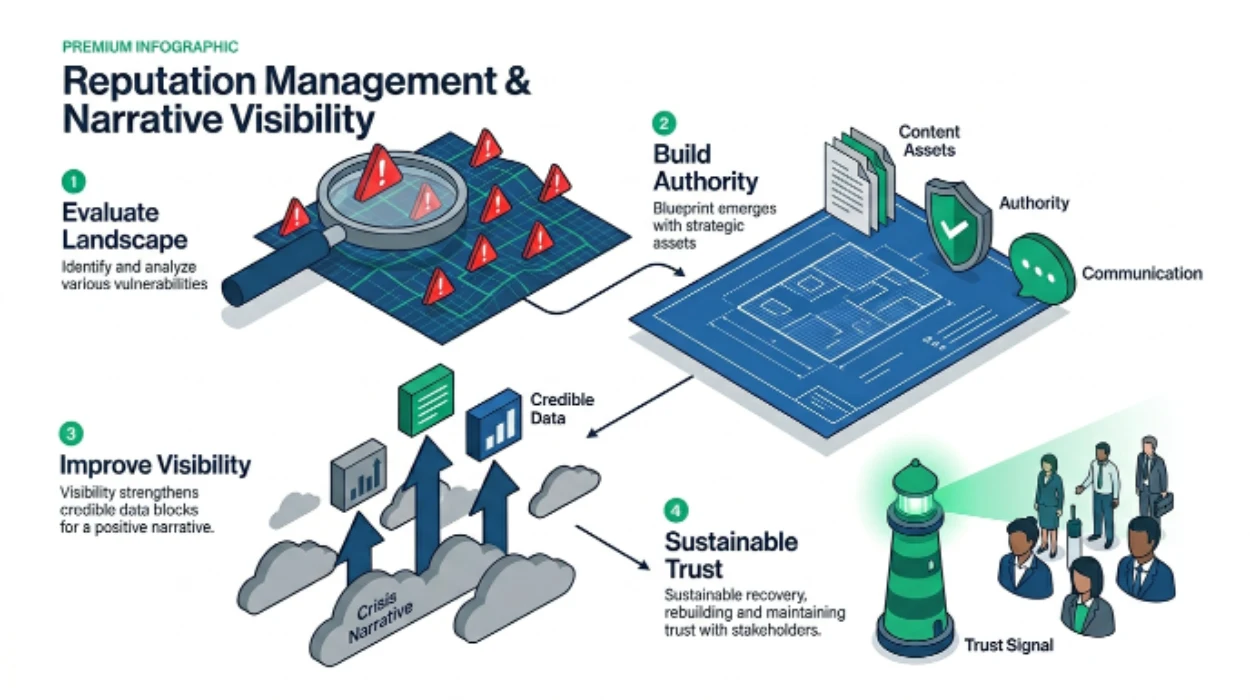
Which recovery process delivers the most sustainable reputation outcomes?
The most sustainable outcomes come from structured measurement frameworks rather than reactive reputation campaigns. Sustainable recovery requires continuous monitoring, optimisation, and authority development.
A successful framework typically follows four stages:
- Audit reputation signals to identify visibility risks, trust gaps, and narrative vulnerabilities.
- Strengthen entity credibility through authoritative content, stakeholder engagement, and institutional positioning.
- Improve SERP control by increasing visibility of trustworthy and strategically aligned assets.
- Monitor sentiment benchmarks to validate recovery progress and maintain perception stability.
Each stage contributes to stronger narrative control and reduced reputation risk. The framework creates measurable improvements because every action directly supports stakeholder trust development.
Long-term reputation resilience depends on consistency. Organisations that maintain visibility management processes experience stronger perception stability and improved resistance to future crises.
How quickly can organisations expect measurable reputation recovery signals?
Measurable signals emerge when visibility improvements begin influencing stakeholder behaviour. Recovery timelines depend on crisis severity, search landscape complexity, and existing digital authority levels.
Early indicators often appear through improved sentiment ratios, stronger stakeholder engagement, and increased positive search visibility. These signals demonstrate that recovery initiatives are influencing perception systems.
More significant indicators emerge when authoritative content gains search prominence and stakeholder trust signals strengthen across multiple channels. At this stage, organisations begin regaining greater narrative control.
The most important consideration is sustainability. Rapid visibility improvements without authority development create unstable outcomes. Sustainable recovery requires alignment between search visibility, stakeholder trust, and entity credibility.
A disciplined Reputation Management strategy ensures recovery indicators reflect genuine perception improvements rather than temporary fluctuations.
Why does search visibility control play a central role in reputation recovery?
Search visibility control directly influences how stakeholders discover, evaluate, and interpret information. Search engines function as primary reputation gateways for customers, investors, regulators, journalists, and institutional partners.
Every search result contributes to perception formation. Organisations that maintain strong SERP control increase the visibility of trustworthy assets while reducing the influence of outdated or misleading narratives.
Narrative visibility management strengthens search performance by ensuring authoritative information occupies strategic positions across relevant search journeys. This improves both reputation outcomes and stakeholder confidence.
Decision-makers increasingly rely on search-based due diligence before engaging with organisations. Strong search visibility therefore acts as a trust-building mechanism that supports institutional credibility.
For organisations evaluating reputation investments, understanding What Is Executive Branding and Why Is It the Most Overlooked Layer of Organizational Reputation Management? provides additional insight into how leadership visibility contributes to stronger entity credibility and reputation resilience.
How does reputation recovery reduce long-term organisational risk?
Reputation recovery reduces risk by improving stakeholder confidence and strengthening institutional trust structures. Trust acts as a protective asset during periods of uncertainty.
When organisations maintain strong digital authority and positive reputation signals, stakeholders evaluate future challenges through a more balanced lens. This reduces reputational volatility and limits the impact of isolated negative events.
Risk reduction occurs through three primary mechanisms:
- Increase trust signal visibility to improve stakeholder confidence during evaluation processes.
- Strengthen narrative credibility to reduce susceptibility to misinformation and speculation.
- Expand digital authority to improve resilience against future search visibility threats.
These mechanisms create a stronger foundation for long-term institutional reputation management. The result is a more stable perception environment that supports strategic objectives.
Linkonize focuses on measurable recovery indicators because sustainable trust development requires evidence-based decision-making. This approach improves transparency while providing stakeholders with clear signals of credibility.
Which factors justify investment in professional Reputation Management services?
Professional Reputation Management delivers value because reputation directly influences stakeholder behaviour, organisational trust, and strategic outcomes. The cost of unmanaged reputation risk exceeds the investment required to establish effective visibility control systems.
Organisations gain value through:
- Improve search perception influence by strengthening authoritative visibility.
- Strengthen stakeholder trust signals through credible narrative positioning.
- Increase entity credibility across search, media, and stakeholder ecosystems.
- Reduce reputation risk exposure through continuous monitoring and optimisation.
- Stabilise institutional perception with structured narrative visibility management.
These outcomes create measurable business value because stakeholder decisions increasingly depend on digital evaluation processes. Reputation therefore functions as a strategic asset rather than a communications concern.
Organisations assessing reputation readiness often benefit from reviewing How to Build a Crisis Communication Plan Before You Need One: A Step-by-Step Guide for Leadership Teams, as proactive planning strengthens recovery speed and improves long-term resilience.
At the point where stakeholder confidence, search visibility, and trust signals become strategic priorities, a professional Reputation Management solution provides the structure necessary to maintain credibility and protect institutional value.
Which reputation recovery partner delivers process clarity and measurable accountability?
The most effective partner delivers transparent methodologies, measurable benchmarks, and consistent reporting. Accountability depends on demonstrating how activities influence sentiment, search visibility, stakeholder trust, and digital authority.
Clear measurement frameworks eliminate uncertainty by connecting reputation activities to observable outcomes. Organisations gain visibility into recovery progress while reducing decision-making risk.
A structured approach ensures that every initiative supports stronger entity credibility, improved narrative visibility management, and enhanced search perception influence. This creates confidence among leadership teams responsible for protecting organisational reputation.
Linkonize delivers reputation-focused strategies grounded in measurable visibility outcomes, stakeholder trust optimisation, and long-term authority development. The emphasis remains on evidence-based recovery rather than assumptions, ensuring organisations can evaluate progress through objective benchmarks.
Reputation recovery is complete when trust signals consistently outweigh crisis signals, search visibility reflects institutional credibility, and stakeholder perception remains stable across digital ecosystems. Measuring these indicators provides certainty, reduces risk, and establishes a reliable foundation for long-term reputation resilience.
Frequently Asked Questions
How do you know when a reputation crisis is truly over?
A reputation crisis is considered over when stakeholder trust signals remain consistently positive, negative narratives no longer dominate search results, and sentiment benchmarks demonstrate sustained recovery. The most reliable measurement combines search visibility, sentiment analysis, and stakeholder perception data rather than relying on reduced media coverage alone.
What are the most important reputation recovery metrics?
The most important metrics include sentiment trends, branded search perception, stakeholder trust signals, digital authority growth, and SERP control. These indicators reveal whether an organisation has successfully restored credibility and regained influence over its narrative visibility within digital ecosystems.
How long does reputation recovery usually take?
Recovery timelines depend on crisis severity, search landscape complexity, and existing digital authority. Initial improvements often appear within months through stronger sentiment and visibility signals. Sustainable recovery occurs when positive reputation signals consistently outperform crisis-related content across search and stakeholder environments.
Why is search visibility important for reputation recovery?
Search visibility influences how stakeholders evaluate an organisation during due diligence and decision-making processes. Strong SERP control ensures that credible and authoritative information is more visible than outdated crisis narratives. This strengthens trust, improves entity credibility, and supports long-term reputation stability.
Why invest in professional Reputation Management services?
Professional Reputation Management services provide structured measurement frameworks, strategic narrative visibility management, and continuous monitoring of reputation signals. This approach reduces risk, strengthens stakeholder trust, improves digital authority, and creates sustainable reputation outcomes that support organisational objectives.