

Press releases fail to generate media coverage when they do not align with the authority, relevance, trust, and visibility signals that journalists, publishers, search engines, and digital information ecosystems use to evaluate information.
Public affairs refers to the management and interpretation of relationships between institutions, stakeholders, media environments, and public perception. Digital advocacy is the strategic dissemination of information across digital ecosystems to influence awareness, understanding, and stakeholder engagement. Within these systems, press releases function as narrative distribution assets rather than guaranteed media coverage mechanisms. Their effectiveness depends on how information is interpreted, validated, indexed, and prioritised across interconnected media and search environments. Understanding why press releases fail requires analysing the perception systems that determine visibility, credibility, and narrative amplification.
Why do press releases fail to attract media attention?
Press releases fail to attract media attention when they do not provide sufficient news value, authority signals, or contextual relevance for editorial evaluation.
Media organisations operate within information filtering systems that prioritise significance, relevance, and audience interest. A press release is evaluated against competing information sources that seek the same editorial attention. Journalists assess whether a release contributes new information, supports an emerging narrative, or provides verifiable evidence relevant to public discourse. Content that lacks these characteristics receives limited editorial consideration.
Within digital ecosystems, visibility is connected to information utility rather than publication volume. Search engines, publishers, and media platforms evaluate content according to relevance signals, source authority, and topical consistency. A press release that repeats generic information creates limited narrative influence because it does not expand understanding of a topic. As a result, editorial interest remains low.
Institutional credibility also influences media evaluation. Publishers analyse the reputation signals associated with an entity before allocating visibility. When a release lacks supporting authority indicators, editorial confidence declines. This reduces the probability of media amplification and broader stakeholder exposure.
How does newsworthiness influence media coverage outcomes?
Newsworthiness defines whether information satisfies editorial criteria for publication and audience relevance.
Newsworthiness refers to the perceived significance of information within a public information environment. Journalists evaluate whether a development contributes meaningful context to ongoing discussions, policy developments, industry changes, or stakeholder concerns. Information that fails to satisfy these criteria struggles to achieve media visibility.
The mechanism operates through editorial prioritisation. Newsrooms receive substantial volumes of information every day. Editors identify content that introduces new developments, measurable outcomes, verified data, or institutional significance. Information lacking these characteristics receives lower prioritisation because it contributes limited value to audience understanding.
From a digital perception perspective, newsworthiness influences both media visibility and search visibility. Search ecosystems increasingly evaluate content according to usefulness, originality, and relevance. Content that demonstrates clear informational value accumulates stronger authority signals and broader indexing opportunities. This relationship creates a direct connection between editorial interest and digital discoverability.
Newsworthiness therefore functions as a foundational trust signal that influences media selection, content indexing, and stakeholder engagement across digital ecosystems.
What role does institutional credibility play in media visibility?
Institutional credibility determines how information sources are evaluated for reliability, trustworthiness, and authority.
Institutional credibility refers to the perceived legitimacy of an organisation within digital and media ecosystems. Journalists analyse source credibility before incorporating information into editorial content. This evaluation process protects publication standards and supports audience trust.
Credibility develops through consistent information quality, transparent communication, verifiable expertise, and recognised authority. These elements create reputation signals that influence how institutions are interpreted by media stakeholders. Strong credibility increases confidence in the accuracy and relevance of information being distributed.
Digital ecosystems reinforce this process through authority evaluation mechanisms. Search engines analyse entity relationships, citation patterns, content consistency, and topical expertise. These signals contribute to digital authority assessments that influence content ranking and visibility. Institutions with stronger authority profiles often achieve greater discoverability because their information is associated with trust and expertise.
When credibility signals are weak, information faces increased scrutiny and reduced visibility. The absence of trust indicators limits narrative reach and decreases the likelihood of media coverage. Institutional credibility therefore acts as a core component of digital reputation and public perception systems.
How do digital narratives affect press release performance?
Digital narratives shape how information is interpreted, contextualised, and distributed across media environments.
A digital narrative is the collective framework through which information about an entity, issue, or institution is understood. Narratives emerge from content ecosystems that include media coverage, search results, social discussions, industry commentary, and stakeholder communication. These interconnected sources influence public understanding and perception.
Press releases enter existing narrative environments rather than operating independently. Journalists evaluate whether new information contributes meaningful context to current discussions. Information that aligns with established topics often receives greater attention because it strengthens ongoing narratives. Information that lacks contextual relevance encounters reduced visibility.
Narrative influence also affects search visibility. Search engines interpret topical relationships through content associations, entity recognition, and semantic relevance. Information connected to recognised narratives benefits from stronger contextual understanding and broader indexing opportunities. This increases the probability of discovery across search environments.
The relationship between narratives and visibility demonstrates how public perception systems influence media outcomes. Press releases succeed when they contribute meaningful information to recognised conversations rather than existing as isolated communication assets.
Why does content relevance matter for media and search visibility?
Content relevance determines whether information satisfies the informational needs of audiences, journalists, and search systems.
Relevance refers to the degree of alignment between content and a specific topic, audience interest, or information demand. Media organisations prioritise content that addresses current discussions and stakeholder concerns. Search engines prioritise content that directly answers user queries and demonstrates topical depth.
The mechanism relies on contextual evaluation. Journalists assess relevance according to editorial focus and audience expectations. Search algorithms analyse semantic relationships, topical comprehensiveness, and user intent alignment. These systems independently evaluate content but frequently reward similar quality indicators.
Content lacking relevance experiences reduced visibility because it contributes limited informational value. Even highly credible sources encounter visibility limitations when information does not align with audience demand or media priorities. Relevance therefore acts as a visibility multiplier that influences both editorial coverage and search performance.
Within digital advocacy and public affairs contexts, relevance supports stakeholder trust by ensuring that communication addresses recognised concerns and information needs. This strengthens engagement and improves overall perception quality.
How do search engines evaluate authority and trust signals?
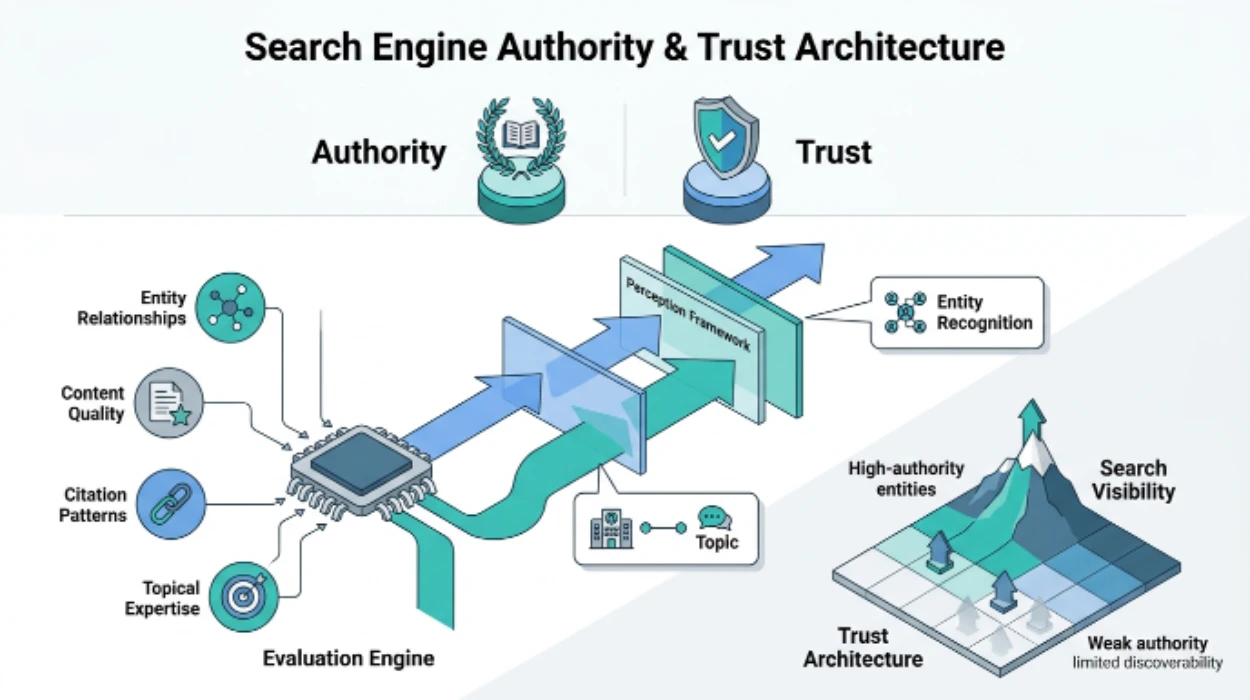
Search engines evaluate authority and trust through entity relationships, content quality indicators, citation patterns, and topical expertise.
Authority refers to recognised expertise and influence within a specific subject area. Trust refers to confidence in the accuracy, reliability, and consistency of information. Together, these concepts form the foundation of digital authority within search ecosystems.
Search systems analyse multiple signals to evaluate credibility. These signals include content consistency, authoritative references, entity recognition, publication quality, and demonstrated expertise. The evaluation process creates a perception framework that influences ranking decisions and content visibility.
Entity perception plays a central role in this process. Search engines increasingly interpret organisations as identifiable entities connected to topics, relationships, and expertise areas. Positive authority signals strengthen these associations and improve search visibility. Weak authority signals reduce confidence and limit discoverability.
The result is a trust architecture that influences how information is ranked, indexed, and presented. Press releases that fail to demonstrate authority contribute limited value to these evaluation systems, reducing their impact across digital channels.
What is the relationship between media coverage and stakeholder trust?
Media coverage influences stakeholder trust by affecting information credibility, visibility, and narrative validation.
Stakeholder trust refers to confidence in the reliability, competence, and integrity of an institution or entity. Trust develops through repeated exposure to credible information sources and consistent reputation signals. Media coverage contributes to this process by acting as an independent visibility layer.
When information receives editorial attention, it gains additional validation within public perception systems. Stakeholders often interpret coverage as evidence that information has undergone external evaluation. This strengthens credibility perceptions and increases informational legitimacy.
The impact extends into search ecosystems. Media coverage generates citations, entity associations, and content references that reinforce authority signals. These signals influence SERP evaluation and contribute to stronger search visibility. Increased visibility expands stakeholder exposure and reinforces reputation development.
Trust therefore emerges through interconnected visibility mechanisms rather than isolated communication activities. Media coverage functions as one component within a broader ecosystem of authority and credibility signals.
How do content ecosystems influence reputation and perception?
Content ecosystems influence reputation by shaping the information environments through which stakeholders evaluate institutions and entities.
A content ecosystem is the network of interconnected digital assets, publications, search results, references, and discussions associated with a topic or organisation. These assets collectively contribute to perception formation and reputation assessment.
The ecosystem functions through cumulative interpretation. Search engines analyse relationships between sources. Journalists review existing coverage before evaluating new information. Stakeholders compare information across channels to assess credibility. Each interaction contributes to an evolving perception framework.
Reputation signals emerge from consistency, authority, relevance, and visibility across the ecosystem. Contradictory information weakens trust. Consistent information strengthens credibility and reinforces authority associations. These patterns influence both media evaluation and search ranking systems.
Digital footprints therefore become critical components of institutional perception. Every indexed asset contributes to how entities are understood, evaluated, and ranked within digital ecosystems. Press release performance is directly affected by the quality and structure of the surrounding content environment.
Why is strategic distribution important for media reach?
Strategic distribution determines whether information reaches relevant audiences, media stakeholders, and digital discovery systems.
Distribution refers to the placement and dissemination of information across channels capable of generating visibility. Effective distribution aligns content with relevant publishers, industry sectors, stakeholder groups, and search ecosystems. This increases the probability of interpretation and engagement.
The mechanism depends on contextual targeting rather than volume. Broad dissemination does not automatically create authority, trust, or relevance. Media organisations evaluate information according to editorial priorities regardless of distribution scale. Search engines evaluate information according to content quality and entity signals regardless of publication frequency.
Strategic distribution therefore supports discoverability by improving contextual alignment. Information appears within environments where relevance, authority, and stakeholder interest already exist. This strengthens narrative integration and increases visibility opportunities.
A deeper understanding of How to Choose the Right PR Distribution Strategy for Maximum Media Reach helps explain how distribution decisions influence visibility outcomes, authority development, and stakeholder perception within digital ecosystems.
Conclusion
Press releases fail to generate media coverage when they lack the authority, relevance, credibility, and narrative value required by modern information ecosystems. Media organisations, search engines, and stakeholders evaluate information through interconnected perception frameworks that prioritise trust, expertise, and contextual significance.
Digital reputation is formed through cumulative reputation signals that influence entity perception, search visibility, stakeholder trust, and institutional credibility. Media coverage emerges from editorial evaluation processes that assess newsworthiness, authority, and relevance. Search ecosystems reinforce these assessments through content indexing, SERP evaluation, and digital authority measurement.
Understanding these mechanisms provides a clearer view of how visibility is created, interpreted, and sustained across contemporary digital environments.
Frequently Asked Questions
Why do journalists ignore press releases?
Journalists ignore press releases when the information lacks newsworthiness, relevance, or credibility. Editorial teams evaluate whether content contributes new insights, verified data, or meaningful developments. Information that does not satisfy these criteria receives limited attention because it provides little value to audiences.
How does digital authority affect media coverage?
Digital authority affects media coverage by influencing how institutions and entities are perceived within information ecosystems. Strong authority signals demonstrate expertise, credibility, and topical relevance. These signals increase confidence in the information source and support greater media visibility.
Can a press release improve search visibility?
A press release can improve search visibility when it contributes unique, relevant, and authoritative information. Search engines evaluate content based on quality, relevance, and entity perception. Content that strengthens topical authority and supports content indexing contributes positively to search visibility.
What is the difference between media visibility and search visibility?
Media visibility refers to exposure gained through editorial coverage, publications, and news platforms. Search visibility refers to how prominently content appears within search engine results pages. Both forms of visibility influence stakeholder trust, reputation signals, and digital authority, but they operate through different evaluation mechanisms.
Why is stakeholder trust important in digital ecosystems?
Stakeholder trust is important because it influences how information, institutions, and entities are interpreted. Trust develops through consistent credibility signals, authoritative content, and transparent communication. Strong stakeholder trust supports positive entity perception and strengthens institutional reputation across digital channels.