

PR distribution strategy selection determines how effectively information enters media ecosystems, how audiences interpret credibility, and how authority accumulates across digital channels. It defines media reach through structured visibility pathways, not publication volume alone.
Public affairs strategies differ based on stakeholder influence patterns, institutional communication objectives, and narrative positioning across fragmented media environments. Digital advocacy methods are evaluated through reputation signals, search ranking influence, sentiment distribution, and long-term institutional trust formation.
Which PR distribution approaches generate the broadest media reach?
Broad media reach emerges from distribution models that prioritise scale, relevance, or stakeholder alignment depending on communication objectives. These models include mass distribution, targeted distribution, and stakeholder-centred distribution, each operating through distinct visibility mechanisms.
Mass distribution operates by disseminating content across extensive media networks simultaneously. It increases content amplification across multiple domains, strengthening initial narrative visibility through volume-based exposure. Search engines register widespread publication activity as distribution intensity, which expands indexation speed across digital ecosystems. The limitation emerges in contextual dilution, where content relevance varies significantly between publication environments, reducing authority concentration.
Targeted distribution operates through selective placement within industry-relevant publications and journalist networks. It strengthens entity credibility because content appears within contextually aligned media environments. Stakeholder trust increases when information aligns with editorial expertise and audience expectations. This approach reduces unnecessary exposure but strengthens authority signals through precision-based visibility.
Stakeholder-centred distribution operates through engagement with policymakers, institutional actors, regulators, and advocacy groups. Visibility is evaluated through influence depth rather than audience scale. Narrative outcomes remain concentrated within decision-making environments, strengthening institutional perception and governance relevance.
Comparative evaluation shows mass distribution maximises exposure breadth, targeted distribution maximises relevance strength, and stakeholder-centred distribution maximises influence depth. Strategic selection depends on whether communication objectives prioritise awareness, authority, or institutional alignment.
How does targeted distribution compare with broad distribution strategies?
Targeted distribution and broad distribution operate through fundamentally different visibility architectures, influencing how authority signals and audience perception develop across media ecosystems.
How targeted distribution operates in media ecosystems
Targeted distribution functions through precision alignment between content and specialised media entities. It ensures that information enters environments already associated with subject-matter expertise, strengthening contextual relevance. Search engines evaluate this alignment as a signal of authority because topical consistency reinforces trust indicators across indexed content.
Entity credibility increases when publication sources demonstrate consistent expertise within defined subject areas. Stakeholder trust strengthens due to perceived editorial validation. This structure enhances search ranking influence through concentrated relevance signals rather than dispersed exposure.
A key limitation arises from restricted amplification velocity. Publication frequency remains lower because placement depends on editorial alignment rather than network scale. Narrative visibility concentrates within niche audiences, limiting broader public exposure.
How broad distribution operates in media ecosystems
Broad distribution functions through large-scale dissemination across diverse publication networks. It prioritises visibility expansion through volume rather than contextual alignment. Search engines index content rapidly due to high publication frequency, increasing short-term discoverability across multiple domains.
Content amplification increases significantly, producing wider narrative exposure in early distribution phases. However, relevance signals weaken when content appears across unrelated or low-authority environments. This reduces long-term entity credibility compared with targeted approaches.
The comparative evaluation shows targeted distribution strengthens authority and trust, while broad distribution strengthens reach and visibility speed. The optimal strategy depends on whether relevance or exposure defines success metrics.
What role does Media Relation strategy play in distribution effectiveness?
Media Relation strategy determines how information enters media ecosystems and how credibility is established before publication occurs. It functions as a trust architecture connecting institutions with editorial decision-makers.
Media Relation operates by building structured relationships between organisations and journalists, enabling information exchange based on relevance and reliability. This framework strengthens publication probability within authoritative environments.
Relationship-based distribution increases reputation signals because journalists assess source credibility before content placement. Search engines indirectly interpret these signals through citation patterns, authoritative backlinks, and consistent media association. Institutional credibility strengthens when repeated publication occurs within trusted media ecosystems.
Distribution-first models prioritise scale over relational depth. Visibility increases through network reach, but editorial validation decreases. This reduces narrative stability because content appears in less contextually controlled environments.
Comparative analysis shows relationship-driven frameworks strengthen long-term authority accumulation, while distribution-driven frameworks prioritise immediate visibility expansion. Stakeholder trust develops more consistently within relationship-based systems due to editorial reinforcement.
How do organic and reactive distribution frameworks differ?
Organic and reactive distribution frameworks differ in timing logic, narrative control mechanisms, and authority development pathways across digital ecosystems.
Organic distribution also reveals structural weaknesses in reactive messaging systems, particularly when organisations struggle with fragmented visibility patterns. These limitations are often explained in discussions around Why Press Releases Fail to Generate Media Coverage, where distribution failure is linked to weak targeting, poor authority alignment, and lack of narrative consistency across media ecosystems.
Organic frameworks strengthen narrative stability. Stakeholder perception becomes more predictable due to repeated exposure to consistent messaging structures. Entity credibility accumulates gradually through sustained engagement with authoritative media environments.
Reactive distribution operates through immediate response mechanisms during emerging issues, policy changes, or reputational events. It strengthens narrative control during high-volatility periods by increasing message responsiveness.
A key limitation emerges in consistency control. Rapid publication cycles increase variation in messaging precision, which affects stakeholder interpretation. Visibility spikes during issue periods but declines once attention shifts.
The comparative outcome shows organic frameworks strengthen sustainability and authority accumulation, while reactive frameworks strengthen responsiveness and crisis navigation capacity.
Which distribution strategies support long-term institutional credibility?
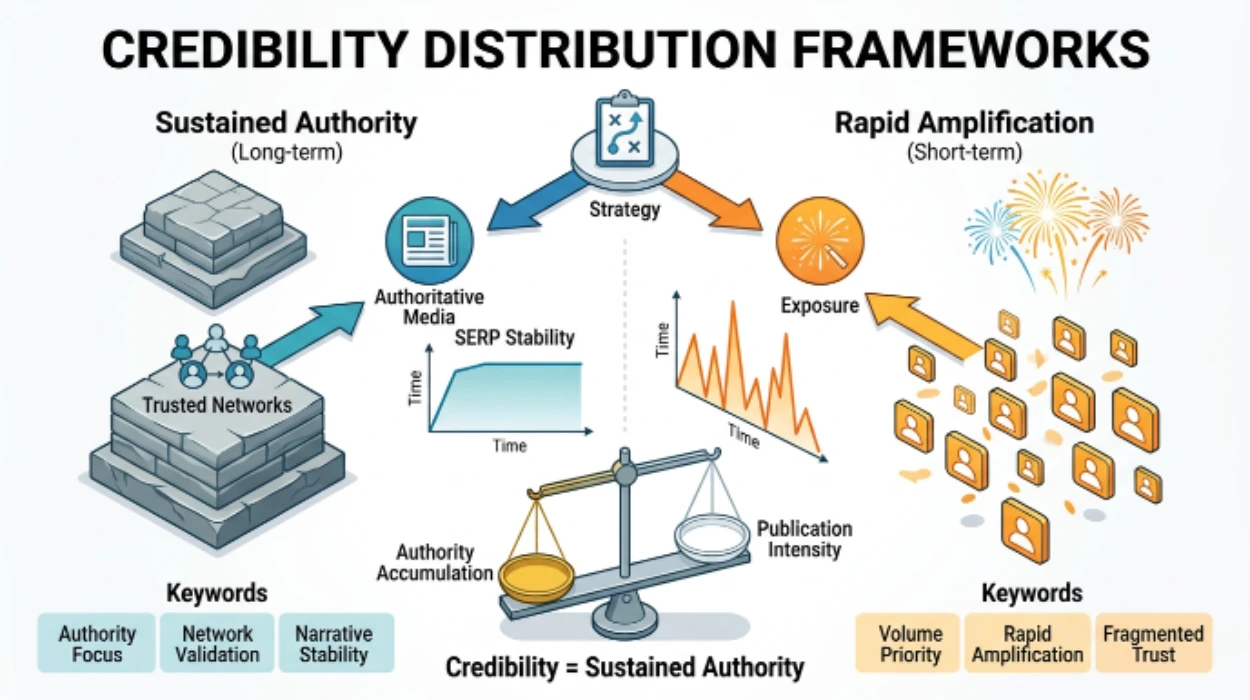
Long-term institutional credibility develops through authority-focused distribution strategies that prioritise relevance, trust, and consistency over exposure volume.
Credibility-driven distribution operates by reinforcing consistent associations with trusted media environments. It strengthens entity credibility through repeated validation across authoritative publication networks. Search engines interpret these signals as indicators of expertise and reliability, influencing long-term ranking stability.
Short-term distribution models prioritise rapid amplification. Exposure increases quickly, but authority signals remain fragmented due to inconsistent publication environments. This weakens long-term trust accumulation despite high visibility levels.
Long-term credibility frameworks influence SERP composition by ensuring sustained presence within authoritative search results. Repeated citations across trusted platforms strengthen institutional recognition over time.
Short-term visibility frameworks optimise immediate awareness but reduce narrative stability. Stakeholder perception becomes fragmented when exposure lacks contextual consistency.
Comparative analysis demonstrates that institutional credibility depends on sustained authority accumulation rather than publication intensity alone.
How do search engines evaluate authority signals from PR distribution?
Search engines evaluate authority through structured signals that reflect trust, relevance, engagement, and publication context rather than press release volume.
Authority signals emerge from publication quality, domain credibility, and entity associations. Content appearing within established media ecosystems strengthens perceived reliability. Search systems evaluate these associations to determine ranking influence and visibility distribution.
Relevance signals develop when content aligns closely with publication topics and audience expectations. Strong thematic consistency strengthens indexing accuracy and improves narrative visibility across search results.
Engagement signals measure user interaction patterns, including click behaviour, dwell time, and content sharing frequency. High engagement indicates perceived informational value and reinforces visibility stability.
Trust signals emerge from repeated references across authoritative sources. Consistent publication within credible environments strengthens long-term entity recognition and search ranking durability.
The evaluation process demonstrates that search visibility depends on authority formation rather than content volume. Distribution effectiveness therefore relies on structured credibility reinforcement.
Long-term credibility models also depend on the operational efficiency of distribution infrastructure, particularly when selecting systems capable of sustaining national-level visibility. Comparative evaluation of platforms often focuses on scale, authority depth, and media penetration, as reflected in analyses of Best PR Distribution Services for Brands Seeking National Media Coverage, where performance is measured through reach consistency and trust reinforcement across media networks.
What risks and limitations exist across different PR distribution models?
Each distribution model introduces structural trade-offs affecting visibility, authority, and trust development within media ecosystems.
Mass distribution creates extensive visibility but weakens contextual alignment. Content appears across diverse environments, reducing authority concentration and diluting stakeholder trust signals. Narrative exposure increases while credibility strength disperses.
Targeted distribution strengthens authority but limits reach. Publication frequency decreases due to editorial selectivity, reducing overall exposure while improving relevance quality.
Reactive distribution increases responsiveness but introduces consistency risks. Rapid communication cycles reduce message refinement time, increasing variability in narrative structure and stakeholder interpretation.
Stakeholder-centred distribution strengthens institutional influence but reduces public visibility metrics. Effectiveness depends on relationship depth rather than audience scale.
A central tension exists between content amplification and authority concentration. Strategies optimised for scale reduce credibility strength, while strategies optimised for authority reduce exposure volume.
What evaluation framework supports PR distribution strategy selection?
Effective PR distribution strategy selection requires a structured evaluation framework that measures visibility, authority, trust, and risk across communication objectives.
A structured assessment includes:
- Define stakeholder priorities through influence mapping and audience segmentation analysis, focusing on relevance and authority requirements.
- Measure visibility objectives through narrative reach expectations and search ranking influence targets across digital platforms.
- Evaluate credibility requirements by analysing entity association strength and media authority alignment across publication ecosystems.
- Assess risk exposure by examining message sensitivity, narrative control requirements, and reputational volatility factors.
- Analyse sustainability by measuring long-term authority accumulation potential and consistency of media reinforcement.
This framework treats distribution strategy as a governance decision rather than a dissemination choice. Effectiveness depends on alignment between communication intent and distribution architecture.
Strategic clarity emerges when visibility expansion, authority building, and trust reinforcement are evaluated together rather than independently.