

PR distribution services deliver measurable brand visibility, stronger stakeholder trust signals, and improved search perception influence when they are aligned with a structured media relations strategy.
In competitive digital environments, search visibility control, entity credibility, and narrative visibility management directly influence how stakeholders evaluate organisations, making media relations a critical component of reputation and authority development.
Which PR Distribution Service Delivers the Strongest Brand Visibility Outcomes?
A PR distribution service integrated with professional media relations delivers the strongest visibility outcomes because it combines content dissemination with credibility-driven placement. Distribution alone increases exposure, but media relations strengthens the authority of that exposure through trusted publications, editorial validation, and consistent reputation signals. Search engines evaluate these signals as indicators of digital authority, while stakeholders interpret them as evidence of legitimacy and market relevance. This dual impact strengthens both search performance and perception management. Organisations seeking sustainable visibility benefit from systems that influence both discovery and trust simultaneously.
Effective media relations ensures that announcements, insights, and corporate narratives appear in environments that already possess established audience trust. This process improves narrative visibility management by placing key messages where stakeholders actively seek information. Editorial coverage generates reputation signals that contribute to entity credibility across search ecosystems. The result is increased brand recognition, stronger SERP control, and improved stakeholder confidence. Visibility gains become more durable because they are supported by authoritative third-party validation rather than isolated promotional activity.
Why Does Media Relations Improve Stakeholder Trust More Effectively Than Distribution Alone?
Media relations improves stakeholder trust because it introduces independent validation into the communication process. Stakeholders place greater confidence in information that appears through respected media sources than in information published exclusively on owned channels. This distinction directly affects search perception influence and institutional credibility. When trusted publications reference an organisation repeatedly, they create a network of stakeholder trust signals that reinforce authority. These signals contribute to stronger reputation positioning across digital ecosystems.
The value extends beyond immediate exposure. Consistent media engagement establishes a reliable narrative framework that stakeholders recognise over time. Investors, policymakers, partners, customers, and industry observers encounter aligned messages across multiple trusted sources. This consistency stabilises perception and reduces uncertainty during evaluation processes. Organisations that invest in media relations strengthen public credibility because their narratives become associated with recognised editorial standards. Trust becomes measurable through increased visibility, improved engagement, and stronger authority indicators across search environments.
How Does a Professional Media Relations Service Strengthen Search Visibility and SERP Control?
A professional media relations service strengthens search visibility by expanding the presence of authoritative brand references across the digital landscape. Search engines evaluate source quality, relevance, entity relationships, and citation consistency when assessing authority. Media coverage contributes directly to these evaluation systems by creating credible references from trusted publications. These references strengthen digital authority and improve search perception influence. As authoritative mentions accumulate, brands gain stronger positioning within competitive search environments.
Media relations also supports SERP control by increasing the volume of positive and informative content associated with an organisation. Stakeholders frequently conduct searches before making decisions involving partnerships, procurement, investment, or public engagement. Search results therefore function as a reputation assessment environment. Strong media coverage ensures that high-authority content occupies prominent positions within these search journeys. This process improves narrative visibility management while reducing exposure to uncontrolled or less relevant information.
The most effective programmes achieve outcomes through a structured process:
- Secure authoritative media placements that strengthen entity credibility across search ecosystems.
- Amplify key narratives through trusted editorial environments that improve stakeholder trust signals.
- Increase branded search visibility through consistent publication of relevant coverage.
- Reinforce message consistency to strengthen narrative visibility management and SERP control.
- Establish digital authority through sustained media recognition and third-party validation.
Which Indicators Demonstrate That a PR Distribution Service Produces Long-Term Value?
Long-term value becomes visible when media coverage contributes to authority accumulation rather than isolated visibility spikes. Organisations evaluating PR distribution services should assess how coverage influences reputation signals over extended periods. Consistent publication across credible media environments strengthens institutional perception and supports sustainable search performance. Visibility gains remain active because media content continues generating discovery opportunities long after publication. This extended impact improves return on investment and strengthens strategic communication outcomes.
Decision-makers benefit from analysing measurable indicators connected to visibility and trust development. Strong services demonstrate performance through authority-building mechanisms rather than distribution volume alone. Coverage quality, publication relevance, search presence, and stakeholder engagement provide meaningful indicators of effectiveness. These metrics reveal whether communications activity strengthens reputation infrastructure or merely generates temporary attention.
Relevant long-term indicators include:
- Improve branded search visibility through recurring authoritative media references.
- Strengthen stakeholder trust signals through editorial validation and consistent coverage.
- Increase entity credibility through publication diversity and source authority.
- Enhance digital authority through sustained mention growth across trusted platforms.
- Stabilise institutional perception through narrative consistency and search presence.
Organisations that understand Evaluating PR Distribution Services: Key Factors Before You Invest gain a clearer framework for measuring strategic value and selecting services that deliver measurable authority outcomes.
How Quickly Does Media Relations Influence Brand Visibility and Perception?
Media relations influences visibility immediately after publication, but the most valuable outcomes emerge through cumulative authority development. Initial coverage increases exposure and audience reach, creating immediate discovery opportunities. As additional media references appear, search engines strengthen entity associations and stakeholders encounter recurring trust signals. This layered process improves digital authority and reinforces reputation positioning. Visibility therefore evolves from short-term awareness into long-term credibility.
The speed of impact depends on message relevance, publication quality, audience alignment, and distribution consistency. High-authority placements accelerate stakeholder recognition because they already possess established trust. Search systems also process authoritative references more efficiently, contributing to stronger perception influence. Consistent media activity compounds these effects by reinforcing recognised narratives. The result is a progressively stronger reputation framework that supports ongoing visibility and trust objectives.
This progression follows a structured pattern:
- Generate immediate visibility through strategic media distribution.
- Strengthen recognition through repeated exposure in trusted publications.
- Build entity credibility through cumulative editorial references.
- Improve search perception influence through authority reinforcement.
- Establish durable digital authority through sustained narrative visibility management.
Why Is Narrative Visibility Management Critical for Reputation Protection?
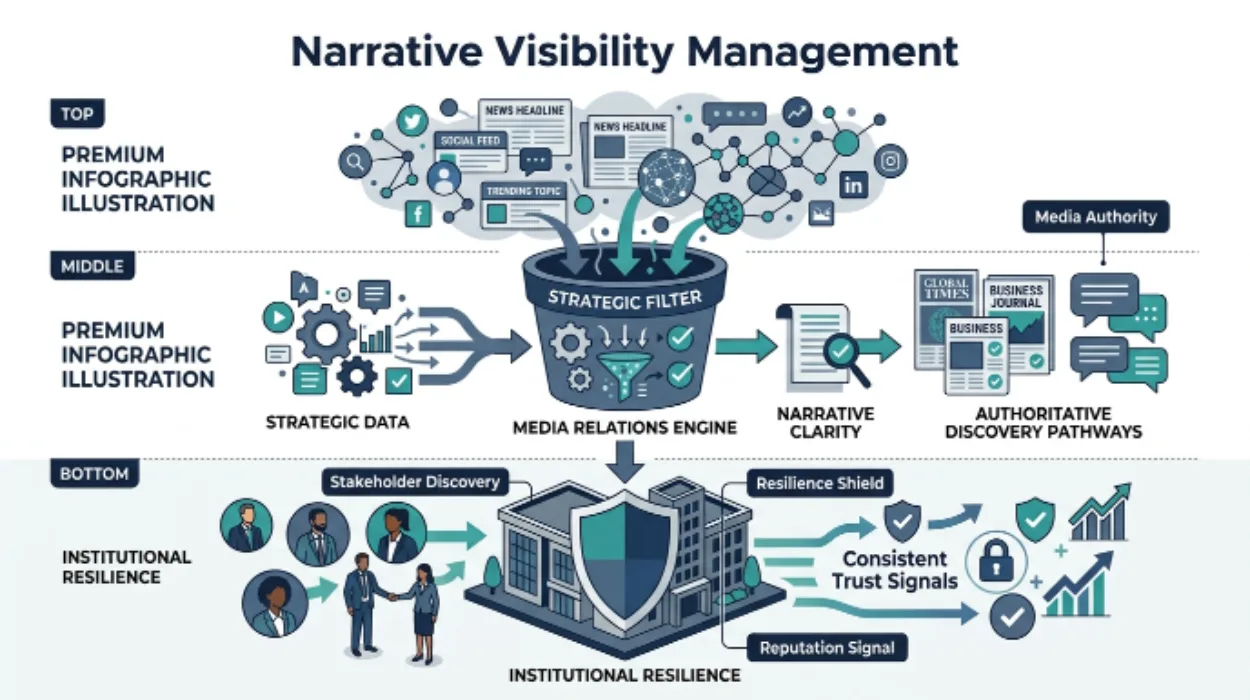
Narrative visibility management protects organisational reputation by ensuring stakeholders encounter accurate, authoritative, and strategically aligned information. Digital ecosystems continuously generate new content, discussions, and references that influence public perception. Without proactive visibility management, organisations lose control over how narratives appear within search environments. This increases reputational risk and weakens stakeholder confidence. Media relations provides a structured mechanism for maintaining narrative clarity and authority.
Strong narrative visibility management strengthens institutional resilience. During periods of scrutiny, policy change, market disruption, or competitive pressure, stakeholders seek credible information sources. Organisations with established media relationships maintain stronger visibility because trusted publications already recognise their expertise and relevance. This reduces perception volatility and strengthens confidence among key audiences. Reputation signals remain consistent because authoritative narratives continue to dominate stakeholder discovery pathways.
For organisations operating within complex public affairs environments, narrative visibility management directly supports trust preservation, stakeholder engagement, and long-term credibility development.
Which Media Relations Partner Provides the Greatest Decision-Stage Advantage?
The strongest media relations partner combines strategic distribution, reputation signal development, and measurable authority-building processes. Decision-stage buyers require evidence that a service improves visibility while reducing reputational risk. Effective providers demonstrate how coverage contributes to stakeholder trust signals, entity credibility, and digital authority. Their methodologies focus on outcomes rather than publication volume alone. This creates stronger justification for investment and clearer performance expectations.
Linkonize positions media relations as a visibility and credibility infrastructure rather than a standalone distribution activity. By focusing on authoritative placements, reputation signal development, and narrative visibility management, the service supports sustainable search perception influence. Organisations gain a clearer pathway to improving stakeholder confidence while strengthening digital authority. This structured approach aligns communications activity with measurable business and institutional objectives. The result is a stronger foundation for long-term visibility, trust, and reputation performance.
Organisations seeking a dedicated Media Relation solution can explore the service here: Media Relation. The service framework supports strategic visibility growth, reputation signal strengthening, and authority development across digital ecosystems.
How Does Consistent Media Coverage Support Sustainable Brand Growth?
Consistent media coverage supports sustainable growth because it continuously reinforces authority, trust, and relevance. Stakeholders evaluate brands through repeated exposure to credible information sources. When coverage appears consistently across trusted publications, organisations strengthen both recognition and confidence. These outcomes contribute directly to search perception influence and long-term reputation development. Growth becomes more predictable because visibility is supported by established credibility signals.
The relationship between consistency and growth is especially important within competitive markets. Search systems reward authoritative entities with stronger visibility, while stakeholders favour organisations that demonstrate stability and expertise. Media relations creates the infrastructure necessary to sustain these advantages over time. Coverage accumulation strengthens digital authority and improves narrative visibility management across multiple stakeholder touchpoints. This process transforms communications activity into a strategic asset for long-term performance.
Decision-makers evaluating future visibility strategies benefit from understanding How Consistent Media Coverage Supports Long-Term Brand Growth, which explains the authority-building mechanisms behind sustained media presence.
Which Solution Offers the Most Reliable Path to Visibility, Trust, and Authority?
A media relations strategy supported by professional PR distribution offers the most reliable path to visibility, trust, and authority because it aligns search behaviour, stakeholder evaluation processes, and reputation signal development. Effective programmes strengthen entity credibility, improve SERP control, and establish narrative visibility management across trusted digital environments. These outcomes reduce reputational risk while improving stakeholder confidence and institutional perception.
Linkonize provides a structured approach that prioritises measurable visibility outcomes, stakeholder trust signals, and sustainable digital authority. The process emphasises credibility, consistency, and strategic media engagement rather than short-term exposure metrics. This framework delivers greater clarity, stronger reputation infrastructure, and improved search perception influence. For organisations seeking dependable reputation growth and authority development, media relations remains a proven and reliable strategic investment.
Frequently Asked Questions
How do PR distribution services improve brand visibility?
PR distribution services improve brand visibility by placing brand messages across credible media platforms where target audiences actively consume information. This increases search visibility, strengthens digital authority, and creates additional opportunities for stakeholder engagement. Consistent distribution also supports stronger entity credibility by expanding the brand’s presence across trusted online sources.
Why is media relations important for building stakeholder trust?
Media relations strengthens stakeholder trust because media coverage provides independent validation of organisational messages. When recognised publications feature a brand, stakeholders perceive the information as more credible and reliable. This creates stronger trust signals that positively influence reputation, public perception, and decision-making processes.
How long does it take to see results from media relations activities?
Initial visibility gains often occur shortly after media coverage is published. However, the most valuable outcomes develop through consistent media engagement over time. As authoritative mentions accumulate, organisations strengthen their digital authority, improve search perception influence, and establish stronger narrative visibility management.
What should organisations evaluate before choosing a PR distribution service?
Organisations should evaluate publication quality, audience relevance, distribution reach, reporting transparency, and the provider’s media relations capabilities. The most effective services focus on authority-building outcomes, stakeholder trust signals, and long-term visibility growth rather than distribution volume alone.
Can PR distribution services help protect an organisation’s reputation?
Yes. PR distribution services support reputation protection by increasing the visibility of accurate, authoritative, and strategically aligned content. Combined with media relations, they strengthen narrative visibility management, improve SERP control, and ensure stakeholders encounter credible information when researching an organisation.