

Consistent media coverage supports long-term brand growth by strengthening visibility, reinforcing reputation signals, and improving the consistency of entity perception across digital ecosystems. It creates a stable information environment that influences search visibility, stakeholder trust, and institutional credibility over time.
Online reputation refers to the collective perception of an entity across digital ecosystems, shaped by indexed content, media references, search engine interpretation, and stakeholder evaluation.
Why does consistent media coverage influence long-term brand growth?
Consistent media coverage influences long-term brand growth because repeated visibility creates stable reputation signals that search engines, media platforms, and stakeholders continuously evaluate. Growth within digital ecosystems depends on sustained recognition rather than isolated exposure. Consistency defines how an entity is understood across content environments and contributes to a coherent digital footprint. Search systems analyse recurring references as indicators of relevance, authority, and topical association. Stakeholders interpret repeated media visibility as evidence of institutional presence within a recognised information landscape. As a result, long-term growth becomes connected to the accumulation of credible references rather than single communication events.
Media coverage is a form of publicly accessible information that contributes to entity understanding. Search engines process published content through indexing, categorisation, and relationship analysis. Repeated references strengthen associations between an entity and specific topics, sectors, or public issues. These associations influence content ranking dynamics and SERP evaluation. A consistent publication pattern also increases the probability that authoritative sources remain visible within search results. This process supports a stronger and more stable representation of the entity across digital channels.
How is online reputation formed through media visibility?
Online reputation is formed through the interaction of media references, search engine interpretation, stakeholder engagement, and content indexing. Reputation is not a single asset. It refers to an evolving collection of signals distributed across websites, news publications, social platforms, and search results. Every indexed mention contributes information that shapes how an entity is perceived. Search engines analyse these references to establish topical relevance and authority relationships. Stakeholders evaluate the same information when assessing credibility and trustworthiness.
Media visibility contributes directly to reputation formation because it increases the volume and accessibility of information available for evaluation. Search engines interpret recurring coverage as evidence of ongoing relevance within a topic area. News publications often serve as trusted sources within digital ecosystems, making their references significant reputation signals. When media coverage remains consistent over time, it creates a structured narrative environment. This environment reduces ambiguity and strengthens entity recognition. The result is a more coherent reputation profile across search and information platforms.
How do search engines interpret authority from media coverage?
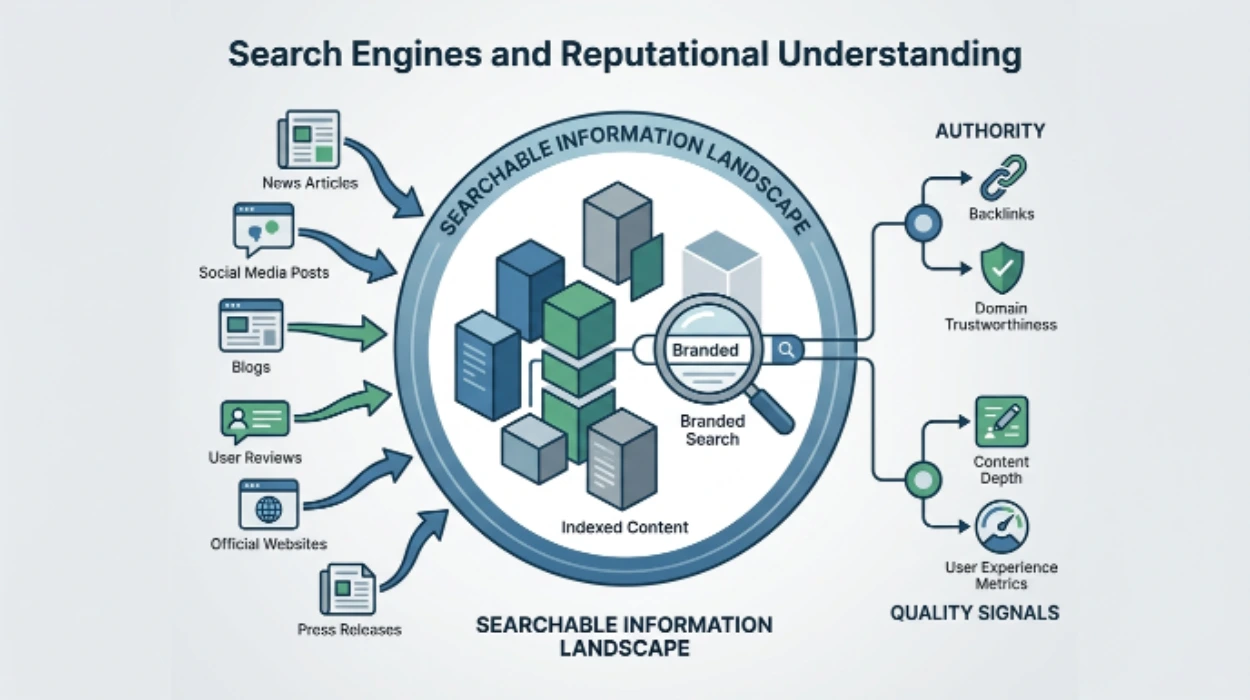
Search engines interpret authority through the quality, consistency, and contextual relevance of information connected to an entity. Digital authority refers to the perceived expertise, credibility, and relevance of an entity within a defined topic area. Authority is established through interconnected signals rather than individual rankings. Media coverage contributes by providing independently published references that reinforce topical associations. These references become part of the broader evaluation framework used for ranking and entity understanding.
Content indexing plays a central role in this process. Search systems analyse publication frequency, source credibility, semantic relationships, and topic consistency. Repeated mentions across recognised publications strengthen entity associations within knowledge frameworks. Authority emerges when search engines identify a sustained pattern of relevant references connected to the same themes. This pattern improves confidence in the entity’s position within a subject area. As confidence increases, search visibility often becomes more stable across related queries.
How do authority signals affect search visibility?
Authority signals affect search visibility by influencing how search engines evaluate relevance and trust. Ranking systems prioritise content that demonstrates expertise and contextual consistency. Media references provide external validation that contributes to these assessments. When authoritative sources repeatedly discuss an entity within a specific topic, search systems develop stronger confidence in those associations. This process supports improved discoverability across relevant search environments.
Authority signals also contribute to entity consolidation. Search engines seek to understand whether different references relate to the same organisation, institution, or public entity. Consistent media coverage provides structured information that assists this interpretation. The outcome is a more defined digital presence and stronger alignment between reputation signals and search visibility.
What role do digital narratives play in stakeholder perception?
Digital narratives define how information is organised, interpreted, and remembered across online environments. A digital narrative is the collection of recurring themes, messages, and contextual associations that shape entity perception. Narratives emerge through repeated publication patterns rather than isolated content pieces. Media coverage contributes by reinforcing particular interpretations of an entity’s activities, expertise, or institutional role. Stakeholders encounter these narratives through search results, news platforms, and content networks.
Narrative influence affects stakeholder trust because perception is formed through accumulated information. Search users evaluate not only individual articles but also the overall consistency of information presented across sources. A coherent narrative creates clarity, while fragmented information creates uncertainty. Consistent media coverage supports narrative continuity by maintaining stable thematic associations. This continuity improves understanding and strengthens credibility assessments. As a result, stakeholders gain a clearer framework for evaluating institutional relevance.
How does consistent media coverage contribute to stakeholder trust?
Consistent media coverage contributes to stakeholder trust by increasing information reliability and reducing uncertainty within digital ecosystems. Stakeholder trust refers to confidence in the accuracy, credibility, and consistency of information associated with an entity. Trust is developed through repeated exposure to dependable information rather than isolated statements. Media visibility creates opportunities for ongoing verification through independent sources. This process strengthens confidence in the integrity of publicly available information.
Trust architecture within digital ecosystems depends on accessible evidence. Search engines, journalists, analysts, and stakeholders all rely on available information when forming evaluations. Consistent coverage increases the volume of verifiable content linked to an entity. It also improves the likelihood that credible information remains visible within search results. The accumulation of trustworthy references creates a stronger foundation for institutional credibility. Consequently, stakeholder trust becomes supported by observable evidence rather than assumptions.
How do SERPs influence public perception of an entity?
Search engine results pages influence public perception because they function as primary evaluation environments. SERPs are often the first point of contact between stakeholders and information about an entity. The content displayed within search results shapes expectations, credibility assessments, and reputational understanding. Search engines organise information according to relevance, authority, and quality signals. Therefore, the composition of a results page directly affects perception.
Media coverage contributes to SERP evaluation by supplying indexed content that can appear across branded and topical searches. Positive, neutral, and critical references all become part of the searchable information landscape. Search systems analyse these references collectively rather than independently. Consistent media visibility increases representation across search results and contributes to a more comprehensive entity profile. This expanded representation influences how stakeholders interpret authority, relevance, and trustworthiness.
How does content ranking affect reputation signals?
Content ranking affects reputation signals because higher visibility increases the likelihood of stakeholder engagement. Ranking determines which information users encounter first. Search systems prioritise content based on relevance and authority assessments. Media references from recognised publications often perform strongly because they satisfy quality and trust criteria. Their visibility therefore amplifies the reputation signals they contain.
Reputation signals gain influence when they remain accessible across search environments. Content that ranks prominently contributes more significantly to entity perception than content that remains difficult to discover. Consistent media coverage supports this process by increasing the quantity of relevant indexed assets. The result is a broader network of visible reputation signals that reinforce credibility and authority evaluations.
Why is institutional credibility connected to content ecosystems?
Institutional credibility is connected to content ecosystems because credibility is evaluated through interconnected sources rather than isolated communications. A content ecosystem refers to the network of websites, publications, databases, social platforms, and search results that collectively shape information availability. Institutions exist within these ecosystems as recognised entities. Their credibility depends on how consistently and accurately they are represented across connected platforms.
Media coverage strengthens institutional credibility by expanding independent references within the ecosystem. Search engines analyse relationships between sources to assess information reliability. Stakeholders perform similar evaluations when comparing information across multiple channels. Consistency across these sources reinforces credibility because it demonstrates alignment and reliability. Consequently, institutional perception becomes linked to ecosystem-wide information quality rather than individual content assets.
How does media sentiment affect digital perception systems?
Media sentiment affects digital perception systems because sentiment influences interpretation, context, and narrative framing. Sentiment refers to the evaluative tone associated with a piece of content. Search engines increasingly analyse contextual meaning rather than relying exclusively on keywords. As a result, sentiment contributes to broader entity understanding. Stakeholders also interpret tone when evaluating credibility and institutional behaviour.
Consistent media coverage provides a larger dataset for sentiment interpretation. Search systems and stakeholders gain a more complete view of how an entity is discussed over time. This broader perspective reduces the influence of isolated references and encourages evaluation based on cumulative information. Sentiment therefore becomes one component within a wider perception framework that includes authority signals, relevance indicators, and narrative consistency. The interaction of these factors shapes long-term reputation outcomes across digital ecosystems.
How does a digital footprint support long-term visibility?
A digital footprint supports long-term visibility because it represents the total collection of indexed information associated with an entity. This footprint includes media coverage, search results, organisational content, public references, and third-party discussions. Search engines rely on this information to understand relevance, authority, and topic relationships. The size, quality, and consistency of the footprint influence search visibility and entity perception.
Consistent media coverage expands the digital footprint through the creation of additional indexed assets. Each publication contributes new information that search systems can analyse and connect to existing knowledge structures. This accumulation strengthens topical associations and increases information availability. Stakeholders benefit from greater access to relevant information, while search engines gain additional context for entity evaluation. Over time, the digital footprint becomes a foundational component of online reputation and institutional credibility.
Conclusion
Consistent media coverage supports long-term brand growth by strengthening reputation signals, expanding digital footprints, and reinforcing authority within search ecosystems. Its influence extends beyond visibility and contributes to how search engines evaluate relevance, how stakeholders assess trust, and how institutions establish credibility. Media references become part of broader content ecosystems that shape narrative influence, SERP evaluation, and entity perception. Through content indexing, authority analysis, and reputation signal accumulation, digital systems develop a clearer understanding of an entity’s role and relevance. Long-term growth therefore emerges from sustained information consistency, stable digital narratives, and the continuous reinforcement of trust-oriented signals across interconnected online environments.
Within broader discussions about media visibility and reputation infrastructure, topics such as Evaluating PR Distribution Services: Key Factors Before You Invest are often examined as part of understanding how content enters and moves through digital ecosystems.