

Media mentions impact search visibility and online reputation by creating reputation signals that search engines use to evaluate authority, credibility, relevance, and entity perception across digital ecosystems.
Online reputation refers to the collective interpretation of an entity’s credibility, trustworthiness, visibility, and authority across search engines, media platforms, websites, and stakeholder-facing digital channels.
Why do media mentions influence search visibility?
Media mentions influence search visibility because they act as external validation signals that define how an entity is referenced, interpreted, and connected within digital ecosystems.
A media mention is a reference to an organisation, institution, public figure, initiative, or entity within a published digital or traditional media source. Within search ecosystems, media mentions contribute to entity recognition, topical association, and reputation development. Search engines evaluate references across indexed content to understand relationships between entities and subjects. This process supports content indexing, knowledge graph development, and search result evaluation. The frequency, relevance, and context of mentions influence how an entity is interpreted across search environments.
The mechanism relies on information retrieval systems that analyse references across trusted sources. When an entity appears within authoritative publications, search engines identify semantic relationships between the entity and surrounding topics. These relationships contribute to entity perception and thematic relevance. Search visibility increases when search engines consistently observe corroborating references across credible sources. This creates a stronger digital footprint that supports discoverability within search engine results pages (SERPs).
The impact extends beyond rankings alone. Media references shape credibility assessment, influence stakeholder trust, and strengthen institutional visibility. Search engines evaluate not only content ownership but also third-party recognition. This external validation contributes to digital authority and strengthens overall search ecosystem presence.
How do search engines interpret media mentions as authority signals?
Search engines interpret media mentions as authority signals by analysing source credibility, contextual relevance, entity relationships, and content consistency.
Authority signals refer to indicators that demonstrate expertise, recognition, and trustworthiness within a specific subject area. Search systems evaluate authority through interconnected data points rather than isolated references. Media mentions contribute to this evaluation because they provide independent evidence of relevance and recognition. The authority of the publishing source influences how the mention is interpreted within ranking systems. Contextual relevance further determines the strength of the signal.
How does source authority affect interpretation?
Source authority defines the perceived credibility of the publication containing the mention. Search engines analyse publication history, editorial standards, topical expertise, and audience trust indicators. Mentions originating from established publications carry stronger authority signals because they exist within trusted information ecosystems. This evaluation process contributes to entity understanding and reputation measurement. The result is a more comprehensive assessment of digital authority.
How does contextual relevance strengthen authority?
Contextual relevance refers to the relationship between the mention and the subject matter surrounding it. Search engines evaluate whether the entity appears within content directly related to its recognised area of expertise or activity. Relevant contextual placement strengthens topical associations and improves semantic understanding. Consistent contextual references reinforce entity perception and support stronger SERP evaluation outcomes. Relevance therefore functions alongside authority rather than independently from it.
What role do media mentions play in online reputation formation?
Media mentions play a central role in online reputation formation because they contribute to the public record that shapes stakeholder perception.
Online reputation is formed through the accumulation of digital references, published information, search visibility patterns, and stakeholder interactions. Media coverage contributes to this process by creating accessible, indexable content that search engines can evaluate. Each mention becomes part of the broader information environment surrounding an entity. These references influence how audiences and algorithms interpret credibility and trustworthiness. Reputation formation therefore emerges from interconnected information systems rather than isolated publications.
The mechanism involves repeated exposure to consistent narratives across trusted sources. Search engines collect, index, and organise information from multiple publications. As references accumulate, patterns emerge regarding expertise, authority, and institutional relevance. These patterns influence entity perception within search systems and contribute to broader reputation signals. Consistency strengthens clarity, while conflicting information affects interpretive certainty.
Institutional credibility is closely connected to this process. Stakeholders evaluate visible information when assessing trustworthiness and legitimacy. Media mentions contribute evidence that informs these evaluations. Search visibility amplifies this effect by increasing the accessibility of reputation-related information. The result is a continuously evolving reputation framework shaped by digital information ecosystems.
How do digital narratives affect stakeholder perception?
Digital narratives affect stakeholder perception by defining the context through which information is interpreted and evaluated.
A digital narrative is a recurring thematic framework that explains an entity, issue, institution, or subject across digital content environments. Narratives emerge through repeated references, media coverage, commentary, and content publication. Search engines analyse these patterns to understand thematic relationships and entity associations. Stakeholders encounter narratives through search results, news coverage, social platforms, and informational content. This creates a shared interpretive environment.
Narrative influence operates through repetition and semantic consistency. When similar descriptions, themes, and contextual associations appear across multiple sources, search systems identify recurring patterns. These patterns contribute to entity perception and influence how information is categorised. Search visibility often reflects the strength and consistency of recognised narratives. Content ranking systems evaluate thematic alignment when determining relevance for specific queries.
Stakeholder trust is affected because narratives influence understanding before direct engagement occurs. Information appearing within search results provides context that shapes expectations and credibility assessments. Consistent narratives support interpretive clarity. Contradictory narratives introduce uncertainty into reputation evaluation processes. Digital narratives therefore function as a core component of online trust architecture.
How do media mentions contribute to institutional credibility?
Media mentions contribute to institutional credibility by providing independent evidence of recognition, relevance, and public visibility.
Institutional credibility refers to the perceived legitimacy and trustworthiness of an organisation, institution, or public entity. Within digital ecosystems, credibility is influenced by observable information signals. Media references create documented evidence that search engines and stakeholders can evaluate. These references contribute to a broader understanding of institutional presence and authority. Credibility therefore develops through visible and verifiable information patterns.
The mechanism depends on external validation. Search systems distinguish between self-published content and third-party references. Independent coverage introduces additional perspectives into the information ecosystem. This broadens the evidence base available for evaluation. Repeated references across credible sources strengthen confidence in entity recognition and relevance.
Institutional visibility further amplifies credibility effects. Search engines prioritise information that demonstrates relevance and trustworthiness. Media mentions increase the volume of discoverable information associated with an entity. Enhanced visibility improves information accessibility and contributes to stronger stakeholder awareness. Credibility and visibility therefore operate as interconnected components of digital reputation systems.
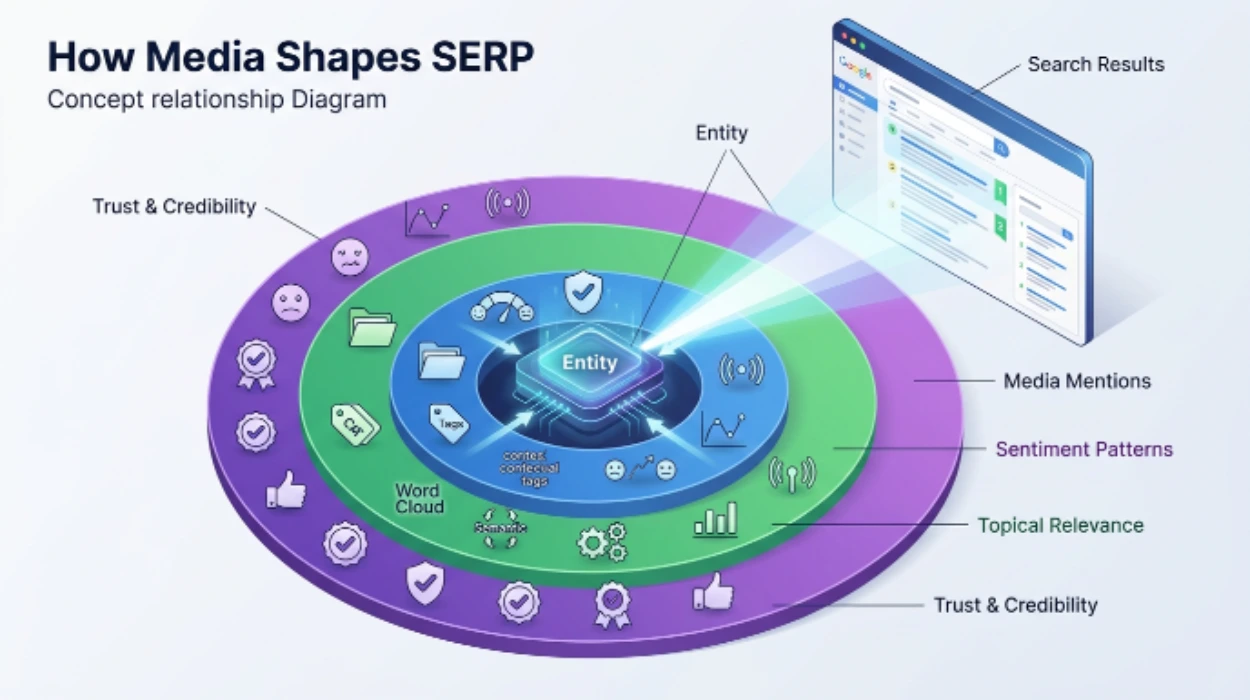
How do media mentions influence SERP evaluation?
Media mentions influence SERP evaluation by providing signals that support relevance assessment, authority measurement, and entity understanding.
SERP evaluation refers to the process through which search engines determine which content appears in search results and how it is positioned. Search systems evaluate thousands of signals during ranking calculations. Media mentions contribute information that helps define entity relationships and credibility indicators. These references become part of the broader dataset used for ranking decisions. Their influence emerges through cumulative signal analysis rather than direct ranking assignment.
Search engines analyse content indexing patterns associated with media references. Indexed mentions contribute additional data regarding topical relevance, authority, and entity associations. The presence of corroborating information across multiple trusted sources strengthens confidence in entity identification. This improves search engine understanding and supports more accurate ranking evaluations. Stronger understanding often translates into broader search visibility.
Media sentiment also contributes contextual information. Search systems analyse language patterns, thematic associations, and contextual relationships surrounding mentions. This process informs entity interpretation and reputation assessment. While sentiment alone does not define rankings, it contributes to the broader information landscape influencing SERP evaluation.
What is the relationship between media visibility and stakeholder trust?
Media visibility and stakeholder trust are connected through information accessibility, credibility assessment, and perception formation.
Media visibility refers to the degree to which an entity appears across searchable and discoverable media environments. Stakeholder trust refers to confidence in an entity’s reliability, legitimacy, and credibility. Increased visibility expands the amount of information available for evaluation. This influences how stakeholders interpret expertise, authority, and relevance. Trust emerges through exposure to consistent and credible information signals.
The mechanism begins with information discovery. Stakeholders frequently encounter entities through search engines before direct engagement occurs. Search results provide an overview of available information, including media references and institutional content. These sources collectively shape initial credibility assessments. Visibility therefore functions as a prerequisite for reputation evaluation.
Trust architecture develops when information remains consistent across multiple touchpoints. Search engines, media publications, and informational resources contribute to this architecture. Consistency strengthens confidence in available information. Credible media mentions reinforce recognised narratives and support stronger reputation signals. The result is a more stable framework for stakeholder trust formation.
How does content indexing amplify the impact of media mentions?
Content indexing amplifies the impact of media mentions by transforming published references into searchable and retrievable information assets.
Content indexing is the process through which search engines discover, analyse, categorise, and store information for future retrieval. Media mentions influence visibility only after indexing occurs. Once indexed, references become part of searchable information repositories. Search systems can then evaluate these references alongside other content signals. This creates long-term visibility effects.
The mechanism involves information processing and semantic classification. Search engines analyse content structure, entity references, topical themes, and contextual relationships during indexing. Media mentions contribute data that expands entity profiles and strengthens subject associations. Indexed references therefore become active components of search evaluation systems. Their influence extends across multiple search queries and informational contexts.
The impact on reputation is significant because indexed information remains accessible over time. Stakeholders encounter indexed content through branded, topical, and informational searches. Search visibility increases when indexed references contribute positively to entity understanding. Content indexing therefore acts as the infrastructure that enables media mentions to influence digital authority and reputation systems.
Why are reputation signals important within digital ecosystems?
Reputation signals are important within digital ecosystems because they help search engines and stakeholders evaluate credibility, authority, and trust.
Reputation signals refer to observable indicators that contribute to perceptions of legitimacy and reliability. These signals include media mentions, content quality, entity associations, citation patterns, and institutional references. Search systems analyse these indicators to understand how entities fit within broader information environments. Reputation signals therefore support both ranking processes and perception analysis. They function as evidence within digital evaluation frameworks.
The mechanism relies on signal aggregation. Search engines do not evaluate credibility through a single factor. Instead, they analyse interconnected signals that collectively define authority and trustworthiness. Media mentions contribute external validation, while content quality supports expertise assessment. Together, these signals shape entity perception and influence search visibility outcomes.
Digital ecosystems depend on trust-based evaluation. Search engines aim to organise information according to relevance, reliability, and authority. Reputation signals provide measurable indicators that support this objective. Strong reputation frameworks improve institutional visibility, reinforce stakeholder trust, and strengthen digital authority across search environments.
How does public perception evolve through digital information ecosystems?
Public perception evolves through digital information ecosystems because search engines, media platforms, and content networks continuously influence information interpretation.
Public perception refers to the collective understanding of an entity, institution, issue, or topic within society. Digital ecosystems shape this understanding by controlling information discovery pathways. Search engines organise information according to relevance and authority. Media platforms contribute narratives and contextual framing. Together, these systems influence perception formation.
The mechanism involves continuous information exposure. Search visibility determines which information receives attention and which narratives gain prominence. Media mentions contribute contextual signals that influence interpretation. Search engines evaluate these signals and integrate them into broader entity understanding processes. Public perception evolves as new information enters the ecosystem and existing narratives are reinforced or redefined.
The relationship between perception and visibility remains central to digital reputation management frameworks. Visibility influences discovery, discovery influences interpretation, and interpretation influences trust. These interconnected processes define how institutions, organisations, and entities are perceived across digital environments. Understanding this relationship provides deeper insight into how authority, credibility, and reputation are constructed online.
Within this broader ecosystem, concepts explored in How PR Distribution Supports SEO, Brand Authority and Search Visibility connect directly to the relationship between information dissemination, authority signals, and search perception frameworks.
Conclusion
Media mentions influence search visibility and online reputation by contributing authority signals, reputation signals, entity associations, and narrative context across digital ecosystems. Search engines evaluate these references to understand credibility, relevance, and institutional visibility within SERPs.
Online reputation develops through interconnected systems involving content indexing, media visibility, stakeholder trust, digital authority, and narrative influence. Media mentions contribute independent evidence that strengthens entity understanding and supports credibility assessment. As search ecosystems continue to organise information through authority and relevance evaluation, media visibility remains a foundational component of digital perception systems and institutional reputation formation.
Frequently Asked Questions
How do media mentions affect online reputation?
Media mentions affect online reputation by contributing publicly accessible information that search engines and stakeholders evaluate. Each mention becomes part of an entity’s digital footprint and influences credibility, authority, and trust perception. Consistent references across recognised publications strengthen reputation signals and improve entity recognition within search ecosystems.
Why are media mentions important for search visibility?
Media mentions are important for search visibility because they provide external validation signals that help search engines understand entity relevance and authority. Indexed mentions contribute contextual information that supports content ranking, entity association, and SERP evaluation. Strong media visibility increases discoverability across relevant search queries.
Can media mentions influence stakeholder trust?
Yes, media mentions influence stakeholder trust by shaping how information is interpreted before direct engagement occurs. Stakeholders often evaluate visible search results and media coverage when assessing credibility. Consistent and authoritative mentions strengthen trust architecture and support positive entity perception.
How do search engines evaluate media coverage?
Search engines evaluate media coverage by analysing source authority, contextual relevance, entity relationships, and content consistency. They assess how frequently an entity is referenced, the credibility of publishing sources, and the thematic connection between the entity and surrounding content. These factors contribute to reputation signals and search visibility outcomes.
What is the connection between media mentions and digital authority?
Media mentions contribute to digital authority by demonstrating recognition from independent sources. Search engines interpret these references as evidence of relevance and credibility within a specific topic area. Repeated mentions across trusted publications strengthen authority signals and improve overall entity perception within digital ecosystems.