

PR distribution supports SEO, brand authority, and search visibility by expanding the reach of institutional narratives across trusted publications, increasing reputation signals, and strengthening entity credibility within search ecosystems. Search engines interpret consistent media references, citation patterns, and authority signals as indicators of relevance, trust, and topical prominence.
Public affairs strategies differ based on visibility objectives, stakeholder priorities, and institutional trust requirements. Digital advocacy methods are evaluated through their influence on narrative visibility, search ranking influence, stakeholder trust, and long-term reputation resilience.
How does PR distribution compare with owned content publishing for search visibility?
PR distribution generates visibility through third-party publication networks, while owned content publishing generates visibility through institutional digital assets. Both approaches contribute to search visibility, but they operate through different authority mechanisms. PR distribution is the structured dissemination of information to media platforms, publishers, and industry-specific outlets. Owned content publishing is the creation and maintenance of content on websites, blogs, resource hubs, and institutional platforms.
PR distribution operates by placing narratives within external environments that already possess established authority signals. Search engines evaluate these references as external validation of entity relevance and credibility. Media citations contribute to entity associations, topic reinforcement, and broader content discovery patterns. This mechanism expands narrative visibility beyond organisational channels and influences how search engines interpret authority relationships.
Owned content publishing operates by building topical depth and semantic relevance within a controlled environment. Search engines analyse internal content structures, topical coverage, user engagement signals, and content freshness. This approach provides greater control over messaging and information architecture. However, visibility growth depends on existing domain authority and content performance.
From an evaluation perspective, PR distribution strengthens external authority signals, while owned content strengthens internal topical authority. PR distribution expands visibility through amplification, whereas owned content expands visibility through semantic depth. The strongest search visibility outcomes emerge when external references and internal content ecosystems reinforce the same entity and topic relationships.
How does media relations influence search ranking influence compared with direct stakeholder engagement?
Media relations influences search visibility through authority transfer and narrative amplification, whereas direct stakeholder engagement influences trust development through relationship-building mechanisms. Media relations is a public affairs function focused on maintaining structured communication with journalists, publishers, and editorial stakeholders. Direct stakeholder engagement focuses on communication with policymakers, community groups, industry participants, regulators, and institutional audiences.
Media relations operates by generating earned visibility across trusted information sources. Search engines interpret recurring media references as signals of prominence and entity recognition. Consistent coverage increases narrative distribution across search-indexed environments and contributes to broader SERP representation. This process strengthens search ranking influence by reinforcing authority associations.
Direct stakeholder engagement operates through dialogue, consultation, feedback mechanisms, and policy communication frameworks. Its primary value is the development of stakeholder trust and institutional credibility. Search visibility effects emerge indirectly through citation opportunities, policy references, public documentation, and ecosystem participation. The impact on search performance is therefore less immediate but more structurally connected to long-term credibility.
The comparison highlights different strategic outcomes. Media relations delivers broader narrative exposure and faster visibility expansion. Stakeholder engagement delivers stronger trust architecture and governance credibility. Search ecosystems increasingly evaluate both prominence signals and trust signals, making the interaction between these approaches significant for institutional visibility.
The relationship between earned media and search performance becomes clearer when analysing how media mentions impact search visibility and online reputation, particularly through authority signals, entity associations, and citation patterns.
Which approach provides stronger entity credibility: media coverage or content authority?
Entity credibility is strengthened through the combination of media coverage and content authority, although each approach contributes different validation signals. Media coverage is external recognition generated through third-party publications. Content authority is topical expertise demonstrated through comprehensive information assets.
Media coverage operates by creating external references that search engines can associate with an entity. Each citation contributes to entity recognition, reputation signals, and contextual relevance. Coverage across authoritative publications expands digital footprints and increases evidence of public relevance. Search systems evaluate these patterns when determining prominence and trustworthiness.
Content authority operates by demonstrating knowledge depth across a defined topic cluster. Search engines analyse semantic relationships, topical completeness, and information quality. Comprehensive content strengthens topical authority and establishes expertise indicators. This process supports sustainable visibility within competitive search environments.
Media coverage provides external validation, while content authority provides internal validation. External validation increases perceived prominence. Internal validation increases perceived expertise. When media references align with authoritative content ecosystems, entity credibility becomes more resilient and more easily interpreted by search engines and stakeholders.
How do organic communication frameworks compare with reactive communication frameworks?
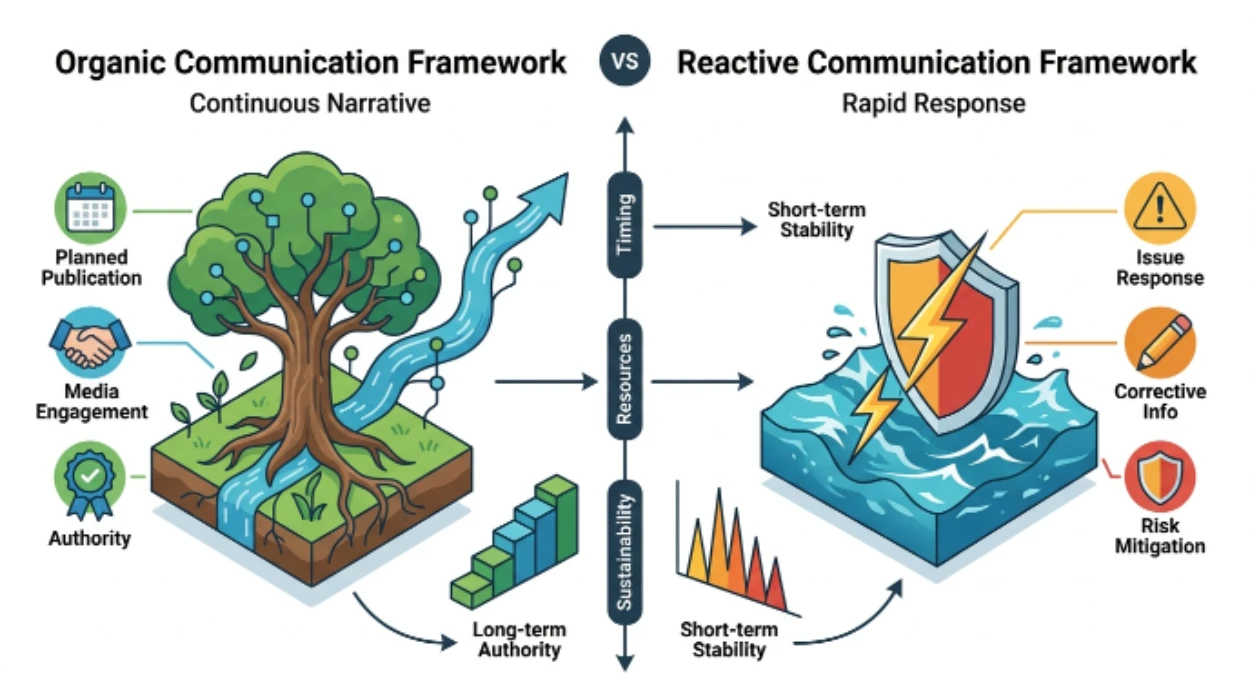
Organic communication frameworks prioritise continuous narrative development, while reactive communication frameworks prioritise response to emerging issues and visibility challenges. These approaches differ in timing, resource allocation, and reputation outcomes.
Organic communication is a long-term strategy based on planned publication, stakeholder communication, media engagement, and authority development. It operates by maintaining consistent visibility across digital and public affairs environments. Search engines benefit from predictable content growth, recurring references, and stable reputation signals. This framework strengthens narrative visibility over extended periods.
Reactive communication is an issue-driven approach focused on responding to events, criticism, misinformation, or reputation threats. It operates by rapidly introducing corrective information into media and search ecosystems. Search visibility changes occur through concentrated publication activity and accelerated narrative distribution. The framework focuses on mitigating visibility risks rather than expanding authority.
Organic communication demonstrates stronger sustainability because authority accumulation occurs continuously. Reactive communication demonstrates stronger short-term responsiveness because narrative interventions occur rapidly. The limitation of reactive frameworks is dependence on external events. The limitation of organic frameworks is slower visibility acceleration. Effective reputation systems evaluate both continuity and response capability.
How does PR distribution affect narrative visibility compared with advertising-based visibility?
PR distribution affects visibility through earned authority signals, while advertising affects visibility through paid placement mechanisms. Both approaches increase exposure, but search engines interpret their signals differently.
PR distribution operates through editorial ecosystems where information is assessed and published by independent entities. This process creates earned references, citation pathways, and contextual authority associations. Search engines interpret these signals as evidence of relevance and recognition. Narrative visibility therefore expands through credibility-linked mechanisms.
Advertising operates through transactional placement models. Visibility is achieved through budget allocation and audience targeting. The mechanism provides immediate reach and message control. However, search engines generally separate advertising signals from organic authority evaluation processes. Advertising increases awareness but contributes less directly to entity credibility assessments.
The comparison reveals distinct outcomes. PR distribution strengthens authority-linked visibility and supports long-term reputation signals. Advertising strengthens exposure volume and audience precision. From a search visibility perspective, PR distribution contributes more effectively to authority interpretation and narrative persistence across indexed environments.
What role does PR distribution play in content amplification versus content suppression?
PR distribution primarily functions as a content amplification mechanism, while content suppression strategies focus on reducing the visibility of competing narratives. These approaches address narrative management from different operational perspectives.
Content amplification is the expansion of information reach across media channels, publications, and digital platforms. PR distribution operates by increasing publication frequency, citation density, and content discoverability. Search engines interpret expanded references as stronger evidence of topic relevance and entity prominence. Amplification therefore increases narrative visibility within search results.
Content suppression is the reduction of visibility for competing, outdated, or negative content through the introduction of more authoritative and relevant information. Search ecosystems prioritise relevance, authority, and user value. Suppression operates indirectly by improving the visibility of preferred content assets rather than removing information. This mechanism changes SERP composition through competitive ranking dynamics.
Amplification demonstrates stronger scalability because publication networks can expand rapidly across sectors and geographies. Suppression demonstrates stronger dependence on existing authority, content quality, and search competitiveness. PR distribution contributes to both processes by increasing the volume and authority of positive reputation signals within digital ecosystems.
Scalability becomes a significant consideration when evaluating enterprise PR distribution services for multi-market campaigns, as cross-market narrative consistency and authority distribution require structured coordination across multiple media ecosystems.
How do short-term narrative management and long-term institutional credibility strategies differ?
Short-term narrative management focuses on immediate visibility outcomes, while long-term institutional credibility strategies focus on sustained trust development. These approaches differ in objectives, measurement frameworks, and reputation durability.
Short-term narrative management is the process of influencing current discourse through targeted communication activities. It operates by increasing visibility around a specific issue, event, announcement, or policy discussion. Metrics include media coverage volume, search visibility shifts, sentiment distribution, and audience exposure. The emphasis is immediate narrative positioning.
Long-term institutional credibility strategies operate through cumulative trust formation. They involve consistent stakeholder engagement, transparent communication, authority development, and evidence-based reputation building. Search engines interpret long-term consistency as a trust signal because recurring authority indicators reinforce entity reliability. Stakeholders interpret consistency as institutional competence and accountability.
Short-term approaches generate faster visibility outcomes but demonstrate greater volatility. Long-term approaches generate slower visibility gains but demonstrate greater resilience. Institutional trust systems depend on sustained credibility signals rather than isolated visibility events. For this reason, long-term credibility strategies provide stronger foundations for reputation stability and search performance.
Which evaluation criteria best measure the effectiveness of PR distribution?
PR distribution effectiveness is measured through visibility, authority, trust, and narrative impact indicators. Evaluation frameworks require both search-based and stakeholder-based measurements to provide accurate analysis.
The following criteria provide structured assessment:
- Measure search ranking influence through changes in visibility for entity-related queries and topic-specific search terms.
- Analyse reputation signals through media citations, reference frequency, and authority source diversity.
- Evaluate sentiment distribution by assessing the balance between positive, neutral, and negative narrative exposure.
- Assess stakeholder trust through engagement quality, institutional references, and credibility indicators.
- Compare SERP composition by identifying changes in narrative prominence across search results.
Each metric evaluates a different dimension of influence. Search ranking influence measures discoverability. Reputation signals measure authority recognition. Sentiment distribution measures perception patterns. Stakeholder trust measures institutional confidence. SERP composition measures narrative visibility outcomes.
A comprehensive evaluation framework combines these indicators because search visibility alone does not explain credibility performance. Public affairs and digital advocacy strategies require analysis of both technical visibility and stakeholder interpretation processes.
Conclusion
PR distribution supports SEO, brand authority, and search visibility through the expansion of reputation signals, entity credibility, and narrative visibility across trusted digital environments. Its effectiveness derives from external validation mechanisms that search engines use to interpret prominence, relevance, and authority.
The comparison of approaches demonstrates that media relations and stakeholder engagement serve different but complementary functions. Organic communication frameworks provide sustainable authority development, while reactive frameworks provide rapid narrative response. Content authority strengthens expertise signals, while media coverage strengthens prominence signals. Content amplification expands narrative reach, whereas content suppression influences SERP composition through competitive visibility dynamics.
Strategic evaluation depends on measuring search ranking influence, stakeholder trust, sentiment distribution, and institutional credibility simultaneously. Public affairs, digital advocacy, and reputation strategy frameworks are most effective when visibility mechanisms and trust mechanisms reinforce each other across search ecosystems and stakeholder environments.