

Brands expand their reach through publisher partnerships by increasing content distribution, strengthening digital authority, and improving visibility across trusted media ecosystems. Publisher partnerships create additional pathways for content indexing, audience exposure, and reputation signal generation within search and information environments.
Online reputation refers to the collective perception of an entity across digital ecosystems. Public affairs refers to the management of relationships, narratives, and stakeholder communication that influence public understanding, while digital advocacy is the strategic dissemination of information designed to shape awareness, engagement, and institutional visibility within online environments.
What Are Publisher Partnerships Within Digital Ecosystems?
Publisher partnerships are structured relationships between organisations and established media platforms that enable content distribution across recognised digital properties.
Within digital ecosystems, publisher partnerships refer to agreements that facilitate the publication, syndication, amplification, or distribution of information through authoritative content channels. These partnerships function as visibility mechanisms because publishers possess established audiences, indexed content archives, recognised entity associations, and existing trust signals. Search engines evaluate publisher domains through historical authority, content quality indicators, user engagement metrics, and citation relationships. When information appears within these environments, it becomes part of a broader network of indexed and discoverable content. This process expands digital presence while contributing additional reputation signals across search ecosystems.
Publisher partnerships also influence entity perception. Entity perception refers to the way algorithms and users interpret the identity, relevance, and credibility of an organisation. Published content contributes contextual associations between entities, topics, industries, and expertise areas. These associations become part of search engine knowledge evaluation processes and affect how information is categorised, surfaced, and ranked within search results.
How Do Publisher Partnerships Increase Search Visibility?
Publisher partnerships increase search visibility by expanding the volume, reach, and discoverability of indexed content.
Search visibility refers to the prominence of information within search engine results pages. Publisher content frequently benefits from strong crawl frequency, established indexing patterns, and recognised authority signals. As a result, information distributed through publishers enters search ecosystems efficiently and gains exposure across a wider range of search queries. This increased content presence strengthens topical relevance signals and expands opportunities for SERP evaluation.
Content ranking dynamics rely on the interpretation of relevance, authority, quality, and contextual relationships. Publisher platforms often possess extensive internal linking structures, topic clusters, and semantic connections that reinforce content discoverability. These structural characteristics improve the likelihood of content being surfaced for informational queries. The result is greater representation across search environments and a broader digital footprint.
Search engines also analyse source credibility when evaluating content. Publisher environments provide recognised attribution, editorial oversight, and content governance frameworks. These characteristics contribute trust signals that influence ranking assessments and content interpretation. Visibility therefore becomes connected not only to publication volume but also to source quality and authority evaluation.
Why Do Publisher Partnerships Affect Digital Authority?
Publisher partnerships affect digital authority because authority is interpreted through source associations, topical relevance, and credibility signals.
Digital authority is the perceived expertise, trustworthiness, and influence of an entity within a specific information domain. Search engines analyse authority through interconnected signals that include citations, content quality, entity associations, and source reputation. Publisher environments contribute authority indicators because they operate within recognised information networks and maintain established positions within search ecosystems.
Authority formation depends on repeated evidence of topical relevance. When information appears across respected publisher platforms, search systems receive consistent signals connecting an entity to specific topics and subject areas. These signals strengthen topical authority and improve contextual understanding. The process contributes to clearer entity definition and stronger semantic associations.
Digital authority also influences stakeholder interpretation. Stakeholders evaluate information through observable credibility indicators such as publication source, consistency of messaging, and frequency of appearance. Publisher partnerships therefore affect both algorithmic assessment and human perception. The authority generated through these environments becomes part of a broader reputation framework that shapes visibility and trust.
How Do Publisher Partnerships Influence Stakeholder Trust?
Publisher partnerships influence stakeholder trust by increasing information accessibility within recognised and credible content environments.
Stakeholder trust refers to confidence in the reliability, consistency, and legitimacy of information associated with an entity. Trust formation depends on evidence, transparency, and source credibility. Publisher ecosystems contribute to trust because they often apply editorial standards, verification processes, and content governance mechanisms that support information integrity.
Trust signals emerge when information appears consistently across recognised channels. Search users frequently evaluate source credibility before interpreting content. Information distributed through established publishers benefits from existing trust architectures that influence audience perception. These trust architectures include editorial reputation, publication history, citation frequency, and domain authority.
Digital stakeholder engagement also depends on information accessibility. Publisher partnerships increase content availability across search engines, news platforms, and discovery systems. Greater accessibility enables stakeholders to locate, verify, and compare information efficiently. This process strengthens confidence in available information and contributes to more stable stakeholder perception.
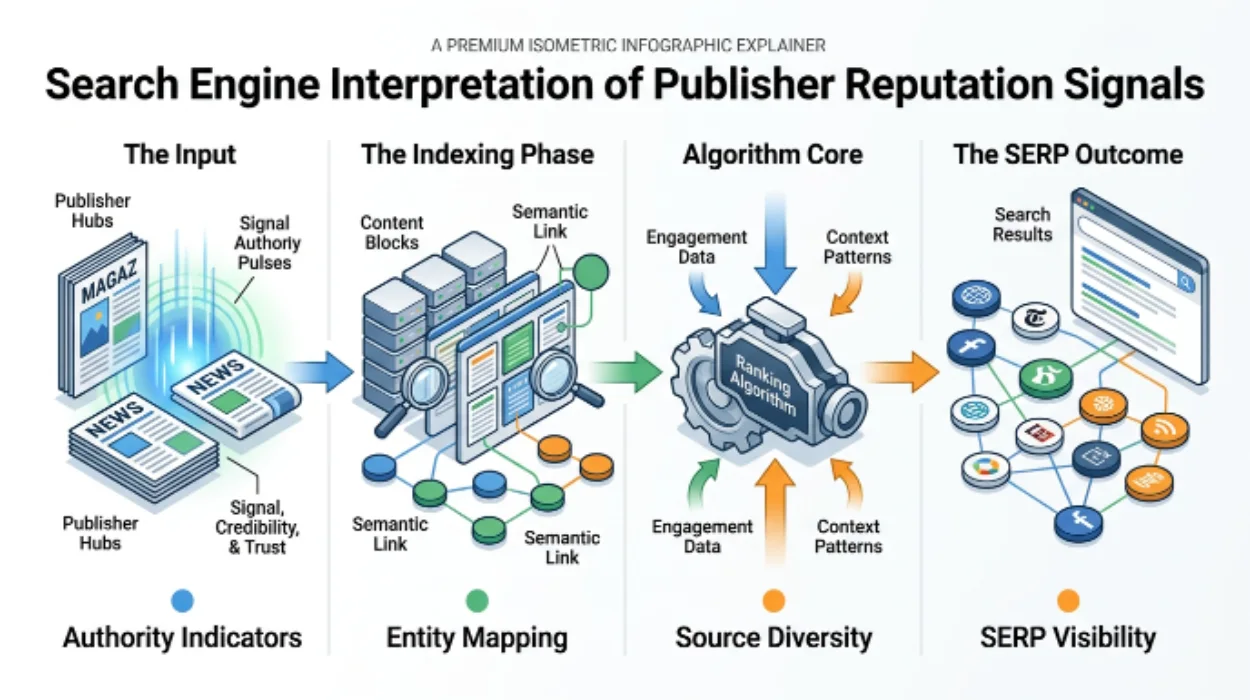
How Do Search Engines Interpret Publisher-Based Reputation Signals?
Search engines interpret publisher-based reputation signals by analysing authority indicators, content relationships, and source credibility patterns.
Reputation signals are measurable indicators that contribute to the evaluation of trust, expertise, and relevance. Search systems process these signals through ranking algorithms that analyse content quality, entity relationships, engagement indicators, and publication context. Publisher content provides structured signals because it exists within established information environments.
Content indexing plays a significant role in this evaluation process. Indexed content becomes part of searchable databases where algorithms assess semantic relevance and contextual relationships. Publisher articles contribute additional reference points that help define entity associations and topic expertise. Search systems evaluate these references collectively rather than independently.
SERP evaluation also incorporates source diversity. Information appearing across multiple credible publishers demonstrates broader recognition within an information ecosystem. This distribution pattern contributes to authority interpretation and reputation assessment. Search engines therefore use publisher-generated signals as part of a wider framework that determines visibility and ranking outcomes.
What Role Do Digital Narratives Play in Publisher Partnerships?
Digital narratives define how information is organised, interpreted, and connected within online environments.
A digital narrative is the structured collection of messages, themes, and informational associations surrounding an entity or topic. Publisher partnerships influence narratives because published content contributes additional context, framing, and topic relationships. Search systems analyse these narrative structures to understand relevance, authority, and subject alignment.
Understanding how publishers shape visibility compared with creator-led distribution requires analysing Media Partnerships vs Influencer Marketing: Which Is More Effective?, as both approaches generate different authority signals, audience trust indicators, and content discovery patterns within digital ecosystems.
Narrative influence affects entity perception. Repeated thematic associations strengthen connections between entities and specific knowledge domains. Search algorithms identify these recurring patterns and use them to improve content classification and retrieval. Consistent narratives therefore contribute to clearer semantic understanding within search ecosystems.
Narratives also affect stakeholder interpretation. Information environments contain competing perspectives, sources, and contextual signals. Publisher content becomes part of the information architecture that stakeholders use to evaluate credibility and expertise. The narrative structure emerging from these sources influences how entities are perceived across digital channels.
How Do Publisher Partnerships Contribute to Institutional Credibility?
Publisher partnerships contribute to institutional credibility by increasing association with recognised information standards and authoritative content environments.
Institutional credibility refers to the perceived legitimacy, competence, and reliability of an organisation. Within digital ecosystems, credibility develops through observable evidence that supports trust and expertise assessments. Publisher platforms provide environments where information is subjected to editorial processes and public scrutiny.
Credibility formation relies on consistency. Search engines and stakeholders evaluate repeated signals over time rather than isolated content appearances. Publisher-distributed information contributes to a cumulative record of public information that supports institutional evaluation. This record becomes part of the digital footprint associated with an entity.
Institutional credibility also affects search visibility. Credible entities generate stronger trust signals and clearer topical associations. Search systems incorporate these indicators into ranking and retrieval processes. Publisher partnerships therefore influence both public perception and algorithmic evaluation through the credibility signals they generate.
How Do Publisher Partnerships Shape Content Ecosystems?
Publisher partnerships shape content ecosystems by expanding information networks and strengthening semantic relationships between entities, topics, and sources.
A content ecosystem is the interconnected environment through which information is created, distributed, indexed, and discovered. Publisher participation increases the number of pathways through which information travels. These pathways influence how content is interpreted by search engines and stakeholders.
Content ecosystems rely on interconnected signals. Search systems analyse links, citations, topic clusters, entity mentions, and semantic relevance to understand relationships between information assets. Publisher content contributes additional nodes within these networks, increasing contextual depth and improving discoverability. The result is a more comprehensive information structure that supports content indexing and retrieval.
The expansion of content ecosystems also influences reputation formation. Reputation emerges through the aggregation of signals distributed across digital environments. Publisher-generated content becomes part of this signal network, contributing evidence used in trust evaluation, authority assessment, and stakeholder interpretation. The broader and more coherent the ecosystem, the stronger the contextual understanding generated by search systems.
Why Is Publisher Reach Important for Entity Perception?
Publisher reach is important because entity perception depends on visibility, context, and information accessibility across digital channels.
Entity perception refers to the understanding that search systems and stakeholders develop about a person, organisation, institution, or topic. Search engines construct entity profiles through information collected from multiple sources. Publisher content contributes valuable contextual information that helps define these profiles.
Visibility influences perception because discoverable information receives greater evaluation opportunities. Publisher reach expands the number of indexed touchpoints available within search environments. This increased presence provides additional evidence for algorithmic interpretation and stakeholder assessment. Entity understanding therefore becomes more comprehensive and accurate.
Reach also affects information consistency. Search systems favour coherent entity definitions supported by multiple credible sources. Publisher partnerships contribute to this consistency by reinforcing recognised topic associations and expertise indicators. The resulting perception framework supports stronger digital authority, clearer reputation signals, and improved search visibility.
Conclusion
Publisher partnerships expand reach by increasing content distribution, strengthening authority signals, and improving visibility across digital ecosystems. Their influence extends beyond audience exposure and contributes directly to content indexing, SERP evaluation, stakeholder trust, and entity perception.
Digital authority develops through source credibility, semantic relevance, and consistent topical associations. Publisher environments provide recognised trust signals that search engines and stakeholders use to evaluate expertise and legitimacy. These signals influence content ranking dynamics, reputation assessment, and institutional credibility.
Digital narratives, content ecosystems, and online trust architecture collectively shape how organisations are interpreted within search environments. Publisher partnerships contribute to these systems by expanding information accessibility, reinforcing authority indicators, and strengthening contextual understanding. As a result, publisher relationships play a significant role in the formation of digital reputation and long-term visibility across modern information ecosystems.
Frequently Asked Questions
How do publisher partnerships increase online visibility?
Publisher partnerships increase online visibility by distributing content through established media platforms that already possess strong search visibility and audience reach. This expands content indexing opportunities and increases the number of search results associated with an entity.
What is the difference between publisher reach and digital authority?
Publisher reach refers to the size and accessibility of an audience through media platforms. Digital authority refers to the level of trust, expertise, and credibility associated with an entity. Reach expands exposure, while authority influences how information is evaluated and ranked.
Why do search engines value content published on trusted websites?
Search engines evaluate source credibility when ranking content. Trusted websites often demonstrate strong editorial standards, consistent content quality, and established reputation signals, which contribute to higher trust assessments during SERP evaluation.
How do publisher partnerships influence stakeholder trust?
Publisher partnerships place information within recognised and credible content environments. This improves information accessibility and strengthens trust signals that stakeholders use when evaluating reliability, legitimacy, and expertise.
What role do digital narratives play in reputation building?
Digital narratives organise information around specific themes and associations. Consistent narratives help search engines understand entity relevance and authority while influencing how stakeholders interpret credibility, expertise, and institutional reputation.