

Media partnerships and influencer marketing achieve visibility through different authority systems, audience relationships, and trust mechanisms. Media partnerships strengthen institutional credibility and narrative visibility, while influencer marketing concentrates on audience engagement and community-driven attention.
Public affairs strategies differ based on how organisations distribute information, build stakeholder trust, and establish credibility across digital ecosystems. Digital advocacy methods are evaluated through their influence on reputation signals, entity credibility, search ranking influence, sentiment distribution, and long-term narrative visibility.
Which approach generates stronger authority and credibility signals?
Media partnerships generate stronger institutional authority signals because they connect organisations with established publishers, news platforms, and editorial ecosystems. Influencer marketing generates social proof through audience relationships and creator trust rather than editorial validation. The effectiveness of each approach depends on the type of credibility being measured and the stakeholders being targeted.
Media partnerships are structured collaborations between organisations and publishing entities that distribute content through editorial channels. Organisations exploring the fundamentals of publisher-led visibility can first understand How Brands Expand Their Reach Through Publisher Partnerships before evaluating comparative communication frameworks.
Influencer marketing is a communication strategy that relies on content creators who maintain direct relationships with defined audience groups. This approach operates by leveraging personal credibility and audience familiarity to distribute messages. Engagement metrics such as comments, shares, and reactions often exceed those generated through traditional media channels. However, entity credibility remains tied to the reputation of the creator rather than the authority of an editorial institution. Search ranking influence is generally indirect because influencer content frequently exists within platform ecosystems that provide limited long-term indexing value. Stakeholder perception therefore depends heavily on audience affinity rather than institutional trust.
How do media partnerships and influencer marketing influence search visibility?
Media partnerships create stronger search visibility through authority transfer, content indexing, and entity association. Influencer marketing creates visibility through platform reach and engagement signals but provides less direct influence on search ecosystem authority.
Search engines interpret media coverage as a trust signal because publisher content contributes to entity understanding and topical relevance. Media partnerships operate by placing information within indexed environments that remain accessible over extended periods. Published content contributes to search ranking influence through citations, entity associations, and contextual relevance. This process supports long-term narrative visibility because authoritative content becomes part of the searchable information environment. Reputation signals generated through publisher relationships often persist long after publication. The result is a durable contribution to SERP composition and digital authority.
Influencer marketing operates differently because most content exists within social media platforms rather than traditional publishing environments. Digital platforms prioritise engagement, audience retention, and content interaction. Visibility is therefore measured through impressions, engagement rates, and audience reach. Search ranking influence remains secondary because platform content often has limited authority transfer to external search ecosystems. Although influencer content can appear in search results, its contribution to entity credibility and authority development is less substantial. Narrative visibility becomes dependent on platform algorithms rather than search engine indexing structures.
How does SERP composition differ between both approaches?
SERP composition reflects the sources search engines consider authoritative for a specific entity or topic. Media partnerships contribute directly to SERP diversity by introducing publisher-based content into search results. News articles, interviews, opinion pieces, and editorial features become indexed assets that shape public perception. These assets create multiple reference points that reinforce narrative consistency and entity understanding.
Influencer marketing contributes to SERP composition primarily through social platform content and creator profiles. Search engines can index some of this content, but visibility remains dependent on platform authority and content accessibility. As a result, influencer activity generates less control over long-term SERP architecture. The search environment remains more vulnerable to competing narratives when authority signals originate primarily from social channels.
Which strategy provides greater stakeholder trust and reputation stability?
Media partnerships provide greater reputation stability because trust originates from institutional authority structures. Influencer marketing provides stronger relational trust among defined communities but faces greater volatility when audience sentiment changes.
Stakeholder trust is a measurement of confidence in information sources, communication consistency, and perceived credibility. Media partnerships strengthen this trust through editorial review processes and established publication standards. Information distributed through recognised publishers benefits from institutional legitimacy that extends beyond individual personalities. Reputation signals therefore remain stable even when audience preferences shift. This stability supports long-term credibility management and sustained narrative visibility. Public affairs frameworks often prioritise these outcomes because institutional trust influences policy audiences, investors, regulators, and professional stakeholders.
Influencer marketing creates trust through perceived authenticity and community engagement. Audience members often view creators as relatable and accessible sources of information. This relationship generates strong engagement outcomes and rapid message dissemination. However, reputation stability remains linked to creator behaviour, audience perception, and platform dynamics. Changes in creator reputation can affect associated entities and alter sentiment distribution. The resulting risk exposure is higher because trust resides within individuals rather than institutional systems.
How does sentiment distribution differ across both models?
Sentiment distribution refers to how positive, neutral, and negative perceptions spread across digital environments. Media partnerships encourage broader sentiment diversification because content reaches multiple audience segments through independent editorial channels. This structure reduces dependence on a single communication source and distributes perception across wider stakeholder groups.
Influencer marketing concentrates sentiment within creator communities. Positive engagement often develops rapidly, but negative sentiment can also spread quickly when controversies emerge. Concentrated sentiment structures create stronger immediate reactions while increasing vulnerability to reputation fluctuations. Stakeholder perception therefore becomes more sensitive to audience mood changes and creator-associated risks.
Which approach is more effective for digital advocacy objectives?
Digital advocacy objectives are achieved through different mechanisms depending on whether visibility, engagement, or credibility represents the primary goal. Media partnerships perform more effectively for authority building and public discourse participation, while influencer marketing performs more effectively for audience mobilisation and engagement generation.
Digital advocacy is the strategic use of digital channels to influence perception, awareness, and stakeholder understanding. Media partnerships operate by integrating messages into recognised information ecosystems. Editorial publication expands narrative visibility and increases the likelihood of information being referenced by journalists, researchers, and policy audiences. Search ranking influence strengthens because authoritative content contributes to entity recognition. These outcomes support long-term visibility and institutional credibility objectives.
Influencer marketing operates by activating existing audience communities. Content dissemination occurs through established creator-follower relationships. Engagement levels often exceed those achieved through publisher channels because audiences interact directly with creators. This model performs effectively when advocacy goals require rapid awareness generation or targeted community participation. However, long-term authority accumulation remains limited because engagement does not automatically translate into sustained entity credibility. Narrative visibility therefore depends on continued creator activity and platform distribution.
How do risk exposure and control mechanisms compare?
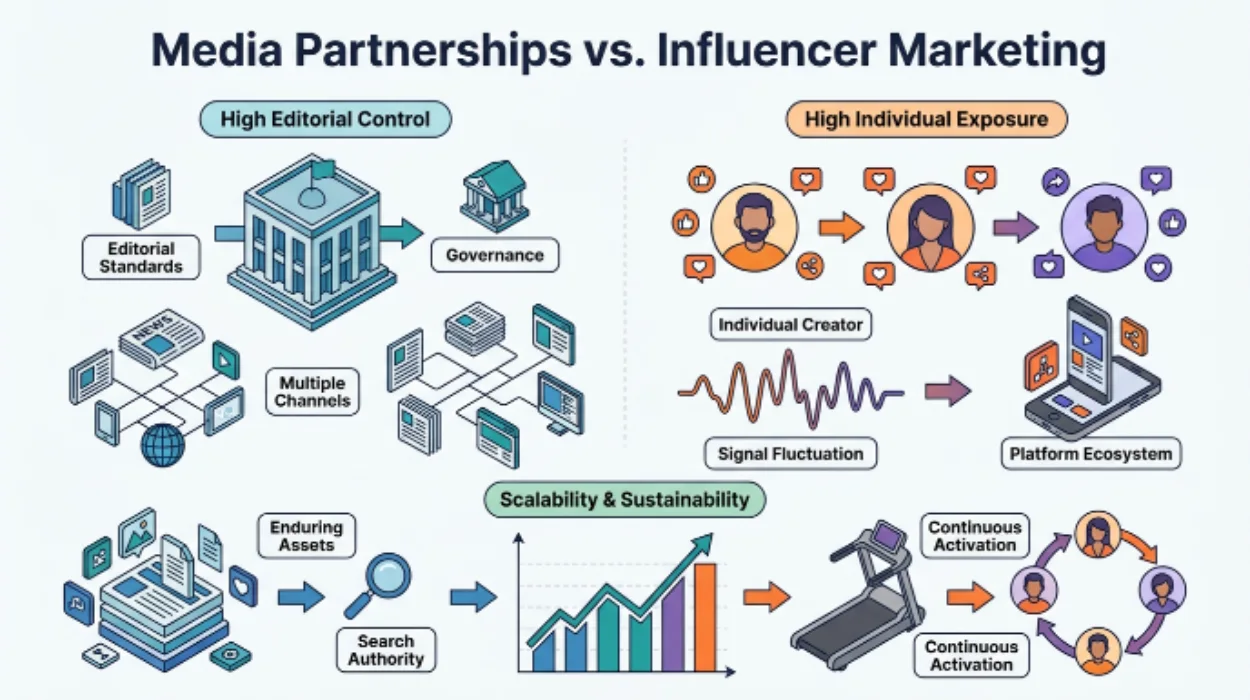
Media partnerships provide stronger control through editorial governance and diversified publication environments. Influencer marketing introduces higher reputational exposure because communication outcomes depend on individual creator behaviour and platform ecosystems.
Risk exposure is the likelihood that communication activities create negative visibility, credibility loss, or narrative disruption. Media partnerships reduce concentration risk by distributing information across multiple authoritative channels. Editorial standards establish content verification processes that limit misinformation concerns and credibility challenges. This structure creates predictable reputation signals and supports consistent stakeholder perception. Institutional credibility benefits from association with recognised publishing environments that maintain established quality controls.
Influencer marketing increases exposure to creator-related risks. Audience reactions, platform algorithm changes, and creator conduct directly affect communication outcomes. Content amplification can occur rapidly, but content suppression can also emerge when platforms alter distribution priorities. Reputation signals therefore fluctuate more frequently. Organisations operating within highly regulated or governance-sensitive environments often evaluate these risks carefully because stakeholder trust depends on communication consistency and credibility.
What factors influence scalability?
Scalability measures the capacity of a communication strategy to expand reach without proportionally increasing complexity or risk.
Media partnerships scale through:
- Expand publisher relationships to increase narrative visibility across multiple editorial ecosystems.
- Strengthen entity associations through repeated publication within relevant topical environments.
- Improve search ranking influence by generating additional authoritative references and indexed content.
Influencer marketing scales through:
- Increase creator participation to expand audience exposure across demographic segments.
- Amplify engagement through platform-native content formats and community interactions.
- Extend campaign reach through creator networks and audience sharing behaviours.
The scalability difference lies in sustainability. Media partnerships create enduring digital assets, while influencer campaigns often require continuous activation to maintain visibility.
Which approach supports long-term institutional credibility more effectively?
Media partnerships support long-term institutional credibility more effectively because they contribute persistent authority signals, durable search visibility, and stable stakeholder trust structures. Influencer marketing supports awareness generation but provides less permanence within the broader information ecosystem.
Institutional credibility is the perceived reliability, expertise, and trustworthiness of an organisation across stakeholder groups. Media partnerships operate by embedding information within authoritative content environments that remain accessible and discoverable over time. Organisations assessing implementation frameworks often examine Strategic Media Partnership Services for Audience Growth and Brand Awareness when evaluating structured media visibility models within broader reputation and stakeholder engagement strategies.
Influencer marketing generates immediate attention and audience engagement. Community trust can produce significant visibility gains within targeted segments. However, authority accumulation remains dependent on ongoing creator participation and platform relevance. Narrative visibility often decreases when campaigns conclude or audience attention shifts. Long-term institutional credibility therefore develops more slowly because the strategy prioritises engagement over editorial authority.
Conclusion
Media partnerships and influencer marketing achieve visibility through fundamentally different mechanisms. Media partnerships strengthen entity credibility, search ranking influence, stakeholder trust, and long-term narrative visibility through authoritative publishing environments. Influencer marketing strengthens audience engagement, community participation, and rapid awareness generation through creator-led communication networks.
The comparison highlights differences in effectiveness, scalability, sustainability, and risk exposure. Media partnerships contribute more directly to institutional credibility and SERP composition, while influencer marketing contributes more directly to engagement and audience activation. Strategic evaluation depends on whether the objective prioritises authority development, stakeholder perception, visibility expansion, or community interaction.
Within broader communications frameworks, both approaches influence reputation signals and sentiment distribution in distinct ways. Their effectiveness is determined by how digital ecosystems interpret authority, trust, and relevance over time.
Frequently Asked Questions
What is the main difference between media partnerships and influencer marketing?
Media partnerships distribute information through publisher and editorial channels, while influencer marketing distributes information through creator-owned audiences. Media partnerships focus on authority, credibility, and search visibility, whereas influencer marketing focuses on engagement, audience interaction, and community reach. Both approaches influence reputation signals differently within digital ecosystems.
Which strategy has a stronger impact on search engine visibility?
Media partnerships have a stronger impact on search engine visibility because publisher content contributes to authority signals, entity recognition, and indexed search assets. Influencer content primarily generates engagement within social platforms. As a result, media partnerships generally provide greater influence on long-term search ranking visibility and SERP composition.
How do media partnerships affect stakeholder trust?
Media partnerships affect stakeholder trust by placing information within established editorial environments. Publishers often apply verification and editorial review processes that strengthen credibility signals. This creates stronger perceptions of reliability among policymakers, investors, industry observers, and other stakeholder groups.
Is influencer marketing more effective for audience engagement?
Influencer marketing is more effective for audience engagement because creators maintain direct relationships with their communities. Social interactions, comments, shares, and discussions often occur at higher rates than traditional media content. This makes influencer marketing effective for generating immediate attention and audience participation.
Which approach is better for long-term reputation management?
Media partnerships are generally more effective for long-term reputation management because they create durable digital assets and authority signals. Published content remains discoverable through search engines and contributes to ongoing narrative visibility. Influencer marketing can support awareness objectives, but its impact is often tied to platform algorithms and creator activity.