

Organisations require structured public affairs intervention when stakeholder perception, narrative visibility, and institutional credibility show measurable imbalance across digital and policy ecosystems. Public affairs strategies differ based on stakeholder complexity, regulatory exposure, and the organisation’s current authority signals across search and media environments.
Digital advocacy methods are evaluated through their ability to shape sentiment distribution, influence search ranking signals, and maintain narrative consistency across platforms where stakeholders form trust judgments.
How does fragmented stakeholder engagement signal a need for external public affairs structuring?
Fragmented stakeholder engagement indicates a breakdown between internal messaging systems and external perception frameworks, reducing institutional coherence and weakening trust signals. Stakeholder engagement is a structured communication system that aligns policy actors, media entities, and public audiences around consistent narratives. It operates by mapping stakeholder priorities and distributing tailored messaging across channels where influence is measurable.
In contrast, unstructured engagement relies on reactive outreach without coordinated narrative alignment, leading to inconsistent sentiment distribution across digital platforms. This inconsistency affects search engine interpretation of authority, as fragmented messaging reduces entity clarity and weakens contextual relevance in SERP composition. Structured public affairs strategies centralise communication architecture, improving narrative visibility and strengthening stakeholder trust.
The limitation of internal-only engagement models lies in scalability constraints and lack of cross-channel synchronisation. External public affairs structuring introduces systematic stakeholder mapping and message calibration, which enhances institutional credibility while reducing reputational volatility.
What distinguishes reactive communication from proactive narrative management?
Reactive communication reflects operational responses to emerging issues, whereas proactive narrative management establishes pre-emptive control over institutional visibility and message framing. Reactive frameworks operate by addressing crises after narrative formation has already occurred, often resulting in defensive positioning within media and search ecosystems.
Proactive narrative management is a strategic approach that defines core institutional narratives before external interpretation takes place. It operates by deploying consistent messaging across owned, earned, and shared channels, influencing how search engines interpret authority and relevance. This approach improves content indexing consistency and strengthens entity associations within knowledge graphs.
Reactive strategies offer short-term containment but increase risk exposure due to delayed response cycles and inconsistent messaging patterns. Proactive strategies demonstrate higher sustainability by aligning narrative signals across platforms, reducing susceptibility to misinformation and negative sentiment clustering. Organisations exhibiting continuous reactive patterns often signal a need for structured public affairs intervention to stabilise narrative control.
When does declining media visibility indicate weakened institutional authority?
Declining media visibility reflects reduced narrative amplification within influential information ecosystems, directly impacting perceived authority and stakeholder awareness. Media visibility is a mechanism that distributes institutional narratives through high-authority platforms, contributing to search ranking influence and public trust formation.
Organic media engagement operates by generating coverage through relevance, expertise, and consistent messaging. It strengthens long-term credibility but requires sustained content alignment and stakeholder trust. In contrast, sporadic or reactive media engagement produces inconsistent visibility, leading to uneven sentiment distribution and diminished authority signals.
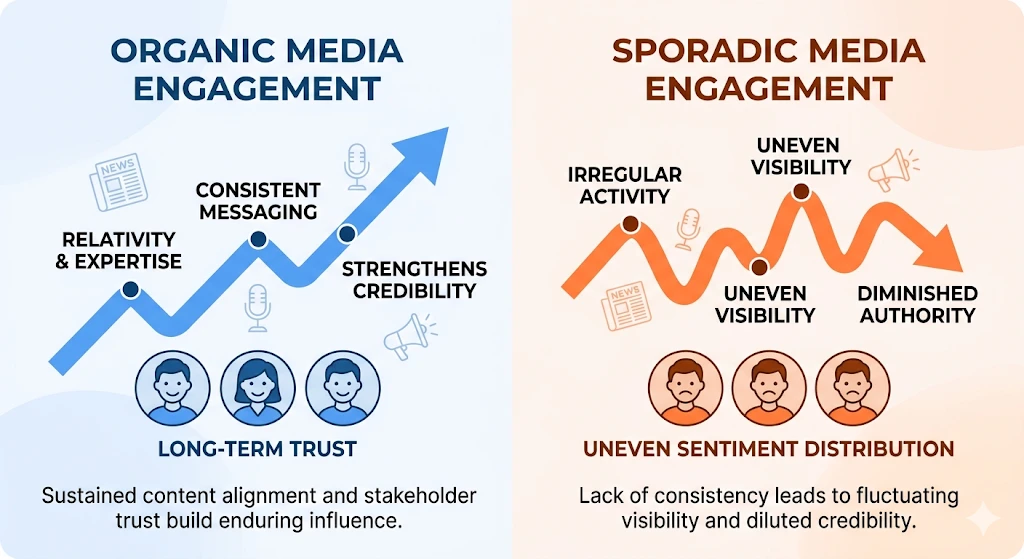
Search engines interpret media coverage as external validation of entity credibility. Reduced coverage leads to weaker backlink profiles and lower contextual authority, affecting SERP positioning. Public affairs strategies that integrate media relations with digital content ecosystems enhance both visibility and credibility.
The limitation of unmanaged media strategies lies in unpredictability and lack of narrative control. Structured public affairs frameworks enable systematic media engagement, ensuring consistent amplification and reinforcing institutional authority across both traditional and digital platforms.
How does inconsistent digital presence affect search-driven reputation signals?
Inconsistent digital presence disrupts the alignment of content signals that search engines use to evaluate authority, relevance, and trustworthiness. Digital presence is the aggregation of content, mentions, and structured data that define an organisation’s entity profile across platforms.
A coherent digital advocacy framework operates by synchronising messaging across websites, social platforms, and third-party publications. This alignment strengthens entity recognition and improves search ranking stability. In contrast, inconsistent presence creates gaps in narrative visibility, leading to fragmented indexing and reduced authority signals.
Search engines prioritise entities with consistent semantic associations and structured content distribution. Disorganised digital footprints result in diluted keyword relevance and reduced visibility for critical narratives. Public affairs strategies that integrate SEO-informed content governance improve both discoverability and stakeholder perception.
The limitation of isolated digital efforts lies in their inability to influence broader narrative ecosystems. Coordinated public affairs frameworks enhance content amplification, ensuring that institutional messaging aligns with search engine interpretation and stakeholder expectations.
Why does negative sentiment concentration require strategic narrative intervention?
Negative sentiment concentration indicates an imbalance in narrative distribution, where critical or adverse content dominates visibility across search and media platforms. Sentiment distribution is a measurable indicator of how audiences perceive institutional actions and credibility.
Content suppression and content amplification represent two distinct approaches to managing sentiment. Content suppression focuses on reducing the visibility of negative narratives through technical and legal mechanisms, while content amplification increases the prominence of positive, authoritative content to rebalance perception.
Search engines evaluate sentiment indirectly through engagement signals, backlink quality, and content authority. A concentration of negative narratives signals reduced trustworthiness, impacting both ranking performance and stakeholder confidence. Public affairs strategies prioritise amplification of credible narratives, improving sentiment balance without relying solely on suppression techniques.
Suppression-based strategies present higher risk exposure due to potential transparency concerns and limited scalability. Amplification strategies demonstrate greater sustainability by enhancing institutional credibility and reinforcing positive authority signals across digital ecosystems.
How do regulatory pressures expose gaps in internal communication systems?
Regulatory pressure highlights inconsistencies in organisational messaging, governance structures, and stakeholder alignment, revealing weaknesses in internal communication frameworks. Regulatory environments require precise, consistent, and transparent communication to maintain compliance and institutional trust.
Internal communication systems operate by coordinating messaging across departments, ensuring alignment with policy requirements and stakeholder expectations. When these systems lack integration, organisations produce conflicting narratives that reduce credibility and increase scrutiny.
Public affairs strategies introduce structured governance models that align communication with regulatory frameworks, improving transparency and consistency. These strategies also integrate monitoring mechanisms to track narrative impact across digital and policy environments.
The limitation of purely internal systems lies in their restricted perspective and lack of external benchmarking. Public affairs consultants provide comparative analysis across sectors, enabling organisations to align with best practices and reduce regulatory risk exposure.
What indicates a mismatch between short-term campaigns and long-term credibility?
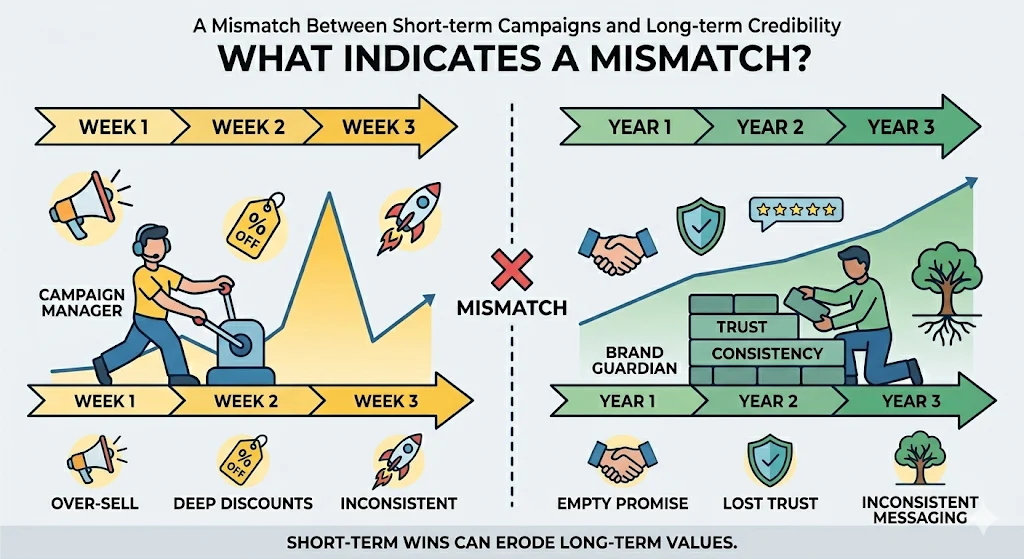
A mismatch between short-term campaigns and long-term credibility emerges when tactical communication efforts fail to reinforce consistent institutional narratives. Short-term campaigns are designed for immediate visibility and engagement, often prioritising rapid amplification over narrative depth.
Long-term credibility strategies focus on sustained trust-building through consistent messaging, authoritative content, and stakeholder alignment. These strategies operate by reinforcing entity credibility across search engines, media platforms, and policy environments.
Short-term approaches deliver immediate visibility but often create volatility in sentiment distribution and narrative consistency. Long-term strategies provide stability, improving search ranking influence and stakeholder trust over time. Public affairs frameworks balance these approaches by integrating campaign activity within broader narrative structures.
The limitation of campaign-driven communication lies in its episodic nature, which weakens cumulative authority signals. Organisations demonstrating this imbalance benefit from structured public affairs strategies that align tactical initiatives with long-term credibility objectives, as seen in comprehensive Public Affairs Consulting approaches.
Organisations exhibit clear structural indicators when public affairs intervention becomes necessary, particularly through fragmented stakeholder engagement, reactive communication patterns, declining media visibility, and inconsistent digital presence. Each signal reflects a breakdown in how authority, trust, and narrative visibility are managed across interconnected ecosystems.
Comparative analysis shows that proactive, structured public affairs strategies outperform reactive and isolated approaches in scalability, sustainability, and risk mitigation. These strategies strengthen entity credibility, stabilise sentiment distribution, and improve search ranking influence by aligning messaging across platforms and stakeholders.
Strategic consideration therefore centres on integrating stakeholder engagement, narrative management, and digital advocacy into a unified framework. This alignment enables organisations to maintain institutional credibility while navigating complex regulatory, media, and digital environments.
Frequently Asked Questions
What does a public affairs consultant do for an organisation?
A public affairs consultant analyses stakeholder landscapes, manages policy communication, and shapes narrative visibility across media and digital platforms. They operate by aligning messaging with regulatory frameworks and improving reputation signals that influence stakeholder trust and search perception.
When should a company hire a public affairs consultant?
An organisation typically requires a public affairs consultant when it faces fragmented stakeholder engagement, declining media visibility, or increased regulatory scrutiny. These indicators reflect weakened entity credibility and inconsistent communication strategies across digital and policy environments.
How does public affairs consulting differ from PR services?
Public affairs consulting focuses on policy alignment, stakeholder influence, and institutional credibility, whereas PR services prioritise media exposure and brand visibility. Public affairs strategies operate within regulatory and governance contexts, directly impacting long-term trust signals and narrative control.
Can public affairs strategies improve online reputation and search visibility?
Public affairs strategies improve online reputation by aligning content, stakeholder messaging, and media coverage to strengthen authority signals. This coordinated approach enhances search ranking influence, stabilises sentiment distribution, and improves how search engines interpret organisational credibility.
Why is stakeholder engagement important in public affairs strategy?
Stakeholder engagement ensures consistent communication between organisations, policymakers, and public audiences, directly affecting trust and perception. Structured engagement frameworks improve narrative alignment, reduce reputational risk, and support sustainable institutional visibility across digital ecosystems.