

Public affairs refers to the strategic management of relationships between institutions, stakeholders, and policy environments to influence governance outcomes. Stakeholder mapping defines the systematic identification, classification, and evaluation of actors who shape policy visibility, authority, and decision-making trajectories across digital and institutional ecosystems.
What is stakeholder mapping in public affairs and digital ecosystems?
Stakeholder mapping is the structured process of identifying actors who influence policy outcomes through authority, visibility, and network positioning within digital and institutional environments. It refers to a method of analysing how individuals, organisations, and entities interact within power structures that shape public perception and governance decisions. Within digital ecosystems, stakeholder mapping extends beyond traditional policy actors to include media entities, algorithmically amplified voices, and search-visible authorities. This process defines how influence is distributed, recognised, and ranked across both institutional and online domains. It establishes a framework for interpreting how narratives are formed and legitimised within search environments and public discourse. As a result, stakeholder mapping directly informs how credibility and authority are constructed and perceived.
The mechanism operates through classification models that assess stakeholder relevance based on influence, reach, and trust signals. These models incorporate both offline authority, such as regulatory power, and online indicators, including search visibility and content authority. Algorithms reinforce stakeholder prominence by indexing and ranking content associated with high-authority entities, which increases their visibility in policy-related queries. This visibility contributes to entity recognition within search engines, strengthening perceived legitimacy. Consequently, stakeholder mapping shapes how institutional actors are prioritised in both policy discussions and digital narratives.
How do stakeholders influence policy outcomes and public perception?
Stakeholders influence policy outcomes by controlling narrative distribution, institutional authority, and information access within both governance and digital ecosystems. This influence refers to the capacity of actors to shape how issues are framed, interpreted, and ranked across search engines and media platforms. Their authority is reinforced through consistent visibility in high-ranking content, authoritative publications, and credible institutional affiliations. These factors create a feedback loop where visibility enhances credibility, and credibility strengthens influence.
The mechanism of influence operates through content production, media engagement, and network positioning. Stakeholders with strong digital authority generate content that is frequently indexed and ranked, thereby shaping the dominant narrative associated with a policy issue. Search engines evaluate this content based on relevance, authority signals, and user engagement metrics, which determine its prominence in search results. As a result, stakeholders who control high-visibility content effectively define the informational landscape surrounding a policy topic. This process directly impacts stakeholder trust, as audiences rely on search-ranked content to interpret legitimacy and authority.
Why is stakeholder mapping critical for digital reputation and institutional credibility?
Stakeholder mapping is critical because it defines how institutional credibility is constructed and maintained within digital perception systems. It refers to the process of identifying which actors contribute to or challenge an entity’s reputation through content, authority signals, and narrative alignment. Institutional credibility is not inherent; it is evaluated continuously through search visibility, media representation, and stakeholder associations. Mapping stakeholders provides clarity on which entities influence these evaluation criteria.
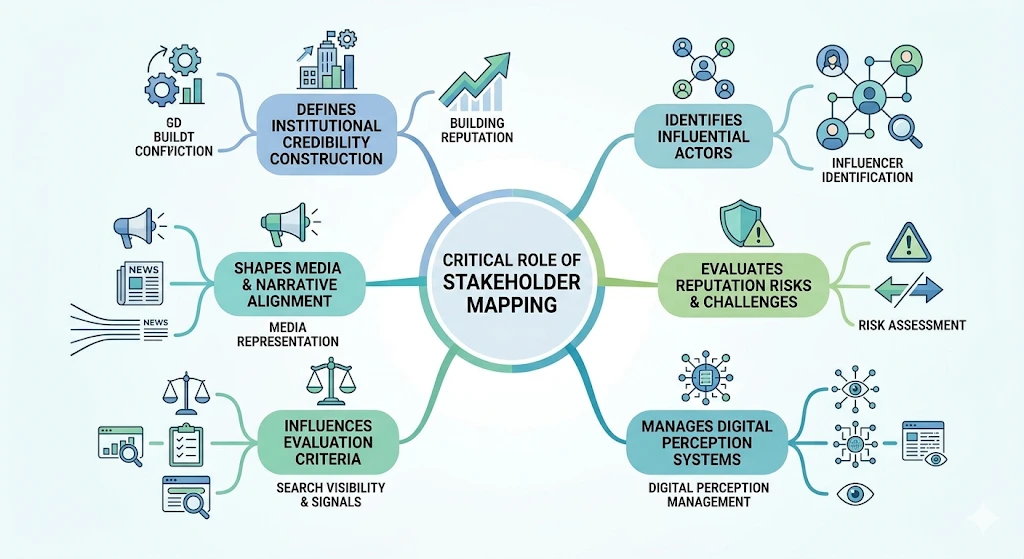
The mechanism involves analysing how stakeholders contribute to reputation signals across digital platforms. High-authority stakeholders enhance credibility when they produce or endorse content aligned with an institution’s narrative. Conversely, stakeholders with conflicting narratives introduce reputational risk by altering sentiment and visibility patterns. Search engines interpret these signals through content indexing and entity association, which affect how an institution appears in search results. This dynamic determines how trust is distributed among audiences, reinforcing or weakening institutional perception.
How are stakeholders identified and categorised within digital advocacy frameworks?
Stakeholder identification refers to the systematic classification of actors based on their influence, authority, and relevance within a policy ecosystem. In digital advocacy frameworks, this process extends to analysing how stakeholders operate across content networks, search environments, and media ecosystems. Identification is based on measurable indicators such as content output, search rankings, backlink authority, and institutional affiliations. These indicators define how stakeholders contribute to narrative formation and visibility.
Categorisation operates through structured evaluation models that group stakeholders according to their role and impact. These categories reflect both traditional policy roles and digital influence patterns:
-
Define regulatory stakeholders, for example government bodies whose official publications dominate search results for policy queries, reinforcing institutional authority.
-
Identify media stakeholders, such as high-authority news platforms that shape narrative framing through widely indexed content.
-
Analyse advocacy stakeholders, including organisations that produce targeted content influencing public perception and sentiment signals.
-
Evaluate digital-native stakeholders, such as thought leaders whose content achieves high engagement and algorithmic amplification.
This classification enables a clear understanding of how influence is distributed and how authority is constructed within digital ecosystems.
How do search engines interpret stakeholder authority and trust signals?
Search engines interpret stakeholder authority through structured evaluation of content relevance, backlink networks, and entity recognition within indexed data. Authority refers to the degree to which a stakeholder is considered a credible source of information within a specific topic cluster. Trust signals include consistent publication history, association with recognised entities, and positive sentiment across indexed content. These factors contribute to how search engines rank stakeholder-generated content in response to policy-related queries.
The mechanism involves algorithmic processes that analyse semantic relationships between entities, topics, and content sources. When a stakeholder consistently produces content aligned with a specific policy area, search engines associate that entity with the topic, strengthening its authority. Backlink structures further reinforce this authority by signalling endorsement from other credible sources. As a result, stakeholders with strong trust signals achieve higher search visibility, which amplifies their influence over public perception. This process demonstrates how digital authority is constructed through measurable signals rather than subjective recognition.
What role do digital narratives play in shaping stakeholder perception?
Digital narratives define how information is structured, presented, and interpreted across online platforms, influencing how stakeholders are perceived within policy ecosystems. A narrative refers to the thematic and semantic framing of content that shapes audience understanding and search engine interpretation. These narratives are not neutral; they are constructed through selective emphasis, language patterns, and content distribution strategies. As a result, narratives determine which stakeholders are positioned as authoritative, credible, or influential.
The mechanism of narrative influence operates through content consistency, keyword alignment, and semantic reinforcement. When stakeholders produce content that aligns with dominant search queries and maintains thematic consistency, their narratives are more likely to be indexed and ranked. Search engines evaluate these narratives based on relevance and authority, which determines their visibility in search results. This visibility shapes stakeholder perception by prioritising certain viewpoints over others. Consequently, digital narratives function as a primary driver of reputation signals and trust formation.
How does stakeholder mapping affect search visibility and SERP positioning?
Stakeholder mapping affects search visibility by identifying which entities control high-ranking content and influence SERP composition. Search visibility refers to the frequency and prominence of an entity’s content within search engine results pages. By mapping stakeholders, it becomes possible to analyse which actors dominate specific query spaces and how their content is structured. This analysis reveals the distribution of authority across a topic cluster.
The mechanism involves evaluating content indexing patterns, keyword targeting, and backlink networks associated with each stakeholder. Stakeholders with optimised content structures and strong authority signals achieve higher rankings, which increases their visibility. This visibility reinforces their influence over how information is presented and interpreted. As a result, stakeholder mapping provides insight into the competitive dynamics of search ecosystems, highlighting which entities shape the informational landscape.
How are power dynamics visualised within stakeholder mapping models?
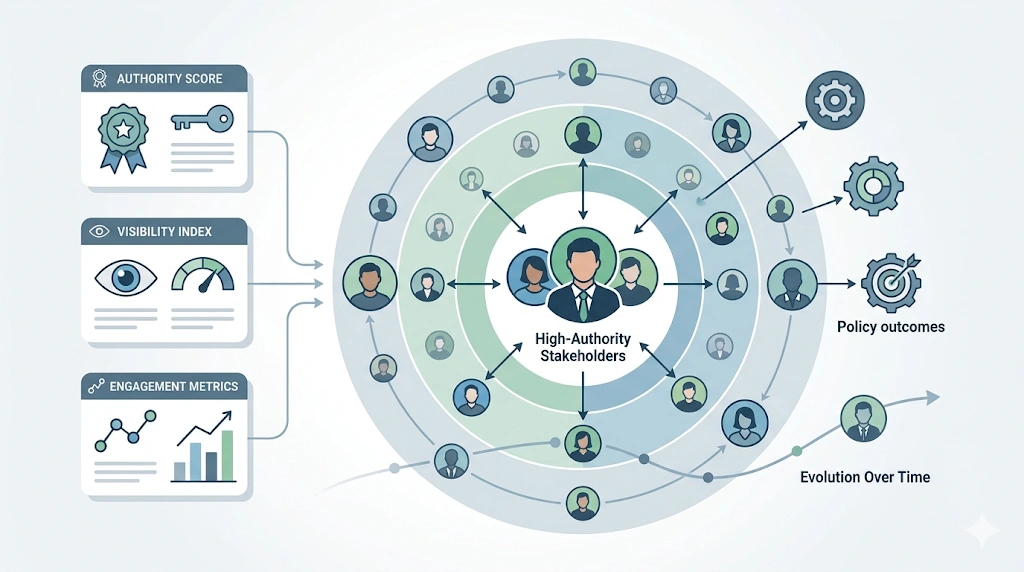
Power dynamics within stakeholder mapping are visualised through models that represent influence, authority, and network relationships. These models define how stakeholders interact and how their positions affect policy outcomes and narrative control. Visualisation techniques include influence matrices, network graphs, and authority hierarchies, each representing different aspects of stakeholder relationships. These models translate complex interactions into structured frameworks that can be analysed systematically.
The mechanism involves assigning measurable attributes to stakeholders, such as authority score, visibility index, and engagement metrics. These attributes are used to position stakeholders within a visual framework that highlights their relative influence. High-authority stakeholders occupy central positions within these models, indicating their role in shaping narratives and policy outcomes. This visualisation enhances understanding of how power is distributed and how it evolves over time within digital ecosystems.
How does stakeholder engagement influence digital authority and trust?
Stakeholder engagement refers to the interaction between entities and their audiences across digital platforms, influencing authority and trust signals. Engagement is measured through content dissemination, audience interaction, and network amplification. High engagement indicates relevance and credibility, which contributes to stronger search visibility and authority recognition. This process defines how stakeholders maintain and expand their influence within digital ecosystems.
The mechanism operates through feedback loops between content production and audience response. When stakeholders produce content that generates engagement, search engines interpret this as a signal of relevance and quality. This leads to higher rankings and increased visibility, which further amplifies engagement. As a result, engagement becomes a critical factor in building and sustaining digital authority. This dynamic demonstrates how trust is constructed through measurable interactions rather than static reputation.
What are the risks of misidentifying key stakeholders in policy ecosystems?
Misidentifying stakeholders introduces distortions in how influence and authority are assessed within policy ecosystems. This refers to the incorrect classification of actors, which leads to flawed interpretations of power dynamics and narrative control. Such errors affect both strategic decision-making and digital visibility analysis. When key stakeholders are overlooked, their influence remains unaccounted for, creating gaps in understanding.
The mechanism of risk emerges through incomplete data analysis and misinterpretation of authority signals. For example, stakeholders with strong digital presence but limited institutional authority may be overestimated, while traditional power holders with lower digital visibility may be underestimated. Search engines amplify this imbalance by prioritising visible content, which can skew perception of influence. This misalignment affects stakeholder trust and institutional credibility, as audiences rely on search results to evaluate authority.
How does stakeholder mapping integrate with broader digital advocacy strategies?
Stakeholder mapping integrates with digital advocacy by providing the structural foundation for understanding influence, authority, and narrative positioning. It refers to the alignment of stakeholder analysis with content strategy, search optimisation, and reputation management. This integration ensures that advocacy efforts are informed by accurate representations of power dynamics and visibility patterns. It connects policy objectives with digital execution.
The mechanism involves aligning stakeholder insights with content production and distribution strategies. By understanding which stakeholders control narrative spaces, digital advocacy can focus on optimising content for search visibility and authority recognition. This includes targeting relevant keywords, building authoritative backlinks, and ensuring consistent narrative alignment. Within this framework, concepts explored in Stakeholder Mapping 101 define how influence is operationalised across digital ecosystems. This integration strengthens the coherence between policy communication and digital perception systems.
Stakeholder mapping defines how influence, authority, and trust are structured within public affairs and digital ecosystems. It explains how stakeholders shape policy outcomes through content visibility, narrative control, and institutional credibility. Search engines reinforce these dynamics by evaluating authority signals and ranking content accordingly, which determines how stakeholders are perceived. Digital narratives further influence this process by framing information and guiding interpretation. Understanding these systems provides clarity on how power operates within both governance and digital environments, enabling more accurate analysis of stakeholder influence and reputation formation.
Frequently Asked Questions
What is stakeholder mapping and why is it important in public affairs?
Stakeholder mapping is the process of identifying and analysing individuals or organisations that influence policy outcomes and public perception. It is important because it clarifies power dynamics, authority signals, and narrative influence within digital and institutional ecosystems.
How do you identify key stakeholders in a policy or advocacy campaign?
Key stakeholders are identified by evaluating their influence, search visibility, institutional authority, and role in content ecosystems. This includes analysing media presence, backlink authority, and their ability to shape narratives across search engine results pages.
What tools or methods are used for stakeholder mapping?
Stakeholder mapping uses methods such as influence matrices, network analysis, and content visibility audits to assess authority and relationships. Digital tools often include SEO platforms, media monitoring systems, and data analysis frameworks that track reputation signals and engagement.
How does stakeholder mapping impact digital reputation and search visibility?
Stakeholder mapping impacts digital reputation by identifying which entities contribute to credibility, trust signals, and narrative framing online. It also improves search visibility by revealing which stakeholders dominate SERPs and influence how content is ranked and interpreted.
How is Linkonize Stakeholder Mapping 101 relevant for understanding policy influence
Linkonize Stakeholder Mapping 101 refers to a structured approach for analysing stakeholder authority, network positioning, and digital influence. It helps define how policy outcomes are shaped through content ecosystems, search visibility, and institutional credibility signals.