

Advocacy communication becomes more human when policy information is translated into stakeholder-centred narratives while preserving factual accuracy and institutional credibility. Effective advocacy communication connects policy outcomes to public relevance through contextual framing, audience alignment, and trust-building mechanisms.
Public affairs strategies differ based on stakeholder expectations, communication objectives, and narrative visibility requirements. Digital advocacy methods are evaluated through their influence on stakeholder trust, reputation signals, entity credibility, engagement quality, and long-term institutional visibility.
How does stakeholder-centred communication compare with policy-centred communication?
Stakeholder-centred communication increases accessibility by connecting policy outcomes to audience interests, while policy-centred communication prioritises procedural accuracy and technical detail.
Stakeholder-centred communication is a framework that organises information around the concerns, priorities, and expectations of specific stakeholder groups. Policy-centred communication is a framework that focuses on legislative details, regulatory structures, consultation processes, and governance mechanisms. Both approaches operate within digital ecosystems, yet they generate different visibility and engagement outcomes.
Stakeholder-centred communication operates by translating policy consequences into practical implications. Search engines and social platforms interpret this format as highly relevant when users seek explanatory content. Policy-centred communication operates by presenting institutional information in its original technical form, creating stronger documentation value but lower accessibility for wider audiences.
From a comparative perspective, stakeholder-centred communication improves narrative visibility, content amplification potential, and sentiment distribution. Policy-centred communication strengthens entity credibility, procedural transparency, and regulatory trust signals. The limitation of stakeholder-centred communication is oversimplification risk. The limitation of policy-centred communication is reduced engagement and lower comprehension among non-specialist audiences.
Institutional credibility benefits from combining both approaches. Human-centred framing increases audience understanding, while technical accuracy protects reputation signals and reinforces stakeholder trust.
Which narrative framing approach generates stronger stakeholder engagement?
Outcome-based framing generates stronger engagement than process-based framing because it focuses attention on tangible implications rather than procedural details.
Outcome-based framing is a communication structure that explains what changes, who is affected, and what measurable impact emerges from a policy decision. Process-based framing is a structure that explains consultation stages, legislative procedures, implementation mechanisms, and governance frameworks.
Outcome-based framing operates by creating direct relevance between policy activity and stakeholder interests. Digital platforms reward relevance through increased engagement indicators, while search engines evaluate relevance through user intent alignment and content satisfaction signals.
Process-based framing contributes to transparency and institutional accountability. It provides evidence of governance quality and procedural integrity. However, it often produces lower narrative visibility because users engage more frequently with consequence-oriented information than procedural explanations.
The comparative advantage of outcome-based framing lies in accessibility, stakeholder perception improvement, and content amplification. The comparative advantage of process-based framing lies in credibility preservation, documentation value, and compliance communication. The limitation of outcome-based framing is reduced contextual depth. The limitation of process-based framing is weaker emotional and cognitive engagement.
Stakeholder trust increases when outcome explanations and process transparency coexist within the same communication framework. This balance improves both understanding and credibility.
How do organic advocacy frameworks compare with reactive communication models?
Organic advocacy frameworks strengthen long-term narrative visibility, while reactive communication models focus on immediate issue response and reputation management.
Organic advocacy is a sustained communication approach that publishes consistent educational, policy, and stakeholder-focused content. Reactive communication is an issue-driven approach that responds to controversies, criticism, regulatory developments, or emerging public concerns.
Organic advocacy operates by gradually building entity credibility across search engines, social platforms, and stakeholder networks. Consistent publication creates cumulative trust signals, increases topical authority, and strengthens search ranking influence over time.
Reactive communication operates by addressing immediate narrative threats. It seeks to influence sentiment distribution, correct misinformation, and reduce reputational exposure. This framework becomes highly visible during periods of heightened public attention but often experiences declining visibility after the issue cycle concludes.
Organic frameworks provide stronger scalability because content assets continue generating visibility beyond their publication date. Reactive models provide stronger responsiveness because communication resources concentrate on emerging risks and stakeholder concerns.
The primary limitation of organic advocacy is slower measurable impact during urgent situations. The primary limitation of reactive communication is dependence on external events and reduced control over narrative timing. Long-term stakeholder trust is more strongly associated with organic visibility systems, while short-term narrative management benefits from reactive interventions.
What role do authority and trust signals play in humanising policy communication?
Authority and trust signals determine whether audiences perceive policy communication as credible, transparent, and worthy of attention.
Authority signals are indicators that demonstrate expertise, consistency, and topical relevance. Trust signals are indicators that demonstrate transparency, accountability, and evidence-based communication. Search engines and digital platforms evaluate both categories when assessing content quality and visibility potential.
Authority operates through topical consistency, subject expertise, semantic relevance, and information depth. Trust operates through source transparency, citation quality, accountability measures, and factual accuracy. Humanised policy communication does not replace these signals. It strengthens them by making information understandable without reducing evidential integrity.
When technical language dominates communication, comprehension barriers emerge. When simplification removes context or evidence, credibility declines. Effective advocacy communication maintains authority while improving accessibility.
Search ranking influence increases when content satisfies informational intent and demonstrates expertise simultaneously. Stakeholder trust increases when audiences understand both the rationale and implications of policy decisions. Entity credibility strengthens when communication remains consistent across multiple digital channels.
The comparative evaluation demonstrates that authority without accessibility reduces engagement, while accessibility without authority reduces trust. Sustainable advocacy communication requires both dimensions.
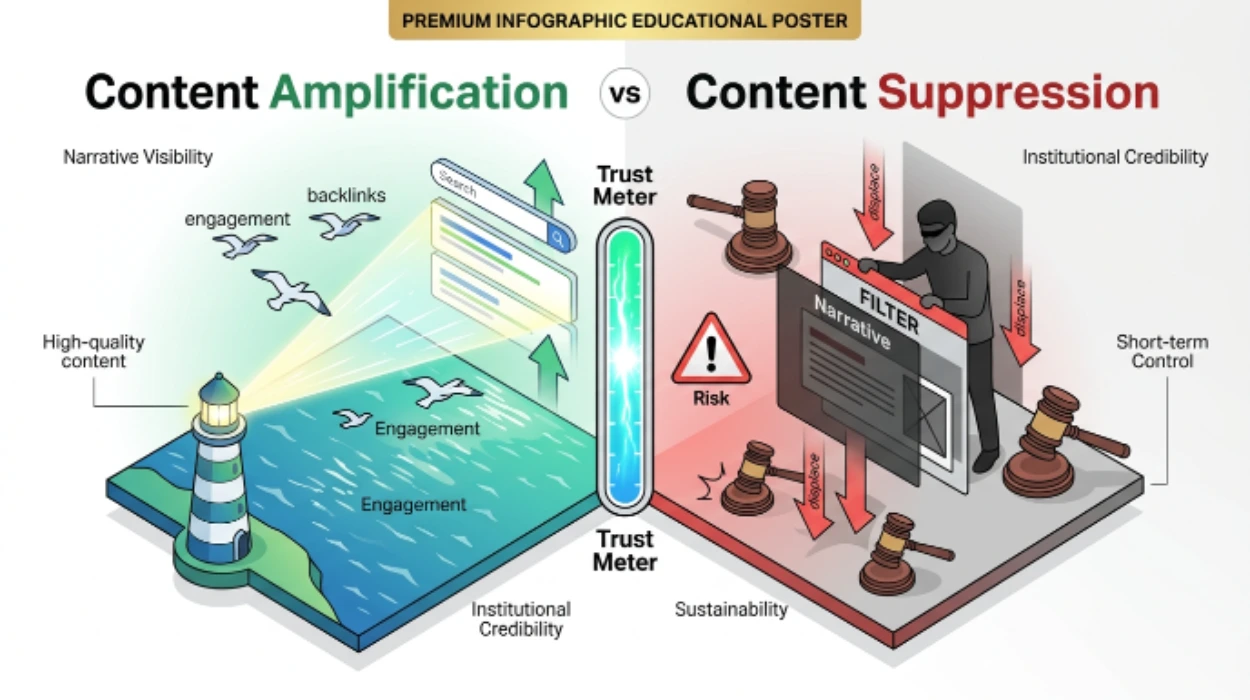
How does content amplification compare with content suppression as a reputation strategy?
Content amplification increases narrative visibility, while content suppression attempts to reduce the visibility of unwanted information.
Content amplification is a reputation strategy that expands the reach of credible, relevant, and authoritative information. Content suppression is a strategy that seeks to minimise the prominence of negative, inaccurate, or outdated content within digital ecosystems.
Amplification operates by publishing high-quality content that attracts engagement, citations, backlinks, and stakeholder attention. Search engines interpret these signals as indicators of relevance and authority. As a result, positive or neutral narratives gain greater visibility within search results and social platforms.
Suppression operates by reducing the discoverability of specific narratives. This approach often relies on legal mechanisms, platform moderation policies, or visibility displacement through competing content. While suppression can reduce exposure, it does not necessarily improve stakeholder perception.
From a comparative perspective, amplification strengthens institutional credibility because it focuses on transparency and information availability. Suppression provides short-term visibility control but creates greater risk exposure if stakeholders perceive information management as evasive or non-transparent.
Narrative visibility improves more sustainably through amplification because the strategy contributes new value to digital ecosystems. Stakeholder trust also benefits from transparency-focused communication. Reputation signals remain stronger when organisations explain issues openly rather than relying primarily on visibility reduction mechanisms.
Which communication formats make complex policy issues easier to understand?
Explanatory formats generate stronger comprehension than information-dense formats because they organise complexity into accessible structures.
Explanatory communication includes question-and-answer structures, issue breakdowns, comparative analyses, and stakeholder impact summaries. Information-dense communication includes technical reports, consultation documents, regulatory updates, and legislative texts.
Explanatory formats improve accessibility by adapting policy information to the communication expectations of different audiences and channels. Content structure, message length, visual presentation, and platform behaviour all influence comprehension and engagement outcomes. These platform-level differences are examined further in Platform-Specific Storytelling for Advocacy: What Works on LinkedIn, X, Instagram and TikTok, which evaluates how advocacy narratives are adapted across digital environments while maintaining message consistency and stakeholder trust.
Information-dense formats operate by preserving completeness and procedural detail. They support transparency requirements and provide reference value for specialist stakeholders. However, they often reduce engagement because audiences expend greater effort interpreting the information.
The strengths of explanatory formats include improved accessibility, higher engagement potential, and stronger narrative visibility. Their limitations include lower procedural detail and reduced technical depth. Information-dense formats provide superior documentation quality but lower audience comprehension.
The most effective communication systems combine explanatory layers with supporting technical resources. This structure allows stakeholders to access both simplified explanations and detailed evidence, improving trust signals and institutional credibility simultaneously.
How do short-term narrative management strategies compare with long-term credibility strategies?
Short-term narrative management influences immediate perception, while long-term credibility strategies shape enduring stakeholder trust.
Short-term narrative management is a communication approach designed to address immediate public attention, stakeholder concerns, or reputational risks. Long-term credibility strategy is an approach focused on consistent trust-building through transparency, expertise, and sustained visibility.
Narrative management operates by responding rapidly to emerging issues. It influences sentiment distribution, message consistency, and public understanding during periods of heightened scrutiny. Digital platforms reward timely communication with increased visibility during active discussion cycles.
Long-term credibility operates by creating predictable patterns of trustworthy communication. Search engines recognise consistent expertise and authority, while stakeholders develop confidence through repeated exposure to reliable information.
The strength of narrative management lies in responsiveness and issue containment. The limitation lies in temporary visibility and dependence on ongoing attention cycles. The strength of credibility strategies lies in sustainability, reputation resilience, and accumulated trust signals. The limitation lies in slower short-term impact measurement.
Institutional resilience depends more heavily on long-term credibility because stakeholder trust develops through repeated evidence of reliability. Narrative management remains important, but its effectiveness increases when supported by an established foundation of entity credibility and authoritative communication.
Conclusion
Humanising policy communication involves balancing accessibility with authority rather than replacing technical accuracy with simplified messaging. Different advocacy communication approaches produce distinct outcomes across narrative visibility, stakeholder trust, reputation signals, and institutional credibility.
Stakeholder-centred communication increases relevance, while policy-centred communication strengthens procedural transparency. Outcome-based framing improves engagement, while process-based framing reinforces accountability. Organic advocacy frameworks support sustainable authority development, whereas reactive models address immediate visibility challenges. Content amplification strengthens narrative visibility more sustainably than content suppression, while long-term credibility strategies provide stronger foundations than short-term perception management alone.
Digital advocacy evaluation depends on how communication frameworks influence search ranking influence, stakeholder perception, sentiment distribution, and entity credibility. Effective approaches maintain factual integrity while improving comprehension, ensuring that complex policy issues remain both understandable and trustworthy.
Within broader discussions of digital advocacy infrastructure, approaches related to How Linkonize Builds Influencer Networks That Move the Needle on Complex Policy Issues are frequently examined when evaluating stakeholder network development, message dissemination mechanisms, and policy narrative amplification models.
Frequently Asked Questions
What is advocacy communication in digital advocacy?
Advocacy communication is the process of presenting policy issues, public interest topics, or institutional positions in a way that audiences can understand and evaluate. In digital advocacy, it combines factual information with stakeholder-focused messaging to improve narrative visibility, stakeholder trust, and engagement quality across digital platforms.
Why is human-centred policy communication more effective than technical policy language?
Human-centred policy communication improves comprehension by explaining how policy decisions affect people, organisations, or communities. Technical policy language provides procedural accuracy, but human-centred communication increases accessibility while maintaining credibility and evidence-based messaging.
How do digital platforms influence advocacy communication performance?
Digital platforms evaluate content through relevance, engagement signals, authority indicators, and audience interaction patterns. Platform algorithms influence narrative visibility, content amplification, and stakeholder reach, making communication structure and audience alignment important factors in advocacy effectiveness.
What is the difference between narrative visibility and institutional credibility?
Narrative visibility refers to how prominently a message appears across search engines, social platforms, and digital discussions. Institutional credibility refers to the level of trust stakeholders place in an organisation based on expertise, transparency, consistency, and reputation signals. Strong advocacy communication balances both elements.
How can advocacy communication support long-term stakeholder trust?
Long-term stakeholder trust develops through consistent, transparent, and evidence-based communication. Advocacy content that explains policy outcomes, maintains factual accuracy, and demonstrates accountability strengthens entity credibility and improves stakeholder perception over time.