

Platform-specific storytelling defines how advocacy narratives are structured, distributed, and interpreted across different digital platforms. Each platform applies distinct visibility signals, engagement mechanisms, and authority frameworks that influence stakeholder perception.
Public affairs refers to the management of relationships between institutions, stakeholders, policymakers, media organisations, and the public. Digital advocacy is the strategic communication of issues, policies, and public-interest narratives through digital ecosystems to influence awareness, understanding, and perception.
Why does platform-specific storytelling matter for digital advocacy?
Platform-specific storytelling matters because digital platforms evaluate and distribute information through different ranking systems. The same advocacy message generates different visibility outcomes depending on how content aligns with platform architecture, audience behaviour, and engagement signals.
Digital advocacy refers to the creation and distribution of issue-based narratives within digital ecosystems. Content visibility is not determined solely by message quality. Algorithms evaluate relevance, engagement velocity, topical authority, content format, and audience interaction patterns. These signals influence content indexing, recommendation systems, and distribution pathways.
Institutional perception is shaped through repeated exposure to consistent narratives. When advocacy communication aligns with platform-specific expectations, audiences encounter coherent messaging across multiple digital touchpoints. This consistency strengthens stakeholder trust and reinforces entity perception. Search engines and social platforms interpret these interactions as reputation signals that contribute to digital authority.
The relationship between advocacy communication and platform architecture directly influences narrative influence. Content that reflects platform-native communication patterns receives greater visibility, while content that ignores platform dynamics experiences reduced distribution. This process affects public understanding, institutional credibility, and long-term reputation formation.
How do digital platforms interpret advocacy narratives?
Digital platforms interpret advocacy narratives through behavioural, semantic, and engagement signals. Algorithms analyse content meaning, user interaction, topical relevance, and authority indicators to determine distribution.
Narrative interpretation refers to the process through which platforms classify content themes and connect them to audience interests. Natural language processing systems evaluate keywords, entities, sentiment indicators, contextual relationships, and subject relevance. These assessments influence content categorisation and recommendation pathways.
Authority assessment is integrated into platform evaluation systems. Algorithms identify expertise signals through content consistency, audience engagement quality, profile credibility, and topical focus. Repeated publication within a defined subject area strengthens digital authority and improves content discoverability.
Trust evaluation occurs through reputation signals generated across digital ecosystems. Engagement quality, audience retention, profile authenticity, content accuracy, and external references contribute to stakeholder trust indicators. These indicators affect visibility allocation and recommendation frequency.
Digital platforms therefore function as perception systems. They do not merely distribute content. They evaluate credibility, relevance, and authority before determining how narratives appear within user feeds, search functions, and recommendation environments.
What works on LinkedIn for advocacy communication?
LinkedIn works best for advocacy communication that emphasises expertise, institutional credibility, and professional relevance. The platform prioritises authority-based engagement and knowledge-oriented discourse.
How does LinkedIn establish authority signals?
LinkedIn evaluates authority through professional identity, subject-matter consistency, and audience interaction quality. Content discussing policy implications, governance frameworks, regulatory developments, and institutional priorities aligns closely with platform expectations.
Professional audiences engage with analytical content that explains complex topics through structured reasoning. Advocacy communication gains visibility when it demonstrates expertise, provides contextual analysis, and maintains topical consistency. This process contributes to digital authority and strengthens entity perception.
Long-form posts, thought leadership commentary, and evidence-based analysis support stakeholder trust formation. These formats encourage meaningful engagement rather than reaction-driven interaction. As a result, credibility signals accumulate through sustained professional relevance.
How does LinkedIn influence institutional reputation?
LinkedIn contributes to institutional reputation through professional visibility. Public-facing communications published on the platform become part of an organisation’s digital footprint and influence search visibility.
Search engines frequently index LinkedIn content, profile information, and professional discussions. This indexing creates additional reputation signals that support SERP evaluation. Consistent publication of authoritative content reinforces institutional credibility and strengthens public perception across interconnected digital ecosystems.
What works on X for advocacy communication?
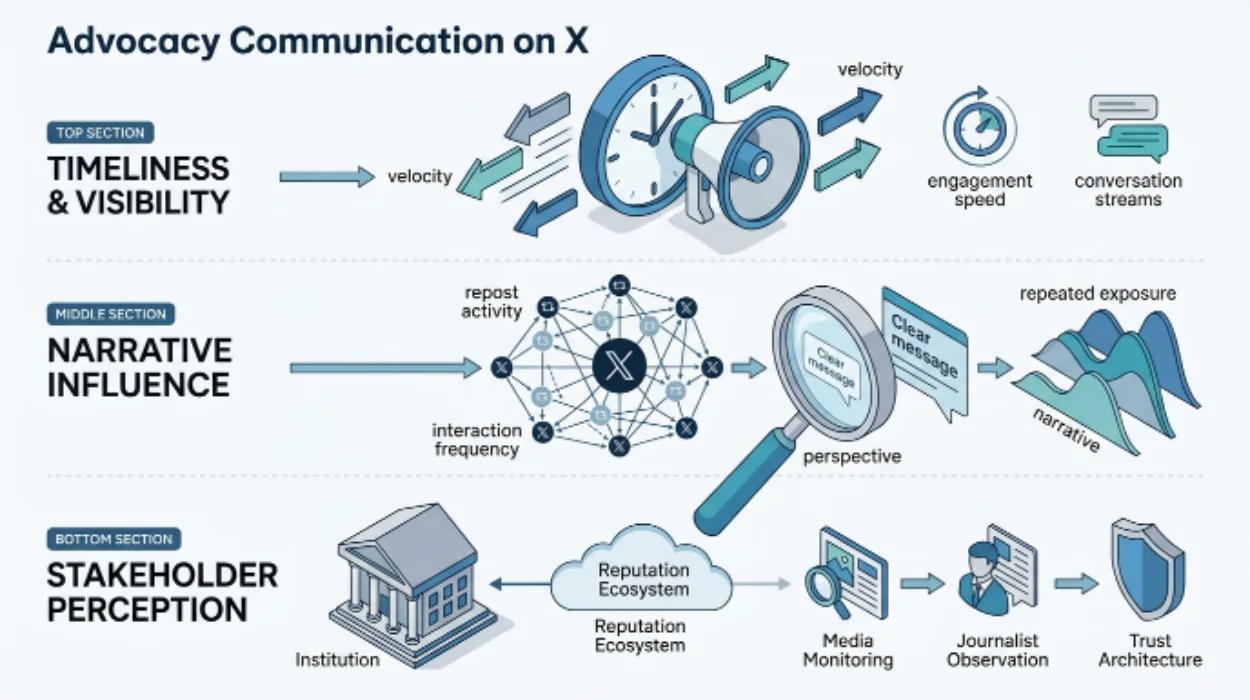
X works best for advocacy communication focused on topical relevance, rapid narrative participation, and issue visibility. The platform prioritises timeliness, conversation velocity, and public discourse engagement.
How does X amplify narrative influence?
Narrative influence on X is driven by participation within active conversations. Platform algorithms evaluate engagement speed, discussion relevance, repost activity, and interaction frequency. These signals determine content visibility within conversation streams.
Advocacy content performs effectively when it contributes clear perspectives to existing public discussions. Concise communication supports discoverability because platform design encourages rapid information consumption. Message clarity becomes a critical visibility factor.
Issue framing plays a significant role in perception formation. Audiences encounter narratives repeatedly through repost networks, quote discussions, and topic aggregation systems. This repeated exposure influences public interpretation and contributes to reputation signal generation.
How does X affect stakeholder perception?
Stakeholder perception on X develops through narrative association. Organisations and institutions become connected to specific issues through repeated content publication and discussion participation.
Digital visibility on the platform influences media monitoring systems, journalist observation patterns, and public discourse tracking. Consequently, narrative positioning on X affects broader reputation ecosystems and contributes to online trust architecture.
What works on Instagram for advocacy communication?
Instagram works best for advocacy communication that simplifies complex information through visual narrative structures. The platform prioritises visual comprehension, content retention, and audience engagement.
How does visual storytelling shape advocacy visibility?
Visual storytelling refers to the communication of information through imagery, design, graphics, and multimedia presentation. Instagram’s algorithm evaluates engagement duration, interaction frequency, content relevance, and audience retention metrics.
Advocacy communication benefits from visual clarity because audiences process information rapidly within image-centric environments. Complex policy issues become more accessible when presented through structured visual formats. This accessibility improves content consumption and narrative comprehension.
Visual consistency also contributes to institutional credibility. Repeated design patterns, thematic coherence, and recognisable communication frameworks strengthen entity recognition. These signals support stakeholder trust and reinforce digital identity.
How does Instagram contribute to reputation signals?
Instagram contributes to reputation signals through audience engagement patterns and content visibility metrics. Engagement quality reflects audience interest and influences algorithmic distribution.
The platform also strengthens digital footprint development. Indexed profile information, branded content references, and external mentions contribute to broader search visibility. These interconnected signals affect how institutions are interpreted across digital ecosystems and influence long-term reputation assessment.
What works on TikTok for advocacy communication?
TikTok works best for advocacy communication that prioritises information efficiency, audience retention, and educational accessibility. The platform evaluates viewer behaviour with exceptional precision.
How does TikTok distribute advocacy content?
TikTok distributes content primarily through recommendation systems rather than follower networks. Algorithms analyse completion rates, rewatch behaviour, interaction frequency, and topical relevance to determine distribution.
Advocacy narratives gain visibility when information is delivered clearly and efficiently. Educational content that explains issues directly aligns with audience consumption patterns. Retention signals demonstrate audience interest and influence recommendation expansion.
Platform architecture enables issue awareness to spread rapidly because distribution depends heavily on content performance rather than existing audience size. This dynamic creates opportunities for broader narrative visibility within public discourse ecosystems.
How does TikTok influence public perception?
Public perception on TikTok develops through repeated exposure to simplified narrative frameworks. The platform’s recommendation systems increase visibility for content that generates sustained audience attention.
This environment encourages the translation of complex issues into accessible explanations. Successful advocacy communication maintains informational accuracy while improving comprehension. When audiences consistently understand and engage with issue-based content, stakeholder trust strengthens and institutional visibility increases.
How do content ecosystems shape stakeholder trust?
Content ecosystems shape stakeholder trust by creating interconnected signals across platforms, search engines, media coverage, and public discourse environments. Trust emerges from consistency, visibility, and credibility.
Stakeholder trust refers to confidence in the reliability, competence, and legitimacy of an entity. Digital ecosystems evaluate trust through observable signals rather than stated intentions. Consistent messaging, authoritative publication patterns, and sustained topical relevance contribute to trust formation.
Search engines reinforce these evaluations through SERP assessment mechanisms. Content appearing consistently across credible digital environments strengthens perceived authority. Search visibility therefore functions as a trust indicator because users interpret prominent positioning as evidence of relevance and legitimacy.
Narrative consistency is particularly significant. Contradictory messaging weakens credibility signals and disrupts entity perception. Consistent communication across LinkedIn, X, Instagram, and TikTok supports coherent reputation formation and strengthens institutional credibility.
How do search engines evaluate advocacy-related authority and credibility?
Search engines evaluate authority and credibility through content quality, entity associations, reputation signals, and topical expertise indicators. These assessments influence ranking outcomes and search visibility.
Authority refers to recognised expertise within a specific subject area. Search systems analyse content depth, publication consistency, citation patterns, semantic relationships, and entity relevance. These factors contribute to digital authority assessment.
Entity perception plays a central role in modern search evaluation. Search engines increasingly analyse relationships between organisations, topics, individuals, and institutions. These relationships help determine credibility and contextual relevance.
Reputation signals originate from multiple sources, including media mentions, professional profiles, social platform activity, and content ecosystems. Search engines integrate these signals into broader credibility assessments. As a result, advocacy narratives influence not only social visibility but also long-term search presence.
The interaction between content indexing, SERP evaluation, and authority assessment creates a feedback system. Greater visibility generates stronger reputation signals, while stronger reputation signals improve future visibility. This cycle shapes institutional perception across the wider digital environment.
What role does narrative consistency play in digital advocacy?
Narrative consistency defines how effectively an institution maintains coherent messaging across platforms, audiences, and digital touchpoints. Consistency strengthens trust, authority, and credibility.
Narrative consistency refers to the alignment of core themes, terminology, evidence, and communication objectives. It does not require identical content. It requires conceptual coherence across different formats and platforms.
Consistent narratives support content indexing because search engines identify recurring topical relevance. This repetition strengthens entity associations and improves authority recognition. Digital ecosystems interpret thematic consistency as evidence of expertise and reliability.
Stakeholder trust is also influenced by consistency. Audiences evaluate credibility through repeated interactions across digital environments. When messaging remains coherent across LinkedIn, X, Instagram, TikTok, and search results, institutional credibility becomes more stable and more easily recognised. Understanding How to Write Advocacy Communication That Makes Dry Policy Feel Human helps explain how complex policy narratives can maintain clarity and consistency across different digital channels. Narrative structure directly influences comprehension, engagement quality, and stakeholder interpretation.
Narrative consistency therefore functions as a foundational element within public perception systems. It connects digital authority, stakeholder trust, search visibility, and reputation formation into a unified communication framework.
Conclusion
Platform-specific storytelling is a perception management mechanism within digital advocacy ecosystems. LinkedIn emphasises professional authority, X prioritises conversational relevance, Instagram rewards visual comprehension, and TikTok focuses on audience retention and information accessibility.
These platforms operate as interconnected reputation environments that influence stakeholder trust, entity perception, and institutional credibility. Algorithms evaluate authority signals, engagement patterns, content relevance, and narrative consistency to determine visibility outcomes. Search engines extend these evaluations through content indexing, SERP assessment, and reputation signal analysis.
Understanding how digital platforms interpret and distribute advocacy narratives provides insight into the broader systems that shape online reputation, public perception, digital authority, and stakeholder trust across contemporary information ecosystems.
Frequently Asked Questions
What is platform-specific storytelling in digital advocacy?
Platform-specific storytelling is the practice of adapting advocacy narratives to the communication formats, audience expectations, and visibility mechanisms of individual digital platforms. It helps improve content relevance, stakeholder understanding, and narrative distribution across digital ecosystems.
Why do advocacy messages perform differently across LinkedIn, X, Instagram, and TikTok?
Each platform uses different algorithms, engagement signals, and content ranking systems. LinkedIn prioritises professional expertise, X focuses on real-time discussion, Instagram emphasises visual communication, and TikTok evaluates audience retention and content consumption patterns.
How do social media algorithms influence public perception?
Social media algorithms influence public perception by determining which content receives visibility and repeated exposure. Ranking systems evaluate engagement quality, relevance, authority signals, and audience interaction patterns, which affect how narratives are interpreted and distributed.
What role does trust play in digital advocacy?
Trust functions as a reputation signal within digital ecosystems. Consistent messaging, credible information, authoritative content, and transparent communication contribute to stakeholder trust, which influences both platform visibility and institutional perception.
How does platform-specific storytelling affect search visibility?
Platform-specific storytelling strengthens digital footprints across multiple channels. Search engines evaluate content indexing, entity associations, reputation signals, and authority indicators from social platforms, which can contribute to stronger search visibility and SERP evaluation.