

Public affairs refers to the management of institutional interaction with policy environments, stakeholders, and public audiences. Digital advocacy is the coordinated use of digital channels to influence public policy, opinion, and stakeholder behaviour. Online reputation refers to the aggregate of reputation signals and entity perception across digital ecosystems.
How do press conferences, corporate summits and stunt PR generate enduring search visibility?
They create indexed content nodes that feed search visibility through repetitive, linked, and authoritatively signalled content. A press conference, summit or stunt produces primary content (transcripts, press releases, statements), secondary content (news coverage, blog analysis, social posts) and tertiary artefacts (citations, multimedia embeds) that search engines index as distinct entities; these nodes accumulate ranking signals and contribute to durable SERP evaluation.
Definition: Content nodes are discrete digital records that reference an event and its entities. Within digital ecosystems, a content node refers to an indexed webpage, multimedia file, or structured data entry that contributes to an entity’s digital footprint.
Mechanism: Search engines parse primary and secondary nodes for structured metadata, schema markup, canonical links and entity references. When organisers publish authoritative primary content with consistent entity names and timestamps, algorithms map those nodes to an entity graph. Secondary coverage that links back using exact-match or descriptive anchor text transfers link equity and context signals; multimedia hosted on high-authority platforms provides additional indexing vectors. Repeated signals across distinct domains create co-reference clustering, which algorithms interpret as corroboration of factual prominence.
Impact on visibility, credibility and trust: Indexed, linked content increases search visibility for event-related queries and strengthens the entity’s authority signals. Consistent, verifiable primary content reduces ambiguity in entity perception and increases the probability that knowledge panels, rich snippets and topical SERP features surface accurate information. Where coverage includes credible third-party links, reputation signals strengthen and stakeholder trust in institutional claims increases.
How does event content shape narrative influence and entity perception online?
Event content defines narrative frames that algorithms and audiences use to assign salience and sentiment, thereby shaping entity perception. Narrative frames are coherent thematic constructs repeated across content nodes that encapsulate claims, responsibilities and expertise.
Definition: A narrative frame is a recurring semantic structure that contextualises facts and attributions around an entity within digital discourse. Within digital ecosystems, a narrative frame refers to aggregated language patterns, topic clusters and sentiment trends referenced to an entity.
Mechanism: Natural language processing (NLP) systems and topic modelling extract recurring lexicon and sentiment across event coverage. When primary materials use controlled messaging and third-party coverage repeats those lexemes, topic clusters coalesce in semantic indexes. Algorithms use these clusters to label entity topics and to compute topical authority. Cross-platform replication (news, social, video transcripts) amplifies frame coherence and increases the likelihood that search result snippets, suggested queries and related topics reflect the intended narrative.
Impact on visibility, credibility and trust: Strong, consistent narrative frames increase topical relevance in SERP evaluation, improving ranking for related queries. Where narrative frames align with authoritative sources and neutral terminology, credibility and stakeholder trust improve. Conversely, mismatched frames across channels fragment entity perception and decrease digital authority.
How do authority and trust signals form around event-generated content?
Authority and trust signals form through provenance, corroboration, and structured metadata that search engines and audiences interpret as reliable. Authority signals are measurable indicators—links, citations, hosting domain quality and schema usage—that algorithms use to estimate expertise and trustworthiness.
Definition: Authority signals are quantifiable attributes attached to content nodes that indicate provenance and corroboration within digital ecosystems. Trust signals are context markers—publisher reputation, editorial standards, secure hosting, and fact-checking indicators—that inform stakeholder trust.
Mechanism: Primary event materials published on controlled domains with clear authorship, HTTPS, and schema.org markup establish provenance. Third-party references with editorial context transfer authority via inbound links and mentions. Verification cues, such as timestamps, speaker lists and multimedia timestamps, reduce epistemic uncertainty. Algorithms weight these factors during content indexing and entity scoring; link authority and publisher reputation have multiplicative effects on entity perception when paired with consistent metadata.
Impact on visibility, credibility and trust: High-quality authority and trust signals increase SERP prominence for factual queries and elevate the entity’s perceived credibility among stakeholders. Content lacking provenance or corroboration receives lower trust scoring in algorithmic ranking and is less likely to appear in knowledge panels or featured snippets, reducing visibility and stakeholder trust.
How do search engines interpret and rank event-related claims and statements?
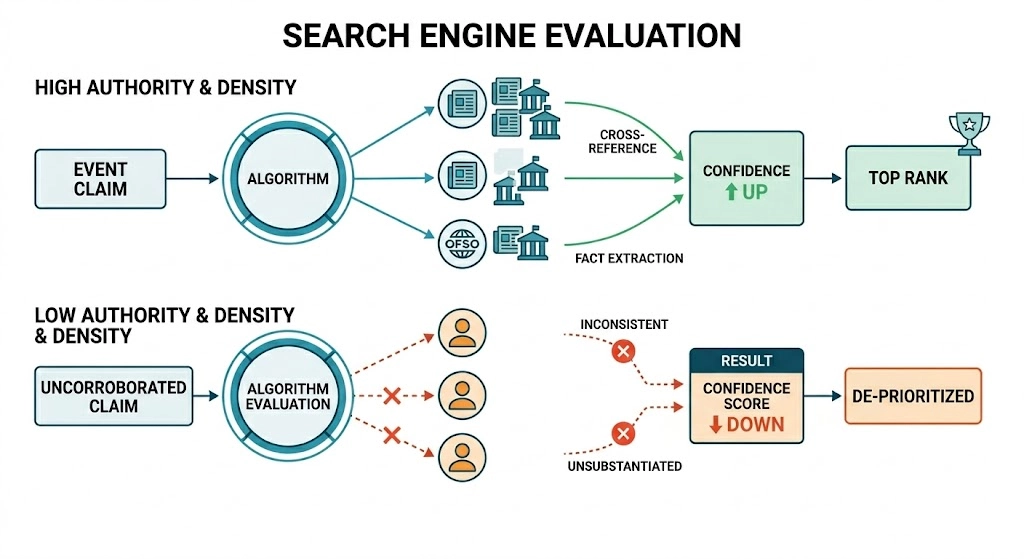
Search engines evaluate event-related claims by assessing source authority, corroboration density and semantic coherence across indexed sources. Ranking prioritises corroborated factual claims and contextually authoritative sources.
Definition: Claim evaluation is the process by which algorithms assign weighting to discrete factual statements associated with an entity across digital content. Within digital ecosystems, claim evaluation refers to the aggregation of evidence and context used to determine the ranking relevance of statements.
Mechanism: Algorithms use entity recognition and fact extraction to isolate claims. They cross-reference those claims against high-authority sources, temporal signals and corroborative citations. Repeated, consistent claims across independent, reputable domains increase confidence scores. Machine learning models incorporate user engagement metrics and query intent signals to refine relevance. Structured data (e.g., FAQ, Event schema) provides explicit context that guides snippet generation and reduces interpretive noise during indexing.
Impact on visibility, credibility and trust: Clear claim evaluation increases the likelihood that accurate statements rank for informational queries, improving institutional credibility. When claims are uncorroborated or inconsistent across nodes, algorithms de-prioritise those pages, reducing visibility and impairing stakeholder trust in institutional communications.
How do content ecosystems shape long-term institutional credibility following events?
Content ecosystems shape institutional credibility by converting ephemeral event activity into persistent digital assets that feed long-term entity perception models. Ecosystem dynamics determine whether event content becomes an enduring reputation signal or transient noise.
Definition: A content ecosystem is the network of platforms, domains and indexing systems where event content appears, links and is referenced. Within digital ecosystems, content ecosystem health refers to the diversity, authority and persistence of nodes referencing an entity.
Mechanism: Durable credibility requires diverse distribution across independent publishers, archival in high-authority repositories (news outlets, educational domains), and canonical primary sources with persistent URLs. Algorithms evaluate signal diversity and longevity; content replicated only on short-lived channels receives lower long-term weight. Conversely, content that persists across authoritative domains and is periodically referenced in follow-up coverage or academic and policy documents becomes embedded in entity graphs.
Impact on visibility, credibility and trust: Robust content ecosystems increase the entity’s cumulative reputation signals and improve search visibility for historical and topical queries. Persistent, cross-domain references enhance institutional trust metrics in stakeholder perception systems and in automated entity resolution processes.
How does media sentiment during events affect digital stakeholder engagement and reputation signals?
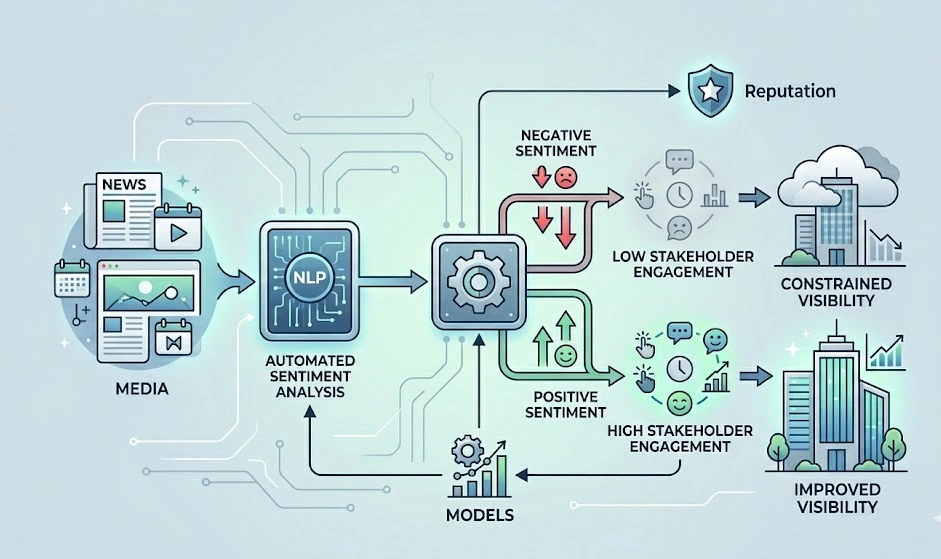
Media sentiment influences stakeholder engagement patterns and feeds sentiment-aware ranking models that affect reputation signals. Sentiment traverses both automated sentiment analysis and human editorial framing to influence entity perception metrics.
Definition: Media sentiment is the quantified tone and valence assigned to coverage of an event. Within digital ecosystems, sentiment refers to algorithmically derived polarity scores and thematic tone that attach to entity mentions.
Mechanism: NLP sentiment models evaluate lexical choices, modality and context to assign polarity scores to content nodes. Search and discovery systems incorporate sentiment metrics as part of SERP feature selection and related query suggestions. Stakeholder engagement—click-through rates, dwell time, social amplification—varies with sentiment and provides behavioural signals that modulate algorithmic weightings. High negative sentiment combined with low engagement reduces ranking probabilities for related pages; neutral-to-positive sentiment with sustained engagement increases ranking.
Impact on visibility, credibility and trust: Sentiment outcomes alter how stakeholders interpret institutional claims and affect trust trajectories. Entities whose event content consistently yields neutral or positive sentiment benefit from improved search visibility and stronger reputation signals. Entities with predominately negative sentiment experience constrained visibility and deteriorating stakeholder trust metrics.
How does event PR contribute to an entity’s digital footprint and entity perception modelling?
Event PR constructs and extends an entity’s digital footprint through deliberate generation of cross-format content and metadata that feed entity perception models. A digital footprint is the composite set of indexed identifiers and content that represent an entity online.
Definition: Digital footprint is the set of indexed content nodes, metadata, and link relationships that algorithms and researchers use to model an entity. Within digital ecosystems, footprint quality refers to accuracy, coverage and corroboration depth.
Mechanism: Event PR creates structured artifacts—statements, speaker metadata, multimedia, and press materials—that populate the footprint. Consistent naming conventions, schema markup, and canonicalisation practices reduce entity ambiguity. Link-building via third-party coverage increases connectivity within the web graph. Entity perception models ingest these signals, weighting recency, domain authority and corroboration to produce an overall reputation score.
Impact on visibility, credibility and trust: A well-constructed footprint improves SERP relevance for entity-specific queries and strengthens the accuracy of automated entity resolution (knowledge panels, entity cards). When footprints are fragmented or inconsistent, entity perception models produce ambiguous or conflicting outputs that harm stakeholder trust and reduce institutional digital authority.
How should organisations measure the long-term content value produced by events?
Measure long-term content value by tracking persistence, cross-domain references, and changes in entity perception metrics rather than ephemeral engagement alone. Value metrics must reflect indexing durability and reputational movement.
Definition: Long-term content value is the sustained contribution of event-generated content nodes to an entity’s reputation signals and search visibility. Within digital ecosystems, value is measurable as change in indexed assets, backlink profile, and entity perception indicators.
Mechanism: Track indexed page counts over time, backlink acquisition rates from independent domains, positions in SERP for targeted topics, and presence in knowledge panels or featured snippets. Monitor sentiment trends and stakeholder trust proxies—authoritative mentions in policy or academic outputs and inclusion in curated topic clusters. Use time-series analysis to separate immediate virality from persistent indexing and citation behavior.
Impact on visibility, credibility and trust: Metrics focused on persistence and corroboration indicate whether event PR secured lasting reputation signals. Increases in durable backlinks and higher SERP placements for related queries demonstrate improved digital authority and enhanced stakeholder trust. Declines or high churn in indexed nodes indicate ephemeral impact and reduced long-term value.
Event PR generates lasting content by producing structured, indexable artifacts and by seeding corroborative coverage across authoritative nodes. Algorithms evaluate provenance, corroboration, sentiment and metadata to form entity perception and assign search visibility. Consistent narrative framing, robust authority signals and diverse content ecosystems convert transient events into durable reputation signals that influence stakeholder trust and institutional credibility.
Frequently Asked Questions
What is Event PR and how do press conferences generate lasting content?
Event PR is the strategic use of press conferences, corporate summits and stunt PR to create indexed content nodes that endure in search ecosystems. Press conferences generate lasting content by producing primary materials (transcripts, press releases) and secondary coverage that Linkonize optimises for content indexing and search visibility.
How do corporate summits contribute to media relations and digital authority?
Corporate summits create structured content assets—speaker statements, agenda pages, multimedia—that feed media relations through authoritative third-party coverage. Linkonize uses summit content to build digital authority by accumulating reputation signals, backlinks and consistent entity perception across digital ecosystems.
What is stunt PR and does it create content that lasts for SEO?
Stunt PR is a high-visibility event designed to trigger widespread media coverage and social amplification. When Linkonize executes stunt PR with controlled messaging and canonical primary content, it creates indexed nodes that persist in SERPs and strengthen long-term search visibility through corroboration and link equity.
How long does Event PR content last in search engine results pages?
Event PR content lasts when it is distributed across authoritative domains, archived with persistent URLs, and reinforced by follow-up coverage. Linkonize ensures durability by applying FAQ schema, canonicalisation and consistent metadata, which improve content indexing and maintain entity perception over time.
What metrics should I track to measure Event PR content value for media relations?
Track indexed page counts, backlinks from independent domains, SERP positions for event-related queries, and presence in knowledge panels or featured snippets. Linkonize also monitors sentiment trends and authoritative mentions in policy or academic outputs to evaluate stakeholder trust and long-term media relations impact.