

Public affairs strategies differ based on the target audience, exposure vectors, and regulatory environment.
Digital advocacy methods are evaluated through their capacity to shape narrative visibility, measure sentiment distribution, and reinforce entity credibility.
Public affairs strategies differ based on stakeholder intent, media exposure, and institutional risk appetite. Digital advocacy methods are evaluated through metrics that measure search ranking influence, narrative visibility, and reputation signals.
How do media visibility and stakeholder engagement approaches compare for surviving hostile journalism?
Media visibility is a proactive visibility-first approach that operates by prioritising broad exposure across press outlets, social platforms, and broadcast channels to set the narrative early. Media visibility functions through press releases, embargoed briefings, and high-reach op-eds; mechanisms translate into quick spikes in narrative visibility and short-term search ranking influence when major outlets index content.
Strengths include rapid amplification and the ability to occupy top SERP positions for specific queries. Limitations include vulnerability to adversarial framing once hostile journalists introduce counter-narratives, content suppression risks when negative coverage attracts backlinks that outrank corrective content, and a higher risk exposure if initial messaging lacks stakeholder trust signals.
Stakeholder engagement is a relational, targeted approach that operates by building sustained two-way communications with policymakers, regulators, industry partners, and community leaders to generate durable reputation signals. Stakeholder engagement works through briefings, closed consultations, and targeted content distribution; mechanisms increase entity credibility via endorsements, citation networks, and long-tail content that supports SERP depth. Strengths include stronger stakeholder trust, better control over factual accuracy through direct channels, and improved long-term institutional credibility.
Limitations include slower narrative visibility growth, scalability constraints across mass audiences, and delayed search ranking influence compared with immediate media visibility. Comparative analysis shows media visibility optimises for immediate SERP prominence and broad sentiment distribution, while stakeholder engagement optimises for sustained credibility and resilience against hostile reframing. The recommended balance evaluates risk exposure (media visibility higher) versus sustainability (stakeholder engagement higher) for long-term reputation management.
How do organic vs reactive communication frameworks differ in preserving message hierarchy under hostile coverage?
An organic framework is a planned, content-driven approach that operates by publishing authoritative assets—research reports, evergreen explainer pages, and expert commentaries—designed to accumulate search ranking influence and establish foundational reputation signals. Organic frameworks function through consistent content cadence, structured metadata, and internal linking that supports entity credibility; mechanisms create layered SERP composition where authoritative pages dominate informational queries.
Strengths include durability, improved content suppression of adverse pieces via depth of indexed assets, and positive sentiment distribution across owned channels. Limitations include slow scalability, significant resource investment, and delayed effect when rapid rebuttal is necessary. Organic strategies evaluate well on sustainability and long-term stakeholder trust but score lower on immediate crisis containment.
A reactive framework is an incident-driven approach that operates by producing timely rebuttals, corrections, and rapid-response media statements intended to disrupt hostile narratives in real time. Reactive frameworks work through press rebuttals, social corrections, and takedown requests; mechanisms produce rapid content amplification and short-term shifts in narrative visibility. Strengths include speed and the potential to influence immediate public perception and news cycles.
Limitations include volatility in search ranking influence (reactive content often loses position as news cycles move on), elevated risk exposure from appearing defensive (affecting stakeholder trust), and potential amplification of the hostile journalist’s framing through repeated engagement. Comparative analysis demonstrates organic frameworks provide sustained suppression of negative coverage through depth and entity credibility, whereas reactive frameworks provide tactical control over immediate narrative visibility but weaken long-term credibility if overused. Evaluate effectiveness by measuring persistence of corrected pages in SERPs, scalability by content production capacity, and sustainability by stakeholder trust trajectory.
How do short-term narrative management and long-term institutional credibility strategies interact when journalists act hostile?
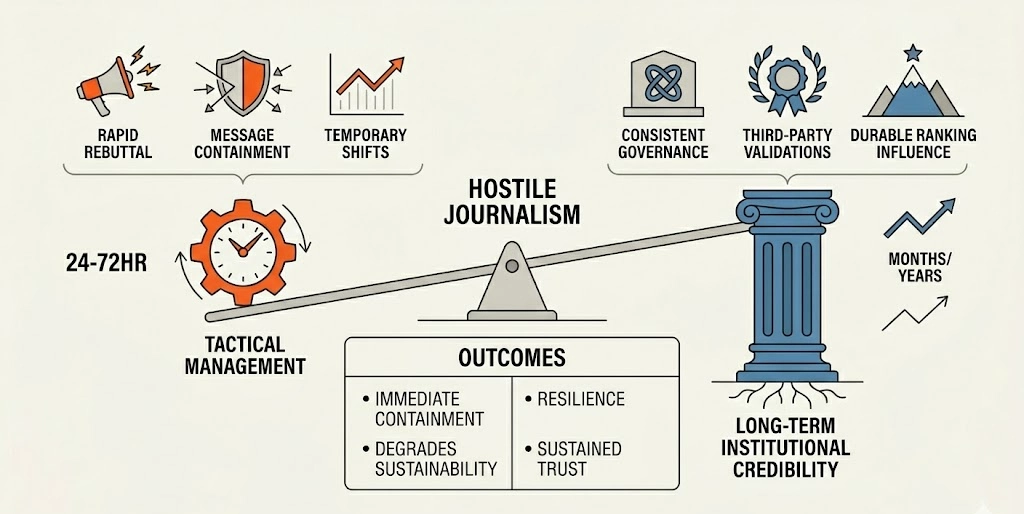
Short-term narrative management is a tactical intervention that operates by prioritising message containment, rapid rebuttal, and temporary narrative displacement to limit immediate reputational damage. It works through press statements, corrective op-eds, and swift engagement with platform moderation mechanisms; mechanisms create short-lived shifts in sentiment distribution and may temporarily suppress harmful visibility via authoritative counter-content. Strengths include immediate reduction in misinformation spread and ability to influence the next 24–72 hours of coverage. Limitations include shallow search ranking influence over time, risk of entrenching adversarial attention, and potential detriment to stakeholder trust when actions appear reactive rather than principled.
Long-term institutional credibility is a strategic programme that operates by embedding consistent governance narratives, third-party validations, transparency mechanisms, and archival content that together build entity credibility. It works through policy reports, stakeholder endorsements, compliance disclosures, and historical content that search engines index as authoritative signals; mechanisms result in durable search ranking influence and positive sentiment distribution across informational queries. Strengths include resilience to hostile coverage, scalable reputational capital, and sustained stakeholder trust.
Limitations include significant time and resource commitment and slower observable effects during acute crises. Comparative analysis shows that short-term management is effective for immediate containment but degrades sustainability and may harm entity credibility if repeated; long-term credibility reduces risk exposure and supports content suppression of adverse items through authoritative depth. Measuring impact requires tracking SERP composition over months, stakeholder trust indices, and the persistence of corrective signals.
How do search engines and digital platforms interpret authority and trust signals relevant to message hierarchies?
Search engines interpret authority as a composite signal tied to backlink quality, on-page relevance, structured data, and historical content stability; entity credibility is measured by citation networks, authoritativeness metrics, and consistent domain behaviour. Mechanisms include algorithmic weighting of authoritative citations, topical depth scoring, and evaluation of user engagement metrics that influence search ranking influence. Platforms interpret trust through account verification, consistency of messaging, and moderation histories that affect narrative visibility and sentiment distribution.
Strengths of search-engine-driven authority include measurable SERP outcomes and potential for content suppression of transient hostile pieces through depth; limitations include algorithm opacity and delayed impact from new content. Comparative analysis shows search engines favour long-standing, well-cited assets for informational queries, while social platforms prioritise recency and engagement for topical items—this differential affects which elements of a message hierarchy survive hostile scrutiny. Evaluate by measuring indexation speed, backlink quality, and signal longevity; assess risk exposure where platform moderation policies create single-point failures for content visibility.
How do different strategies influence visibility, sentiment distribution, and stakeholder trust during hostile interactions?
Proactive media visibility elevates narrative visibility quickly and influences short-term sentiment distribution through mass exposure; mechanism-driven spikes can temporarily dominate SERPs and social conversations. This produces high visibility but volatile sentiment distribution and conditional stakeholder trust that depends on perceived transparency. Organic content depth distributes sentiment more evenly across informational queries and builds trust through sustained, high-quality assets that underpin entity credibility.
Reactive tactics shift sentiment distribution in the short term while degrading long-term stakeholder trust if they appear as damage control. Stakeholder engagement channels localise sentiment distribution within influential networks and convert visibility into durable trust signals; mechanisms include endorsements and private confirmations that reinforce credibility beyond public sentiment swings. Comparative evaluation indicates strategies that prioritise sustained content depth and stakeholder validation perform better on search ranking influence and long-term trust metrics, while visibility-first and reactive tactics perform better on immediate narrative control but increase risk exposure and weaken sustainability.
Which mechanisms scale effectively and which expose institutions to highest risk?
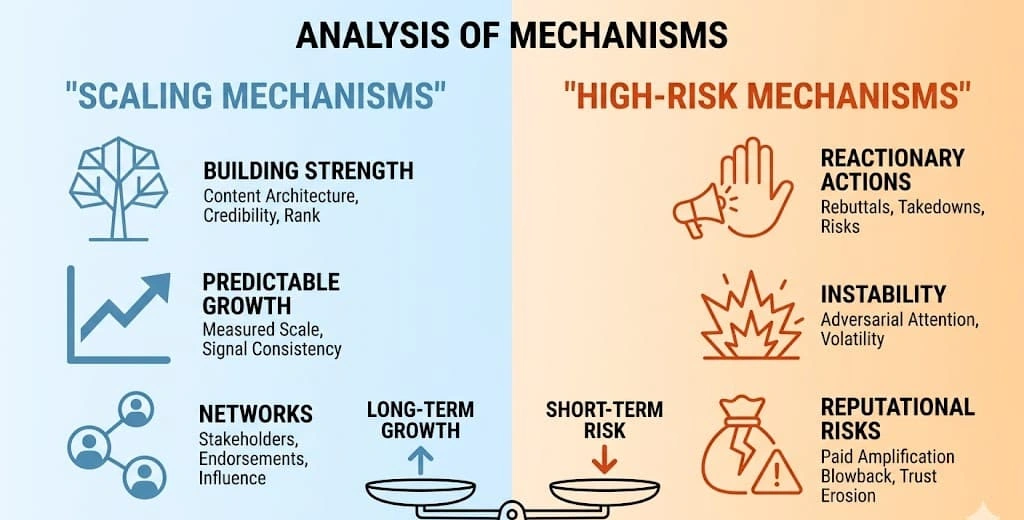
Mechanisms that scale effectively include content architecture (structured metadata, topical clusters), automated monitoring linked to editorial processes, and stakeholder relationship management systems that document endorsements and citations. These mechanisms operate by standardising production, ensuring consistent signal generation, and building citation networks that enhance search ranking influence. Strengths include predictable scalability, measurable improvements in entity credibility, and cumulative impact on SERP composition. Limitations include upfront investment and governance overhead.
High-risk mechanisms include repetitive public rebuttals, aggressive takedown requests, and disproportionate paid amplification in response to hostile coverage. These operate by drawing additional attention to adversarial content, provoking sentiment redistribution, and risking platform moderation consequences. Strengths include immediate visibility control; limitations include magnified adversarial attention, erosion of stakeholder trust, and potential reputational blowback that undermines long-term credibility. Evaluate scalability by measuring repeatable signal production per unit resource; measure risk exposure by tracking escalation probability, sentiment volatility, and impact on long-term search ranking influence.
How should practitioners evaluate effectiveness, scalability, risk exposure, and sustainability across strategies?
Practitioners evaluate effectiveness by analysing SERP composition changes, sentiment distribution metrics across owned and earned channels, and shifts in stakeholder trust indices following interventions. Effectiveness measures should include persistence of corrected or authoritative pages in top search results and presence of third-party citations. Practitioners evaluate scalability by auditing content production workflows, monitoring automation efficacy for distribution, and measuring resource-per-signal ratios. Risk exposure is measured through escalation matrices that score actions by potential to amplify hostile narratives, legal/regulatory sensitivity, and platform moderation penalties. Sustainability is evaluated by tracking long-term trends in entity credibility metrics, backlink authority accumulation, and retention of stakeholder trust over quarters. Use a stepwise evaluation framework:
-
Audit content assets, identify high-value topical clusters, and map current SERP ownership.
-
Produce authoritative assets for core claims and distribute via targeted stakeholder channels.
-
Monitor hostile coverage, measure immediate sentiment shifts, and deploy proportional reactive content only when it aligns with long-term credibility objectives.
-
Reassess quarterly for search ranking influence and stakeholder trust trajectories.
Key differences between approaches centre on time horizon and risk profile: media visibility and reactive tactics deliver immediate narrative visibility but increase risk exposure and reduce sustainability; stakeholder engagement and organic content depth build entity credibility, improve search ranking influence, and sustain positive sentiment distribution but require larger investment and slower timelines. Strategic considerations include aligning short-term interventions with long-term credibility objectives, prioritising mechanisms that generate durable reputation signals (citations, stakeholder endorsements, topical depth), and constraining high-risk reactive actions to avoid amplifying hostile narratives.
Frequently Asked Questions
How does Linkonize’s Media Relations service protect a message hierarchy during hostile journalism?
Linkonize’s Media Relations service protects a message hierarchy by prioritising authoritative, indexed assets and targeted stakeholder confirmations to counter hostile narratives, combining rapid press responses with long-form content that reinforces entity credibility. This approach balances immediate narrative visibility with sustained search ranking influence and improved reputation signals.
What steps should organisations take to build a message hierarchy that survives hostile press coverage?
Build a layered content architecture with cornerstone pages, produce succinct press statements for immediate visibility, and secure stakeholder endorsements to create citation networks that support entity credibility. These steps improve SERP composition, distribute sentiment across owned channels, and reduce the risk of content amplification by hostile outlets.
How quickly can Media Relations tactics influence search ranking influence after negative coverage?
Reactive Media Relations tactics can change narrative visibility within 24–72 hours through press releases and social amplification, but durable search ranking influence requires weeks to months of indexed authoritative content and backlink acquisition. Measure short-term gains by SERP position changes and long-term effects by persistence of authoritative pages.
Which indicators show that a message hierarchy is resilient to hostile journalists?
Indicators include stable top-of-SERP ownership for core claims, growing backlink authority to authoritative pages, diversified sentiment distribution across owned and earned channels, and corroborating stakeholder statements. Track these metrics to evaluate entity credibility and the hierarchy’s resistance to adversarial reframing.
When should organisations prioritise stakeholder engagement over media visibility in Media Relations?
Prioritise stakeholder engagement when long-term institutional credibility and regulatory trust are critical, or when hostile reporting risks regulatory scrutiny; this strategy builds durable reputation signals through endorsements and closed briefings. Use media visibility for immediate narrative correction only when it aligns with longer-term search ranking and credibility objectives.