

Earned media influences consumer purchase decisions by shaping trust, credibility, and perceived authority through independent third-party coverage. Its impact extends beyond visibility, affecting how consumers interpret reputation signals across digital ecosystems.
Online reputation refers to the collective perception of an entity formed through digital content, media references, search visibility, and stakeholder interactions. Public affairs refers to the management and interpretation of relationships between institutions, stakeholders, media environments, and public perception systems. Within digital ecosystems, earned media functions as a reputation signal that contributes to authority evaluation, trust formation, and narrative influence.
What Is Earned Media Within Digital Reputation Systems?
Earned media is third-party coverage, mention, citation, or reference that is generated independently of direct editorial control. Within digital ecosystems, earned media refers to externally validated visibility that contributes to reputation assessment and authority recognition.
Unlike owned content, earned media originates from external publishers, journalists, industry commentators, institutional sources, or recognised media entities. Search engines interpret these references as indicators of relevance, authority, and entity prominence. Media citations contribute to content indexing patterns and influence how entities are associated with topics, industries, and public discussions.
From a perception perspective, earned media functions as a credibility layer. Stakeholders evaluate information differently when it appears within independent editorial environments rather than self-published channels. This distinction influences trust formation because third-party publication introduces external validation. As a result, earned media becomes part of the broader architecture through which digital authority is established and interpreted.
The significance of earned media extends beyond publication itself. Search systems analyse relationships between entities, topics, publishers, and audience engagement signals. These relationships contribute to search visibility and influence how authority is ranked within search engine results pages (SERPs).
Why Does Earned Media Affect Consumer Trust?
Earned media affects consumer trust because it introduces independent verification into the information environment. Trust is strengthened when information is supported by external sources that possess recognised editorial standards or institutional authority.
Trust formation within digital ecosystems relies on credibility signals. Consumers evaluate not only the content they encounter but also the source through which information is delivered. Independent media references provide contextual evidence that an entity exists within a recognised information network. This process influences stakeholder trust because credibility becomes distributed across interconnected sources.
Search engines evaluate similar patterns. Authority assessments rely on signals associated with source quality, citation relationships, content relevance, and topical expertise. Earned media contributes to these evaluations by reinforcing associations between entities and authoritative information sources. Consequently, trust operates simultaneously at the human perception level and the algorithmic interpretation level.
Digital trust architecture is therefore constructed through repeated validation signals. When independent publications consistently reference an entity within relevant topics, stakeholders encounter a coherent credibility framework. This framework influences confidence, perception stability, and information acceptance during purchase evaluation processes.
How Do Search Engines Interpret Earned Media Signals?
Search engines interpret earned media signals as indicators of relevance, authority, and entity recognition across the web. These signals contribute to broader evaluations related to content ranking and reputation assessment.
Modern search systems analyse entities rather than isolated keywords. An entity represents a recognised person, organisation, institution, concept, or topic within a structured information environment. Earned media strengthens entity recognition by increasing the number of contextual references associated with that entity across authoritative sources.
When search engines identify consistent references from trusted publishers, they evaluate patterns relating to expertise, topical relevance, and authority. These patterns influence indexing priorities and SERP evaluation processes. Content connected to recognised entities receives stronger contextual understanding because search systems can more accurately interpret relationships between topics and sources.
Earned media also contributes to knowledge development within search ecosystems. Citations, references, and discussions create semantic connections that improve topic association. These associations influence how information is categorised, ranked, and presented to users. As a result, earned media affects both visibility outcomes and perception outcomes.
How Does Earned Media Shape Consumer Perception Before Purchase?
Earned media shapes consumer perception by influencing information interpretation before transactional decisions occur. It contributes to the narrative environment through which consumers evaluate credibility, competence, and legitimacy.
Consumer decision-making relies on information availability and information quality. Before a purchase occurs, individuals often encounter search results, news coverage, reviews, industry commentary, and expert analysis. Earned media occupies a significant position within this information landscape because it appears as independently published content rather than promotional communication.
Perception formation occurs through repeated exposure to consistent signals. Positive, neutral, or critical media narratives influence how stakeholders interpret entity reputation. These narratives create cognitive frameworks that define expectations regarding quality, expertise, transparency, and reliability.
Search visibility amplifies this effect. Media content often ranks prominently within SERPs due to publisher authority and content relevance. Consequently, earned media frequently becomes one of the first information sources encountered during research processes. Its prominence increases narrative influence and contributes directly to reputation evaluation before purchase decisions are finalised.
What Role Do Digital Narratives Play in Purchase Decisions?
Digital narratives define how information is organised, interpreted, and remembered across online environments. A digital narrative is the collection of interconnected messages, media references, discussions, and content themes associated with an entity or topic.
Narratives influence perception because stakeholders rarely evaluate isolated pieces of information. Instead, they interpret patterns across multiple sources. Earned media contributes to these patterns by providing independent content that reinforces or challenges existing perceptions. The cumulative effect shapes entity perception and affects trust development.
Narrative influence depends on consistency, visibility, and authority. When similar themes appear across respected media publications, search results, and stakeholder discussions, those themes gain prominence within public perception systems. Search algorithms recognise these recurring associations and use them to evaluate topical relevance.
Purchase decisions are influenced by narrative coherence. Stakeholders often seek informational consistency before making judgments regarding credibility and value. Earned media strengthens or alters narratives by introducing externally validated information into the broader content ecosystem. This process affects both human interpretation and algorithmic assessment.
How Does Media Visibility Influence Institutional Credibility?
Media visibility influences institutional credibility by increasing public exposure to independently verified information. Institutional credibility refers to the perceived legitimacy, reliability, and authority of an organisation within public and digital environments.
Credibility develops through observable evidence. Earned media provides evidence that institutions are participating in recognised conversations, industry developments, policy discussions, or public interest topics. These references create signals that stakeholders use when evaluating legitimacy.
Visibility alone does not establish credibility. The context surrounding visibility determines perception outcomes. Media references associated with expertise, research, governance, accountability, or recognised achievements contribute positively to institutional reputation. Search engines similarly evaluate contextual relationships rather than simple mention frequency.
Institutional credibility also affects stakeholder trust. When credible institutions receive consistent recognition across authoritative media sources, perception stability increases. Stakeholders encounter corroborating information that supports confidence in the institution’s authority and relevance. Consequently, earned media becomes an important component of digital credibility formation.
How Do Content Ecosystems Amplify Earned Media Influence?
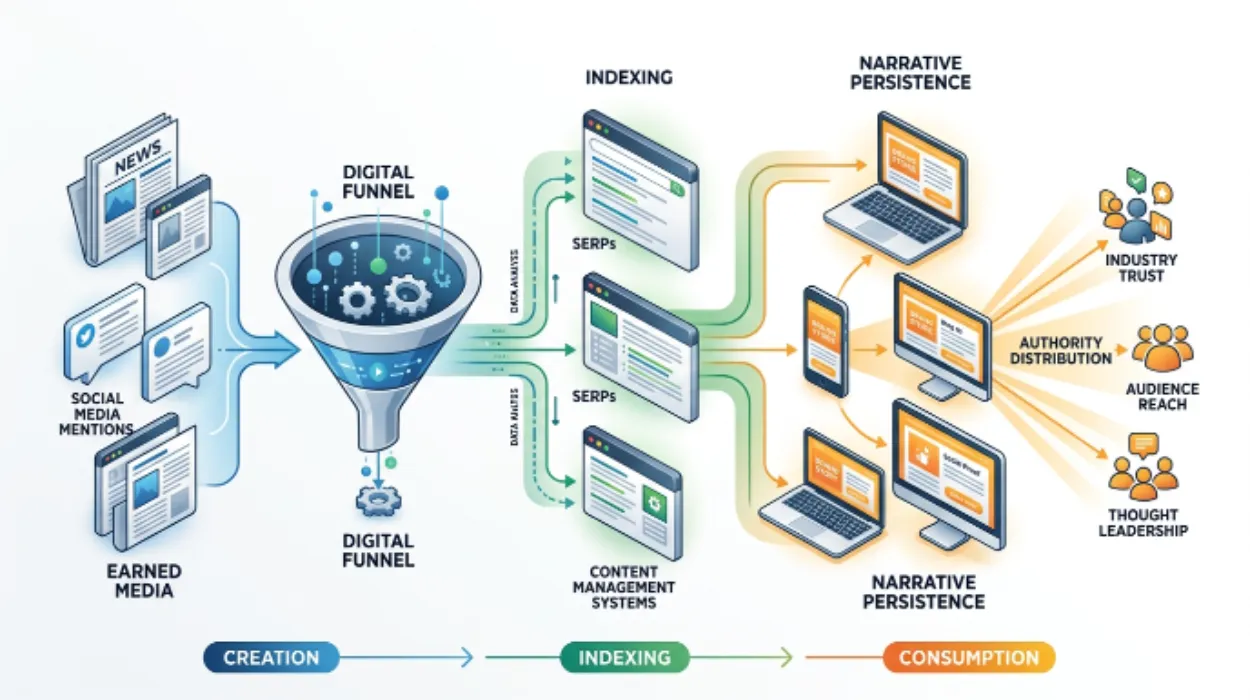
Content ecosystems amplify earned media influence by distributing information across interconnected platforms, publishers, search systems, and stakeholder networks. A content ecosystem is the network of channels through which information is created, indexed, referenced, and consumed.
Earned media rarely exists in isolation. Once published, content is indexed by search engines, referenced by secondary sources, discussed across digital platforms, and incorporated into broader information flows. Each interaction expands visibility and reinforces reputation signals.
This amplification process strengthens narrative persistence. Search engines identify recurring references and evaluate relationships between sources. Stakeholders encounter information through multiple touchpoints, increasing recognition and familiarity. These repeated encounters contribute to trust formation and perception consistency.
Content ecosystems also influence authority distribution. High-authority publishers often act as credibility hubs within digital networks. References originating from these hubs can generate secondary citations and additional visibility. As a result, earned media contributes to both direct perception outcomes and indirect authority development across the wider digital environment.
What Authority Signals Are Created Through Earned Media?
Authority signals are indicators that demonstrate expertise, relevance, recognition, and credibility within digital ecosystems. Earned media generates authority signals by establishing independent validation from external sources.
Key authority signals emerge through identifiable mechanisms:
- Establish topical association by connecting an entity to specific subjects through editorial coverage. Search systems use these associations to evaluate relevance within topic clusters.
- Reinforce source recognition by increasing references from trusted publishers. Repeated citations strengthen entity prominence within information networks.
- Demonstrate expertise through inclusion in industry analysis, commentary, research discussions, or specialist reporting. These references contribute to authority evaluation.
- Expand citation networks by generating secondary references from other publications. Broader citation patterns enhance digital authority and search visibility.
These signals influence both stakeholder interpretation and algorithmic assessment. Authority is therefore not defined solely by visibility but by the quality, relevance, and consistency of external recognition.
How Does Earned Media Affect Search Visibility and SERP Evaluation?
Earned media affects search visibility by contributing to relevance assessment, authority interpretation, and entity recognition. SERP evaluation refers to the processes through which search systems determine ranking positions and information presentation.
Search engines analyse relationships between content sources, entities, and topics. Earned media provides external references that support these evaluations. Authoritative citations help search systems understand whether an entity is recognised within a particular subject area.
Visibility improvements occur through multiple mechanisms. Publisher authority often increases the ranking potential of earned media content. High-ranking media coverage introduces additional opportunities for entity exposure within search results. Simultaneously, the underlying authority signals contribute to broader reputation assessment.
SERP evaluation increasingly incorporates entity-based understanding. Search systems seek evidence of expertise, recognition, and credibility across multiple sources. Earned media contributes directly to this evidence base. Consequently, its influence extends beyond individual articles and affects broader search ecosystem interpretation.
Within discussions about media exposure and visibility strategies, understanding What Distribution Channels Generate the Most Media Pickups? provides additional context regarding how information spreads across interconnected publishing environments and contributes to authority development.
How Does Stakeholder Engagement Influence Earned Media Impact?
Stakeholder engagement influences earned media impact because perception is shaped through interpretation as well as exposure. Stakeholders include consumers, institutions, regulators, journalists, investors, employees, and public interest groups.
Earned media provides information, but engagement determines how that information is evaluated. Stakeholders interpret media content through existing knowledge, expectations, and contextual understanding. These interpretations contribute to reputation formation and narrative development.
Digital ecosystems enable rapid interaction between media content and stakeholder responses. Search visibility, social discussion, citation patterns, and content sharing create additional layers of interpretation. Search engines monitor aspects of these interactions when assessing content relevance and prominence.
Effective stakeholder engagement strengthens information clarity and perception consistency. When earned media aligns with recognised expertise, institutional credibility, and established authority signals, stakeholders encounter a more coherent reputation framework. This coherence supports stable entity perception across digital environments.
Conclusion
Earned media influences consumer purchase decisions by shaping trust, authority, credibility, and narrative interpretation across digital ecosystems. Its value extends beyond publicity because it functions as an externally validated reputation signal that affects both stakeholder perception and algorithmic evaluation.
Search engines interpret earned media through entity recognition, topical relevance, citation relationships, and authority assessment. Stakeholders interpret earned media through credibility frameworks, narrative consistency, and institutional trust signals. These parallel processes contribute to search visibility, digital authority, and reputation formation.
As digital ecosystems continue to prioritise entity understanding and contextual relevance, earned media remains a significant component of online trust architecture. Its influence emerges through content indexing, SERP evaluation, authority development, and the creation of perception systems that shape how information is discovered, interpreted, and trusted.
Frequently Asked Questions
How is earned media different from owned media?
Earned media is content created and published by independent third parties, such as news publications, industry websites, and editorial platforms. Owned media refers to content published directly by an organisation through its own website, blog, or social channels. Earned media contributes external credibility because it originates outside direct organisational control.
Why do consumers trust earned media more than promotional content?
Consumers often view earned media as more credible because it is produced by independent sources. Editorial oversight and third-party validation create stronger trust signals than self-published promotional content. This perception influences how information is evaluated during purchase research.
Can earned media improve search visibility?
Earned media can improve search visibility by creating authority signals and strengthening entity recognition across digital ecosystems. Search engines analyse references from trusted publishers to understand relevance, credibility, and topical expertise. These signals contribute to broader SERP evaluation processes.
What role does earned media play in online reputation?
Earned media contributes to online reputation by influencing how stakeholders perceive credibility, expertise, and institutional authority. Media coverage becomes part of the digital footprint associated with an entity. Search results, citations, and editorial references collectively shape reputation signals.
How do digital narratives influence purchasing behaviour?
Digital narratives organise information into consistent themes that stakeholders encounter across media sources, search results, and online discussions. These narratives influence perception by defining expectations around trustworthiness, expertise, and reliability. Consistent narratives can affect how consumers evaluate purchasing decisions.