

Newswire networks, journalist-targeted outreach, owned media ecosystems, and digital amplification channels generate the highest volume of media pickups, but their effectiveness differs according to audience relevance, authority transfer, editorial trust, and narrative visibility outcomes.
Public affairs strategies differ based on stakeholder influence pathways, information distribution structures, and institutional credibility objectives. Digital advocacy methods are evaluated through media adoption rates, reputation signals, search ranking influence, sentiment distribution, and long-term narrative visibility across digital ecosystems.
Which distribution channels generate the highest volume of media pickups?
Newswire distribution and direct journalist outreach generate the highest volume of media pickups, although the nature and quality of those pickups differ significantly.
Newswire distribution is a content dissemination model that operates by syndicating information across publisher networks, media databases, aggregators, and content platforms. The mechanism focuses on scale. A single announcement enters multiple publication systems simultaneously, increasing exposure across regional, national, and sector-specific outlets. This approach produces broad visibility and creates substantial content amplification. However, syndicated pickups often generate limited editorial endorsement because identical content appears across multiple domains without independent journalistic evaluation.
Direct journalist outreach is a relationship-based media relation approach that operates by matching a story to a journalist’s editorial focus and audience requirements. The mechanism relies on relevance rather than distribution volume. Media pickups generated through direct outreach receive greater editorial validation because journalists independently assess and publish the information. This process strengthens stakeholder trust and entity credibility. The limitation involves scalability, as outreach requires editorial alignment, targeting accuracy, and response management.
Comparatively, newswire distribution excels in content amplification and rapid visibility expansion, while journalist outreach performs more effectively for trust signals, narrative authority, and institutional credibility. Search engines evaluate both approaches differently because editorial coverage contributes stronger authority signals than syndicated content. As a result, pickup quantity and pickup quality represent distinct evaluation categories.
How does journalist outreach compare with automated distribution networks?
Journalist outreach generates stronger credibility signals, while automated distribution networks generate broader exposure.
Journalist outreach is a targeted communication framework. It operates by identifying relevant reporters, editors, and sector specialists who influence public discourse. The mechanism prioritises contextual relevance, exclusivity, and editorial value. Media coverage produced through this approach contributes to reputation signals because independent journalists validate and interpret information before publication.
Automated distribution networks are structured syndication systems. They operate by distributing identical content across large publisher ecosystems. The mechanism prioritises reach, speed, and distribution consistency. Media pickups emerge through publication agreements rather than editorial investigation. This increases content visibility but reduces differentiation between original reporting and syndicated material.
From a stakeholder perception perspective, journalist outreach strengthens narrative credibility because audiences recognise editorial scrutiny. Automated distribution strengthens discoverability because content appears across numerous indexed locations. In search environments, editorially produced articles contribute stronger authority indicators than duplicated releases. In institutional communication strategies, outreach supports long-term credibility development, whereas automated networks support short-term visibility objectives.
The evaluation therefore depends on measurement criteria. Volume metrics favour automated distribution, while trust-based metrics favour journalist-led publication.
How do owned media channels compare with earned media distribution?
Owned media provides message control, whereas earned media provides external validation.
Owned media is a communication asset controlled directly by an organisation. Examples include websites, blogs, research hubs, resource centres, and institutional publications. Owned media operates by publishing information within controlled environments where messaging remains consistent. The mechanism enables complete narrative control and supports long-term authority development through content accumulation.
Earned media is third-party coverage obtained through editorial interest and external publication. It operates by transferring information from an originating source into independent media environments. The mechanism introduces external validation because journalists, publishers, analysts, or sector commentators decide whether content merits coverage.
The primary advantage of owned media is sustainability. Content remains accessible and contributes to entity recognition over extended periods. Search engines interpret consistent publication activity as a signal of topical authority. The limitation involves credibility transfer. Audiences recognise that the source controls the message.
Earned media generates stronger stakeholder trust because independent publication acts as a validation mechanism. Reputation signals increase when authoritative publishers reference an entity or issue. The limitation is reduced message control. Editorial interpretation can alter emphasis, framing, and narrative direction.
From a media pickup perspective, owned media functions as an origin point, while earned media functions as a credibility amplifier. Effective distribution ecosystems often rely on interaction between both structures rather than treating them as isolated channels.
Which channels create stronger authority and trust signals in search ecosystems?
Editorial media coverage generates stronger authority signals than syndicated distribution alone.
Authority signals are measurable indicators used by search engines and digital platforms to assess credibility, expertise, relevance, and trustworthiness. These signals influence search ranking influence, entity recognition, and narrative visibility.
Editorial coverage operates by creating independent references to an organisation, institution, policy issue, or public initiative. Search engines interpret these references as third-party validation. The mechanism strengthens entity credibility because independent sources confirm relevance and importance. Coverage from authoritative publishers contributes stronger authority transfer than self-published content.
Syndicated content operates by increasing content distribution across multiple domains. The mechanism improves discoverability and expands indexed content presence. However, duplicated content structures limit authority differentiation because search engines identify similarities across publication networks.
Owned content contributes authority through topical depth and knowledge consistency. Search systems evaluate semantic relationships, content comprehensiveness, and entity associations. Sustained publication strengthens expertise signals over time.
Comparatively, editorial media coverage generates stronger trust signals, owned media supports authority accumulation, and syndicated distribution expands visibility. The strongest search outcomes emerge when all three channels reinforce one another. Authority development therefore depends on validation, consistency, and discoverability rather than publication volume alone.
How do digital advocacy channels influence media pickup performance?
Digital advocacy channels increase media pickup probability by strengthening issue visibility and stakeholder engagement.
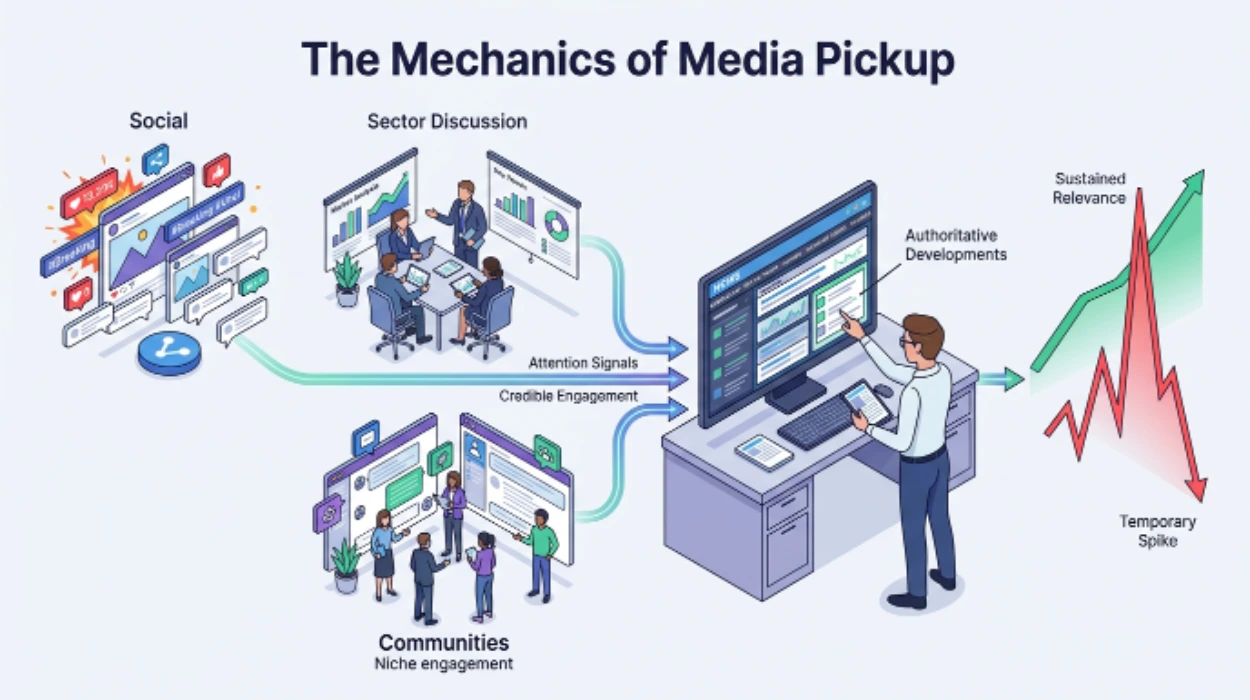
Digital advocacy is a communication framework that operates by mobilising attention around a policy issue, institutional objective, social concern, or public interest topic. The mechanism uses digital platforms to increase discussion volume, stakeholder participation, and narrative visibility.
Social platforms generate attention signals by facilitating rapid information dissemination. Journalists monitor these environments to identify emerging topics, stakeholder sentiment, and public discourse trends. Increased visibility can elevate media interest and improve pickup likelihood. The limitation involves volatility because attention cycles shift rapidly.
Professional networks generate credibility-oriented engagement. The mechanism focuses on expert commentary, institutional analysis, and sector discussion. Media professionals often use these channels to identify authoritative voices and emerging developments. This contributes to stronger trust-based pickup opportunities.
Issue-focused digital communities create concentrated stakeholder engagement. These ecosystems operate through topic-specific discussion and audience participation. Journalists frequently analyse these environments to identify narrative trends and stakeholder concerns.
The effectiveness of digital advocacy channels depends on their ability to generate sustained relevance rather than temporary attention spikes. Media pickups increase when advocacy activity produces measurable stakeholder engagement, credible discussion, and evidence of public interest.
How does reactive communication compare with proactive distribution strategies?
Proactive distribution generates more predictable media pickup outcomes than reactive communication.
Reactive communication is a response-oriented framework. It operates by addressing developments after an event, controversy, policy change, or reputational challenge emerges. The mechanism prioritises speed, clarification, and narrative correction. Media pickups occur because journalists seek responses to existing developments.
Proactive distribution is a planned communication strategy. It operates by introducing information before external events dictate narrative direction. The mechanism focuses on agenda setting, issue framing, and visibility management. Media pickups emerge from deliberate content placement rather than external pressure.
Reactive communication often achieves immediate visibility because media demand already exists. However, narrative control remains constrained by external circumstances. Coverage tends to focus on the triggering event rather than broader institutional objectives. Risk exposure increases because message timing depends on external developments.
Proactive distribution provides greater narrative control and strategic consistency. Stakeholder perception develops through repeated exposure to defined themes and messages. Reputation signals strengthen because communication activity aligns with long-term visibility objectives.
When evaluated against sustainability metrics, proactive approaches support stronger institutional credibility. Reactive approaches remain necessary for issue management but perform less effectively as standalone visibility strategies.
Which approach supports long-term institutional credibility most effectively?
Long-term institutional credibility depends on integrated visibility, authority development, and stakeholder trust mechanisms.
Institutional credibility is the perceived reliability, competence, and legitimacy of an organisation or public entity. It develops through consistent information quality, transparent communication, and sustained external validation.
Short-term visibility strategies focus on immediate media exposure. These approaches operate through campaign-driven activity, rapid content distribution, and concentrated attention generation. Media pickups increase quickly, but authority accumulation remains limited when visibility lacks continuity.
Long-term credibility strategies operate through ongoing stakeholder engagement, earned media development, thought leadership publication, and authority-building content ecosystems. The mechanism emphasises consistency rather than volume. Reputation signals strengthen as audiences encounter recurring evidence of expertise and reliability.
Comparative analysis shows that short-term visibility improves awareness metrics, while long-term credibility improves trust metrics. Search engines reinforce this distinction because authority develops through accumulated references, semantic relevance, and sustained recognition.
Institutional resilience increases when communication strategies prioritise credibility development alongside visibility expansion. Media pickups become one indicator within a broader trust ecosystem rather than the sole measurement of success.
How should media pickup effectiveness be evaluated across distribution channels?
Media pickup effectiveness is measured through visibility quality, authority transfer, stakeholder trust, and narrative influence rather than publication volume alone.
Evaluation frameworks operate by analysing outcomes instead of distribution activity. A comprehensive assessment examines both quantitative and qualitative indicators.
Key evaluation mechanisms include:
- Measure editorial adoption rates to determine whether journalists independently publish and interpret information.
- Analyse authority transfer by identifying references from established media entities and sector publications.
- Evaluate sentiment distribution to understand how narratives spread across digital ecosystems.
- Assess search ranking influence by examining visibility changes for priority topics and entities.
- Compare stakeholder engagement patterns to identify trust development and audience response.
- Examine narrative visibility to determine whether coverage reinforces intended themes or introduces competing interpretations.
Volume-based measurement identifies reach but does not explain credibility outcomes. Authority-based measurement evaluates trust transfer but does not capture total exposure. Narrative-based measurement explains how information influences public discourse and stakeholder perception.
The most effective assessment frameworks combine all three perspectives. This approach provides a more accurate understanding of how distribution channels influence visibility, reputation signals, and institutional credibility across interconnected digital environments.
Conclusion
Distribution channels generate media pickups through distinct mechanisms that influence visibility, authority, and stakeholder trust in different ways. Newswire distribution excels in scale and content amplification, while journalist outreach produces stronger editorial validation and entity credibility. Owned media supports long-term authority accumulation, whereas earned media strengthens external trust signals through independent publication.
Digital advocacy channels contribute to media pickup performance by increasing narrative visibility and stakeholder engagement. Proactive communication frameworks provide greater control and sustainability than reactive approaches, while long-term credibility strategies outperform short-term visibility tactics in institutional trust development.
The most effective evaluation framework compares media pickups through authority transfer, search ranking influence, sentiment distribution, stakeholder trust, and narrative visibility. Media pickup volume remains an important metric, but comprehensive analysis requires assessment of credibility, sustainability, and reputational impact across the wider digital ecosystem.
Within broader communication ecosystems, concepts explored in How Earned Media Influences Consumer Purchase Decisions provide context for understanding trust formation and credibility transfer. Similarly, evaluation of distribution effectiveness connects to operational considerations examined in PR Distribution Solutions for Startups, Scaleups and Enterprise Brands.