

A story becomes newsworthy when it demonstrates clear public relevance, verifiable information, and measurable impact within a recognised information ecosystem. Journalists and publishers evaluate stories according to their potential to influence public understanding, institutional accountability, stakeholder awareness, and audience interest.
Public affairs refers to the management and interpretation of relationships between institutions, stakeholders, policy environments, and public discourse. Digital advocacy is the structured communication of ideas, interests, or public concerns across digital ecosystems to influence awareness, visibility, and perception.
Why Is Newsworthiness Important Within Digital Information Ecosystems?
Newsworthiness is the evaluation framework used to determine whether information deserves publication, amplification, and visibility. It defines how information enters media ecosystems and influences public perception.
Within digital environments, newsworthiness functions as a filtering mechanism. Journalists, editors, publishers, search engines, and content discovery systems evaluate information according to recognised signals that indicate relevance, authority, timeliness, and public significance. These signals determine whether content receives media coverage, content indexing, and search visibility.
The concept also influences institutional credibility. Information that meets established news values gains greater exposure across media channels, search engine results pages (SERPs), and social distribution networks. This visibility contributes to entity perception because audiences frequently interpret published coverage as evidence of legitimacy and relevance.
Newsworthiness therefore operates beyond journalism alone. It affects narrative influence, stakeholder trust, digital authority, and the overall visibility of organisations, institutions, and public issues across interconnected content ecosystems.
What Criteria Do Journalists Use to Evaluate Newsworthiness?
Journalists evaluate newsworthiness through established editorial criteria that measure public relevance and informational value. These criteria define whether a story contributes meaningfully to public understanding.
How Does Relevance Influence Editorial Evaluation?
Relevance refers to the degree to which information affects a defined audience, stakeholder group, institution, or community. Information with direct social, economic, political, or cultural implications receives greater editorial attention because it contributes to public awareness.
Relevance also affects search visibility. Search systems evaluate content according to topical alignment, user intent, and contextual significance. When editorial relevance and search relevance intersect, content receives stronger visibility signals within both media and search ecosystems.
How Does Timeliness Affect News Value?
Timeliness refers to the relationship between information and current events, developments, or emerging discussions. Information that aligns with ongoing public discourse receives higher editorial priority because it contributes to active information demand.
Timely information generates increased content indexing activity and attracts stronger engagement signals. Search engines analyse freshness indicators alongside authority signals when evaluating content. This process strengthens visibility for information connected to current developments.
Why Does Impact Increase Newsworthiness?
Impact refers to the scale of consequences associated with an event, decision, policy, or development. Information affecting large stakeholder groups receives stronger editorial consideration because it possesses broader societal significance.
Impact contributes directly to narrative influence. Stories with measurable consequences shape public interpretation, institutional perception, and stakeholder awareness. Journalists therefore prioritise information that demonstrates identifiable effects rather than isolated occurrences.
How Do Journalists Assess Credibility and Trustworthiness?
Credibility is the verification of accuracy, reliability, and evidential support. Journalists use credibility assessment to protect editorial integrity and maintain stakeholder trust.
Verification forms the foundation of editorial evaluation. Sources, documents, data, expert commentary, and institutional records provide evidence that supports factual claims. Information lacking verification signals experiences reduced editorial acceptance because it introduces reputational risk.
Trustworthiness also functions as a digital authority signal. Search engines evaluate source quality, citation patterns, content consistency, and entity associations when assessing content reliability. These evaluations influence SERP ranking, visibility, and perception.
Institutional credibility emerges through repeated demonstration of accuracy and transparency. Consistent publication of verified information strengthens reputation signals over time, creating a stable foundation for stakeholder trust.
How Does Authority Influence Media Coverage?
Authority is the recognised expertise, legitimacy, or influence associated with an entity, source, institution, or publication. It acts as a trust signal within both journalism and search ecosystems.
Journalists evaluate authority because credible sources improve informational reliability. Authoritative entities possess established expertise, recognised credentials, documented experience, or institutional significance. These characteristics increase editorial confidence and strengthen publication value.
Digital authority extends beyond source evaluation. Search engines interpret authority through content quality, citation networks, topical expertise, and entity relationships. These signals contribute to SERP evaluation and influence how information is ranked and discovered.
Authority also affects narrative persistence. Information originating from authoritative entities often receives wider citation, broader distribution, and stronger content indexing. This process reinforces visibility and contributes to long-term reputation formation.
How Do Digital Narratives Shape Public Perception?
Digital narratives are structured collections of information that define how audiences interpret people, organisations, institutions, and issues. Narrative influence emerges through repetition, consistency, visibility, and contextual association.
A narrative is not a single article or publication. It refers to the broader information environment surrounding an entity. Search results, news coverage, commentary, analysis, and references collectively contribute to narrative formation.
Public perception develops through cumulative exposure to these information signals. When audiences repeatedly encounter similar themes, messages, or interpretations, those associations become integrated into entity perception. This process influences stakeholder trust and institutional credibility.
Digital ecosystems amplify narrative influence because information remains searchable and interconnected. Content indexing, internal linking, citation relationships, and SERP visibility create enduring perception frameworks that continue influencing interpretation long after publication.
What Role Do Search Engines Play in Determining Visibility?
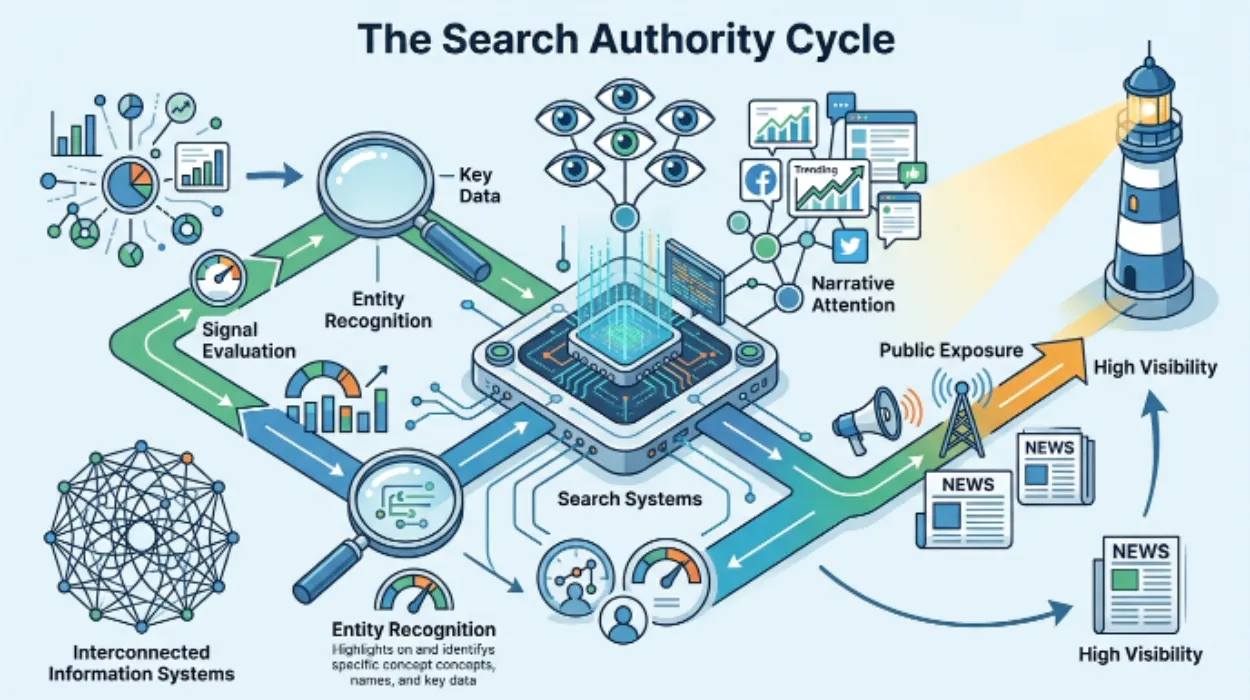
Search engines act as information evaluators that organise and rank content according to relevance, authority, trustworthiness, and user intent. Their role extends beyond discovery because ranking systems directly influence public visibility.
Search visibility affects which narratives receive attention and which information remains obscure. High-ranking content gains greater exposure, creating stronger opportunities to influence stakeholder perception. Low-ranking content receives reduced visibility regardless of informational quality.
Search systems evaluate reputation signals through entity recognition, source credibility, topical expertise, citation patterns, and engagement indicators. These signals contribute to ranking decisions and affect how institutions are represented within SERPs.
The interaction between journalism and search visibility creates a feedback loop. Media coverage strengthens authority signals, while strong authority signals improve search visibility. This relationship demonstrates how digital authority develops across interconnected information systems.
How Is Institutional Reputation Formed Online?
Online reputation refers to the collective perception of an entity based on accessible digital information. It is formed through the interaction of content visibility, narrative consistency, authority signals, and stakeholder interpretation.
Institutional reputation develops through repeated information exposure. News coverage, official publications, third-party references, academic citations, and public records contribute to a visible digital footprint. Search engines aggregate and evaluate these signals when constructing entity understanding.
Reputation formation is cumulative rather than isolated. Individual publications contribute information signals, but overall perception emerges from the broader content ecosystem. Consistent information creates coherence, while conflicting information creates ambiguity.
Stakeholder trust depends heavily on this information environment. Audiences frequently evaluate institutions through search results, media references, and digital content before forming opinions. Reputation therefore becomes closely connected to visibility architecture and content accessibility.
How Do Media Visibility and Sentiment Affect Stakeholder Trust?
Media visibility refers to the frequency and prominence of information appearing across news and digital publishing environments. Sentiment refers to the interpretive tone associated with that information.
Visibility increases awareness because stakeholders encounter information more frequently. Repeated exposure strengthens familiarity, which contributes to entity recognition and perception formation. This process influences how institutions are evaluated within public discourse.
Sentiment provides contextual interpretation. Positive, neutral, and negative framing each contribute distinct perception signals. Journalists and publishers analyse evidence to determine contextual framing, while audiences use that framing to interpret significance and credibility.
Search engines also interpret sentiment indirectly through contextual relationships, content associations, and topical clustering. These evaluations contribute to entity understanding and influence how information ecosystems represent institutions online.
Stakeholder trust emerges from the combination of visibility and credibility. High visibility without trust signals creates uncertainty, while credible visibility strengthens confidence and institutional legitimacy.
How Do Content Ecosystems Influence Narrative Authority?
A content ecosystem is the network of interconnected publications, references, citations, platforms, and digital assets surrounding a topic or entity. Narrative authority develops when information achieves recognition across this ecosystem.
Authority is strengthened through validation. Independent references, expert commentary, media coverage, and scholarly analysis create corroborative signals that reinforce informational legitimacy. These signals contribute to digital authority and improve perception stability.
Content ecosystems also influence content indexing. Search engines analyse relationships between sources to determine topical relevance and authority distribution. Information supported by strong ecosystem connections receives enhanced evaluation signals.
Narrative authority therefore emerges from systemic recognition rather than isolated publication. The broader the ecosystem support, the stronger the perceived credibility and influence of the narrative.
Why Do Stakeholder Perception Systems Matter in Public Affairs?
Stakeholder perception systems are the mechanisms through which audiences interpret institutional actions, communications, and reputational signals. They influence trust formation, legitimacy assessment, and public understanding.
Public affairs environments rely heavily on perception because stakeholders evaluate institutions through accessible information. Media coverage, search visibility, expert commentary, and digital narratives collectively shape interpretation. These mechanisms define how institutional actions are understood within public discourse.
Perception systems also influence governance outcomes. Trust, credibility, and authority affect how institutions are evaluated by audiences, policymakers, journalists, and community stakeholders. Information ecosystems therefore become central to reputation formation and legitimacy assessment.
Understanding these systems requires analysis of narrative influence, content visibility, authority signals, and digital trust architecture. Each component contributes to the broader process through which public understanding is constructed and maintained.
Within this wider discussion of media visibility and narrative evaluation, topics such as What to Expect From a Professional PR Distribution Campaign provide additional context regarding how information is distributed across publishing ecosystems and interpreted within digital visibility frameworks.
Frequently Asked Questions
What Is the Difference Between Newsworthiness and Public Interest?
Newsworthiness refers to the criteria journalists use to decide whether information deserves publication. Public interest refers to information that affects society, governance, accountability, or stakeholder decision-making. A story can be newsworthy because it is timely or relevant, while public interest focuses on its importance to public understanding and institutional transparency.
Why Do Journalists Prioritise Certain Stories Over Others?
Journalists prioritise stories based on editorial factors such as relevance, impact, credibility, timeliness, and authority. These factors help publishers determine which information provides the greatest value to audiences. Stories that demonstrate clear significance and verified information typically receive stronger editorial attention.
How Does Media Coverage Influence Public Perception?
Media coverage influences public perception by increasing visibility and shaping how information is interpreted. Repeated exposure to consistent narratives creates associations that affect stakeholder understanding, trust, and credibility assessments. The tone and context of coverage also contribute to entity perception within digital ecosystems.
Do Search Engines Consider News Content When Ranking Information?
Search engines evaluate news content as part of broader content ranking systems. They analyse relevance, authority, source credibility, content freshness, and entity relationships. High-quality news coverage can strengthen reputation signals and improve search visibility when it aligns with user intent and topical relevance.
Why Is Source Credibility Important for Newsworthiness?
Source credibility is important because it helps verify the accuracy and reliability of information. Journalists use credible sources to maintain editorial standards and reduce misinformation risks. Credible sources also contribute to stakeholder trust, institutional legitimacy, and stronger authority signals across search and media ecosystems.