

A professional PR distribution campaign is a structured communication process that distributes news, announcements, and institutional narratives across media ecosystems to influence visibility, credibility, and stakeholder awareness.
Public affairs strategies differ based on communication objectives, stakeholder expectations, and reputation requirements. Digital advocacy methods are evaluated through visibility outcomes, authority signals, sentiment distribution, and long-term stakeholder trust.
How Does a Professional PR Distribution Campaign Operate Within Digital Media Ecosystems?
A professional PR distribution campaign is a media relations process that distributes information to journalists, publishers, news platforms, industry publications, and digital information networks. The campaign operates by connecting a news asset with relevant media entities through targeted distribution mechanisms. Distribution is measured through publication reach, citation frequency, narrative visibility, and reputation signals generated across digital channels. Search engines interpret published media coverage as authority indicators when reputable sources reference an organisation, institution, or public initiative. The campaign therefore influences both media exposure and search ranking influence through content amplification.
Traditional media distribution and digital-first distribution represent two distinct operational approaches. Traditional distribution focuses on established journalist networks and editorial gatekeeping processes. Digital-first distribution expands dissemination through online publishers, syndicated content networks, and search-visible news platforms. Traditional approaches often generate stronger entity credibility due to editorial scrutiny, while digital-first models create broader narrative visibility across larger information environments. The evaluation of effectiveness depends on whether the objective prioritises credibility concentration or visibility scale.
Campaign performance also depends on publication relevance rather than publication volume. A smaller number of authoritative placements often generates stronger stakeholder trust than widespread distribution across low-authority domains. Search engines evaluate source quality, topical relevance, and entity relationships when interpreting media references. This evaluation process affects long-term reputation signals and institutional visibility.
Which Distribution Approaches Generate Stronger Visibility Outcomes?
Targeted media distribution generates stronger relevance signals, while mass distribution generates broader exposure metrics. Targeted distribution is a selective process that identifies publishers, journalists, and media outlets aligned with a specific topic or stakeholder group. Mass distribution operates by disseminating content across extensive publication networks regardless of audience specificity. Both approaches influence visibility, but they produce different outcomes in stakeholder perception and search ecosystem performance.
Targeted distribution strengthens narrative alignment because content reaches audiences already engaged with the subject matter. Journalists covering specialised sectors often provide contextual reporting that reinforces entity credibility. This mechanism improves sentiment distribution because stakeholders encounter information within trusted editorial environments. Visibility remains concentrated, but credibility indicators become stronger and more sustainable.
Mass distribution expands reach through content amplification across numerous digital platforms. The approach increases publication frequency and broadens SERP composition by generating multiple indexed references. However, visibility expansion does not automatically improve stakeholder trust. Repetitive syndication can reduce editorial uniqueness and weaken authority signals when identical content appears across low-value domains. The approach therefore delivers scale advantages but introduces limitations in credibility development.
From an evaluation perspective, targeted distribution performs strongly in trust generation and stakeholder engagement. Mass distribution performs strongly in reach expansion and narrative saturation. The most appropriate framework depends on whether the communication objective prioritises credibility depth or visibility breadth.
How Does Media Relations Compare With Automated Distribution Networks?
Media relations is a relationship-based communication approach, whereas automated distribution networks are technology-driven dissemination systems. Media relations operates by engaging journalists, editors, and publishers through relevance, editorial value, and subject expertise. Automated distribution networks operate by distributing content simultaneously across pre-established publishing infrastructures. Both approaches contribute to visibility, but their mechanisms differ significantly.
Media relations creates opportunities for independent editorial coverage. Journalists evaluate information according to news value, audience relevance, and institutional significance. Editorial interpretation often generates unique content that expands narrative visibility beyond the original announcement. Search engines frequently interpret these independent references as stronger authority indicators because they represent third-party validation rather than direct distribution.
Automated distribution networks prioritise efficiency and distribution scale. The mechanism increases publication speed and expands content availability across multiple domains. Visibility metrics often increase rapidly because the information appears in numerous locations simultaneously. However, editorial engagement remains limited because content frequently retains identical formatting and messaging. This reduces differentiation and can weaken long-term entity credibility compared with independently produced coverage.
Risk exposure also differs between the two approaches. Media relations requires greater planning and message precision because journalists can independently evaluate and challenge information. Automated distribution provides greater message consistency but creates dependency on distribution infrastructure rather than editorial endorsement. The comparison demonstrates that media relations strengthens trust signals, while automated systems strengthen distribution efficiency.
How Do Newsworthiness Standards Influence Campaign Effectiveness?
Newsworthiness standards determine whether information receives editorial attention and sustained visibility. A professional PR distribution campaign depends on the ability to align information with recognised media evaluation criteria. Newsworthiness is a content assessment framework that measures relevance, timeliness, impact, significance, and audience interest. The concept operates by helping journalists prioritise information within competitive media environments.
Campaigns built around strong newsworthiness indicators generate higher publication quality because journalists identify clear editorial value. Coverage arising from editorial interest often creates stronger stakeholder trust than coverage generated through distribution volume alone. This mechanism improves reputation signals and reinforces institutional credibility across information ecosystems.
Campaigns lacking newsworthiness often rely heavily on content amplification without achieving meaningful editorial engagement. Distribution may increase publication counts, yet narrative visibility remains weak because audience interest remains limited. Search engines increasingly evaluate engagement signals, contextual relevance, and authority relationships, making editorial quality an important factor in visibility sustainability.
The evaluation of campaign effectiveness therefore requires an understanding of What Makes a Story Newsworthy to Journalists and Publishers. Newsworthiness functions as a gateway mechanism that influences publication acceptance, media visibility, and authority generation. Strong distribution infrastructure cannot compensate for weak editorial relevance because the underlying narrative lacks sufficient value for independent amplification.
How Does Organic Communication Compare With Reactive Communication Frameworks?
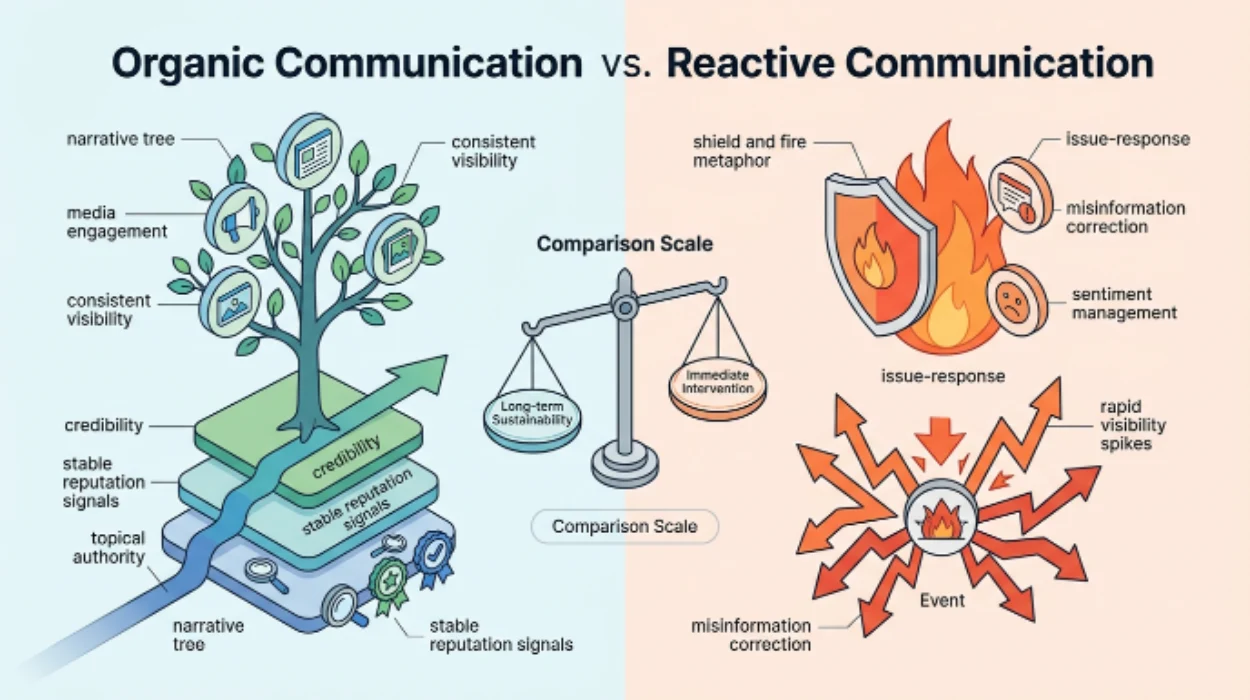
Organic communication is a proactive visibility strategy, while reactive communication is an issue-response framework. Organic communication operates through planned narrative development, consistent media engagement, and long-term authority building. Reactive communication operates by responding to events, criticism, emerging risks, or public scrutiny. Both frameworks influence reputation outcomes, but they differ in sustainability and risk exposure.
Organic communication strengthens institutional credibility because information appears consistently across trusted channels over extended periods. Repeated visibility creates stable reputation signals and reinforces stakeholder familiarity. Search engines interpret ongoing publication activity as evidence of topical authority, supporting stronger search ranking influence and entity recognition.
Reactive communication addresses immediate narrative challenges. The framework focuses on correcting misinformation, responding to stakeholder concerns, and managing sentiment distribution during periods of heightened scrutiny. Narrative visibility often increases rapidly because stakeholder attention intensifies around specific events. However, visibility generated through reactive activity remains dependent on external developments rather than strategic planning.
The comparison reveals different strengths. Organic communication delivers long-term sustainability and authority accumulation. Reactive communication delivers immediate narrative intervention and issue containment. Evaluation criteria therefore include duration of impact, stakeholder trust preservation, and exposure to reputational volatility.
Which Strategy Better Supports Institutional Credibility: Content Amplification or Content Suppression?
Content amplification increases visibility of preferred narratives, whereas content suppression reduces visibility of unwanted narratives. Both approaches seek to influence information landscapes, but their mechanisms and outcomes differ substantially. Content amplification operates by expanding publication reach, increasing authoritative references, and strengthening positive reputation signals. Content suppression operates by limiting exposure, reducing discoverability, or displacing negative information through competing content.
Content amplification supports institutional credibility when authoritative sources independently reference relevant information. Positive narrative visibility becomes embedded within search ecosystems through citations, media mentions, and topical associations. Search engines interpret these patterns as authority indicators because multiple trusted entities validate similar information. Stakeholder trust often increases when transparency and visibility remain consistent.
Content suppression focuses on reducing the prominence of unfavourable narratives. The mechanism influences SERP composition by introducing alternative content assets or increasing the visibility of more relevant information. While suppression can reduce exposure to harmful narratives, it does not inherently strengthen entity credibility. The approach addresses discoverability rather than trust generation.
From a strategic perspective, content amplification contributes directly to reputation signal development. Content suppression contributes indirectly by managing information prominence. Institutional credibility is therefore more closely associated with amplification frameworks because they generate observable evidence of authority and relevance.
How Should Campaign Effectiveness Be Evaluated Across Visibility and Trust Metrics?
Campaign effectiveness is measured through visibility indicators, credibility indicators, and stakeholder response indicators. Visibility metrics assess publication reach, search presence, referral traffic patterns, and narrative exposure. Credibility metrics assess source authority, editorial quality, and third-party validation. Stakeholder metrics assess engagement patterns, sentiment distribution, and trust outcomes.
A structured evaluation framework includes the following actions:
- Measure publication authority by analysing the credibility and topical relevance of media placements.
- Assess search ranking influence by tracking how media references contribute to SERP composition and entity recognition.
- Evaluate sentiment distribution by examining the balance of positive, neutral, and negative narrative visibility.
- Analyse stakeholder trust by reviewing engagement quality, reference frequency, and audience interaction patterns.
- Compare narrative persistence by measuring how long campaign-generated visibility remains discoverable within search ecosystems.
Visibility alone does not indicate campaign success. High publication volume can coexist with weak authority signals. Similarly, limited publication volume can generate strong institutional credibility when coverage originates from trusted sources. Effective evaluation therefore requires a combined analysis of reach, trust, authority, and sustainability.
The assessment process also informs decision-making when organisations evaluate future communication frameworks. Factors examined during this stage often overlap with considerations explored in Looking for a PR Distribution Partner? What Brands Should Evaluate First, particularly when analysing distribution quality, media relevance, and authority outcomes. The focus remains on evaluation criteria rather than promotional selection.
What Are the Long-Term Limitations and Sustainability Considerations of PR Distribution Campaigns?
PR distribution campaigns create measurable visibility outcomes, but sustainability depends on underlying communication quality. Distribution is a visibility mechanism rather than a credibility guarantee. Campaigns achieve stronger long-term outcomes when narrative relevance, stakeholder value, and editorial quality remain consistent. Sustainability therefore depends on strategic alignment rather than publication frequency alone.
One limitation involves diminishing returns from repetitive content distribution. Repeated dissemination of similar information can reduce editorial interest and weaken engagement performance. Search ecosystems increasingly prioritise originality, relevance, and contextual value, making differentiation essential for sustained visibility. Campaigns that rely exclusively on volume-based amplification often experience declining authority impact over time.
Another limitation involves dependency on media attention cycles. Visibility generated through news publication can decline rapidly when stakeholder interest shifts. Long-term institutional credibility requires ongoing evidence of expertise, transparency, and relevance beyond individual campaigns. Distribution supports these objectives, but it does not replace broader reputation management frameworks.
Scalability also introduces governance considerations. Expanding distribution activity increases visibility opportunities but also increases scrutiny exposure. Information accuracy, message consistency, and stakeholder alignment become critical components of risk management. Sustainable communication strategies therefore integrate visibility objectives with credibility maintenance and stakeholder trust preservation.
Conclusion
A professional PR distribution campaign functions as a structured visibility mechanism that connects institutional narratives with media ecosystems, search environments, and stakeholder audiences. Different approaches produce different outcomes. Targeted distribution strengthens relevance and credibility, while mass distribution expands reach. Media relations generates stronger editorial validation, while automated distribution increases dissemination efficiency. Organic communication supports long-term authority development, while reactive communication addresses immediate reputation challenges.
The evaluation of campaign effectiveness depends on visibility quality rather than visibility volume alone. Authority signals, stakeholder trust, sentiment distribution, and search ranking influence provide deeper indicators of performance than publication counts. Long-term sustainability relies on editorial relevance, narrative quality, and institutional credibility rather than distribution scale in isolation. A comprehensive assessment therefore compares mechanisms, limitations, risk exposure, and trust outcomes across the entire communication framework.