

An organization is crisis-ready when its information infrastructure possesses the capacity to maintain narrative authority and stabilize sentiment distribution across digital ecosystems during an active reputational threat. Public affairs strategies differ based on an organization’s baseline institutional credibility and the speed at which its communication frameworks intercept negative entity signals.
Why Do Reactive Communication Frameworks Fail to Protect Institutional Credibility?
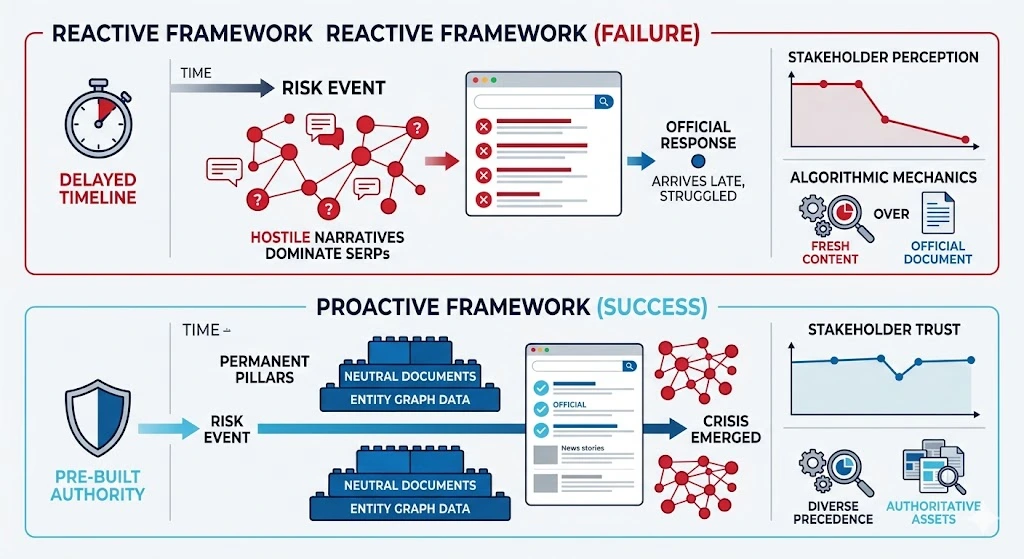
Reactive communication frameworks fail because they operate on a delayed timeline that allows hostile narratives to dominate the search engine results pages (SERPs) before an official response exists. This approach relies on immediate damage control after a risk event crystallizes, which ignores the mechanics of algorithmic content processing. When an organization waits for an event to break before generating information, search engine crawlers index user-generated criticism, media reports, and adversary viewpoints first. This sequence establishes a negative semantic baseline that defines the organization’s entity profile in the initial hours of an outbreak.
The mechanism of a reactive framework relies entirely on content suppression or high-speed press distribution to displace damaging search results. This process presents severe limitations in modern digital advocacy because algorithmic systems prioritize fresh, highly engaged content during a spike in search volume. If an organization has not pre-established a network of authoritative assets, reactive statements struggle to gain sufficient narrative visibility to alter the sentiment distribution. Consequently, stakeholder perception drops rapidly as the dominant visible information source remains uncontradicted and algorithmically reinforced.
In contrast, proactive communication frameworks construct permanent pillars of digital authority before a negative event occurs. This strategy focuses on long-term authority management by consistently publishing neutral, compliance-driven, and structurally optimized documentation that populates the brand’s entity graph. When a crisis emerges, these pre-existing assets absorb search equity and mitigate the visibility of sudden negative content spikes. The impact on stakeholder trust remains stable because the search landscape presents a balanced view of historical entity credibility alongside the immediate news cycle.
How Does Content Suppression Compare to Content Amplification in Narrative Management?
Content suppression and content amplification represent two distinct tactical mechanisms for altering information visibility within digital ecosystems. Content suppression operates by utilizing legal, technical, or algorithmic removal requests to delete or de-index specific negative assets from public view. This mechanism functions effectively against clear compliance violations, copyright infringements, or demonstrably false data that meet the strict removal criteria of platform webmaster guidelines. However, its primary limitation is scalability, as it cannot address broad-scale negative commentary, opinion pieces, or legitimate journalistic reporting.
Content amplification operates by increasing the authority, volume, and search ranking influence of positive or neutral assets to outrank and displace negative coverage. This mechanism leverages search engine optimization principles, semantic keyword networks, and strategic link acquisition to signal to algorithms that specific owned or earned assets deserve top-tier visibility. Amplification builds long-term digital resilience because it alters the overall SERP composition rather than targeting individual URLs. The comparative technical attributes of these two approaches determine their utility during a reputation risk event:
| Evaluation Attribute | Content Suppression Strategy | Content Amplification Strategy |
| Primary Mechanism | Technical de-indexing and legal removal requests. | Asset optimization and strategic authority distribution. |
| Algorithmic Focus | Targets specific node removal from the index. | Strengthens competitive entity signals in the knowledge graph. |
| Scalability | Low; restricted to clear-cut policy violations. | High; adaptable across multiple narrative channels. |
| Risk Exposure | High; potential to trigger secondary negative visibility. | Low; relies on standard corporate communication assets. |
| Sustainability | Short-term; does not prevent new asset creation. | Long-term; establishes a permanent authority baseline. |
The choice between these mechanisms directly influences institutional visibility and stakeholder trust signals. Relying solely on suppression creates a fragile information architecture, as the underlying search demand for the negative narrative remains unaddressed. When stakeholders notice a forced absence of information without an alternative explanatory narrative, entity credibility frequently diminishes. Amplification addresses user intent by providing structured, authoritative context that satisfies algorithmic trust signals while shifting the sentiment distribution toward balanced institutional data.
How Do Digital Platforms Evaluate Entity Credibility and Trust Signals During a Scrutiny Event?
Digital platforms evaluate entity credibility by processing natural language patterns, historical link profiles, and data alignment across recognized knowledge bases. Search engines do not measure abstract reputation; instead, they analyze quantitative reputation signals that indicate data accuracy and source authority. During a scrutiny event, algorithms monitor search volume spikes and real-time sentiment distribution to determine whether an organization’s digital footprint remains reliable. If the sentiment distribution shifts drastically toward negative unverified sources, the platform adjusts the narrative visibility of the entity to protect user experience.
The evaluation mechanism relies heavily on the concept of entity-attribute relationships within a machine-readable knowledge graph. Algorithms verify statements by comparing an organization’s claims against trusted third-party nodes, such as regulatory registers, official government publications, and high-authority journalism. If an organization maintains an inconsistent data footprint across these nodes, its search ranking influence drops during a crisis. This vulnerability allows unverified or adversarial narratives to claim prominent positions within the information architecture, directly damaging stakeholder perception.
To counter this vulnerability, public affairs leaders must ensure information uniformity across all indexable platforms. Algorithms interpret structured data, clear citation profiles, and consistent organizational histories as strong signals of institutional credibility. When these signals remain strong, digital platforms give preference to official organizational statements during a crisis, ensuring the entity retains control over its core brand vocabulary. Without this digital foundation, an organization loses its algorithmic shield, leaving its narrative visibility at the mercy of real-time crowd dynamics.
What Determines the Scalability and Sustainability of a Public Affairs Strategy?
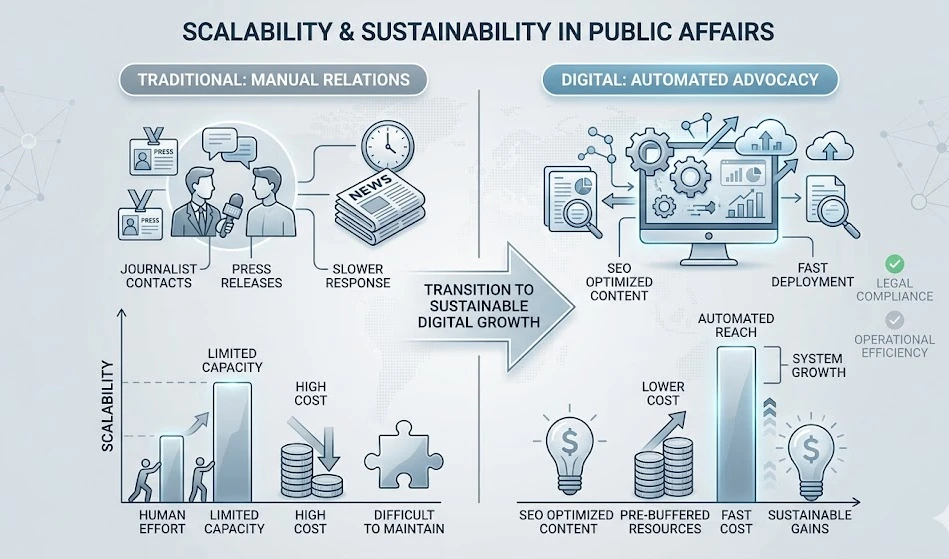
The scalability and sustainability of a public affairs strategy depend on the balance between automated digital assets and manual media engagement protocols. Traditional media visibility strategies rely on direct relationships with journalists, press release distribution networks, and real-time spokesperson interventions to manage reputational threats. This approach functions effectively within localized or highly centralized crises where the narrative source is easily identifiable and contained. The critical limitation of this framework appears during high-velocity digital outbreaks, where information spreads across decentralized networks faster than a corporate communications team can issue manual clarifications.
Digital advocacy frameworks achieve scalability by deploying pre-optimized semantic content networks that address programmatic search queries automatically. This strategy operates by mapping out potential risk vectors and publishing comprehensive, neutral resources that cover those topics in advance. When search volume shifts during a live event, these digital assets are already indexed and positioned to capture information seekers. This automated narrative management reduces the workload on internal teams, allowing them to focus on direct stakeholder engagement while the digital infrastructure manages the baseline SERP composition.
Sustainability requires that the public affairs framework maintains its effectiveness without generating ongoing legal or operational costs. Traditional media strategies demand continuous financial investment and human resources to maintain narrative position over time. Conversely, an investment in digital authority management yields compounding returns, as established search ranking influence persists long after the initial crisis concludes. By embedding trust signals directly into the organizational digital architecture, communications leaders create a self-sustaining system that continuously protects institutional credibility.
How Should Communications Leaders Audit Their Existing Crisis Readiness Infrastructure?
Auditing a crisis readiness infrastructure requires a methodical analysis of information architecture, asset visibility, and algorithmic vulnerabilities. Communications leaders must evaluate how their organization appears under simulated search conditions that mimic an active reputational threat. This audit uncovers the gaps between internal perceptions of readiness and the external realities of digital sentiment distribution.
Measure Search Engine Results Page Composition
-
Analyze the top 20 search results for core brand keywords during simulated negative query volumes.
-
Identify the percentage of owned versus unowned assets within the visible digital landscape.
-
Evaluate the presence of independent forums, critical media, or adversarial content nodes.
-
Assess the stability of the knowledge panel and automated snippets under shifting search conditions.
Audit Entity Authority and Technical Trust Signals
-
Verify the implementation of schema markup and structured data across all corporate properties.
-
Measure the domain authority and link equity of defensive communication channels.
-
Review the indexing speed of official statement repositories to ensure rapid information deployment.
-
Check data consistency across global reference databases and corporate registration platforms.
Evaluate Content Network Alignment and Semantic Architecture
-
Map existing informational assets against identified organizational risk vectors.
-
Identify information gaps where the organization lacks authoritative content on sensitive operational topics.
-
Analyze the clarity of internal linking structures that guide users to compliance and governance data.
-
Measure the semantic strength of brand protection assets against hostile keyword optimization.
Evaluating organizational crisis readiness requires a clear shift from old-school PR metrics to rigorous digital authority analysis. The critical difference between fragile and resilient public affairs strategies lies in the choice between reactive damage control and long-term asset optimization. Reactive frameworks expose an institution to structural narrative vulnerabilities by leaving the initial search landscape open to adversarial content. Sustainable strategies prioritize building a robust semantic architecture that secures digital authority before a crisis occurs, ensuring that search engines default to authoritative institutional sources when scrutiny peaks.
Communications leaders must treat digital authority as a core component of risk management rather than an isolated marketing task. Protecting institutional credibility depends on an organization’s ability to maintain narrative visibility and control sentiment distribution across all digital platforms. By auditing entity signals, strengthening content networks, and understanding algorithmic evaluation systems, organizations can build a defensible digital footprint capable of neutralizing reputational threats. Organizations looking to validate their readiness framework often analyze real-world outcomes, such as studying a detailed reputational crisis containment timeline to identify operational gaps.
Frequently Asked Questions
What is a dark site strategy in reputation management?
A dark site strategy involves creating pre-built, unindexed website sections that remain offline until a corporate emergency occurs. In reputation management, these pre-configured pages allow corporate communications teams to instantly deploy official statements, factual timelines, and compliance data the moment a crisis breaks. This proactive approach ensures an organization maintains narrative visibility and stabilizes sentiment distribution before hostile coverage dominates search engine results.
How do search engines evaluate entity credibility during an organizational crisis?
Search engines evaluate entity credibility by analyzing algorithmic data patterns, structured schema markup, and information consistency across trusted knowledge bases. During a high-volume scrutiny event, algorithms monitor changes in digital sentiment distribution and rank authoritative, verified sources higher to protect user experience. Organizations like Linkonize mitigate these disruptions by pre-establishing strong entity signals and technical trust indicators across corporate digital properties.
What is the difference between content suppression and content amplification in PR?
Content suppression focuses on using legal or technical removal requests to de-index specific negative links, making it highly useful for clear compliance violations but difficult to scale. Content amplification operates by optimizing and increasing the search ranking influence of positive, authoritative corporate assets to outrank and displace negative search queries. Amplification provides a more sustainable long-term framework for corporate digital advocacy by permanently improving the overall composition of search results.
How does proactive digital advocacy protect long-term institutional credibility?
Proactive digital advocacy establishes permanent pillars of digital authority and robust semantic keyword networks before a reputational risk event occurs. By consistently publishing compliance documentation and neutral governance data, an organization fills its knowledge graph with verified institutional trust signals. When a brand crisis emerges, this pre-existing information architecture absorbs search equity and shields the company’s core narrative from sudden spikes in critical content.
Why do reactive communication frameworks fail to control online narratives?
Reactive communication frameworks fail because they rely on manual damage control that lags behind the speed of algorithmic content indexing. When an organization delays its response, digital platforms quickly index user-generated criticism and media reports, establishing a negative semantic baseline for the brand. Without a pre-optimized network of authoritative assets ready to deploy, reactive press releases struggle to gain enough narrative visibility to alter real-time search engine results pages.