
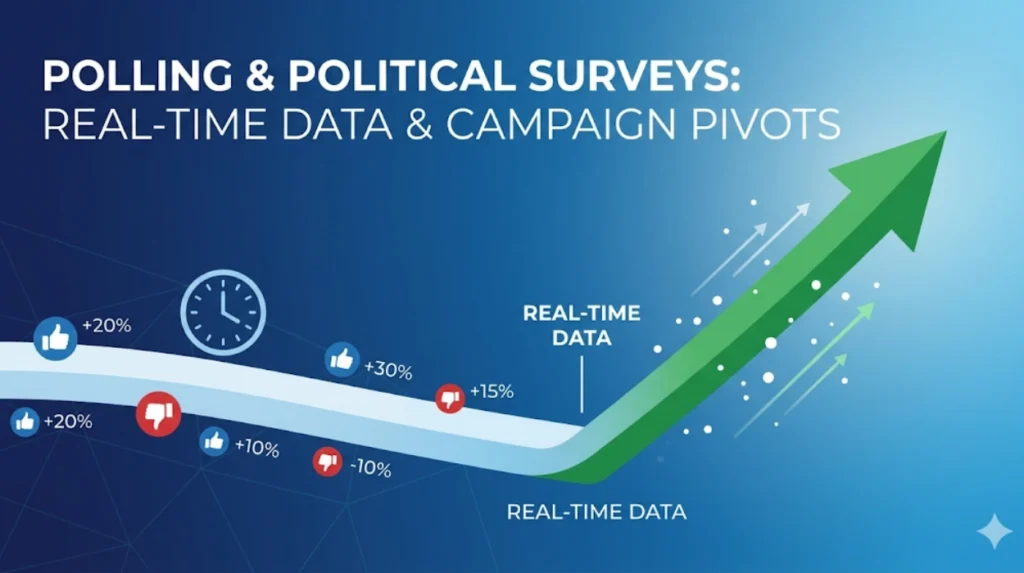
Public affairs refers to the practices by which institutions manage stakeholder perception, regulatory engagement and public policy influence. Digital advocacy is the coordinated use of online channels to shape public debate and policy outcomes. Online reputation refers to the aggregate perception of an entity across search and social ecosystems.
What is real-time sentiment data and how does it enable campaign pivoting?
Real-time sentiment data is structured, timestamped measurement of public sentiment across digital channels that defines trends in attitude and engagement. It refers to aggregated outputs from social listening, quick-turn polling, search trend analysis and automated sentiment classification within digital ecosystems. Mechanistically, real-time sentiment data ingests signals — search query volume, social mentions, poll responses, engagement rates — and maps them to sentiment classifiers and topic taxonomies to produce time-series indicators.
The impact on visibility, credibility and stakeholder trust is direct: high-frequency sentiment shifts alter SERP evaluation by changing topical relevance signals, modify social amplification algorithms through virality metrics, and re-weight reputation signals used by institutional perception models. Campaigns that integrate real-time sentiment data convert latent risk into operational decisions and reallocate communication resources to preserve digital authority.
How do polls and political surveys define stakeholder sentiment online?
Polls and political surveys are quantitative instruments that measure public attitude at discrete intervals and so define a reproducible snapshot of stakeholder sentiment. They refer to structured question sets, sampling frames and weighting procedures within digital and offline collection environments. Mechanistically, surveys translate attitudes into quantified variables (approval scores, intention percentages, issue salience indices) that feed predictive models and sentiment overlays used by digital platforms and analysts.
The impact on institutional perception is through measurable reputation signals: updated poll results alter media visibility when aggregated into narrative frames, shift search visibility by generating news cycles that increase query volume, and influence stakeholder trust when surveys signal legitimacy or decline in public support. Accurate polling informs content indexing priorities and recalibrates message cadence to protect digital authority.
How does real-time polling alter content ranking dynamics in search engines?
Real-time polling alters content ranking dynamics by changing topical relevance, recency and engagement signals that search engines use to evaluate authority. It defines ranking-relevant inputs such as query spikes, newsworthiness metadata and link velocity. Mechanistically, when polling produces new data, publishers generate coverage and analysis; this activity increases query volume and inbound linking for related terms, which causes search algorithms to re-evaluate freshness and relevance for associated pages.
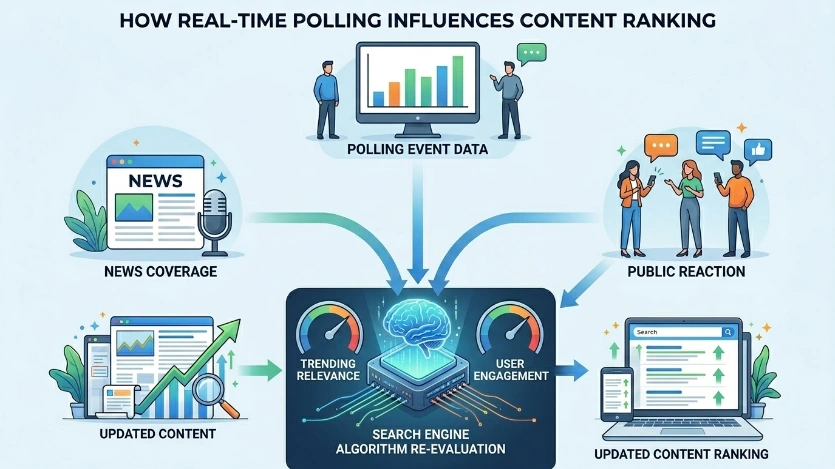
The impact on search visibility is measurable: pages tied to current poll data experience transient indexing priority and elevated SERP placement, which alters the entity perception narrative presented to stakeholders. Campaigns that ignore these dynamics lose opportunities to correct misperceptions and to re-establish narrative control within SERP evaluation.
How do algorithms interpret authority, trust and credibility signals from polling data?
Algorithms interpret authority, trust and credibility signals by correlating data provenance, engagement metrics and contextual associations to produce entity-level trust scores. Polling data is a provenance signal when it cites methodology, sample integrity and reputable sponsors; it is an engagement signal when it triggers amplification across social and news ecosystems. Mechanistically, algorithmic models parse structured metadata (publisher domain authority, citation patterns), unstructured text (methodology sections, disclaimers) and behavioural metrics (click-through rates, dwell time, share rates) to produce composite credibility assessments.
The impact on institutional credibility is structural: high-quality, transparent polling increases digital authority by generating reliable backlinks, authoritative citations and improved content indexing; conversely, opaque or low-quality polls degrade reputation signals and reduce stakeholder trust through diminished SERP weight and weaker media visibility.
How do digital narratives created from polling influence public perception systems?
Digital narratives created from polling influence public perception systems by supplying causal frames, salience hierarchies and sentiment anchors that shape downstream interpretation. A narrative is an organised storyline that links data points to explanations, attributions and recommended actions within discourse networks. Mechanistically, narratives constructed from polling data spread via publishers, social influencers and search results; the framing language, repeated motifs and metadata tags reinforce thematic indexes that content ecosystems use for topic clustering.
The impact on stakeholder perception is systemic: narratives alter entity perception by shifting attention to particular issues, recalibrating reputation signals and changing trust heuristics used by audiences and algorithmic intermediaries. Well-structured narratives increase search visibility for targeted themes and strengthen digital authority by generating consistent, indexable content across platforms.
How does survey methodology affect the credibility of online reputation signals?
Survey methodology is the set of design, sampling and weighting procedures that determines the reliability of poll outputs and therefore the integrity of reputation signals. Methodology refers to modes of collection (probability vs non-probability), sample stratification and measurement framing. Mechanistically, methodological choices change error margins, bias profiles and replicability metrics; algorithms and human analysts evaluate these attributes via metadata extraction and contextual signals in reporting.
The impact on institutional perception is quantifiable: transparent methodology produces positive credibility signals — explicit margins of error, sample sizes and sampling frames increase trust metrics — which improve SERP evaluation through enhanced citation quality and stronger backlink profiles. Poor methodology generates negative reputation signals that reduce digital authority and impair stakeholder trust by increasing perceived uncertainty.
How does the digital footprint of polling activities shape institutional credibility?
A digital footprint is the trace of content, interactions and metadata that polling activities leave across the web and social platforms; it shapes institutional credibility by creating persistent evidence used in entity perception models. The footprint refers to raw data points (poll release pages, datasets), derivative content (analysis, media coverage) and hyperlink structures. Mechanistically, the footprint influences indexing and citation networks: each published poll generates new nodes in content ecosystems that algorithms crawl and index, altering topical authority and backlink graphs.
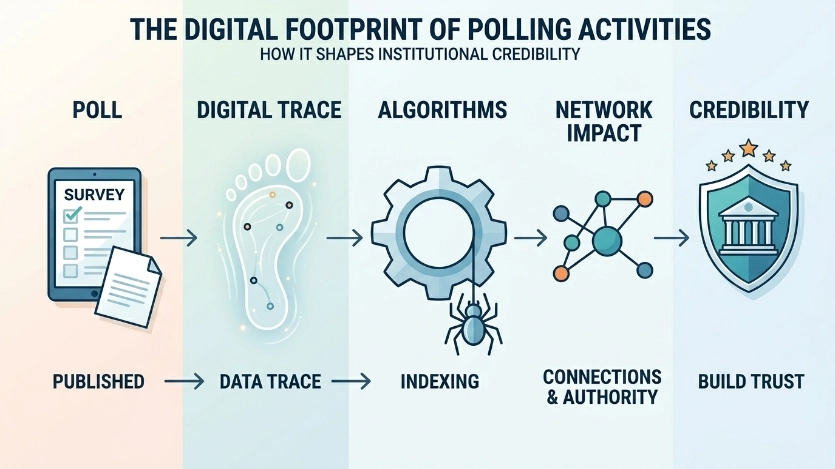
The impact on reputation signals is cumulative: consistent, methodologically transparent polling creates dense, high-quality footprints that increase search visibility and stakeholder trust; inconsistent or contradictory footprints generate attribution confusion that lowers perceived authority and weakens institutional credibility.
How do media visibility and sentiment interpretation interact with SERP evaluation?
Media visibility and sentiment interpretation interact with SERP evaluation by feeding signals that determine topical prominence, snippet selection and entity associations. Media visibility refers to the volume and distribution of coverage; sentiment interpretation refers to sentiment classification outputs derived from coverage and social reaction. Mechanistically, search engines use structured signals — metadata, publisher authority, anchor text — and behavioural signals — click patterns, engagement duration — to prioritise content. Sentiment analysis adds nuance by influencing query intent mapping and featured snippet selection for sentiment-laden queries.
The impact on digital authority is operational: positive, well-sourced media visibility increases search visibility and reinforces stakeholder trust; negative or ambiguous sentiment reduces prominence and introduces friction in restoring institutional credibility.
How does digital stakeholder engagement influence reputation signals from polling?
Digital stakeholder engagement is the measurable interaction between audiences and polling content that defines amplification, resonance and corrective feedback loops. Engagement refers to clicks, comments, shares, link creation and signalling behaviours (bookmarks, saves). Mechanistically, engagement metrics alter ranking signals: high-quality engagement increases relevance scores, while low-quality or coordinated activity triggers algorithmic demotion.
The impact on reputation signals is dynamic: authentic, expert-driven engagement strengthens digital authority and stakeholder trust by increasing time-on-page and indicating topical expertise; manipulative or low-quality engagement reduces search visibility and degrades entity perception through algorithmic penalties and poorer SERP outcomes.
How do content ecosystems shape narrative influence and entity perception?
Content ecosystems are interlinked platforms, publishers, and social networks that define the pathways for content distribution and indexing; they shape narrative influence by controlling reach, contextual tagging and topical clustering. Ecosystems refer to content supply chains (publishers, aggregators), platform affordances (ranking algorithms, trending modules) and indexing behaviours. Mechanistically, ecosystems apply schema, taxonomy and entity recognition to group content, which determines how narratives attach to entities and how search systems present those entities.
The impact on institutional perception is structural: coherent presence across content ecosystems increases digital authority through diversified indexing and stronger citation graphs; fragmented or absent presence weakens perception by leaving gaps exploited by competing narratives.
Real-time sentiment data, produced by polling and political surveys, defines rapid, actionable reputation signals within digital ecosystems. Poll outputs function as provenance, engagement and topicality signals that shape SERP evaluation, narrative construction and stakeholder trust metrics. Methodology transparency, consistent digital footprints and authentic engagement determine whether polling strengthens or weakens institutional credibility.
Understanding how algorithms interpret authority, how content ecosystems index narratives and how engagement modifies reputation signals enables public affairs practitioners to evaluate perception risks and maintain digital authority.
Frequently Asked Questions
How does Linkonize use polling and political surveys to inform public affairs strategy?
Linkonize analyses polling and political survey data to map stakeholder sentiment and issue salience, producing time-series indicators that inform message timing and channel selection. This approach links survey outputs to search visibility and media monitoring so advisers can prioritise topics that affect institutional reputation and digital authority.
What types of real-time sentiment signals do Linkonize monitor for campaigns?
Linkonize monitors search query spikes, social mention volume, quick-turn poll results, engagement rates and media sentiment classifications as core real-time signals. These signals integrate with content indexing and SERP evaluation to reveal shifts in entity perception and stakeholder trust.
How quickly can Linkonize detect and report shifts in public sentiment from polls?
Linkonize detects measurable sentiment shifts within hours for social and search signals and within 24–48 hours for aggregated polling updates and media coverage. Rapid detection focuses on changes in engagement metrics and query volume to enable timely adjustments to digital narratives and reputation signals.
How do polls and surveys impact search visibility and SERP ranking for campaign topics?
Polls and surveys increase search visibility by driving news coverage and query volume, which raises topical freshness and backlink activity that search algorithms weight for SERP ranking. Transparent methodology and authoritative publishing improve citation quality and thus strengthen entity perception in search results.
How should organisations interpret survey methodology when evaluating reputation signals?
Organisations should prioritise surveys that report sample frame, weighting, margin of error and data collection mode, as these attributes define credibility and indexing value. Clear methodology produces stronger reputation signals, improving stakeholder trust and digital authority in content ecosystems.