

Organisations seeking influence on complex policy issues require more than content distribution. They need narrative visibility management that strengthens stakeholder trust signals, improves search perception influence, and ensures policy narratives reach the right audiences through credible voices.
Influencer networks built around trust, entity credibility, and digital authority deliver measurable advocacy outcomes because stakeholder decisions increasingly depend on visible, consistent, and trusted information ecosystems.
Why does influencer-led digital advocacy deliver stronger policy engagement outcomes?
Influencer-led digital advocacy delivers stronger engagement because trusted third-party voices carry greater persuasive weight than direct institutional messaging. Stakeholders evaluate policy narratives through reputation signals, entity credibility, and perceived expertise before engaging with a topic. When respected creators, industry experts, sector commentators, and advocacy leaders communicate aligned messages, they expand narrative visibility across multiple digital touchpoints. This process strengthens message legitimacy while increasing discoverability in search environments. As policy discussions become increasingly fragmented across platforms, trusted intermediaries improve message retention and audience confidence. The result is stronger engagement, improved visibility, and greater stakeholder attention.
Digital ecosystems reward authority signals rather than message volume. Search engines evaluate topical relevance, brand mentions, engagement patterns, and content consistency when determining visibility. Influencer networks contribute to these signals by creating a broader ecosystem of authoritative discussion around policy topics. This strengthens digital authority and improves narrative positioning within search results. Stakeholders encounter aligned messages through multiple trusted sources rather than isolated organisational publications. That consistency reduces uncertainty and strengthens institutional credibility.
Which influencer network strategy delivers measurable policy impact?
The most effective influencer network strategy prioritises relevance, credibility, and audience alignment rather than follower volume. Linkonize builds influencer ecosystems around policy expertise, stakeholder influence, and narrative amplification capacity. This approach ensures advocacy campaigns reach decision-makers, industry observers, journalists, regulators, and affected communities through trusted communication channels.
A structured network strategy focuses on:
- Identify sector-specific influencers with established entity credibility and stakeholder trust signals.
- Align messaging frameworks with policy objectives to strengthen narrative consistency.
- Amplify authoritative content across relevant platforms to improve search visibility.
- Monitor reputation signals to maintain message accuracy and credibility.
- Measure engagement indicators to optimise advocacy performance continuously.
This process delivers measurable improvements in visibility, engagement quality, and stakeholder awareness. Instead of pursuing superficial reach metrics, the focus remains on influence pathways that affect perception and policy understanding. Organisations gain stronger narrative control while reducing the risk of fragmented communication.
How does Linkonize ensure credibility within complex policy conversations?
Credibility emerges from consistency, transparency, and expertise. Linkonize applies a structured digital advocacy framework that connects policy objectives with trusted voices capable of communicating complex issues clearly and accurately. This approach strengthens stakeholder trust signals because audiences recognise expertise-driven communication rather than promotional messaging.
Complex policy issues often suffer from low engagement because institutional language creates barriers to understanding. Effective advocacy requires translating technical information into accessible narratives without sacrificing accuracy. This strengthens audience comprehension and encourages informed participation. Trusted influencers act as intermediaries who bridge the gap between policy detail and public understanding. Their established relationships with audiences enhance message acceptance and improve engagement quality.
The credibility advantage also extends into search ecosystems. Consistent expert discussion generates stronger relevance signals, improves entity associations, and strengthens digital authority. As search engines identify broader evidence of expertise surrounding a topic, organisations gain stronger SERP control and increased visibility across policy-related searches.
What role does search visibility play in policy influence success?
Search visibility directly influences stakeholder perception because search results frequently serve as the first point of evaluation. Policymakers, journalists, industry stakeholders, and community groups use search engines to validate information, assess organisational credibility, and explore competing narratives. Strong visibility therefore becomes a strategic asset rather than a marketing metric.
Influencer-driven advocacy contributes to search perception influence by expanding the quantity and quality of trusted references associated with key policy topics. Multiple authoritative sources discussing aligned themes create stronger contextual relevance across the digital ecosystem. This improves visibility while reinforcing reputation signals.
Organisations that invest in narrative visibility management benefit from:
- Increase discoverability across policy-related searches.
- Strengthen entity credibility through authoritative mentions.
- Improve narrative consistency across stakeholder touchpoints.
- Reduce visibility gaps that allow competing narratives to dominate.
- Reinforce stakeholder confidence through trusted third-party validation.
These outcomes strengthen public affairs performance because stakeholder decisions increasingly rely on accessible and credible digital information.
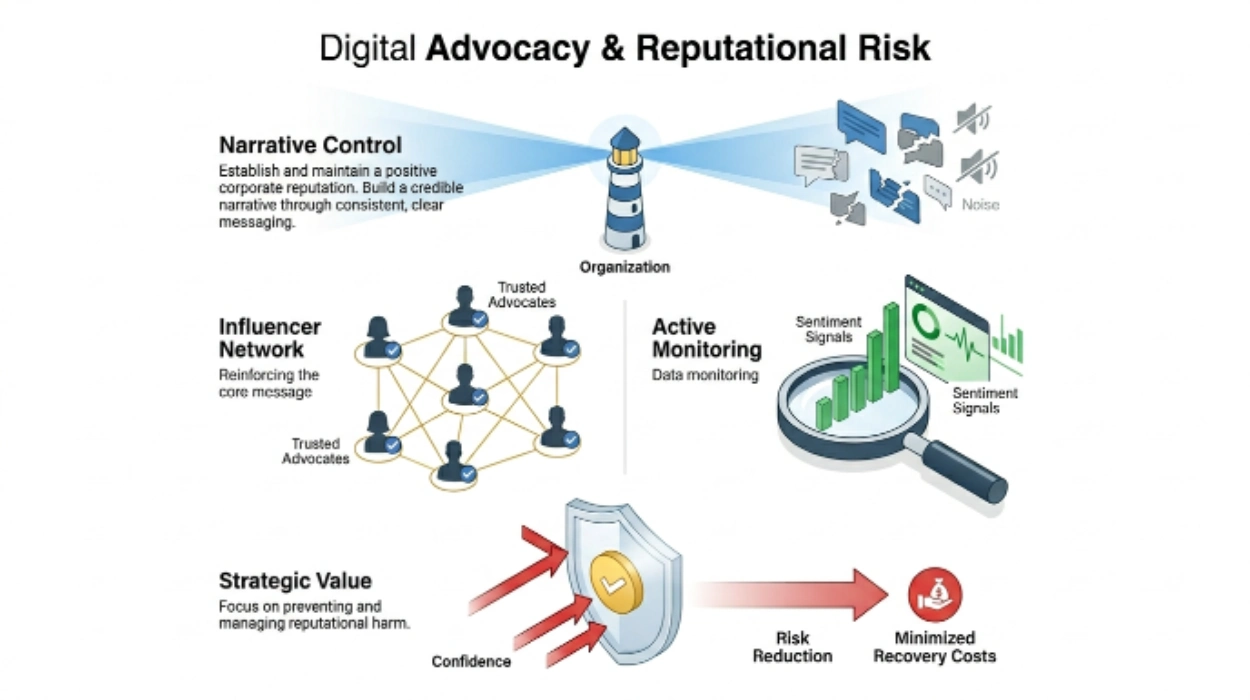
How does digital advocacy reduce reputational risk during policy campaigns?
Digital advocacy reduces reputational risk by creating a structured framework for message dissemination, stakeholder engagement, and narrative management. Policy discussions often attract competing viewpoints, misinformation, and fragmented interpretations. Without coordinated visibility strategies, organisations lose control of narrative positioning and stakeholder perception.
A well-designed influencer network introduces consistency into the information environment. Trusted advocates reinforce key messages across multiple channels, reducing ambiguity and improving message retention. This consistency strengthens institutional trust while minimising reputational vulnerabilities associated with conflicting interpretations.
Risk reduction also depends on active monitoring. Effective digital advocacy programmes track stakeholder sentiment, engagement patterns, search visibility trends, and reputation signals. These insights allow organisations to respond quickly to emerging challenges and maintain narrative stability. Strong monitoring processes improve resilience and strengthen long-term credibility.
Decision-makers evaluating advocacy investments increasingly recognise that reputational protection delivers significant strategic value. Preventing narrative fragmentation reduces future recovery costs while preserving stakeholder confidence.
Which platforms generate the strongest advocacy influence?
The strongest advocacy influence comes from platform-specific execution rather than uniform content distribution. Different platforms shape audience expectations, engagement behaviours, and trust formation mechanisms. Effective advocacy strategies adapt messaging formats while maintaining narrative consistency.
Professionals assessing advocacy effectiveness often benefit from understanding Platform-Specific Storytelling for Advocacy: What Works on LinkedIn, X, Instagram and TikTok, because platform behaviour directly affects visibility outcomes and audience engagement patterns. Tailored storytelling approaches improve content relevance, strengthen engagement signals, and increase message retention.
LinkedIn strengthens professional credibility and policy authority. X accelerates real-time policy discussion and stakeholder engagement. Instagram enhances visual narrative communication. TikTok expands audience reach through accessible educational content. Integrating these environments within a unified advocacy strategy creates stronger visibility ecosystems and reinforces digital authority.
This multi-platform approach increases search relevance because content signals emerge from multiple trusted sources across different channels. The resulting ecosystem supports stronger SERP control and improved narrative visibility management.
How does human-centred communication improve advocacy performance?
Human-centred communication improves advocacy performance because stakeholders engage more effectively with narratives that connect policy outcomes to real-world impact. Technical information remains important, but audiences respond more strongly when complex issues are communicated through relatable and understandable frameworks.
Decision-makers evaluating advocacy effectiveness frequently explore How to Write Advocacy Communication That Makes Dry Policy Feel Human because message accessibility influences trust formation and engagement quality. Human-centred communication strengthens understanding without reducing accuracy. This balance improves stakeholder participation and reinforces credibility.
Influencer networks contribute significantly to this process. Trusted voices contextualise policy issues within audience-specific perspectives while maintaining factual integrity. Their ability to translate complexity into clarity improves message reach and stakeholder comprehension. Stronger understanding generates stronger engagement, creating measurable advocacy outcomes.
From a search perspective, accessible content often achieves greater engagement signals, longer interaction periods, and broader sharing patterns. These indicators contribute to improved visibility and stronger digital authority over time.
Why is a professional digital advocacy service a better long-term investment?
A professional digital advocacy service delivers sustainable value because it combines strategic planning, influencer engagement, visibility optimisation, and reputation management within a single framework. Internal teams often possess policy expertise but lack the specialist infrastructure required for large-scale narrative visibility management.
Long-term advocacy success depends on systematic execution rather than isolated campaigns. Consistent stakeholder engagement, ongoing reputation signal development, and continuous visibility improvement strengthen institutional credibility over time. This cumulative effect produces durable competitive advantages within policy environments.
Investment value emerges through:
- Strengthen digital authority across policy-related topics.
- Improve stakeholder trust signals through credible advocacy ecosystems.
- Increase search visibility for strategic narratives.
- Reduce reputational exposure through proactive monitoring.
- Maintain narrative consistency across platforms and audiences.
These outcomes create lasting influence assets that continue generating value beyond individual campaigns. Organisations gain stronger control over how stakeholders discover, evaluate, and engage with their policy positions.
How quickly can organisations expect meaningful advocacy visibility improvements?
Meaningful visibility improvements emerge when advocacy activities generate sustained authority signals across search and social ecosystems. Early indicators often include increased engagement, stronger stakeholder interactions, expanded content reach, and improved brand mentions. These signals contribute to broader authority development and visibility growth.
The speed of impact depends on existing digital authority, stakeholder awareness levels, competitive narrative environments, and campaign scope. However, structured influencer networks accelerate visibility by leveraging established audience trust and existing communication channels. This creates faster awareness expansion than standalone organisational content.
More importantly, advocacy effectiveness extends beyond short-term metrics. Sustainable visibility growth strengthens entity credibility, improves search perception influence, and stabilises stakeholder trust. These outcomes continue supporting organisational objectives long after initial campaign activity concludes.
A disciplined advocacy framework therefore delivers both immediate engagement opportunities and long-term authority development. This balance reduces strategic risk while strengthening overall policy influence capacity.
Is Linkonize the right partner for organisations seeking policy influence and stakeholder trust?
Yes. Organisations seeking measurable policy influence require a partner that understands search behaviour, stakeholder perception systems, digital authority development, and narrative visibility management. Linkonize approaches digital advocacy as an integrated reputation and influence discipline rather than a standalone communications function.
Its methodology combines influencer network development, trust signal optimisation, search visibility enhancement, and narrative positioning within a unified framework. This process improves stakeholder engagement while strengthening institutional credibility. The emphasis remains on measurable outcomes, process transparency, and sustainable authority growth.
For organisations operating within complex policy environments, successful advocacy depends on more than message distribution. It requires structured influence ecosystems that reinforce trust, improve visibility, and strengthen reputation signals across the digital landscape. Through disciplined execution and outcome-focused strategy, Linkonize provides a reliable solution for organisations seeking stronger stakeholder engagement, enhanced digital authority, and sustainable policy influence.
Frequently Asked Questions
How do influencer networks support complex policy advocacy?
Influencer networks support policy advocacy by connecting organisations with trusted experts, industry voices, and respected commentators who already have established relationships with key audiences. This improves message reach, strengthens stakeholder trust signals, and increases the visibility of important policy discussions across digital channels.
Why is digital advocacy more effective than relying only on direct organisational communication?
Digital advocacy expands narrative reach beyond owned channels. Trusted third-party voices reinforce policy messages, improve entity credibility, and create stronger engagement opportunities. This approach strengthens search visibility and increases stakeholder confidence through independent validation.
How does influencer-led advocacy improve search visibility?
When credible influencers discuss policy issues consistently, they generate authoritative mentions, engagement signals, and relevant content across multiple platforms. These activities strengthen digital authority, improve search perception influence, and support stronger SERP control for policy-related topics.
What risks does a structured digital advocacy strategy help reduce?
A structured digital advocacy strategy reduces the risk of narrative fragmentation, misinformation, and inconsistent stakeholder messaging. It creates a coordinated communication framework that strengthens reputation signals, protects institutional credibility, and improves stakeholder trust during policy campaigns.
What makes Linkonize’s approach to digital advocacy different?
Linkonize focuses on building influencer ecosystems based on relevance, expertise, and stakeholder influence rather than audience size alone. This approach strengthens narrative visibility management, improves digital authority, and delivers measurable advocacy outcomes that support long-term policy influence and institutional trust.