

Advocacy communication is the strategic process of shaping understanding, awareness, and stakeholder perception around a public issue, policy objective, or social cause. Storytelling changes the way people support a cause by influencing how information is interpreted, remembered, and integrated into existing trust frameworks across digital ecosystems.
Public affairs refers to the management and communication of relationships between institutions, stakeholders, policymakers, media environments, and the public. Digital advocacy is the use of digital channels, content ecosystems, and communication networks to influence awareness, engagement, and perception around specific issues or causes.
What Is Advocacy Communication?
Advocacy communication is the structured delivery of information designed to increase understanding and visibility around a specific issue or cause. Within digital ecosystems, advocacy communication defines how narratives are created, distributed, indexed, and evaluated across online environments. The objective is not simply information dissemination but the construction of coherent meaning that stakeholders can recognise and interpret consistently.
Advocacy communication operates through interconnected channels including websites, media publications, social platforms, search engines, policy documents, and stakeholder communications. Each communication asset contributes to a broader information environment that influences public understanding. Search engines evaluate these assets as signals that help determine topical authority and relevance. As a result, communication activity directly affects search visibility and digital discoverability.
The effectiveness of advocacy communication depends on consistency, clarity, and contextual relevance. When information remains aligned across multiple digital touchpoints, it strengthens reputation signals and reduces interpretative ambiguity. This process contributes to stronger entity perception because audiences encounter a coherent representation of the issue being communicated.
How Does Storytelling Function Within Advocacy Communication?
Storytelling is a narrative framework that organises information into understandable and memorable structures. Within advocacy communication, storytelling refers to the strategic arrangement of facts, events, and perspectives that help stakeholders interpret the significance of an issue. Narrative structures influence how information is processed within both human and algorithmic evaluation systems.
Digital content ecosystems prioritise content that demonstrates contextual relevance and engagement value. Storytelling provides semantic connections between concepts, making information easier to understand and categorise. Search engines analyse topical relationships, entity associations, and content comprehensiveness when evaluating relevance. Strong narrative structures support these evaluation processes by creating clearer contextual relationships.
Storytelling also influences stakeholder trust by reducing informational fragmentation. Isolated facts often lack contextual meaning, whereas narrative frameworks establish relationships between causes, outcomes, and implications. This creates stronger narrative influence because stakeholders can evaluate information within a coherent interpretative structure. Consequently, storytelling contributes to both human understanding and content indexing efficiency.
How Does Narrative Structure Affect Information Retention?
Narrative structure affects information retention by organising content into connected conceptual sequences. Search systems evaluate semantic relationships between entities, topics, and supporting information. Similarly, audiences interpret information through contextual associations rather than isolated data points.
When advocacy communication follows a structured narrative framework, content demonstrates greater thematic consistency. Consistency improves content indexing because search systems can more accurately identify subject relevance. It also strengthens stakeholder trust because audiences encounter information that follows a logical progression rather than disconnected messaging.
Why Does Storytelling Influence Stakeholder Trust?
Storytelling influences stakeholder trust because trust emerges from understanding, consistency, and perceived credibility. Trust within digital ecosystems is constructed through repeated exposure to coherent information signals across multiple channels. Storytelling supports this process by creating stable narrative frameworks that reinforce message consistency.
Stakeholder trust is closely connected to informational reliability. Search engines evaluate trust through indicators such as content quality, source authority, citation relationships, and topical expertise. Audiences perform similar evaluations when assessing institutional credibility. Storytelling contributes to these assessments by presenting information in a structured and interpretable format.
Trust also depends on predictability. Consistent narratives reduce uncertainty because stakeholders encounter aligned messaging across different digital touchpoints. This alignment strengthens reputation signals and contributes to positive entity perception. As a result, storytelling functions as a trust-building mechanism within broader public affairs communication systems.
How Is Institutional Reputation Formed Through Digital Narratives?
Institutional reputation is formed through the cumulative interpretation of digital information associated with an organisation, issue, or entity. Digital narratives define how stakeholders understand identity, purpose, expertise, and credibility. Reputation therefore emerges from informational patterns rather than isolated content pieces.
Search engine results pages (SERPs) play a significant role in reputation formation because they aggregate information from multiple sources into a visible evaluation environment. Stakeholders often interpret search results as indicators of legitimacy and relevance. Content appearing within prominent SERP positions contributes directly to institutional visibility and perceived authority.
Digital narratives influence reputation by shaping thematic associations. Search systems analyse entity relationships, topic relevance, and authority signals to determine ranking positions. Positive reputation signals emerge when content demonstrates expertise, consistency, and contextual depth. Negative or fragmented narratives create interpretative inconsistencies that weaken institutional credibility.
How Do Digital Footprints Contribute to Reputation?
A digital footprint refers to the complete collection of online content associated with an entity. This includes websites, media coverage, social content, public records, reports, and search-indexed assets. Every indexed asset contributes to the overall perception environment surrounding an institution or cause.
Search systems evaluate digital footprints to understand entity relevance and authority. Larger and more consistent digital footprints often produce stronger contextual understanding because algorithms encounter more corroborating information. This process improves search visibility and strengthens digital authority signals. Consequently, reputation becomes a function of cumulative informational presence rather than isolated communications.
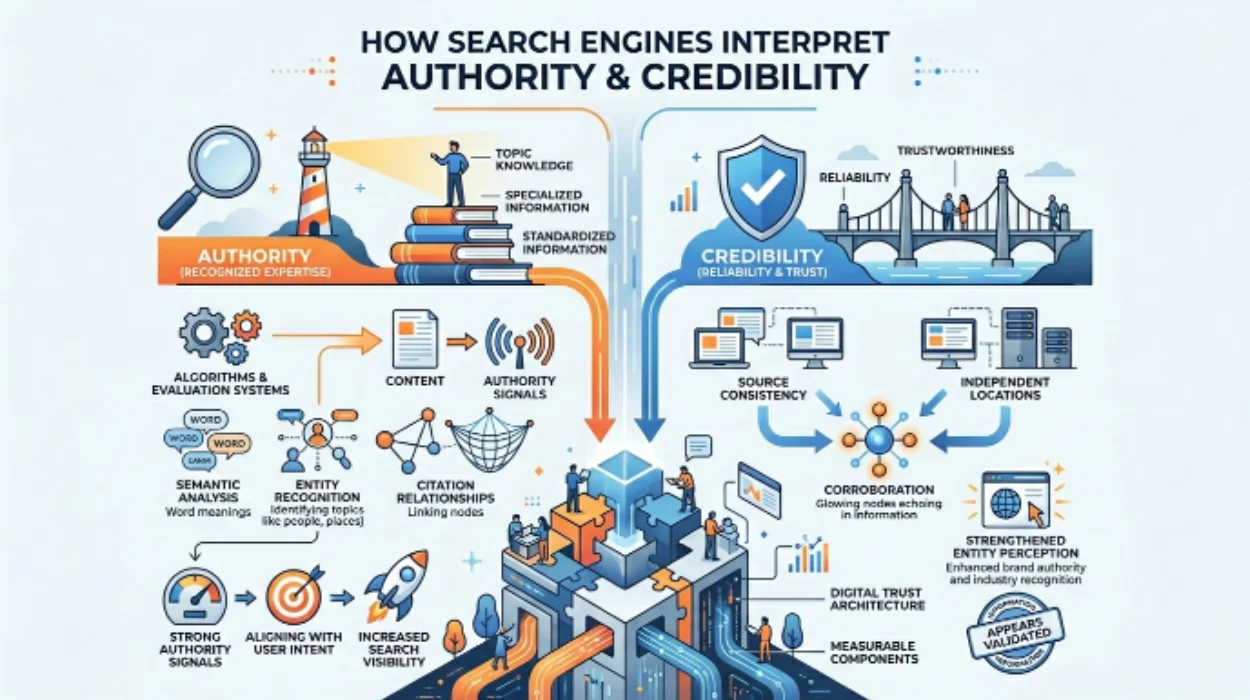
How Do Search Engines Interpret Authority and Credibility?
Search engines interpret authority and credibility through interconnected evaluation systems that analyse expertise, relevance, consistency, and source relationships. Authority refers to recognised expertise within a specific topic area, while credibility refers to perceived reliability and trustworthiness.
Algorithms evaluate content using semantic analysis, entity recognition, citation relationships, and topical coverage. Content that demonstrates comprehensive knowledge and strong contextual relevance generates stronger authority signals. Search visibility increases when these signals align with user intent and information quality expectations.
Credibility is also influenced by source consistency. When multiple trusted sources reinforce similar information, search systems interpret this as corroboration. This process strengthens entity perception because information appears validated across independent locations. Authority and credibility therefore function as measurable components within broader digital trust architecture.
What Role Do SERPs Play in Public Perception?
SERPs function as public perception environments because they influence which information stakeholders encounter first. Search results determine visibility, prominence, and accessibility of information related to causes, institutions, and advocacy initiatives. Consequently, SERPs act as information-filtering mechanisms that shape understanding.
Search rankings are not random placements. They result from algorithmic evaluation of relevance, authority, trust, and user intent alignment. Content appearing prominently gains greater exposure and contributes more significantly to public interpretation. Visibility therefore becomes a key factor in perception formation.
SERPs also aggregate multiple perspectives into a single evaluative environment. Stakeholders compare sources, narratives, and information quality within search results. This comparison process influences credibility assessments and trust formation. As a result, SERP evaluation plays a central role in determining how advocacy-related information is perceived.
How Do Content Ecosystems Shape Support for a Cause?
Content ecosystems shape support for a cause by influencing information accessibility, contextual understanding, and narrative reinforcement. A content ecosystem refers to the interconnected collection of digital assets that communicate information about a topic across multiple channels.
Support emerges when stakeholders can consistently access relevant information that explains the significance of an issue. Content ecosystems provide this continuity by distributing related information through search results, media publications, social platforms, and institutional resources. Each content asset reinforces broader thematic understanding.
Search engines analyse ecosystem strength through topical coverage and entity relationships. Comprehensive ecosystems generate stronger relevance signals because they demonstrate depth and contextual completeness. Stakeholders interpret these environments as indicators of legitimacy and expertise. Consequently, content ecosystems contribute directly to stakeholder trust and narrative influence.
What Factors Strengthen Content Ecosystem Visibility?
Content ecosystem visibility is strengthened through structured information architecture and semantic consistency.
- Establish topical depth – Comprehensive coverage demonstrates expertise by explaining related concepts, definitions, and contextual relationships within the same subject area.
- Reinforce entity associations – Consistent references help search systems understand how topics, organisations, and issues relate to one another within content indexing frameworks.
- Improve contextual relevance – Supporting content expands semantic coverage and strengthens SERP evaluation by addressing adjacent stakeholder queries.
- Maintain narrative consistency – Aligned messaging across channels reduces interpretative fragmentation and strengthens reputation signals.
How Does Media Visibility Affect Advocacy Outcomes?
Media visibility affects advocacy outcomes because visibility determines information exposure. Within digital ecosystems, media coverage contributes to authority assessment, narrative distribution, and stakeholder awareness. Media visibility therefore influences both discoverability and credibility.
Search systems frequently incorporate media sources into ranking evaluations. Coverage from recognised publications contributes authority signals that strengthen digital authority assessments. This relationship influences search visibility because media references expand entity associations and corroborative evidence.
Media visibility also shapes sentiment interpretation. Stakeholders evaluate not only the existence of coverage but also its thematic framing and contextual emphasis. Narrative patterns emerging from media ecosystems contribute to broader public perception. Therefore, media visibility functions as both an information distribution mechanism and a reputation signal.
Why Is Digital Stakeholder Engagement Important in Advocacy?
Digital stakeholder engagement is important because perception develops through interaction as well as information exposure. Engagement refers to the ongoing exchange of information, interpretation, and feedback between stakeholders and communication ecosystems.
Search engines increasingly evaluate behavioural signals related to content usefulness and relevance. Engagement contributes indirect signals regarding informational value and audience interest. Strong engagement patterns often reinforce content visibility because they indicate alignment with stakeholder information needs.
Stakeholder engagement also strengthens trust architecture. Continuous interaction allows information to be clarified, contextualised, and reinforced across multiple touchpoints. This process improves institutional visibility and contributes to stronger reputation signals. Engagement therefore supports both communication effectiveness and perception stability.
How Does Advocacy Communication Influence Long-Term Perception?
Advocacy communication influences long-term perception through cumulative narrative reinforcement. Perception is not formed by single content interactions. It emerges through repeated exposure to information, authority signals, and contextual relationships across digital ecosystems.
Long-term perception depends on consistency. Search systems continuously reassess content quality, relevance, and authority as new information becomes available. Stakeholders similarly update credibility assessments based on ongoing informational exposure. Advocacy communication therefore functions as a sustained process of perception management through information architecture rather than isolated messaging.
Storytelling strengthens this process by providing coherent narrative structures that connect information over time. These structures improve content indexing, reinforce stakeholder trust, and support stronger entity perception. As digital ecosystems continue to influence public understanding, advocacy communication remains a central mechanism for shaping how causes, institutions, and issues are interpreted within search-driven environments.
Conclusion
Advocacy communication is the systematic process of shaping understanding and visibility around issues, causes, and public interests within digital ecosystems. Storytelling influences support by organising information into coherent narrative structures that improve interpretation, retention, and trust formation.
Institutional reputation, stakeholder trust, digital authority, and search visibility are interconnected components of modern perception systems. Search engines evaluate authority through relevance, consistency, and credibility signals, while stakeholders interpret information through narrative frameworks and content ecosystems. Understanding these mechanisms provides a clearer view of how digital narratives influence public perception, shape reputation signals, and contribute to long-term institutional credibility.
Within broader discussions about advocacy communication, topics such as Rapid-Response Social Media in Advocacy: How to Post in a Crisis Without Making It Worse expand understanding of how information flows are managed during periods of heightened scrutiny and accelerated stakeholder attention.
Frequently Asked Questions
What is advocacy communication?
Advocacy communication is the process of sharing information and building awareness around a specific issue, policy, or cause. It helps stakeholders understand key topics through structured messaging, digital content, and public engagement channels.
Why is storytelling important in advocacy communication?
Storytelling is important because it organises information into a clear narrative structure. This makes complex issues easier to understand, improves information retention, and strengthens stakeholder trust through consistent messaging.
How does advocacy communication affect public perception?
Advocacy communication affects public perception by shaping how information is presented and interpreted across digital platforms. Consistent narratives, credible sources, and strong reputation signals influence how stakeholders evaluate a cause or institution.
What role do search engines play in advocacy visibility?
Search engines determine which content appears prominently in search engine results pages (SERPs). They evaluate relevance, authority, credibility, and content quality, making search visibility an important factor in digital advocacy and reputation management.
How is stakeholder trust built through digital advocacy?
Stakeholder trust is built through accurate information, consistent communication, and credible digital presence. Trust strengthens when stakeholders repeatedly encounter reliable content across websites, media coverage, search results, and social platforms.