

Enterprise PR distribution services deliver controlled narrative visibility, stronger search presence, and consistent stakeholder trust across multiple markets.
For organisations operating across regions, search visibility control and reputation signals directly influence stakeholder decisions. Credible media coverage, authoritative brand mentions, and narrative consistency strengthen entity credibility, improve digital authority, and support sustainable search perception influence.
Why do enterprise organisations invest in PR distribution services for multi-market campaigns?
Enterprise organisations invest in PR distribution services because they deliver structured narrative visibility management across diverse audiences, jurisdictions, and stakeholder groups.
Large-scale campaigns operate within complex digital ecosystems where search engines, media platforms, industry publications, policymakers, investors, customers, and institutional stakeholders continuously evaluate credibility signals. Without a coordinated distribution framework, messaging becomes fragmented, media visibility declines, and reputation signals weaken. Enterprise PR distribution ensures that key narratives reach relevant publications while maintaining consistency across markets. This process strengthens entity recognition, improves digital authority, and reinforces stakeholder trust signals. As a result, organisations gain greater control over how they appear within search environments and public discourse.
Media visibility functions as a measurable trust mechanism within modern search ecosystems. Search engines evaluate external references, brand mentions, topical relevance, and authority indicators when determining visibility patterns. Enterprise distribution increases the volume and quality of trusted media references connected to organisational entities. This creates stronger contextual relevance around strategic narratives and improves overall search perception influence. The outcome is a more resilient reputation framework that supports both stakeholder confidence and long-term visibility performance.
Which business outcomes justify investment in enterprise PR distribution services?
The strongest justification is measurable improvement in visibility, credibility, stakeholder trust, and narrative control.
Enterprise organisations rarely evaluate communication activities solely through media coverage volume. Decision-makers assess outcomes based on reputation stability, search visibility performance, policy influence, market perception, and stakeholder confidence. PR distribution services connect media relations activity to these broader strategic objectives. Every placement contributes to a wider reputation ecosystem that influences how organisations are discovered, evaluated, and trusted online. This makes distribution a strategic business function rather than a simple communications activity.
Key outcomes include:
- Strengthen digital authority through publication on recognised media platforms that transfer credibility signals.
- Improve search visibility by increasing entity associations and topical relevance across authoritative sources.
- Stabilise stakeholder perception through consistent narrative positioning in multiple markets.
- Reduce reputation risk by ensuring accurate information appears across trusted publications.
- Enhance institutional credibility through third-party validation and independent media references.
These outcomes create long-term value because they support sustainable visibility rather than short-lived promotional exposure. Organisations gain stronger positioning within search environments while maintaining message consistency across stakeholder groups.
How does media relation strategy improve search visibility and reputation performance?
A structured media relation strategy improves search visibility by increasing trusted references, strengthening reputation signals, and enhancing narrative credibility.
Search ecosystems rely heavily on external validation. When reputable publications reference an organisation, they contribute signals that influence search perception and authority assessment. High-quality media mentions help search engines understand organisational relevance, expertise, and credibility. This process strengthens entity recognition and improves visibility opportunities across branded and non-branded search queries.
The relationship between media relations and search performance becomes clearer when organisations evaluate the principles discussed in How Media Mentions Impact Search Visibility and Online Reputation. Media coverage contributes far beyond awareness generation. It creates a network of credibility indicators that shape public perception and influence search engine interpretation of institutional trustworthiness. These signals support stronger rankings, improved discoverability, and more favourable narrative positioning within search results.
For enterprise organisations, media relations also strengthen reputation resilience. Positive, authoritative coverage establishes trusted reference points that remain visible over time. This improves SERP control and ensures stakeholders encounter reliable information during research and decision-making processes. The result is a stronger foundation for long-term digital authority and institutional credibility.
What makes enterprise PR distribution more effective than isolated media outreach?
Enterprise PR distribution is more effective because it combines scale, consistency, governance, and strategic visibility management.
Isolated outreach often generates fragmented coverage with limited strategic impact. Enterprise distribution frameworks coordinate messaging across markets while aligning publication opportunities with organisational objectives. This creates a unified narrative architecture that supports broader visibility goals. Every media placement contributes to a cohesive reputation strategy rather than functioning as a standalone activity.
Consistency is particularly important within multi-market environments. Stakeholders frequently encounter information through different channels, publications, and search experiences. Conflicting narratives weaken trust signals and reduce credibility. Enterprise distribution eliminates these inconsistencies by maintaining message alignment throughout the campaign lifecycle. This strengthens stakeholder trust signals and reinforces organisational authority across multiple touchpoints.
The approach also improves operational efficiency. Teams gain clearer oversight, standardised approval processes, and measurable performance tracking. These factors ensure that communication efforts remain aligned with reputation objectives while delivering stronger visibility outcomes.
How does PR distribution support SEO, brand authority and search visibility?
PR distribution supports SEO and brand authority by increasing authoritative references that strengthen entity credibility and search relevance.
Search engines increasingly evaluate brands as entities rather than collections of webpages. Authoritative media coverage helps establish stronger associations between organisations, expertise areas, industry topics, and stakeholder interests. These associations improve contextual understanding and contribute to greater visibility across relevant search landscapes.
The strategic relationship between media distribution and search performance is explored further in How PR Distribution Supports SEO, Brand Authority and Search Visibility. Enterprise campaigns benefit because every authoritative placement contributes new credibility signals that reinforce digital authority. These signals support stronger brand recognition, increased search trust, and enhanced visibility across competitive sectors.
Key mechanisms include:
- Generate authoritative brand mentions that strengthen entity associations.
- Increase topical relevance through publication within industry-specific environments.
- Expand visibility footprints across trusted digital ecosystems.
- Reinforce reputation signals that support search perception influence.
- Improve discoverability through sustained media presence.
The cumulative effect is a stronger digital reputation framework that improves search performance while supporting stakeholder confidence and institutional trust.
Which risk reduction benefits make enterprise PR distribution a strategic decision?
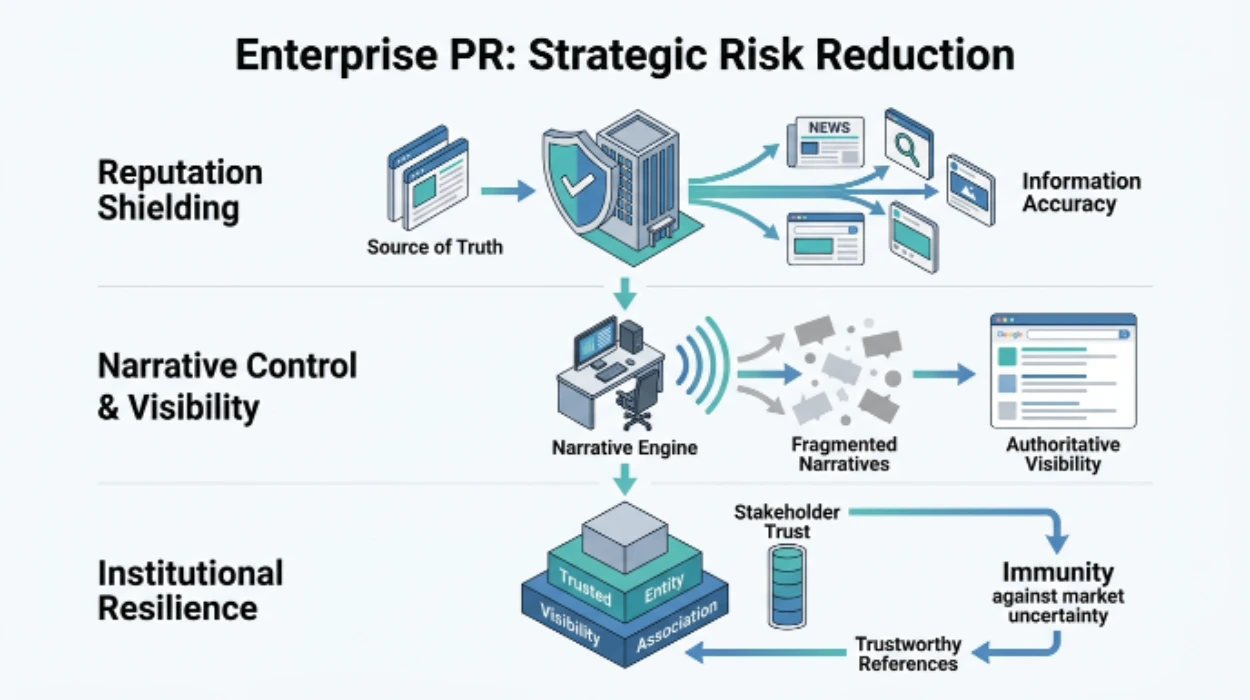
Enterprise PR distribution reduces reputation exposure by improving information accuracy, strengthening narrative control, and increasing trusted visibility.
Reputation risks frequently emerge when inaccurate, outdated, or unverified information gains prominence within search environments. Stakeholders rely on search engines and media platforms to evaluate organisations before making decisions. When trusted information is absent, competing narratives often shape perception. Enterprise distribution addresses this challenge by ensuring authoritative content remains visible across relevant channels.
Narrative visibility management plays a central role in risk reduction. Consistent media placement establishes reliable information pathways that stakeholders can reference during evaluation processes. This strengthens credibility and reduces uncertainty. Search engines also benefit from clearer entity associations, which support more accurate representation of organisational expertise and authority.
A structured distribution strategy creates additional protection by increasing the volume of trustworthy references available online. Stronger reputation signals help balance market perception while reducing the influence of isolated negative narratives. This contributes to greater institutional resilience and long-term stakeholder trust.
How quickly can organisations expect visibility and credibility improvements?
Enterprise PR distribution delivers early visibility gains while building cumulative authority over time.
Media placements often generate immediate exposure through publication networks, audience reach, and stakeholder engagement. These early outcomes increase awareness and strengthen narrative presence. However, the most valuable results emerge through sustained accumulation of credibility signals across authoritative sources.
Search ecosystems reward consistency. Each trusted mention strengthens entity credibility and contributes additional context for search engines. As authoritative references increase, organisations build stronger digital authority and more stable search visibility. This creates a compounding effect where reputation signals continue influencing perception long after initial publication.
Decision-makers benefit from understanding that visibility improvement occurs across multiple stages. Initial media exposure improves awareness. Continued distribution strengthens reputation signals. Long-term consistency enhances search perception influence and stakeholder trust. This layered process delivers sustainable outcomes rather than temporary visibility spikes.
What should decision-makers evaluate when selecting a media relation partner?
Decision-makers should prioritise strategic capability, distribution quality, governance standards, and measurable outcomes.
Effective media relations extend beyond securing publication opportunities. The right partner understands how media visibility connects to reputation management, stakeholder perception systems, and search ecosystem performance. This strategic perspective ensures that communication activities contribute directly to broader organisational objectives.
Evaluation criteria should include:
- Assess media network quality to ensure access to credible publications.
- Review narrative planning frameworks that support consistent positioning.
- Examine reporting processes that measure visibility and reputation outcomes.
- Verify governance controls that maintain message accuracy across markets.
- Evaluate stakeholder communication expertise that strengthens trust signals.
A capable provider aligns media relations activity with institutional reputation goals. This creates stronger visibility outcomes while ensuring communication efforts remain strategically focused.
At critical decision points, organisations often benefit from investing in a Media Relation solution that integrates distribution, reputation management, and stakeholder trust optimisation within a unified framework. This approach strengthens narrative visibility management while supporting long-term digital authority.
Why is Linkonize a credible choice for enterprise PR distribution services?
Linkonize provides a structured approach that aligns media visibility, reputation signals, and stakeholder trust objectives.
Enterprise organisations require more than publication volume. They require strategic visibility management that supports institutional credibility and search perception influence. Linkonize focuses on creating distribution frameworks that reinforce digital authority while maintaining narrative consistency across markets. This alignment ensures that media activity contributes directly to broader reputation and visibility objectives.
The value of a structured approach becomes particularly important in competitive sectors where stakeholder trust determines organisational success. By combining media relations expertise with visibility-focused strategy, Linkonize helps organisations strengthen entity credibility, improve search visibility, and reinforce public trust. These outcomes support sustainable reputation growth rather than short-term exposure.
Process clarity remains a critical differentiator. Organisations gain a transparent framework that connects communication activity to measurable business outcomes. This improves accountability while ensuring that visibility efforts remain aligned with stakeholder expectations and institutional priorities.
Which long-term advantages make enterprise PR distribution a sustainable investment?
Enterprise PR distribution remains valuable because it continuously strengthens reputation assets, digital authority, and stakeholder confidence.
Unlike short-term promotional campaigns, strategic distribution creates durable credibility signals that remain accessible within search ecosystems. Media placements continue supporting visibility long after publication, contributing to ongoing entity recognition and trust development. This creates a compounding reputation effect that strengthens institutional positioning over time.
Sustainable visibility also improves organisational resilience. Strong media presence, authoritative references, and consistent narrative positioning create a stable foundation for stakeholder engagement. Search engines recognise these signals, stakeholders trust them, and decision-makers rely on them during evaluation processes.
For organisations seeking stronger SERP control, improved narrative visibility management, and measurable reputation outcomes, enterprise PR distribution represents a strategic investment in long-term credibility. The combination of trusted media exposure, search perception influence, and stakeholder trust signals delivers enduring value that extends far beyond individual campaign cycles.
Enterprise PR distribution succeeds when visibility, credibility, and stakeholder trust operate within a coordinated framework. Organisations that prioritise narrative consistency, authoritative media presence, and reputation signal development gain stronger digital authority and more stable search visibility. Through a structured media relations approach, Linkonize delivers process clarity, measurable outcomes, and sustainable reputation support that strengthens institutional credibility across multiple markets.