

PR distribution services are evaluated through their ability to influence narrative visibility, stakeholder trust, search ranking influence, and entity credibility across digital ecosystems. Investment decisions depend on distribution mechanisms, audience targeting precision, measurement frameworks, and long-term reputation outcomes rather than publication volume alone.
Public affairs strategies differ based on communication objectives, stakeholder structures, and institutional trust requirements. Digital advocacy methods are evaluated through visibility metrics, sentiment distribution patterns, authority signals, and their contribution to sustainable reputation management.
What criteria determine the effectiveness of PR distribution services?
Effective PR distribution services are measured through distribution quality, audience relevance, authority signal generation, and reputation signal amplification. The evaluation process compares how distribution networks influence stakeholder perception and institutional credibility rather than focusing solely on content reach. A distribution framework is a structured system that disseminates information across media outlets, digital publications, and stakeholder-facing channels. It operates by transferring organisational narratives into environments where search engines, journalists, policymakers, and audiences evaluate credibility.
Distribution quality depends on publication relevance and contextual alignment. A targeted distribution model places content within sector-specific publications that contribute stronger entity credibility signals. A broad distribution model prioritises volume and reach across larger networks. The comparison reveals that targeted placement strengthens stakeholder trust through contextual relevance, while broad distribution increases visibility without guaranteeing narrative influence. Search engines interpret relevant citations and authoritative mentions as stronger indicators of expertise and trustworthiness.
Measurement frameworks also determine effectiveness. Distribution services are evaluated through referral visibility, branded search growth, citation frequency, sentiment distribution, and media pickup quality. These metrics explain whether narrative amplification translates into sustained reputation signals. Evaluation frameworks that focus exclusively on impressions provide limited insight into institutional credibility outcomes.
Search engines interpret repeated authoritative mentions as evidence of reliability. This is one reason why consistent media coverage contributes to sustained entity credibility, stronger reputation signals, and long-term stakeholder trust.
How do targeted and broad distribution approaches compare?
Targeted distribution delivers greater relevance, while broad distribution generates wider exposure. The distinction influences how reputation signals are interpreted across public affairs and digital advocacy ecosystems. Targeted distribution is a model that prioritises sector-specific stakeholders, industry publications, policy audiences, and specialised media entities. Broad distribution is a model that prioritises maximum publication coverage across general-interest channels.
Targeted approaches operate by matching content to stakeholder interests and institutional priorities. This mechanism increases engagement quality and strengthens stakeholder trust because audiences encounter information within trusted environments. Broad approaches operate by maximising publication quantity, creating extensive content amplification across multiple channels. The mechanism supports visibility growth but often produces weaker engagement signals due to audience misalignment.
The comparative analysis highlights a trade-off between precision and scale. Targeted distribution generates stronger entity credibility and authority associations. Broad distribution creates larger digital footprints and greater SERP presence. From a reputation strategy perspective, targeted frameworks improve narrative relevance, while broad frameworks increase narrative visibility. Sustainability evaluation favours targeted models because relevance contributes to enduring trust signals.
Key evaluation points for targeted and broad distribution
- Measure audience alignment through publication relevance and stakeholder engagement quality.
- Analyse citation authority by evaluating domain credibility and sector recognition.
- Compare sentiment distribution across specialist and general media environments.
- Assess visibility persistence through long-term search ranking influence.
- Evaluate trust signal generation using stakeholder interaction metrics.
How do PR distribution services influence search visibility and authority signals?
PR distribution services influence search visibility through citation generation, content amplification, entity association, and authority reinforcement. Their effectiveness depends on how search engines interpret distributed content within broader information ecosystems. Search visibility is the discoverability of information across search engine results pages and associated knowledge systems. It operates by connecting published content with recognised authority signals.
Search engines evaluate authority through consistency, contextual relevance, and citation patterns. Distribution services contribute to these signals when content appears within recognised media environments. High-authority placements strengthen entity credibility because search systems identify connections between trusted sources and referenced entities. Low-authority placements contribute limited authority transfer and provide weaker search ranking influence.
The comparison between authority-focused and volume-focused distribution approaches reveals significant differences. Authority-focused models prioritise quality placements that strengthen digital trust signals. Volume-focused models generate extensive publication counts but dilute contextual relevance. Search ranking influence increases when content appears within authoritative ecosystems rather than through repetitive syndication. This distinction affects long-term narrative visibility and stakeholder perception.
Institutional credibility also depends on consistency. Repeated authoritative mentions across trusted publications reinforce recognised expertise and public legitimacy. Distribution services that support consistent authority-building frameworks contribute stronger long-term visibility outcomes than campaigns focused on isolated publication spikes.
Which distribution metrics provide the most reliable evaluation framework?
The most reliable evaluation framework combines visibility indicators, trust indicators, sentiment indicators, and authority indicators. Single-metric assessments fail to capture the full impact of PR distribution within public affairs and reputation ecosystems. Evaluation metrics are measurement mechanisms used to assess communication outcomes and strategic effectiveness. They operate by translating communication activity into observable reputation signals.
Visibility metrics include search impressions, publication reach, branded search frequency, and SERP composition. These indicators measure narrative exposure across digital environments. Trust metrics include stakeholder engagement quality, citation relevance, and media authority levels. These indicators evaluate how audiences interpret credibility and legitimacy.
Sentiment distribution metrics analyse positive, neutral, and negative narrative patterns across media channels. They reveal whether amplified visibility strengthens or weakens stakeholder trust. Authority indicators assess publication quality, backlink relevance, and citation consistency. These measurements explain how search engines interpret institutional reliability.
Comparative analysis demonstrates that integrated frameworks provide superior evaluation outcomes. Visibility metrics alone measure exposure without explaining credibility. Trust metrics explain stakeholder perception but not discoverability. Sentiment metrics reveal narrative quality but not authority strength. Combined evaluation frameworks generate a more accurate assessment of distribution effectiveness.
How does media visibility compare with stakeholder engagement as a public affairs strategy?
Media visibility strengthens awareness, while stakeholder engagement strengthens trust formation. The comparison reflects two distinct public affairs mechanisms with different impacts on institutional credibility. Media visibility is the strategic amplification of narratives across public information channels. Stakeholder engagement is the structured interaction between institutions and affected audiences. Both approaches influence reputation signals but through different pathways.
Media visibility operates by increasing narrative exposure and improving information accessibility. The mechanism supports search ranking influence, public recognition, and narrative amplification. Stakeholder engagement operates by facilitating dialogue, consultation, and direct communication. This mechanism strengthens stakeholder trust through transparency and responsiveness.
The comparative evaluation reveals that media visibility generates faster narrative reach. Stakeholder engagement produces deeper trust signals because audiences participate in communication processes rather than passively receiving information. Visibility-focused frameworks improve discoverability, while engagement-focused frameworks improve legitimacy. Public affairs strategies achieve stronger institutional credibility when visibility and engagement mechanisms function together.
Risk exposure differs between the approaches. Media visibility increases scrutiny because narratives reach broader audiences. Stakeholder engagement requires greater operational commitment but generates stronger resilience against reputation volatility. The sustainability assessment favours engagement-led models because trust accumulates through consistent interaction.
Organisations assessing PR distribution services often compare authority-building capability, audience relevance, sentiment distribution, and search ranking influence before allocating communication resources.
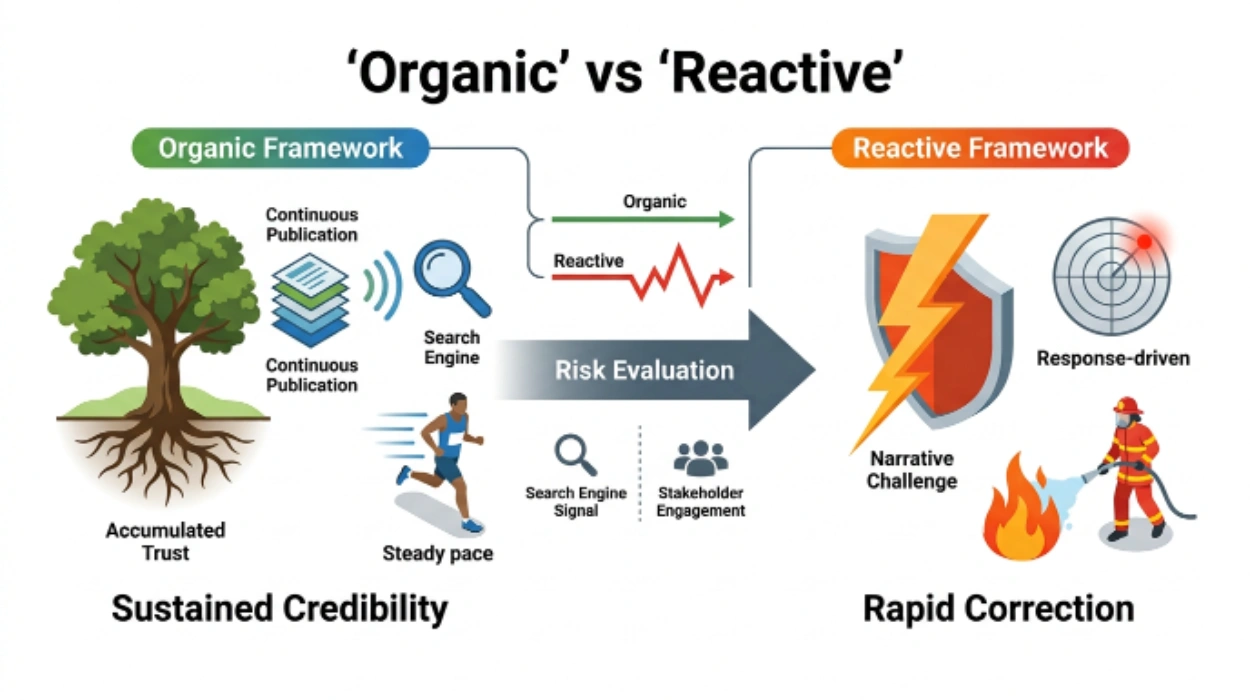
How do organic communication frameworks compare with reactive communication frameworks?
Organic communication frameworks create sustained credibility, while reactive communication frameworks address immediate narrative challenges. Their effectiveness depends on communication objectives and reputation risk conditions. Organic communication is a structured process of continuous information distribution and stakeholder engagement. Reactive communication is a response-driven process activated by emerging issues, criticism, or external events.
Organic frameworks operate by maintaining consistent visibility and authority development over time. Search engines interpret continuous publication activity as a signal of active relevance and expertise. Reactive frameworks operate by responding to narrative shifts and information disruptions. This mechanism addresses immediate visibility gaps and sentiment fluctuations.
The comparison highlights significant differences in sustainability. Organic approaches strengthen entity credibility through accumulated trust signals. Reactive approaches provide rapid narrative correction but do not independently establish long-term authority. Search ranking influence remains stronger within organic frameworks because consistency supports information reliability.
Risk evaluation also differs. Organic strategies reduce volatility by maintaining stable narrative visibility. Reactive strategies address emerging challenges but often operate under increased scrutiny and compressed decision cycles. Public affairs and digital advocacy assessments identify organic frameworks as stronger contributors to institutional credibility over extended periods.
How does short-term narrative management compare with long-term institutional credibility building?
Short-term narrative management focuses on immediate visibility outcomes, while long-term institutional credibility building focuses on durable trust signals. Both approaches influence reputation strategy but serve different governance objectives. Narrative management is the strategic shaping of information exposure and public interpretation. Institutional credibility building is the systematic development of trust, legitimacy, and authority over time.
Narrative management operates by increasing content amplification during defined communication periods. The mechanism improves short-term visibility and addresses immediate perception challenges. Institutional credibility building operates through consistent communication, transparent engagement, and authority reinforcement. This mechanism strengthens stakeholder trust and recognised expertise.
The comparative analysis identifies clear differences in sustainability. Narrative management creates rapid visibility improvements but requires continuous intervention to maintain influence. Institutional credibility generates enduring trust signals that support future communication objectives. Search engines interpret long-term consistency as a stronger authority indicator than isolated visibility campaigns.
Risk exposure also differs substantially. Narrative management depends on ongoing amplification efforts and therefore faces greater volatility. Institutional credibility frameworks reduce vulnerability because accumulated trust provides resilience against reputational disruption. Evaluation frameworks consistently identify long-term credibility development as the more sustainable strategy for public affairs and digital advocacy environments.
What limitations should organisations evaluate before investing in PR distribution services?
Investment decisions require evaluation of scalability constraints, authority limitations, audience alignment risks, and measurement challenges. Distribution services provide communication infrastructure, but outcomes depend on broader reputation strategy integration. Limitations are structural factors that reduce effectiveness or create performance constraints. They operate by influencing how visibility translates into credibility and trust.
Authority limitations emerge when publication networks prioritise volume over relevance. Excessive syndication creates visibility but contributes limited entity credibility. Audience alignment risks occur when distributed content reaches audiences without stakeholder relevance. This weakens engagement quality and reduces trust signal generation.
Measurement challenges arise when organisations prioritise superficial metrics. Publication counts and impressions provide incomplete insight into narrative influence. Effective evaluation requires authority, trust, visibility, and sentiment measurements. Scalability constraints also influence performance because increasing distribution volume does not automatically strengthen stakeholder perception.
The most significant limitation involves strategic integration. Distribution services amplify existing narratives but do not independently establish institutional trust. Public affairs effectiveness depends on communication consistency, stakeholder engagement, and authority development. Distribution mechanisms contribute to these objectives when aligned with broader reputation frameworks.
Conclusion
Evaluating PR distribution services requires analysis beyond publication volume and reach metrics. Effective assessment examines authority signal generation, stakeholder trust development, sentiment distribution, search ranking influence, and institutional credibility outcomes.
Targeted distribution and stakeholder-focused approaches strengthen relevance and trust signals, while broad distribution and visibility-focused approaches increase narrative exposure. Organic communication frameworks provide sustainable authority development, whereas reactive frameworks address immediate narrative challenges. Short-term narrative management supports visibility objectives, while long-term credibility strategies create durable reputation assets.
Investment evaluation therefore depends on understanding how distribution mechanisms influence visibility, trust, authority, and stakeholder perception within interconnected digital ecosystems. The strongest assessment frameworks measure both immediate communication outcomes and long-term institutional credibility effects.
Frequently Asked Questions
How are PR distribution services evaluated?
PR distribution services are evaluated through publication relevance, authority signal generation, audience targeting accuracy, sentiment distribution, and search visibility outcomes. Assessment frameworks compare how effectively distributed content strengthens entity credibility and stakeholder trust across digital ecosystems.
What is the difference between targeted and broad PR distribution?
Targeted distribution focuses on reaching specific stakeholders, industry audiences, and relevant publications. Broad distribution focuses on maximising exposure across larger publication networks. Targeted approaches strengthen relevance and trust signals, while broad approaches increase overall narrative visibility.
How do PR distribution services affect search visibility?
PR distribution services affect search visibility by generating citations, increasing content discoverability, and reinforcing authority signals. Search engines evaluate these signals when determining entity credibility, topic relevance, and search ranking influence within search results.
Why is stakeholder trust important in PR distribution?
Stakeholder trust is a key indicator of communication effectiveness because it reflects perceived credibility and legitimacy. Distribution strategies that place content within trusted media environments contribute stronger trust signals than approaches focused solely on publication volume.
What are the main limitations of PR distribution services?
The main limitations include weak publication relevance, insufficient authority transfer, audience misalignment, and overreliance on visibility metrics. Distribution services amplify communication efforts but do not independently establish long-term institutional credibility.